
Značka: latest news

Starknet voters back research into life beyond Ethereum

Starknet’s community has voted to support research into becoming an independent, post-quantum layer-1 blockchain. The network’s potential departure from Ethereum gained overwhelming support. The governance vote that ran for seven days closed on Thursday. The poll drew about 3,200 votes, with 93.52% of voting power in favor of the transition. The non-binding poll recorded the highest participation in Starknet’s governance history, according to StarkWare, which said it abstained from voting to leave the decision to the community.The outcome allows StarkWare and the Starknet Foundation to proceed with research into an independent L1. The actual shift itself would require a separate, binding governance vote. For now, Starknet will continue operating as an Ethereum layer-2 network. “We’re beginning work on a whitepaper even before we start the weekend, and hope to release a draft for public scrutiny in November,” StarkWare CEO Eli Ben-Sasson told Cointelegraph. Starknet outlines next steps for post-quantum L1 researchStarkWare and the Starknet Foundation have established a working group to examine the proposed transition and develop more detailed technical proposals.The governance proposal states that STRK will remain the network’s native token, with no new token planned, while existing bridges between Starknet and Ethereum will remain open.StarkWare first raised the potential transition on Oct. 8, citing concerns about the network’s dependence on Ethereum for security. Although Starknet uses hash-based STARK proofs and supports programmable accounts capable of adopting post-quantum signatures, its bridge and data availability infrastructure remain dependent on Ethereum’s upgrade timeline.Related: Trump administration outlines quantum, AI initiatives in $6B science pushIn June, StarkWare unveiled a three-phase quantum-resistance roadmap covering cryptographic upgrades, smart-contract migration and Ethereum-dependent infrastructure. StarkWare’s Quantum Hub says it has already tested technology designed to withstand future quantum attacks, successfully processing a transaction on Starknet’s live network. However, the technology remains experimental and has not yet undergone a security audit.Ben-Sasson has set a 2027 target for making Starknet quantum-resistant, ahead of Ethereum’s projected timeline. “Ethereum’s target of 2029 to become quantum-safe is too late, and deadlines slip,” he said. Magazine: 5 alternatives to Ledger to store your Bitcoin

Čítaj viac

Move over memecoins: Crypto ‘meme games’ coming, bagholders and all

AI could unleash a flood of short-lived crypto “meme games,” attracting the same speculative traders who helped push memecoins to record highs in late 2024, according to Illuvium co-founder Kieran Warwick. Speculative crypto games such as Wolf Game and Fishing Frenzy, where players compete for financial rewards, once took months to develop. But Warwick says AI tools have reduced the time and cost of creating similar games to just days and around $1,000. He predicts as many as 100,000 such games could launch within a year, with many designed to survive for only a few days — long enough for their creators to turn a profit. “Like you have serial deployers of memes, you’ll get serial deployers of games,” Warwick told Cointelegraph. But whether that flood would benefit crypto gaming and the broader industry is less clear. Cheaper development could make niche games viable and revive attention across the sector, but a wave of disposable crypto games could leave a lot of speculators “holding the bag.”“There will be ridiculous gains, and people will get absolutely f****ing rinsed,” Warwick wrote on X on Monday. A memecoin-style boom… and bust? In 2024, Pump.fun and similar launchpads helped fuel a surge in memecoins by making tokens easy to create. The sector’s combined market capitalization reached $150.6 billion in December 2024 before falling nearly 69% to $47.2 billion by November 2025, according to CoinGecko.The boom divided industry figures, with supporters championing memecoins’ appeal to traders while critics argued they diverted capital from useful projects and damaged crypto’s reputation.Warwick said he expects a similar speculative wave to touch crypto meme games. “These degens who are gambling in crypto, they get a thousand-dollar paycheck and they put $500 in Pump.Fun. You’re giving them a new venue and a new shiny wrapper … for them to be able to go and gamble.”Asked whether a mass of short-lived crypto games will ultimately be good for the crypto gaming ecosystem, Warwick said: “probably not.” “Like in the long run, I don’t think so. The sustainable model that Illuvium has been building towards for years, where really good quality games with ownership underneath, that I think is still the dream of where crypto gaming should be building towards.” Warwick said Illuvium’s flagship Overworld game has been in development for more than six years, with a revamped full release targeted for the first quarter of 2027.Animoca Brands CEO Robby Yung took a similar view. “I think if there is a type of meme game, as Warwick is describing, that doesn’t particularly take much effort to make… I don’t think it would become a lasting category because user retention is the lifeblood of games and always has been,” he told Cointelegraph. More games, but where are the players? Meanwhile, Mirai Labs co-founder and CEO Corey Wilton questioned whether an AI-driven surge in supply can overcome weak demand for crypto games.“We shipped quite a few games, six or seven games, into the market,” Wilton said. “Ultimately, it came to the conclusion that the demand for or within the Web3 space simply isn’t there.”Dappradar’s tracking of gaming decentralized apps (Dapps) shows just $232.2 million in total value locked in 2,356 apps. A basket of the top 50 gaming tokens has a combined market capitalization of $3.8 billion at the time of writing. “I think the lack of demand and liquidity in so-called altcoins is definitely an issue, but I think, at the same time, there is also a lack of choice out there of really enjoyable, fun games that captivate people’s imaginations,” said Yung. Related: Proof of Play to shut down after blockchain gaming thesis falls short“The reality is the number of game titles that use crypto is very small, and so there’s not a lot of choice for consumers. That makes it difficult to actually judge whether crypto is the issue or it’s just that there aren’t enough good games.”Recent crypto games show there is still interest in the sector despite recent pivots. The developers of Yield Fields, an upcoming web3 farming game built on the Robinhood chain, raised an estimated $8.3 million on Oct. 14 selling digital land plots as nonfungible tokens. The game is set to launch at the end of the month. AI game development hits cryptoMeanwhile, data shows AI has already entered crypto game development. In the Blockchain Game Alliance’s 2025 survey of 506 industry professionals, 32.8% said their company had implemented or experimented with AI for game design and content creation.Yung compared the arrival of AI development tools to the early days of mobile gaming, when cheaper development encouraged more studios to enter the market. “Frankly, I think that’s a great thing all around,” said Yung. “It reminds me a bit of when mobile first started to become popular around 2010. A lot of people started developing for mobile because it was much cheaper and much faster than developing for PC or console.” “People asked the same questions about whether the market would soon become flooded with games of lower quality. I think, frankly, what happened was we just got more games of all kinds of quality, and customers had a choice of playing what they liked.Magazine: Agents can trade 24/7 — but Yat Siu warns you could lose access at any time

Čítaj viac

PHP Foundation admits ‘structural failure’ delayed critical security fix

The PHP Foundation has acknowledged that indecision and a shortage of resources delayed a fix for a critical security flaw first identified in 2024, calling the stalled response a “structural failure.” Government agencies and other organizations worldwide took websites offline Wednesday as a precaution while PHP released emergency patches for two related critical vulnerabilities. The flaws could allow unauthenticated attackers to execute code on affected servers without logging in. PHP is a programming language widely used to power websites and web applications, including content management systems. In a blog post following the release of the patch, the foundation described how its developers first found signs of the vulnerability in 2024, but struggled to come up with a solution without disrupting the large ecosystem of software built using PHP.“Combined with the lack of a known path to remote code execution and the small team of core developers with the necessary deep knowledge of the engine occupied with many responsibilities, this decision process caused work on a fix to stall and restart repeatedly over months,” said the foundation.“We won’t pretend otherwise: the delay was a structural failure, caused by both the security team’s decision process and its lack of resources.”The foundation was pointed to the vulnerability again on August 11, after security firm Calif and OpenAI independently reported the same underlying issue, with Calif demonstrating unconditional remote code execution, which made it a top security priority. Websites go dark amid PHP security scareThe disruption stretched across the world as developers disconnected websites while preparing to install the emergency fixes.The Netherlands shut its digital identity service, and the country’s National Cyber Security Center also took its website offline. Finland’s state IT provider Valtori disconnected government public web services, while France’s Interior Ministry temporarily took prefecture websites offline. Germany’s federal IT provider ITZBund also disabled several websites, according to Reuters. In Australia, the Australian Signals Directorate acknowledged that its cybersecurity website, cyber.gov.au, was among government sites affected by the PHP issue.Japanese Prime Minister Sanae Takaichi took to X to urge website operators to prepare to apply the patch as quickly as possible. In a post, she said temporarily suspending website functions could reduce the risk if the patch couldn’t be applied immediately. The Wikimedia Foundation, which operates Wikipedia, said it took some supporting services offline as a precaution, including Toolforge and Cloud VPS, which host tools and projects used by volunteer developers, leading to parts of Wikipedia going offline on Wednesday. Blockchain security firm SlowMist said its MistEye service surveyed PHP use across the crypto industry, urging exchanges, DeFi platforms and wallet providers to review their exposure and upgrade. It identified 793 domains with direct PHP fingerprints among 1,488 domains assessed.Intersect, a membership organization supporting the Cardano blockchain’s development and governance, said it had temporarily taken its Members Area offline while it assessed potential exposure. The page is still offline at the time of writing. Related: Tech giants rush to block 8 eMudhra certs that could enable fake sites Coinbase chief security officer Jeff Lunglhofer said the company found no evidence of any exposed PHP instances. “Whenever we hear about vulnerabilities like this, we automatically conduct a full sweep to make sure everything is as safe as we can make it. We’re also working with our third party suppliers for extra assurance.”Digital asset infrastructure company BitGo also said its platform was unaffected by the PHP vulnerability. Meanwhile, Binance co-founder Changpeng Zhao warned internet users on Wednesday to be “extra careful” visiting any website in the next few days, as some web administrators may not be up-to-date with security patches. OpenAI has released a Codex skill to help website operators check for potentially vulnerable PHP versions and identify applicable updates, which can be accessed via GitHub. The PHP security team said it has not identified any functional exploits at the time of its public disclosure. Magazine: 5 alternatives to Ledger to store your Bitcoin

Čítaj viac

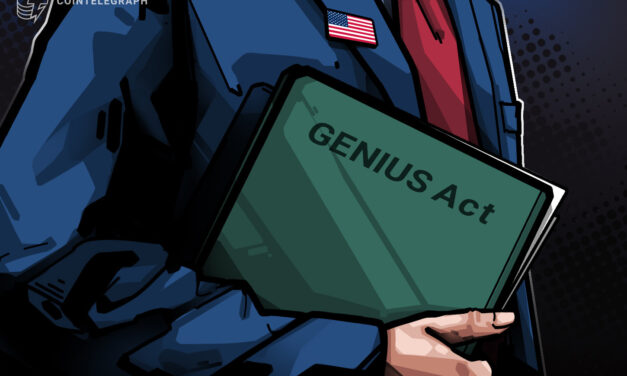
American Bankers Association: OCC’s GENIUS rules ‘undermine’ US Congress

A lobbying group for US banks has weighed in on the Office of the Comptroller of the Currency’s (OCC’s) recently finalized rules on payment stablecoin issuance and custody, arguing that the regulator’s interpretation went against Congress’ intent.In a Wednesday notice, the American Bankers Association (ABA) said that while the OCC’s final rules implementing the GENIUS Act included “several positive steps,” the banking group remained critical of provisions related to stablecoin yield. The regulator dropped a provision that would have established a presumption that certain third-party arrangements violated the law’s ban on yield payments.“The final rule removes the OCC’s originally proposed safeguards that would have addressed indirect arrangements involving affiliates, exchanges and other distribution partners,” said ABA. “As a result, payment stablecoin issuers can provide economically equivalent yield while technically avoiding the statutory prohibition. The OCC also declined to adopt a broader presumption against arrangements designed to circumvent the ban.”The group added:“Those gaps risk undermining the distinction Congress drew between payment stablecoins and traditional bank deposits, threatening the funds banks use to make the loans that drive the US economy.”Stablecoin rewards were one of the key issues lawmakers and interest groups debated before and after GENIUS passed Congress in July 2025, and they continue to face scrutiny amid discussions of the Digital Asset Market Clarity Act, a crypto market structure bill currently in limbo after a failed procedure vote in the Senate last month. Notably, the Blockchain Association approved of the change to yield prohibition, arguing that the OCC “[brought] the final rule more closely in line with the statutory text.” The Bank Policy Institute, another banking industry advocacy group, largely sided with ABA, saying that “the decision to omit the yield presumption replaces clarity with ambiguity and puts the banking system and its customers at risk of deposit flight.”The OCC finalized its rules ahead of the GENIUS Act’s implementation in January 2027. Other government departments are expected to release rules on GENIUS related to their agencies’ purview over stablecoins, including the Federal Reserve and Treasury.Related: ABA, state banking groups push back on CLARITY Act stablecoin yield provisions

Čítaj viac

Tether backs Bolivian fintech bringing USDT payments to food delivery and banking

Tether has led a pre-seed funding round in Bolivian fintech Peso, which offers USDT payments through food delivery apps and local banking networks, to support the company’s expansion across Latin America.In a Wednesday announcement, Tether said the investment will help Peso expand its stablecoin payment infrastructure across Bolivia, Brazil, Colombia and Argentina, including services that connect USDT with local currencies through banking and merchant payment systems.Peso has integrated USDT payments into Yango’s food delivery service in Bolivia, allowing customers to pay for orders using the stablecoin. The fintech offers QR payments, point-of-sale services for merchants and virtual accounts linked to Bolivia’s banking system through ACH transfers. Tether did not disclose the size of its investment.Source: TetherThe investment comes as other fintech companies expand USDT-based financial services in Bolivia. On Tuesday, lending platform Tala announced a partnership with El Dorado to offer credit directly through the digital wallet, allowing eligible customers to receive and repay loans in USDT on the Tempo blockchain. Related: Tether, Kazakhstan cenbank mull tenge stablecoin and asset tokenizationBolivia turns to stablecoins amid US dollar shortageBolivia has increasingly turned to stablecoins since 2025 amid a prolonged US dollar shortage and high inflation, with businesses beginning to accept USDT for purchases as access to foreign currency became more difficult.In November 2025, the government announced plans to integrate cryptocurrencies and stablecoins into the financial system, including allowing banks to offer digital asset custody and crypto-linked financial products.The government subsequently began considering a regulatory framework in July 2026 that would recognize USDT for payments, savings and trade alongside the boliviano and US dollar.The proposal came as Bolivia struggled with a prolonged dollar shortage after abandoning its longstanding currency peg in June, fueling demand for dollar-denominated alternatives such as USDT, as Cointelegraph reported in July.Magazine: Agents can trade 24/7 — but Yat Siu warns you could lose access at any time

Čítaj viac

Trump didn‘t mention ‘crypto’ once in White House cybercrime roundtable

US President Donald Trump hosted a roundtable at the White House on cybercrime, even as he and members of his administration face scrutiny from lawmakers and voters over accusations that they used their positions to enrich themselves with digital assets. Speaking at the roundtable event on Wednesday, Trump said “countless” Americans lost more than $20 billion from cybercrime in 2025 through impersonation schemes, ransomware attacks, scam centers and other methods. The president added that federal officials had frozen $1 billion in “cybercurrency tied to foreign scammers” and prevented $1.6 billion in losses in 2025 from going to criminals engaging in cybercrime following a March executive order.Secretary of Defense Pete Hegseth (left), President Donald Trump (center) and Attorney General Todd Blanche (right) speaking at the White House on Wednesday. Source: White HouseNotably, neither the president nor Attorney General Todd Blanche explicitly used the term “cryptocurrency” or “digital assets” when discussing the scams affecting many Americans, despite reports before the roundtable signaling a crackdown on foreign crypto scams would be the focus of the event. Homeland Security Secretary Markwayne Mullin similarly only referred to “digital extortion.” “Cybercurrency,” the word Trump used, is a dated term for what many people now call cryptocurrency.The Federal Bureau of Investigation reported that Americans had lost $11 billion from scams in 2025 specifically related to digital assets, including through crypto ATMs. Cointelegraph reached out to the White House for comment on the roundtable but did not receive an immediate response.Related: Ex-Trump crypto adviser profited after helping pass stablecoin bill: WSJThe president and his family are tied to several crypto ventures which Trump reported netted him $1.4 billion in 2025, while his alleged “schemes” cost investors about $4.7 billion, according to a Public Citizen report. His family’s crypto company, World Liberty Financial, also faces scrutiny for its USD1 stablecoin being used to settle a $2 billion investment in Binance by an entity tied to Sheikh Tahnoon bin Zayed Al Nahyan in the United Arab Emirates. Trump’s memecoin project, Official Trump (TRUMP), is hosting another dinner for tokenholders on Nov. 22. Similar events organized by the team behind the memecoin have prompted accusations from lawmakers and interest groups of Trump selling access to the presidency through “pay-to-play” schemes.Italian police arrest 30 people in crypto money laundering schemeThe White House roundtable followed reports that Italian authorities arrested 30 people for using crypto to launder millions of dollars through a bank allegedly tied to the mafia. According to Bloomberg, Italy’s police were investigating a criminal network that sent money from corporate fraud, crypto investment scams, and drug trafficking to digital wallets.Magazine: Can the SEC and CFTC’s pro-crypto rules be overturned? Legal opinion

Čítaj viac

Cardano Foundation urges EU against expanding MiCA rules to DeFi and staking

The Cardano Foundation has urged the European Union not to introduce new, standalone regulations for decentralized finance and staking, arguing that existing financial laws should govern such activities based on their functions and risks rather than the technologies they use.In a Wednesday blog post outlining its 19-page Sept. 30 submission to the European Commission, the foundation called for a distinction between direct participation in decentralized networks and financial services provided by intermediaries, particularly those involving custody or control of users’ assets.“Regulation should follow the substance of an activity, the functions performed, and the risks created, not the technology through which it is conducted,” the foundation wrote.The foundation said Cardano users can delegate their native ADA (ADA) tokens to help secure the network without surrendering custody or locking their tokens, arguing that such participation should be treated differently from staking services operated by intermediaries.The submission also called for clearer distinctions between the EU’s Markets in Crypto Assets Regulation (MiCA) and existing financial laws, warning that overlapping requirements and inconsistent interpretations across member states could create uncertainty for crypto businesses.The foundation’s position comes as EU regulators consider expanding oversight of crypto services. In September, the European Securities and Markets Authority (ESMA) recommended additional safeguards for staking, lending and borrowing, along with a new regulated service category for firms providing access to DeFi protocols.The Cardano Foundation has also pushed for greater regulatory clarity across the Atlantic, joining five other blockchain organizations in an Oct. 20 letter urging the US Securities and Exchange Commission to formally recognize digital commodities as non-securities under its proposed crypto framework.Magazine: Can the SEC and CFTC’s pro-crypto rules be overturned? Legal opinion

Čítaj viac

Solana’s Alpenglow launches on mainnet, targets 99% faster finality

Solana’s first major consensus upgrade, Alpenglow, went live on mainnet around 1:54 pm UTC on Wednesday, according to the Solana Foundation’s Alpenglow dashboard.Alpenglow seeks to reduce transaction finality by 99%, to roughly 150 milliseconds from about 12.8 seconds, according to the Solana Foundation’s July announcement.The upgrade’s first phase, Votor, replaces the existing voting and finalization mechanism with direct validator voting and a certificate-based system designed to cut transaction finality to roughly 150 milliseconds. A later phase will introduce Rotor, a new block data-distribution protocol intended to replace Turbine.Alpenglow is Solana’s first major consensus upgrade, replacing its current consensus model, TowerBFT. The upgrade’s 150-millisecond finality target seeks to introduce near-immediate transaction finality for users, which could mean faster payments, trade settlements and more responsive applications. Cointelegraph has approached the Solana Foundation for comment on Alpenglow’s finality measurements in testnet environments and its expected performance in real-world applications.Solana Alpenglow activation dashboard. Source: Solana.comAt press time, the Solana mainnet showed a 6.6-second transaction finality and a throughput of 4,721 transactions per second, according to the Alpenglow dashboard.Related: Solana Foundation targets settlement in seconds with DvP launchAlpenglow marks “biggest change” for Solana’s core protocol: AnzaAlpenglow will introduce the “biggest change to Solana’s core protocol” since genesis, Anza researchers wrote in a May blog post.A 150-millisecond latency, “Solana can compete with Web2 infrastructure in terms of responsiveness, potentially making blockchain technology viable for entirely new categories of applications,” wrote Anza researchers Quentin Kniep, Kobi Sliwinski and Roger Wattenhofer on May 19.In August, Solana reduced its slot time for the first time since genesis, as part of the Solana Foundation’s plans to halve slot times to 200ms, arguing that it would improve latency and accelerate confirmations on the blockchain network. It completed the fourth stage of the slot reduction plan in October.Following Alpenglow, Solana validators are expected to continue working on Agave 4.5, an upgrade that proposes increasing the number of accounts supported by a versioned transaction from 64 to 96. The increase could create better swap routes and execution prices, according to the Solana Foundation. The upgrade is currently in development and planned for December 2026.SOL/USD, 1-year chart. Source: CoinMarketCapThe Solana (SOL) token’s price rose nearly 3% in the 24 hours leading up to the upgrade, reversing part of its 42% decline seen during the past year, according to CoinMarketCap.Magazine: Solana’s fee overhaul increases burn and makes resource hogs pay

Čítaj viac
Načítava

Získaj BONUS 8 € v Bitcoinoch

nakup bitcoin z karty

Registrácia Binance

Burza Binance

Aktuálne kurzy