Značka: cryptocurrency exchange

Bitcoin may fall lower but BTC power-law frames crash to $58K as ‘normal’

Bitcoin’s (BTC) drop to $58,000 has pushed the price into a zone that long-term power-law models have historically associated with cycle bottoms. The data does not confirm a bottom range, though it shows BTC trading in a price range that has repeatedly marked major lows since 2014. Derivatives data and liquidation levels highlight $55,000 as the next key support level and the $65,000-$68,000 range as the next major upside area of interest. Bitcoin power-law puts $58,000 in historical rangeGiovanni’s Bitcoin power-law model places the network’s long-term trend price near $135,000, making the recent drop to $58,000 roughly 54% below the all-time high and 1.22 standard deviations beneath that trend.According to the analyst, the key takeaway is straightforward: the previous cycle lows in 2012, 2015, 2019, 2020, and 2022 all fell within a similar statistical range. By that measure, the latest decline falls within a territory that has historically marked the deep bear-market lows rather than a break in Bitcoin’s long-term growth path.Bitcoin price deviation based on the power-law trend. Source: XThe model estimates the commonly referenced “-1σ” support near $68,000, while the stronger historical floor sits closer to $55,000. Giovanni also noted that Bitcoin would need to trade below roughly $17,000 for more than a year before the power-law itself could be considered invalid.A second metric points in the same direction. Bitcoin’s power-law quantile has fallen to 6.2%, indicating the asset is cheaper than roughly 94% of its historical observations when measured against the power-law model. The chart highlights similar readings during the 2015, 2020, and 2023 cycle lows, with the current market now revisiting that historically rare valuation zone.Bitcoin power-law quantile regression chart. Source: CheckonchainRelated: Bitcoin drops to $58K on high US PCE inflation as trader sees ‘manipulation’Key BTC price levels to watchBitcoin fell to a new yearly low of $58,000 after aggressive selling swept through Binance. The hourly taker sell volume reached $2.1 billion, followed by another $1.9 billion in the next hour after the New York market open, marking the exchange’s largest hourly sell pressure since May 4.Bitcoin taker sell volume on Binance. Source: CryptoQuantThe flush liquidated more than $300 million in long BTC positions before the price rebounded toward $60,000. That level now carries added significance. A daily close back above $60,000 preserves the developing relative-strength index (RSI) bullish divergence across the one-hour, four-hour, and daily time frames which signals that selling momentum is fading even as the price prints lower lows.BTC/USDT, one-day chart. Source: Cointelegraph/TradingViewFutures trader Byzantine General shared a similar outlook, saying the move to $58,000 cleared out leveraged longs while drawing in fresh short sellers. In his view, a daily close above $60,000 would strengthen the case that Bitcoin has printed a local bottom for now. That would also shift attention toward a large pocket of upside liquidity. More than $4 billion in short liquidations cluster near $65,000, compared with about $1 billion below $55,000, creating a four-to-one imbalance. A relief rally could then target internal liquidity near $68,000, where a daily fair-value gap adds another area of interest for traders. BTC liquidation map. Source: CoinGlassMeanwhile, a daily close below $60,000 reinforces the bearish bias on both the short-term and long-term charts. The next area of interest then shifts to $55,000, where Bitcoin’s September 2024 weekly range low converges with its realized price near $54,000. The realized price, which tracks the average cost basis of all onchain coins, has historically provided support at every major Bitcoin bear-market bottom since 2014. That trend makes the $54,000-$55,000 region a key level for traders to watch if selling pressure continues. Bitcoin’s realized price. Source: XRelated: Bitcoin drop to $58K brings out bears: Is BTC’s next stop below $50K?

Čítaj viac
XRP risks drop below $1, but onchain data highlights silver lining

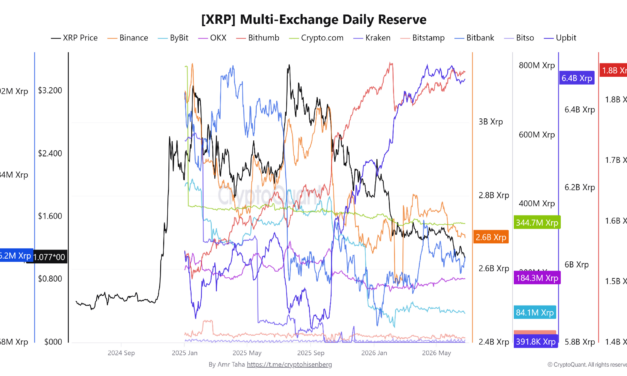
XRP is trading just above $1, leaving the token at its weakest price level of the year, but onchain data paints a different picture. The exchange-held XRP supply continues to fall, Binance withdrawals have exceeded deposits for seven straight days, whale flows are holding positive and spot XRP exchange-traded funds (ETFs) have attracted $243 million in inflows since April.The improving onchain data points to healthy network positioning, even as XRP continues to search for a price bottom.  XRP supply on exchanges continues to shrinkCrypto analyst Amr Taha noted that Binance’s XRP reserve has fallen to its lowest level since March after roughly 100 million XRP left the exchange over the past month. Binance’s balance stood at about 2.68 billion XRP on June 25, down from 2.78 billion XRP on May 12, accounting for the largest outflow among major trading platforms.XRP multi-exchange daily reserve. Source: CryptoQuantOther exchanges also posted smaller declines. Upbit’s reserve fell to 2.48 billion XRP on June 25 from 2.51 billion XRP on May 31, while Bybit’s holdings declined to 82 million XRP from 92 million XRP on June 2. Binance led in absolute outflows, while Bybit recorded the steepest percentage decline.Taha also highlighted a significant shift in Binance transaction activity. XRP withdrawal transactions have exceeded deposits for seven consecutive days since June 17. The seven-day withdrawal share climbed to 53.8% on June 23, its highest reading since June 2024, while deposits fell to 46.1%, the weakest level since 2024.XRP daily deposit/withdrawal transactions (%) on Binance. Source: CryptoQuantThe metric tracks transaction count rather than XRP volume. This indicates users are moving coins off Binance more frequently than sending them to the exchange, marking the longest withdrawal-led stretch in roughly a year.Large XRP holders supported the trend. XRP whale flow on the 90-day moving average has stayed positive throughout the quarter at 5.143 million XRP per day, showing consistent net accumulation by large wallets instead of distribution. XRP whale flows. Source: CryptoQuantInstitutional demand has also added support. Spot XRP ETFs recorded $2 million in net inflows on June 24, lifting June’s total netflows to $31 million. Since April, the total cumulative inflows have reached $243 million.Related: SBI to acquire Bitbank in $289M deal creating Japan’s biggest crypto exchangeXRP price approaches a major demand zoneFrom a technical standpoint, the higher-time-frame market structure remains bearish for the altcoin. XRP touched $1.01 on Thursday, its lowest price of 2026, leaving the token close to its first move below $1 since November 2024. The decline has pushed XRP down 43% year-to-date.XRP/USDT, one-week chart. Source: Cointelegraph/TradingViewThe next key area for XRP sits within the fair value gap between $1 and $0.63, an unfilled price gap created during the sharp rally in late 2024 that could attract buying interest if the decline extends in the coming weeks. Black Swan Capitalist founder Versan Aljarrah continues to focus on the longer-term chart. The analyst said XRP has spent years building a large accumulation range with higher lows on both weekly and monthly timeframes.XRP/USD, one-month chart analysis by Versan Aljarrah. Source: XAljarrah argued that extended consolidations often produce stronger breakout moves once the price eventually breaks out of the range, with the analyst targeting $10, i.e., a 900% increase from the current price. Related: HYPE down 22% from record highs: Will spot demand revive the uptrend?

Čítaj viac

South Korean authorities fine Bithumb $136K over sharing user information overseas

South Korean cryptocurrency exchange Bithumb was order to pay a $136,000 fine after it was found to have breached personal information protections rules when it sent user data overseas.In a Thursday notice, the country’s Personal Information Protection Commission (PIPC) said that its investigation into Bithumb found that the exchange had “transferred personal information overseas without the separate consent of the data subjects during the process of order book sharing and virtual asset transfer with overseas virtual asset exchanges.” The incident was connected to Bithumb sharing its Tether (USDT) order books between September and November 2025 with BingX, despite obtaining consent to share the data with Stellar, as well as sharing user information with 13 overseas exchanges.“The Personal Information Protection Commission determined that there is a necessity to provide personal information for anti-money laundering purposes when transferring virtual assets to other exchanges, but regarding the overseas transfer of personal information and the data subject’s right to self-determination, it was determined that, as this is a closely related matter, it is necessary to strictly comply with the requirements and procedures stipulated in the Protection Act,” the notice said, in translation.Source: PIPCOne of the largest crypto exchanges in South Korea, Bithumb has been subject to intense scrutiny from authorities. The country’s financial watchdog imposed a six-month suspension of the exchange’s activities in March over alleged violations of South Korea’s Financial Information Act, but a court reversed the decision in April. Earlier this month, police reportedly raided Bithumb’s offices as part of an investigation into alleged nepotism involving South Korean lawmaker Kim Byung-gi.Related: SBI to acquire Bitbank in $289M deal creating Japan’s biggest crypto exchangeSouth Korean crypto tax set to take effect in 2027South Korea’s Finance Ministry confirmed in May that a 22% tax on cryptocurrency gains would be imposed beginning in January 2027. The tax has faced several delays in implementation after initially expected to go into effect in 2025, but will likely affect many South Koreans who hold crypto.According to the Yonhap news agency, about 16 million South Koreans were invested in digital assets as of March 2025.Earlier this month, Chainalysis said that it signed a memorandum of understanding with the Korean National Police Agency (KNPA), aimed at building investigative capability within South Korea’s law enforcement. One of the driving factors behind the pact is to better combat North Korea-linked crypto attacks, with South Korea’s police “at the forefront” of tackling these threats. Magazine: Japanese pension fund tips 1% in crypto, G7 urges action on NK hackers: Asia Express

Čítaj viac

SBI to acquire Bitbank in $289M deal creating Japan's biggest crypto exchange

Japan’s SBI Holdings has signed agreements to acquire full control of crypto exchange Bitbank through a 46.7 billion Japanese yen ($289 million) transaction, advancing a deal first disclosed in May that would create the country’s biggest crypto exchange.On Thursday, SBI said that its wholly owned subsidiary SBICAH will acquire shares from Bitbank CEO Noriyuki Hirosue and other shareholders before subscribing to a third-party share allotment. The exchange will then buy back shares held by MIXI and Ceres, leaving SBI with 100% indirect ownership. SBI expects the transaction to close around October, subject to regulatory clearance.The acquisition would expand SBI’s regulated crypto exchange footprint and customer base, giving it another potential distribution channel for the stablecoins, tokenized assets and onchain financial products.Bitbank’s daily trading volume has hovered below $50 million for most of the last four months, CoinGecko data showed. Volume is dominated by the BTC/JPY pair (39.5%), followed by XRP/JPY and ETH/JPY (both at 19.7%).SBI said combining Bitbank with SBI VC Trade would give the group about 1.1 trillion yen in assets under custody and roughly 2.92 million crypto accounts, based on figures from the end of April. The company said the combined business would rank first among Japanese crypto exchanges by assets under custody and among the largest by account numbers.Bitbank trading volume has hovered below $50 million for most of the last four months. Source: CoinGeckoSBI builds broader digital asset ecosystemThe Bitbank deal is the latest in a series of moves by SBI to build infrastructure, including crypto trading, stablecoins and tokenized financial markets. In February, SBI and Startale Group unveiled Strium, a layer-1 blockchain designed to support around-the-clock trading and settlement of tokenized equities and real-world assets. Related: Circle, Nomura eye Japan corporate FX with stablecoin settlement: ReportOn Wednesday, SBI and Startale launched the yen-pegged stablecoin, JPYSC. The token is issued by SBI Shinsei Trust Bank and distributed by SBI VC Trade. The stablecoin is initially limited to transfers within SBI VC Trade accounts, while public blockchain circulation will roll out after resolving outstanding legal and tax conditions, according to SBI. The same day, Ripple and SBI Group launched the dollar-backed Ripple USD (RLUSD) stablecoin in Japan also through SBI VC Trade. At launch, RLUSD became available to institutional and retail customers after receiving approval under Japan’s regulatory framework for foreign-issued stablecoins. Magazine: Japanese pension fund tips 1% in crypto, G7 urges action on NK hackers: Asia Express

Čítaj viac

Binance faces EU service limits next week as MiCA rules take effect

Binance has notified European Union users that access to key services will be restricted after the exchange failed to secure Markets in Crypto-Assets (MiCA) authorization from a member state before a July 1 deadline.Those restrictions include halting onboarding new EU users and limiting certain services for EU-based accounts effective July 1, according to exchange notices shared by users on social media.The notices said users will still be able to withdraw their assets after that date, stating that “all digital assets are still available for withdrawal,” in line with applicable regulatory requirements.The move marks one of the first major transitions under the EU’s MiCA framework after Binance announced it withdrew its MiCA license application in Greece on Wednesday.Cointelegraph approached Binance for comment on its plans but did not receive a response prior to the time of publication.Binance advises moving funds to self-custodial wallets or other exchangesIn circulating notices, Binance told users they may move assets to self-custody wallets or transfer funds to other crypto asset service providers (CASPs).The exchange operator said the transition is intended to be an “orderly process” aimed at minimizing disruption to users, with services reduced to position management and withdrawals after the deadline.Source: IT_Tech_PLMultiple MiCA-licensed CASPs including Revolut and OKX have been actively recruiting new users in EU member states ahead of next week’s deadline.Users seek clarity on staking and tradingSome Binance users have raised concerns over how specific services will be handled once EU service restrictions take effect after the MiCA transition ends.In public replies on social media, users asked what will happen to staked crypto assets on Binance after the deadline, reflecting uncertainty around whether yield-generating positions will be affected by the upcoming service changes.Source: FilipebinanceIn response, a Binance representative said user balances “remain available and safe as always,” but did not provide specific details on how staking rewards or active positions will be treated under the restricted-services phase.Community divides over Binance user impactViews across the crypto industry differ on how significant the upcoming MiCA transition will be for existing Binance users in the European Union.Dominik Tomczyk, CEO of SIA AlphaRoute, operating as Kanga Exchange EU, told Cointelegraph that non-licensed platforms may still continue serving existing users under the legal concept of “reverse solicitation.” He said that, from a user perspective, “nothing will change,” apart from restrictions on marketing and user acquisition within the EU.Sławomir Zawadzki, co-CEO of Kanga Exchange, said existing users are unlikely to see major disruptions. He also suggested that much of the concern around MiCA-related changes is being overstated, adding that competitive positioning may be shaping parts of the public narrative.Mixed response from usersOne Binance EU user told Cointelegraph they were not overly concerned about the MiCA deadline, pointing to Binance’s liquidity and proof-of-reserves reporting. “I’ll honestly continue using Binance until I see evidence of a potential enforcement action,” the person said.Another user said the impact on Binance EU users would depend on how heavily they rely on the platform. They noted that their primary use of the platform is as a trading gateway and would switch to another exchange if needed, while suggesting the biggest disruption would likely affect active traders and users with large balances on the platform.Related: EUR trading accounts for 1% of Binance spot volume, CryptoQuant saysAccording to media reports, Binance’s global client base counts at least 300 million customers, while the app was downloaded more than 4 million times in the EU last year. Magazine: How crypto laws changed in 2025 — and how they’ll change in 2026

Čítaj viac

Iran-linked entities moved $3.8B through CoinEx, TRM says

Wallets with identifiable links to sanctioned Iranian entities have moved over $3.84 billion through cryptocurrency exchange CoinEx since 2019, making it one of the main channels used to bypass US economic sanctions, according to blockchain analytics company TRM Labs.About 60 Iranian platforms were tied to the funds, with $2.7 billion of this flowing between CoinEx and Nobitex, Iran’s largest domestic cryptocurrency exchange, at an average rate of about $1 million per day since 2018, wrote TRM Labs in a Wednesday report.By 2024, CoinEx was Nobitex’s largest external counterpart, nearly nine times that of the next-largest exchange, a pattern that TRM Labs called “inconsistent with independent market behaviour.”The report comes three weeks after the US Treasury sanctioned four Iranian crypto exchanges as part of its “Economic Fury” campaign. Days before the sanctions, Treasury Secretary Scott Bessent said the Treasury had seized $1 billion in crypto from Iranian exchanges and wallets since the start of the war.In a statement published Thursday on X, CoinEx denied having any commercial relationship with the Iranian government or domestic Iranian exchanges and said it has never provided funding channels to sanctioned parties. The exchange also disputed TRM Labs’ interpretation of blockchain data, saying onchain fund flows do not demonstrate a platform’s knowledge of or participation in illicit activity.Iranian exchanges: CoinEx exposure & share volume, 2025. Source: TRM LabsTop Iranian exchanges route up to 10% of volume through CoinExMost of the major Iranian domestic exchanges route about 5% to 10% of their trading volume through CoinEx, indicating a “coordinated arrangement rather than organic adoption,” according to TRM Labs.CoinEx’s share of illicit transaction volume is nearly 8%, above the 0.3% threshold found at other compliant exchanges. Related: US authorities freeze $344M in crypto linked to IranCoinEx-affiliated mining pool ViaBTC accounted for another $154 million in traced exposure to Nobitex through mining payouts and supplied emergency liquidity to Nobitex following Predatory Sparrow’s $90 million hack in June 2025.Cointelegraph contacted ViaBTC for comment on TRM Labs’ findings but had not received a response by publication.Nobitex was at the center of Iran’s “digital dollar pipeline” and handled about 50% of the country’s crypto trading volume, according to a June 2 report by blockchain forensics platform Chainalysis.In May, Nobitex was reportedly linked to members of a powerful family with ties to Supreme Leader Ali Khamenei.In January, the Office of Foreign Assets Control sanctioned UK-registered Zedcex and Zedxion for being used as front companies for the Iranian Revolutionary Guard Corps (IRGC).Magazine: Inside the Iranian Bitcoin mining industry

Čítaj viac

HYPE down 22% from record highs: Will spot demand revive the uptrend?

Hyperliquid’s HYPE token is down 22% from its $75 all-time high, bringing its 2026 uptrend to a key test of support. Market participation has cooled across the derivatives markets, while the spot flows show early signs of stabilization after strong selling pressure in early June. The $50-$54 area now stands out as the most important support zone beneath current prices and the first major trend test since January. Spot selling begins to ease for HYPEHYPE fell below $60 on Wednesday after rejecting another retest of its all-time high near $76. The decline has pushed the price toward the 50-day exponential moving average, a level that has acted as trend support throughout the rally from March.The recent pullback resembles HYPE’s consolidation in May 2025. At that time, the token printed a new high near $40 before entering a multi-week pause that cooled momentum without producing a bearish break on the daily chart. HYPE price comparison, July 2026 and May 2025. Source: Cointelegraph/TradingViewThe relative strength index is following a similar setup, rolling over from overbought conditions while remaining above the levels typically associated with trend reversals.However, onchain data paints a cautious picture. Aggregated spot cumulative volume delta (CVD), which measures net buying and selling activity in spot markets, has improved from recent lows during the correction. The recovery has reduced the earlier sell imbalance, though spot CVD remains deeply negative at nearly $95 million.HYPE price, open interest, spot and futures CVD, funding rate. Source: VeloThe shift suggests selling pressure is easing rather than aggressive accumulation. Spot buyers have started absorbing supply near current levels, though the scale of demand remains modest compared to $110 million in selling recorded during HYPE’s decline from $76 in early June. The derivatives activity continues to weaken. Open interest has fallen to $1.73 billion from $2.2 billion, while derivatives CVD has continued trending lower and now sits near negative $389 million, down from $400 million at the beginning of June. Currently, HYPE traders appear to be reducing exposure rather than opening new positions.Related: Solana grabs 95% of tokenized equity as traders debate if SOL bottom is in$50 support comes into focusThe next major test lies between $50 and $54, where the rising 50-day exponential moving average aligns with an unfilled daily fair-value gap. The zone represents the first significant support cluster below the current prices.Holding above the region preserves HYPE’s sequence of higher highs and lows, which has remained intact since January. It also keeps the current pullback consistent with previous consolidations that developed within the broader uptrend.HYPE/USDT, one-day chart. Source: Cointelegraph/TradingViewA daily close below $53 would mark the first meaningful bearish shift on the daily chart this year. The 100-day EMA near $51.6 becomes the next support level, followed by the lower boundary of the fair value gap near $49. Below that, the next notable support area sits near $38.For now, the most important signal is the gap between improving spot flows and declining participation across leveraged markets. The strength of demand around the $50-$54 support zone may offer the clearest indication of whether HYPE’s correction is nearing exhaustion or preparing for a deeper retracement.Speaking in terms of accumulation, crypto trader Altcoin Sherpa said, “HYPE, I think anywhere in the 55-64 area is a pretty good place to accumulate this one. I think it goes to $100 later this year personally and is still the best altcoin…but it’s going to also depend a lot on bitcoin IMO.Related: Bitcoin crash to $60K opens new $530M demand zone: Will bulls buy in?

Čítaj viac

FTX exec’s wife scheduled for November trial on campaign finance charges

Michelle Bond, the wife of former FTX Digital Markets co-CEO Ryan Salame, who is serving a 7.5-year prison sentence after reaching a plea agreement with prosecutors, is scheduled to stand trial in November following delays stemming from motions related to her husband’s plea deal.On Wednesday, Judge George Daniels in the US District Court for the Southern District of New York ordered a trial start date of Nov. 9 for Bond, who faces four charges related to campaign finance law violations. The proceedings came a week after the judge denied Bond’s motion to dismiss the indictment, based on claims that prosecutors had promised Salame she would not be charged if she pleaded guilty.Bond’s case is one of the final criminal proceedings related to the collapse of cryptocurrency exchange FTX, which filed for bankruptcy in 2022. The event led to criminal charges for Salame and other executives, including former CEO Sam “SBF” Bankman-Fried and former Alameda Research CEO Caroline Ellison.In an August 2024 indictment, prosecutors alleged that Bond and Salame “illegally funded” the former’s 2022 campaign for the US House of Representatives. Salame allegedly used $400,000 of FTX funds as part of a “sham” payment in violation of campaign finance laws. Bond ran as a Republican in New York’s 1st congressional district but lost in the primary to Nicholas LaLota.2022 campaign post on X (then Twitter) Source: Michelle BondSalame, charged in 2022 along with Bankman-Fried and others, was sentenced to 90 months in prison in 2024 after pleading guilty to conspiracy to make unlawful political contributions. He initially attempted to vacate his plea after claiming that prosecutors misled him over charging Bond, but ultimately reported to prison in October 2024 and left the matter to his wife’s case.Bankman-Fried, angling for a presidential pardon, loses appealSalame, Bankman-Fried and Ellison were the only three people tied to FTX to receive prison time. Two other executives, Nishad Singh and Gary Wang, were given time served after testifying against SBF at trial. Ellison, meanwhile, was released early in January after serving less than her two-year sentence.Related: US lawmakers warn against presidential pardon for Sam Bankman-FriedAside from Bond’s expected trial, Bankman-Fried was the only one connected to the crypto exchange to have his day in court. He was found guilty on seven felony charges and sentenced to 25 years in prison in 2024.Although Bankman-Fried filed to appeal his conviction and sentence, he also recently applied for a presidential pardon from Donald Trump. The Second Circuit Court of Appeals rejected SBF’s appeal earlier this month, leaving the US Supreme Court or a presidential pardon as his only likely path to freedom over the next 20 years. Magazine: AI is banking the unbanked in Africa… faster than crypto

Čítaj viac

Multi-year Bitcoin holder selling falls to 19-month low as halving model flags new market bottom date

Bitcoin (BTC) holders who acquired their coins more than five years ago have cut spending to a 90-day average of 962 BTC, the lowest level since November 2024, according to CryptoQuant data. The slowdown follows three major spending peaks over the past two years, including a high of 3,860 BTC in May 2024. At the same time, BTC analysts said that market and profitability indicators are converging in the second half of 2026, putting a new timeline of a potential Bitcoin bottom. Bitcoin “OG” holders step backCrypto analyst Darkfost said the current cycle has produced the highest level of spending by long-term Bitcoin holders on record. The cohort tracked in the dataset consists of investors who acquired Bitcoin more than five years ago. Using spent transaction outputs (STXO), which track Bitcoin that has moved across the network, the analyst identified three major spending waves following strong rallies.OG Bitcoin Holders selling pressure. Source: CryptoQuantThe 90-day moving average peaked at 3,860 BTC in May 2024, 3,200 BTC in February 2025 and 2,360 BTC in September 2025. Individual sessions were far larger, with some days recording output exceeding 10,000, 30,000 and even 142,000 BTC.That selling pressure has eased sharply. The 90-day average has dropped to 962 BTC, the lowest reading in 19 months. Darkfost said the most expensive coins held by this group were acquired for about $63,200, which is close to current prices. This indicates that many of these holders are choosing not to sell, even though their holdings are trading near their highest cost basis.Bitcoin Researcher Axel Adler Jr. further noted a split between newer and older BTC investors. The analyst said that Bitcoin’s adjusted net unrealized profit/loss (aNUPL) has fallen to -0.14 from near zero a month ago, showing that the average holder has moved back into unrealized losses as BTC traded near $62,500. However, Adler Jr argued, “STH capital has shrunk by -56%, while LTH capital has barely drawn down. Weak hands are capitulating. Strong hands have not even flinched.” Adler Jr. added that the key metric has spent nearly half of the past three months below zero, indicating sustained pressure on newer BTC market participants rather than a broad capitulation across long-term holders. STH vs LTH realized cap analysis. Source: Axel Adler Jr.Related: Bitcoin slump worsens amid SpaceX rout: Can BTC price hold $60K any longer?BTC halving cycle points to September bottom, says analystCrypto analyst LP highlighted a recurring pattern tied to Bitcoin’s halving cycles. The previous bear market entered a final capitulation phase 826 days after the halving event, followed by a major low and sideways consolidation for 70 to 110 days.For the current cycle, the 826-day marker falls on July 6. Applying the same timing range places a potential bottoming window in early September.BTC bottom analysis by LP. Source: XThe trader noted that the scenario becomes more relevant if Bitcoin continues to trade higher into early July. Likewise, BTC trader Titan also identified downside liquidity below the current levels. On the quarterly chart, Bitcoin has an untapped low near $58,900 and an open fair value gap between roughly $49,000 and $58,900. The trader explained that leaving the quarterly low untouched throughout September may draw more attention to that liquidity zone, eventually leading to a market bottom between Q3 and Q4. BTC quarterly analysis. Source: XRelated: Bitcoin gets new $54K warning as BTC price hits 11-day low on Asia tech sell-off

Čítaj viac

Andrew Cuomo to lead joint TradFi-crypto venture between OKX and Intercontinental Exchange

Cryptocurrency exchange OKX and the Intercontinental Exchange (ICE), parent company of the New York Stock Exchange, announced that former New York Governor Andrew Cuomo would co-lead a joint venture focused on digital assets.In a Monday notice, OKX and ICE said Cuomo, who lost his bid to be New York City’s mayor in 2025, would co-chair the joint project between the two companies “focused on building next-generation infrastructure for tokenized and digitally native financial products.” The venture, which the companies said would allow OKX users to “access ICE futures and NYSE tokenized equities markets,” is subject to regulatory approval. Cuomo has largely been out of the public eye since his failed 2025 mayoral run, in which he said he intended to make New York City the “global capital for cryptocurrency.” He had the endorsement of the crypto-aligned Innovate NY political action committee (PAC), but lost to Democratic candidate Zohran Mamdani, who secured more than 50% of the vote. The former governor began working with OKX in 2023.The joint venture notice followed a partnership between ICE and OKX announced in March in which the former invested an undisclosed amount in the exchange at a $25 billion valuation. ICE’s ventures into the crypto industry also included a $2 billion investment pledge into prediction markets platform Polymarket.Related: NYSE owner ICE to launch oil-linked futures with OKXSince taking office on Jan. 1, Mamdani has not announced any significant policies related to crypto or blockchain. He confirmed in January that he holds no digital assets as New York City mayor.New York to hold party primaries on TuesdayOn Tuesday, New York, Utah and Maryland will hold primaries to determine candidates for US House of Representatives and Senate seats in the November general election. Cryptocurrency-aligned PACs, including Fairshake, have poured money into advertising and other campaign efforts to support candidates they view as favorable to the digital asset industry.Magazine: Bitcoin decouples from tech stocks, Ether eyes ‘selling wave’: Market MovesCointelegraph is committed to independent, transparent journalism. This news article is produced in accordance with Cointelegraph’s Editorial Policy and aims to provide accurate and timely information. Readers are encouraged to verify information independently.

Čítaj viac

Bitcoin weekly close above $63K amid RSI divergence may be bottom signal: Data

Bitcoin (BTC) continues to exhibit a strong technical setup after holding a weekly close above $63,000 for three consecutive weeks since tagging a new 2026 low near $59,000. This pattern closely resembles a bottom-building phase seen in previous trend reversals in bearish periods.At the same time, Bitcoin futures open interest has fallen 19.5% from its June peak, funding rates have cooled to 0.02% from 0.1%, and spot Bitcoin exchange-traded fund (ETF) outflows have slowed sharply to $540 million over the past two weeks from $5.5 billion the prior month. Together, the data points to a market that is shedding excess selling pressure while holding near a key support zone for BTC. Bitcoin’s weekly chart echoes prior market bottomsBitcoin’s recent weekly price action resembles a pattern seen several times since 2023. Once a local bottom is established, the price often trades close to that range for weeks before a sustained uptrend develops. One exception came in November 2025, when the price spent roughly 10 weeks moving sideways above $88,000 before breaking lower to the $60,000 level. BTC/USD, one-week chart. Source: Cointelegraph/TradingViewThe current setup also resembles the price from late 2022 and early 2023. During that period, the weekly relative strength index (RSI) entered oversold territory, recovered, and later formed a higher low, while the BTC price printed a lower low, creating a bullish divergence. That bullish divergence marked a key turning point, preceding the broader uptrend that developed during 2023. The focus is now on the $63,000 area, where the price has formed a positive RSI divergence. The repeated weekly closes above $63,000, keeps Bitcoin trading above its recent low at $59,000 rather than extending towards it. The behavior fits a range-building phase that has appeared near previous turning points, as identified in the chart. Related: US dollar strength hits highest since May 2025: Five things to know in Bitcoin this weekBTC futures turn less crowded as ETF sell-pressure eases Bitcoin derivatives markets have become notably less crowded over the past three weeks. Bitcoin funding rates cooled to 0.02% from 0.1% at the start of June, reducing signs of aggressive long positioning.Bitcoin funding rate on all exchanges. Source: CryptoQuantCrypto analyst Woominkyuu noted that total Bitcoin open interest across exchanges peaked at $25.96 billion on June 1, then fell to $20.89 billion by June 21. The 19.5% decline exceeded Bitcoin’s 11.4% price drop during the same period.The simultaneous decline in the price and open interest typically signals that existing positions are being closed or liquidated rather than new leveraged bets entering the market. This indicates a significant reduction in excess leverage. It also points to limited evidence of aggressive new short positioning at current levels.Spot Bitcoin ETF flows show a similar shift with $5.5 billion leaving the spot ETFs between May 15 and June 11. The outflows over the past two weeks total about $540 million, marking a sharp slowdown in selling activity.Weekly spot BTC ETF netflows. Source: SoSoValueOnchain data paints a mixed but constructive picture. Bitcoin researcher Axel Adler Jr. highlighted that long-term holders’ realized supply recently reached 12.42 million BTC, a level associated with supply maturation and coins moving into stronger hands. At the same time, Bitcoin’s sales pressure metric has stayed inactive for 1,256 consecutive days, the longest stretch on record. The data points to continued supply maturation alongside other signs that Bitcoin may be stabilizing near a potential cycle low.Bitcoin LTH realized supply. Source: Axel Adler Jr.Related: Strategy adds $300M to USD Reserve, acquires 520 BTC

Čítaj viac

Enso launches RWA app and trading for over 500 tokenized assets

Switzerland-based Web3 development platform Enso has launched a real-world asset (RWA) application offering access to more than 500 tokenized assets through integrations with xStocks, Ondo Finance and Anchorage Digital’s Porto.Through Enso’s execution layer, users can access tokenized stocks, ETFs, Treasurys, commodities and stablecoins. Ondo will provide tokenized equities, treasury products and capital markets infrastructure, while xStocks will enable access to tokenized equities and ETFs, according to a Monday announcement shared with Cointelegraph.Available assets include major US companies such as Apple, Microsoft, Nvidia, Amazon, Alphabet, Meta, Tesla and SpaceX.Enso said bringing these assets under a unified distribution and execution layer would simplify access to tokenized assets across multiple venues and improve the user experience.The launch adds Enso to a growing field of European crypto firms expanding into tokenized traditional assets. Earlier this year, Austria-based Bitpanda expanded its offering to roughly 10,000 stocks and ETFs, while a number of European digital asset firms have moved to capitalize on growing demand for tokenized securities.Enso expands access to tokenized assets. Source: EnsoTokenized US equities have attracted significant demand from investors outside the US, particularly in Europe, Enso co-founder and CEO Connor Howe told Cointelegraph:The demand concentrates in two places: tokenized access to US markets, with the around-the-clock trading traditional venues can’t match, and yield-bearing dollar assets.”Tokenized asset holders rise 13% amid growing demandThe launch comes amid growing demand for tokenized assets. The number of tokenized asset holders rose 13.4% over the past 30 days to 930,612, according to data from RWA.xyz. The total value of tokenized assets, however, fell 0.9% during the same period.Total RWA value onchain, all-time chart. Source: RWA.xyz US Treasury debt was the largest tokenized asset category with $15 billion in onchain value, followed by tokenized commodities at $4.6 billion and asset-backed credit at $2.2 billion. Tokenized stocks accounted for $1.6 billion in total onchain value, ranking fifth among tokenized asset categories.Related: Franklin Templeton, BNP Paribas see tokenization boosting EU’s capital efficiencyTokenized stocks first crossed $1 billion in total onchain value on March 10, when Ondo accounted for about 58% of the market and xStocks about 24%.Magazine: Can Robinhood or Kraken’s tokenized stocks ever be truly decentralized?

Čítaj viac
Načítava

Získaj BONUS 8 € v Bitcoinoch

nakup bitcoin z karty

Registrácia Binance

Burza Binance

Aktuálne kurzy