Značka: Cryptocurrencies

Bitcoin may fall lower but BTC power-law frames crash to $58K as ‘normal’

Bitcoin’s (BTC) drop to $58,000 has pushed the price into a zone that long-term power-law models have historically associated with cycle bottoms. The data does not confirm a bottom range, though it shows BTC trading in a price range that has repeatedly marked major lows since 2014. Derivatives data and liquidation levels highlight $55,000 as the next key support level and the $65,000-$68,000 range as the next major upside area of interest. Bitcoin power-law puts $58,000 in historical rangeGiovanni’s Bitcoin power-law model places the network’s long-term trend price near $135,000, making the recent drop to $58,000 roughly 54% below the all-time high and 1.22 standard deviations beneath that trend.According to the analyst, the key takeaway is straightforward: the previous cycle lows in 2012, 2015, 2019, 2020, and 2022 all fell within a similar statistical range. By that measure, the latest decline falls within a territory that has historically marked the deep bear-market lows rather than a break in Bitcoin’s long-term growth path.Bitcoin price deviation based on the power-law trend. Source: XThe model estimates the commonly referenced “-1σ” support near $68,000, while the stronger historical floor sits closer to $55,000. Giovanni also noted that Bitcoin would need to trade below roughly $17,000 for more than a year before the power-law itself could be considered invalid.A second metric points in the same direction. Bitcoin’s power-law quantile has fallen to 6.2%, indicating the asset is cheaper than roughly 94% of its historical observations when measured against the power-law model. The chart highlights similar readings during the 2015, 2020, and 2023 cycle lows, with the current market now revisiting that historically rare valuation zone.Bitcoin power-law quantile regression chart. Source: CheckonchainRelated: Bitcoin drops to $58K on high US PCE inflation as trader sees ‘manipulation’Key BTC price levels to watchBitcoin fell to a new yearly low of $58,000 after aggressive selling swept through Binance. The hourly taker sell volume reached $2.1 billion, followed by another $1.9 billion in the next hour after the New York market open, marking the exchange’s largest hourly sell pressure since May 4.Bitcoin taker sell volume on Binance. Source: CryptoQuantThe flush liquidated more than $300 million in long BTC positions before the price rebounded toward $60,000. That level now carries added significance. A daily close back above $60,000 preserves the developing relative-strength index (RSI) bullish divergence across the one-hour, four-hour, and daily time frames which signals that selling momentum is fading even as the price prints lower lows.BTC/USDT, one-day chart. Source: Cointelegraph/TradingViewFutures trader Byzantine General shared a similar outlook, saying the move to $58,000 cleared out leveraged longs while drawing in fresh short sellers. In his view, a daily close above $60,000 would strengthen the case that Bitcoin has printed a local bottom for now. That would also shift attention toward a large pocket of upside liquidity. More than $4 billion in short liquidations cluster near $65,000, compared with about $1 billion below $55,000, creating a four-to-one imbalance. A relief rally could then target internal liquidity near $68,000, where a daily fair-value gap adds another area of interest for traders. BTC liquidation map. Source: CoinGlassMeanwhile, a daily close below $60,000 reinforces the bearish bias on both the short-term and long-term charts. The next area of interest then shifts to $55,000, where Bitcoin’s September 2024 weekly range low converges with its realized price near $54,000. The realized price, which tracks the average cost basis of all onchain coins, has historically provided support at every major Bitcoin bear-market bottom since 2014. That trend makes the $54,000-$55,000 region a key level for traders to watch if selling pressure continues. Bitcoin’s realized price. Source: XRelated: Bitcoin drop to $58K brings out bears: Is BTC’s next stop below $50K?

Čítaj viac
XRP risks drop below $1, but onchain data highlights silver lining

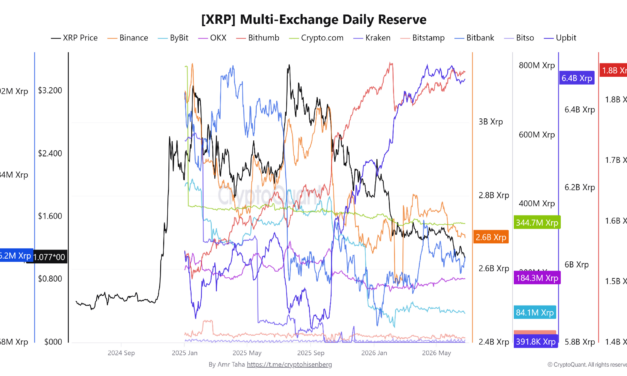
XRP is trading just above $1, leaving the token at its weakest price level of the year, but onchain data paints a different picture. The exchange-held XRP supply continues to fall, Binance withdrawals have exceeded deposits for seven straight days, whale flows are holding positive and spot XRP exchange-traded funds (ETFs) have attracted $243 million in inflows since April.The improving onchain data points to healthy network positioning, even as XRP continues to search for a price bottom.  XRP supply on exchanges continues to shrinkCrypto analyst Amr Taha noted that Binance’s XRP reserve has fallen to its lowest level since March after roughly 100 million XRP left the exchange over the past month. Binance’s balance stood at about 2.68 billion XRP on June 25, down from 2.78 billion XRP on May 12, accounting for the largest outflow among major trading platforms.XRP multi-exchange daily reserve. Source: CryptoQuantOther exchanges also posted smaller declines. Upbit’s reserve fell to 2.48 billion XRP on June 25 from 2.51 billion XRP on May 31, while Bybit’s holdings declined to 82 million XRP from 92 million XRP on June 2. Binance led in absolute outflows, while Bybit recorded the steepest percentage decline.Taha also highlighted a significant shift in Binance transaction activity. XRP withdrawal transactions have exceeded deposits for seven consecutive days since June 17. The seven-day withdrawal share climbed to 53.8% on June 23, its highest reading since June 2024, while deposits fell to 46.1%, the weakest level since 2024.XRP daily deposit/withdrawal transactions (%) on Binance. Source: CryptoQuantThe metric tracks transaction count rather than XRP volume. This indicates users are moving coins off Binance more frequently than sending them to the exchange, marking the longest withdrawal-led stretch in roughly a year.Large XRP holders supported the trend. XRP whale flow on the 90-day moving average has stayed positive throughout the quarter at 5.143 million XRP per day, showing consistent net accumulation by large wallets instead of distribution. XRP whale flows. Source: CryptoQuantInstitutional demand has also added support. Spot XRP ETFs recorded $2 million in net inflows on June 24, lifting June’s total netflows to $31 million. Since April, the total cumulative inflows have reached $243 million.Related: SBI to acquire Bitbank in $289M deal creating Japan’s biggest crypto exchangeXRP price approaches a major demand zoneFrom a technical standpoint, the higher-time-frame market structure remains bearish for the altcoin. XRP touched $1.01 on Thursday, its lowest price of 2026, leaving the token close to its first move below $1 since November 2024. The decline has pushed XRP down 43% year-to-date.XRP/USDT, one-week chart. Source: Cointelegraph/TradingViewThe next key area for XRP sits within the fair value gap between $1 and $0.63, an unfilled price gap created during the sharp rally in late 2024 that could attract buying interest if the decline extends in the coming weeks. Black Swan Capitalist founder Versan Aljarrah continues to focus on the longer-term chart. The analyst said XRP has spent years building a large accumulation range with higher lows on both weekly and monthly timeframes.XRP/USD, one-month chart analysis by Versan Aljarrah. Source: XAljarrah argued that extended consolidations often produce stronger breakout moves once the price eventually breaks out of the range, with the analyst targeting $10, i.e., a 900% increase from the current price. Related: HYPE down 22% from record highs: Will spot demand revive the uptrend?

Čítaj viac

HYPE down 22% from record highs: Will spot demand revive the uptrend?

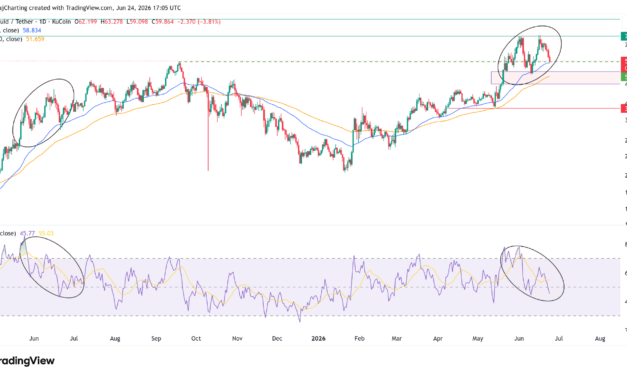
Hyperliquid’s HYPE token is down 22% from its $75 all-time high, bringing its 2026 uptrend to a key test of support. Market participation has cooled across the derivatives markets, while the spot flows show early signs of stabilization after strong selling pressure in early June. The $50-$54 area now stands out as the most important support zone beneath current prices and the first major trend test since January. Spot selling begins to ease for HYPEHYPE fell below $60 on Wednesday after rejecting another retest of its all-time high near $76. The decline has pushed the price toward the 50-day exponential moving average, a level that has acted as trend support throughout the rally from March.The recent pullback resembles HYPE’s consolidation in May 2025. At that time, the token printed a new high near $40 before entering a multi-week pause that cooled momentum without producing a bearish break on the daily chart. HYPE price comparison, July 2026 and May 2025. Source: Cointelegraph/TradingViewThe relative strength index is following a similar setup, rolling over from overbought conditions while remaining above the levels typically associated with trend reversals.However, onchain data paints a cautious picture. Aggregated spot cumulative volume delta (CVD), which measures net buying and selling activity in spot markets, has improved from recent lows during the correction. The recovery has reduced the earlier sell imbalance, though spot CVD remains deeply negative at nearly $95 million.HYPE price, open interest, spot and futures CVD, funding rate. Source: VeloThe shift suggests selling pressure is easing rather than aggressive accumulation. Spot buyers have started absorbing supply near current levels, though the scale of demand remains modest compared to $110 million in selling recorded during HYPE’s decline from $76 in early June. The derivatives activity continues to weaken. Open interest has fallen to $1.73 billion from $2.2 billion, while derivatives CVD has continued trending lower and now sits near negative $389 million, down from $400 million at the beginning of June. Currently, HYPE traders appear to be reducing exposure rather than opening new positions.Related: Solana grabs 95% of tokenized equity as traders debate if SOL bottom is in$50 support comes into focusThe next major test lies between $50 and $54, where the rising 50-day exponential moving average aligns with an unfilled daily fair-value gap. The zone represents the first significant support cluster below the current prices.Holding above the region preserves HYPE’s sequence of higher highs and lows, which has remained intact since January. It also keeps the current pullback consistent with previous consolidations that developed within the broader uptrend.HYPE/USDT, one-day chart. Source: Cointelegraph/TradingViewA daily close below $53 would mark the first meaningful bearish shift on the daily chart this year. The 100-day EMA near $51.6 becomes the next support level, followed by the lower boundary of the fair value gap near $49. Below that, the next notable support area sits near $38.For now, the most important signal is the gap between improving spot flows and declining participation across leveraged markets. The strength of demand around the $50-$54 support zone may offer the clearest indication of whether HYPE’s correction is nearing exhaustion or preparing for a deeper retracement.Speaking in terms of accumulation, crypto trader Altcoin Sherpa said, “HYPE, I think anywhere in the 55-64 area is a pretty good place to accumulate this one. I think it goes to $100 later this year personally and is still the best altcoin…but it’s going to also depend a lot on bitcoin IMO.Related: Bitcoin crash to $60K opens new $530M demand zone: Will bulls buy in?

Čítaj viac

Bitcoin nearly loses $59K as DXY surges: Are traders bracing for more pain?

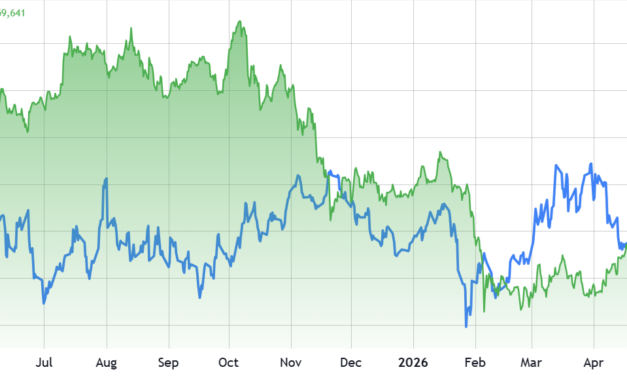
Key takeaways:Cooling oil prices and a multi-month high for the US dollar are keeping intense pressure on non yield-bearing assets.Spot Bitcoin ETF outflows paired with Strategy’s slowest buying pace in 18 months signal short-term downside risks.Bitcoin (BTC) traded down to $59,060 on Wednesday despite the sharp retreat in oil prices. Inflationary pressures eased following a memorandum of understanding between the US and Iran, which temporarily reopened the Strait of Hormuz. Bitcoin traders fear that the bounce back to $60,000 might not last long as the US dollar strengthened.US dollar strength index (left) vs. Bitcoin/USD (right). Source: TradingViewThe US dollar jumped to its highest level against a basket of foreign currencies in 13 months, indicating growing confidence in the US economy. Typically, this metric shows a negative correlation with Bitcoin’s price, as some investors view the cryptocurrency as a hedge against inflationary pressures traditionally driven by high oil prices.Gold (left) vs. Brent Crude oil, USD. Source: TradingViewGold prices fell below $4,000 for the first time in 7 months as Brent crude oil plummeted below $74, nearing levels seen prior to the conflict in Iran. Investors signaled lower demand for scarce assets despite moderate anxiety about tech-sector cash flows amid increased capital expenditure by AI hyperscalers.Bitcoin investment thesis weakened by reduced inflation perspectives and AI sector growthInflation will take time to cool down to the US Federal Reserve (Fed) target of 2%, leading traders to anticipate interest rates remaining higher for longer, which ultimately favors fixed-income investments. The latest US Labor Department unemployment benefit claims data fell by 4,000 from the prior week, further confirming that the economy is not slowing.US expanded Monetary Base (M2), USD. Source: Fed St LouisRegardless of investors’ risk assessments of the profitability of AI infrastructure investments, US government debt has been driving up liquidity over the past 3 years. Data released on Tuesday revealed that the US expanded Monetary Base (M2) increased to $23.05 trillion in May, up from $22.8 trillion the prior month.Related: Lyn Alden tips Bitcoin outperforming gold over next ‘two to three years’While there is no short-term correlation between the amount of money in circulation and Bitcoin’s price, investors will eventually seek gains elsewhere if higher demand for fixed income causes diminished yields. For now, the tech sector remains investors’ largest bet, weakening the case for alternative scarce assets such as Bitcoin.Micron (MU US), the computer memory and data storage manufacturer, reported strong quarterly earnings on Wednesday. Micron’s market capitalization has grown to $1.16 trillion, following a 265% gain over 6 months. More impressively, chipmakers SK Hynix and Samsung now account for 40% of the entire South Korean stock market, according to CNBC.Strategy (MSTR US) Bitcoin reserve changes, BTC. Source: StrategyThe slowdown in Strategy’s Bitcoin acquisition pace has likely contributed to the weaker market sentiment. The company, led by Michael Saylor, reported adding 520 BTC during the week ending June 21, marking its lowest weekly intake in 18 months. Moreover, $300 million of the net proceeds from MSTR’s stock issuance during the period were used to replenish its cash position.Bitcoin’s negative performance on Wednesday partly reflects macroeconomic conditions, with gold prices also affected. However, heavy net outflows from spot Bitcoin exchange-traded funds (ETFs) and disappointment that Strategy’s stock trades below its Bitcoin reserve acquisition cost have added significant pressure. Thus, further downside from the $59,000 level should not be ruled out.

Čítaj viac

Crypto-backed candidates notch wins in three US state primaries

Several Democrats and one Republican who were supported by more than $8 million worth of ads funded by cryptocurrency-aligned political action committees (PACs) won their respective US primaries on Tuesday, setting up their candidacies for the November election.Party primaries for US House of Representatives and Senate candidates in Utah, Maryland and New York resulted in wins for many aligned with crypto industry interests. PACs like Fairshake and its affiliates, largely backed by crypto companies Coinbase and Ripple Labs, spent a combined $8 million on media to support the candidates it considered likely in favor of digital asset policies for the next session of Congress.In New York, Democrat Ritchie Torres won a primary for the state’s 15th congressional district with 71.9% of the vote, while in Utah, Republican Blake Moore won in the 2nd district with 57.5% of the vote. Fairshake affiliate Protect Progress reported $5.5 million in expenditures to support Adrian Boafo, who won the Democratic primary for Maryland’s 5th district with 32% against other candidates who opposed “spending from crypto billionaires.” “We went big and we went early,” said Fairshake spokesperson Geoff Vetter. “We did our part to move Adrian Boafo from fifth place to the halls of Congress.”Source: The New York TimesFairshake, which reported having “$150 million cash on hand” in June after its spending in several US state primaries, may have already influenced voters in key elections in its attempts to send candidates to Congress it considers to be “pro-crypto.” Other PACs aligned with crypto interests that have reported spending on 2026 candidates included Fellowship, backed by Cantor Fitzgerald and Anchorage Digital, and the Blockchain Leadership Fund, a hybrid PAC backed by Anchorage and Chainlink Labs.Related: Trump cancels signing of housing bill with CBDC banNot every pro-crypto candidate emerged a winner on Tuesday. Alex Bores, a Democrat running in New York’s 12th District, lost to Micah Lasher. He criticized Bores in a June debate, saying that he potentially benefitted from Ripple Labs co-founder Chris Larsen spending $3.5 million to support his campaign.Next primaries in Colorado and Arizona, but no reports of spending yetMany expect Fairshake and other crypto-aligned PACs to turn their attention to candidates in Colorado and Arizona next. The two states are scheduled to hold primaries on June 30 and July 21, respectively, but Fairshake affiliates had not disclosed significant spending in any of the races as of Wednesday. In 2024, the PAC and its affiliates poured more than $10 million into media to support Ruben Gallego’s Senate race in Arizona and $2.1 million for Democratic Representative Yadira Caraveo in Colorado’s 8th district. Gallego won his race, while Caraveo lost in the November 2024 election to Republican Gabe Evans.Magazine: AI is banking the unbanked in Africa… faster than crypto

Čítaj viac

Bitcoin crash to $60K opens new $530M demand zone: Will bulls buy in?

Bitcoin (BTC) has fallen 3% over the past 24 hours, trading into a dense buy-side liquidity zone after slipping below $61,000. More than $525 million in buy bids initially stacked between $60,500 and $61,500 created a key area of demand as liquidation risk builds on both sides of the market.BTC’s orderbook data shows concentrated liquidity pockets below $60,500 and near $65,000, placing liquidity flows at the center of Bitcoin’s short-term price action.Bitcoin momentum weakens below $63,000Bitcoin closed at $62,700 on Tuesday, its lowest daily candle close since June 10. The move also produced a bearish engulfing candle against Monday’s range, erasing the prior day’s gains and signaling weaker short-term momentum.BTC/USDT, one-day chart. Source: Cointelegraph/TradingViewThe price has since consolidated beneath $63,000 after losing that level as support. The one-hour chart shows a series of lower highs following the rejection near $66,000 earlier this week. The momentum indicator, or relative strength index (RSI), has cooled from recent overbought levels, while Bitcoin continues to trade above the June range low near $60,500.BTC/USD, one-hour chart. Source: Cointelegraph/TradingViewCrypto trader Lennaert Snyder called for caution and expected BTC to test the lower liquidity before considering long exposure. The trader said, “Bitcoin started a little bounce, but I’m not convinced and not buying in yet,” Snyder wrote in a recent market update.The trader identified $61,500 and $60,500 as the primary levels to watch for bullish reactions. On the upside, he pointed to $63,500 and $64,000 as potential areas where liquidity could attract price before another move lower.Related: Multi-year Bitcoin holder selling falls to 19-month low as halving model flags new market bottom date$530 million in BTC buy bids sit below $61,000Data from Velo shows that BTC traders initially added 8,366 BTC to bid liquidity between $61,500 and $60,500. At the time of writing, Bitcoin has traded through a significant portion of that range, triggering roughly $270 million worth of buy orders as the price dipped below $61,000.The remaining bids remain near the lower end of the liquidity cluster, where traders are attempting to absorb the latest wave of selling pressure.BTC buy bids analysis. Source: Velo ChartThe move below $61,000 has already flushed a significant portion of the leveraged long positions clustered around $61,500. CoinGlass data shows more than $125 million in long liquidations over the past hour, reducing downside liquidation pressure near the current price.With much of the nearby long-side leverage cleared out, the liquidation map now shows a growing imbalance toward short positions positioned above spot price.Now, more than $1.2 billion in short positions sit near $63,500. A stabilization in the remaining bid liquidity around $60,500-$61,000 may shift attention toward those positions, especially as the downside liquidation pools become less concentrated following the latest flush.Bitcoin liquidation map. Source: CoinGlassThe next major concentration of liquidation risk sits near $65,000, where more than $2.4 billion in short positions are vulnerable. Such setups often trigger fast moves as liquidations fuel additional buying. For now, the largest liquidity concentrations remain near $60,500, where both spot demand and leveraged exposure remain heavily stacked.Related: BTC price four-year trend calls for $76K as analysis says Bitcoin ‘not broken’

Čítaj viac

DeFi TVL drops 39% in 2026 amid market downturn and record hack activity

Total value locked (TVL) in decentralized finance (DeFi) has fallen by about 39% in 2026 so far, declining to just over $70 billion from roughly $115 billion in January.A Wednesday report from crypto data aggregator CryptoRank attributed the decline to the broader market correction that followed the October 2025 crypto market peak.After Bitcoin reached a record high above $122,000, a market-wide liquidation event on Oct. 10, 2025, erased more than $19 billion in leveraged positions and accelerated a deleveraging cycle across digital assets.Despite the decline, CryptoRank noted that the current drawdown remains far smaller than during the 2021-2022 bear market, suggesting a more resilient DeFi market.DeFi TVL, 1-year chart, monthly. Source: CryptoRankFallout from Kelp DAO exploit accelerated the DeFi TVL decline: analystCryptoRank said security incidents added another layer of pressure on DeFi in 2026, with 121 hacks and roughly $942 million in losses year-to-date. While exploits were not the primary driver of the decline, the data provider said their frequency likely weighed on user confidence and reinforced capital outflows from DeFi.According to Nicolai Søndergaard, senior research analyst at crypto intelligence platform Nansen, the fallout from the $293 million Kelp DAO exploit on April 18 compressed into days what would otherwise have been weeks of DeFi outflows. Aave users withdrew about $15 billion in deposits in the four days following the exploit.Related: CryptoQuant warns on Strategy’s dividend coverage as cash reserve falls 38%The second quarter of 2026 became the most-hacked quarter on record by incident count, with 83 exploits targeting crypto protocols. However, the $755 million stolen during the quarter remained well below the $3.56 billion lost in the fourth quarter of 2020, the costliest quarter for crypto hacks on record.The falling total value stolen is not due to more robust industry security but a sign that hackers are expanding their attack surface, according to Dmytro Matviiv, CEO of crowdsourced security and bug bounty platform HackenProof. He told Cointelegraph that the lower aggregate losses are “misread as progress,” but only the leading protocols have become harder to exploit, forcing attackers to expand their attack surface.Alvin Kan, chief operating officer at Bitget Wallet, said that the cyber exploits are making users more cautious, but added that these may also result in capital leaving “weaker” DeFi protocols for those with “stronger venues and clearer yield models,” leading to more industry consolidation.Magazine: Bitcoin, the ‘canary in the coal mine,’ XRP transaction demand falls 91.5%: Market Moves

Čítaj viac

$170M Ether longs liquidated as crypto market tumbles: Is ETH doomed?

Key takeaways:Negative ETH futures funding rates and six weeks of spot ETF outflows highlight a fragile investment climate.Ethereum’s 53% market share in DeFi keeps it well-placed for a recovery, even as negative news continues to batter the network.Ether (ETH) price faced a 5% correction on Tuesday, erasing gains from the previous 12 days. The move triggered $170 million in liquidations of bullish leveraged ETH positions, putting traders on alert. Disconcerting news that the Ethereum Foundation was laying off 20% of its staff contrasts with optimism surrounding an upcoming network upgrade, but should ETH traders be worried?ETH perpetual futures annualized funding rate. Source: LaevitasDemand for bearish ETH positioning briefly surged on Tuesday as the perpetual futures annualized funding rate flipped into deeply negative territory, meaning shorts (sellers) paid to keep their positions open. The current 3% level signals a lack of confidence from bulls, but it should not come as a surprise given Ether’s recent weakness.ETH/USD (orange) vs Total crypto capitalization (blue). Source: TradingViewEther price declined by 20% over 30 days, slightly worse than the 17% drop in the broader cryptocurrency market capitalization. Part of the move ties to investors’ fear over ongoing peace negotiations between the US and Iran. Moreover, high costs of artificial intelligence build-out have led investors to act more cautiously.Ethereum leads DeFi even as activity slumpsThe overall weakness in the decentralized applications (DApps) industry has led multiple projects to shut down, while the aggregate total value locked (TVL) shrank by 23% in three months. Lower demand for blockchain data processing weakens the case for ETH investment, although the Ethereum network’s leadership in TVL and activity should not be understated.Blockchains ranked by Total Value Locked, USD. Source: DefiLlamaEthereum’s $38 billion decentralized finance (DeFi) TVL represents a 53% market share, signaling institutional investors’ preference. Additionally, when including its layer-2 scaling solutions, the Ethereum ecosystem accounts for 43% of decentralized exchange (DEX) volumes. However, Ethereum faces criticism for relatively low 30-day fees of $11 million.Despite controlled ETH issuance at 0.8% equivalent annual inflation, the staking reward rate was 2.7%, lower than the US money market yield. Adding to investors’ concerns, the publicly listed company BitMine (BMNR US) held $9.3 billion in unrealized losses on its ETH reserves. The company, led by its Chairman Tom Lee, continues to increase its position.Even though there is no imminent risk of BitMine being forced to reduce its ETH holdings, the situation likely deters institutional investors’ appetite. More concerningly, US-listed Ether spot exchange-traded funds (ETFs) posted net outflows for six consecutive weeks. Regardless of the rationale behind the move, the constant selling pressure undermined traders’ sentiment.Related: Morgan Stanley amends Ethereum, Solana ETFs to reveal record cheap feesUS-listed spot Ether ETFs weekly net flows, USD. Source: SoSoValueA total of $910 million has left the US-listed spot Ether ETFs since mid-May, reducing total net assets to $9.4 billion. The downturn in the cryptocurrency market coincided with the Ethereum Foundation’s (EF) organizational restructuring due to a 40% budget cut. The EF announced on Tuesday that 20% of its workforce was let go.Still, Ethereum’s development does not depend solely on EF’s work, and the upcoming Glamsterdam protocol upgrade is expected to reduce centralization by splitting block creation while improving security and execution efficiency through parallel transaction processing.At least in relative terms, ETH stands well-positioned to capture the eventual comeback in DApp demand, given the Ethereum network’s dominance in institutional investor activity.

Čítaj viac

Multi-year Bitcoin holder selling falls to 19-month low as halving model flags new market bottom date

Bitcoin (BTC) holders who acquired their coins more than five years ago have cut spending to a 90-day average of 962 BTC, the lowest level since November 2024, according to CryptoQuant data. The slowdown follows three major spending peaks over the past two years, including a high of 3,860 BTC in May 2024. At the same time, BTC analysts said that market and profitability indicators are converging in the second half of 2026, putting a new timeline of a potential Bitcoin bottom. Bitcoin “OG” holders step backCrypto analyst Darkfost said the current cycle has produced the highest level of spending by long-term Bitcoin holders on record. The cohort tracked in the dataset consists of investors who acquired Bitcoin more than five years ago. Using spent transaction outputs (STXO), which track Bitcoin that has moved across the network, the analyst identified three major spending waves following strong rallies.OG Bitcoin Holders selling pressure. Source: CryptoQuantThe 90-day moving average peaked at 3,860 BTC in May 2024, 3,200 BTC in February 2025 and 2,360 BTC in September 2025. Individual sessions were far larger, with some days recording output exceeding 10,000, 30,000 and even 142,000 BTC.That selling pressure has eased sharply. The 90-day average has dropped to 962 BTC, the lowest reading in 19 months. Darkfost said the most expensive coins held by this group were acquired for about $63,200, which is close to current prices. This indicates that many of these holders are choosing not to sell, even though their holdings are trading near their highest cost basis.Bitcoin Researcher Axel Adler Jr. further noted a split between newer and older BTC investors. The analyst said that Bitcoin’s adjusted net unrealized profit/loss (aNUPL) has fallen to -0.14 from near zero a month ago, showing that the average holder has moved back into unrealized losses as BTC traded near $62,500. However, Adler Jr argued, “STH capital has shrunk by -56%, while LTH capital has barely drawn down. Weak hands are capitulating. Strong hands have not even flinched.” Adler Jr. added that the key metric has spent nearly half of the past three months below zero, indicating sustained pressure on newer BTC market participants rather than a broad capitulation across long-term holders. STH vs LTH realized cap analysis. Source: Axel Adler Jr.Related: Bitcoin slump worsens amid SpaceX rout: Can BTC price hold $60K any longer?BTC halving cycle points to September bottom, says analystCrypto analyst LP highlighted a recurring pattern tied to Bitcoin’s halving cycles. The previous bear market entered a final capitulation phase 826 days after the halving event, followed by a major low and sideways consolidation for 70 to 110 days.For the current cycle, the 826-day marker falls on July 6. Applying the same timing range places a potential bottoming window in early September.BTC bottom analysis by LP. Source: XThe trader noted that the scenario becomes more relevant if Bitcoin continues to trade higher into early July. Likewise, BTC trader Titan also identified downside liquidity below the current levels. On the quarterly chart, Bitcoin has an untapped low near $58,900 and an open fair value gap between roughly $49,000 and $58,900. The trader explained that leaving the quarterly low untouched throughout September may draw more attention to that liquidity zone, eventually leading to a market bottom between Q3 and Q4. BTC quarterly analysis. Source: XRelated: Bitcoin gets new $54K warning as BTC price hits 11-day low on Asia tech sell-off

Čítaj viac

Bitcoin funding rate hits 2-week high: Is $70K next?

Key takeaways:The Bitcoin funding rate climbed to 7%, showing confidence, but spot ETF outflows keep a $70,000 breakout on hold for now.Strong order-book bids and lower oil prices helped, but weakness across stocks, bonds, and gold signals a preference for cash.Bitcoin (BTC) flirted with the $65,500 level on Monday after US Vice President JD Vance said that the Strait of Hormuz remains open amid “encouraging progress” on talks with the Iranian delegation in Switzerland. Bitcoin traders showed signs of optimism through growing demand for bullish leveraged positions, raising the question of whether $70,000 is next.Bitcoin perpetual futures annualized funding rate. Source: LaevitasThe Bitcoin perpetual futures annualized funding rate jumped to 7% on Monday, its highest level in nearly three weeks. Although still within the neutral 6%-12% range, the indicator reflects growing confidence among bulls. Part of the optimism likely stemmed from Brent crude oil prices declining to $77.50, their lowest level since March.Crude Brent oil, USD (left) vs. Nasdaq 100 futures (right). Source: TradingViewThe Nasdaq 100 Index posted a modest 1% decline as artificial intelligence stocks weakened. SpaceX (SPCX US) shares dropped 13% after the company announced plans to raise debt despite holding more than $100 billion in cash. Investors fear the sector will need higher investments for longer before turning profitable.Bitcoin options premium put-to-call ratio at Deribit, USD. Source: LaevitasDemand for put (sell) options outpaced call (buy) instruments by over two times on Monday, signaling stronger demand for downside price protection. The indicator has leaned toward bearish strategies since Friday, reversing the trend from the prior week. Strategy eases concerns, but stocks and bonds signal increased riskPart of traders’ concerns stemmed from weakness in Strategy’s (STRC US) valuation. Shares of Strategy traded 13% below the $64.1 billion cost to acquire BTC 847,363. Despite holding a comfortable $6.75 billion in debt, investors feared the company would need to sell reserves. Those concerns eased somewhat as Strategy announced a $300 billion additional cash position.Aggregated Bitcoin orderbook 1% liquidity delta, USD. Source: CoinGlassBids on major exchanges’ Bitcoin order books exceeded offers by $12 million on Monday, reversing the weekend trend. Consequently, Bitcoin’s failure to hold the $65,000 level should not signal weakness, especially since gold traded down 0.9% on Monday while investors sold US government bonds.Related: Bitcoin tipped for $66K top as trader flags ‘suspicious’ BTC price gainsGold/USD (left) vs. US 5-year Treasury yield (right). Source: TradingViewHigher yields on US Treasuries signal that investors demanded higher returns to hold those bonds, whether driven by inflation or by the anticipation of dilution from rising US government debt levels. The simultaneous weak performance across stocks, bonds, and gold points to a preference for cash positions, creating a cautious backdrop for Bitcoin.Weak demand for US-listed Bitcoin exchange-traded funds (ETFs) continues to weigh on investor sentiment after six weeks of outflows. Bitcoin spot ETFs saw $228 million in net outflows the prior week, according to CoinGlass data. Consequently, the odds of a short-term Bitcoin rally to $70,000 look limited.

Čítaj viac

Solana grabs 95% of tokenized equity as traders debate if SOL bottom is in

Solana (SOL) captured 95% of all tokenized equity trading activity across blockchains last week, setting a new record with $1.29 billion in trading volume. The surge comes as SOL trades more than 75% below its all-time high near $295, leaving SOL traders divided on whether the asset is nearing a cycle bottom. SOL onchain activity continues to expand across several metrics, even as a SOL price reversal remains the central focus for market traders.Tokenized equities on Solana hit record activityData shows Solana generated $21 million in weekly app revenue, ahead of Ethereum, Hyperliquid, and Base. Over the past month, Solana applications produced $82.84 million in revenue, compared with $67.43 million on Hyperliquid and roughly $51 million on Ethereum.App revenue generated by chains. Source: DefiLlamaSolana has also led the charge for tokenized equity trading on its chain. Independent reporting from Solana Floor noted that the network recorded its largest week on record for tokenized stock trading, with $1.29 billion in volume, accounting for 95% of activity across all chains.According to Solana Floor, last week’s volume exceeded the total for the entire previous month, driven largely by the release of SpaceX’s IPO token, SPCX. At the same time, the total value locked (TVL) on Solana stands near $5.7 billion. TVL measures the value of assets deposited across decentralized finance applications and serves as a gauge of onchain capital participation.Solana’s TVL chart. Source: DefiLlamaThat figure sits well below Solana’s all-time high TVL of roughly $13 billion from September 2025, showing that capital committed to DeFi applications has not returned to peak-cycle levels despite strong transaction activity and revenue generation.Related: These XRP price charts hint at potential 25% relief rally in JulySOL traders remain split on accumulation timingMarket analysts and traders remain divided on whether SOL has already entered a durable bottoming phase.Crypto trader Ardi said Solana is approaching the area that attracts the trader’s attention for the next bull cycle. Ardi noted that SOL has already fallen about 77% to $60, from its cycle peak near $295. Drawing on historical drawdown compression seen in Bitcoin and Ether, Ardi said an 80%–85% decline would place SOL in the $45-$60 range, the most attractive accumulation zone.SOL/USD, one-week analysis by Ardi. Source: XCrypto trader Bluntz took a more constructive view, arguing that the price forming a weekly bullish divergence with respect to the relative strength index (RSI) following an 80% drawdown often appears near the market lows. The trader implied that SOL could trend higher sooner rather than later based on this setup. Meanwhile, crypto trader Dyme urged caution, noting that Solana spent roughly 500 days from May 2022 to October 2023, building a base before its last major recovery. The comparison suggests that SOL may require a longer period of sideways trading before a durable bottom forms. SOL/USD, one-week chart analysis by Dyme. Source: XTrading Stable founder Ryan Clark also questioned the recent optimism, noting that SOL continues to trade below the key weekly 50-period and 200-period simple moving averages. The analyst, popularly known as HORSE, said that a move back above the $90 region would provide a stronger technical signal. For now, the debate centers on whether demand SOL can build higher before the price reaches the $45-$60. Related: Altcoin selling tops $266B as capital rotates out of crypto: Is altseason extinct?

Čítaj viac

Andrew Cuomo to lead joint TradFi-crypto venture between OKX and Intercontinental Exchange

Cryptocurrency exchange OKX and the Intercontinental Exchange (ICE), parent company of the New York Stock Exchange, announced that former New York Governor Andrew Cuomo would co-lead a joint venture focused on digital assets.In a Monday notice, OKX and ICE said Cuomo, who lost his bid to be New York City’s mayor in 2025, would co-chair the joint project between the two companies “focused on building next-generation infrastructure for tokenized and digitally native financial products.” The venture, which the companies said would allow OKX users to “access ICE futures and NYSE tokenized equities markets,” is subject to regulatory approval. Cuomo has largely been out of the public eye since his failed 2025 mayoral run, in which he said he intended to make New York City the “global capital for cryptocurrency.” He had the endorsement of the crypto-aligned Innovate NY political action committee (PAC), but lost to Democratic candidate Zohran Mamdani, who secured more than 50% of the vote. The former governor began working with OKX in 2023.The joint venture notice followed a partnership between ICE and OKX announced in March in which the former invested an undisclosed amount in the exchange at a $25 billion valuation. ICE’s ventures into the crypto industry also included a $2 billion investment pledge into prediction markets platform Polymarket.Related: NYSE owner ICE to launch oil-linked futures with OKXSince taking office on Jan. 1, Mamdani has not announced any significant policies related to crypto or blockchain. He confirmed in January that he holds no digital assets as New York City mayor.New York to hold party primaries on TuesdayOn Tuesday, New York, Utah and Maryland will hold primaries to determine candidates for US House of Representatives and Senate seats in the November general election. Cryptocurrency-aligned PACs, including Fairshake, have poured money into advertising and other campaign efforts to support candidates they view as favorable to the digital asset industry.Magazine: Bitcoin decouples from tech stocks, Ether eyes ‘selling wave’: Market MovesCointelegraph is committed to independent, transparent journalism. This news article is produced in accordance with Cointelegraph’s Editorial Policy and aims to provide accurate and timely information. Readers are encouraged to verify information independently.

Čítaj viac
Načítava

Získaj BONUS 8 € v Bitcoinoch

nakup bitcoin z karty

Registrácia Binance

Burza Binance

Aktuálne kurzy