Značka: Bitcoin Price

Bitcoin ETFs post June's biggest daily outflows as BTC falls below $60K

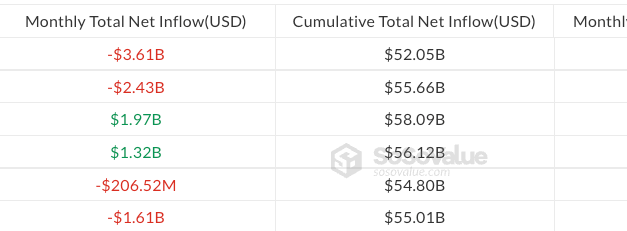
US-listed spot Bitcoin exchange-traded funds (ETFs) recorded their largest daily net outflows of June on Thursday as Bitcoin fell below $60,000.Spot Bitcoin ETFs shed $696.3 million, surpassing the previous monthly high of $519.2 million logged on June 2, according to SoSoValue data.The latest withdrawals pushed June’s total outflows to $3.61 billion, bringing year-to-date net outflows to $4.6 billion.Monthly flows in US spot Bitcoin ETFs as of Friday. Source: SoSoValue The ETF outflows coincide with signs that other large sources of institutional Bitcoin demand are also slowing. Strategy, the world’s largest corporate Bitcoin holder, has reduced its accumulation pace in June, prompting debate over whether the company should conserve cash during the market downturn.ETF assets down 57% from 2025 peakUS-listed spot Bitcoin ETFs have seen total net assets fall below $73 billion for the first time since late 2024, as recent outflows and a roughly 50% drop in Bitcoin’s price from its October peak weigh on the sector.According to SoSoValue, total net assets in US spot Bitcoin ETFs reached a record $169.5 billion in October 2025. As of Friday, that figure stood at about $72.6 billion, a decline of roughly 57%.BTC holdings for US spot Bitcoin ETFs as of market close on Tuesday. Source: Wallet PilotSeparate data from WalletPilot shows the funds held a combined 1.24 million BTC as of Tuesday, with about 63,500 BTC leaving the products over the past 30 days.Strategy slows Bitcoin buying in June to about 3,600 BTC amid criticismSome analysts argue that Strategy should pause BTC purchases and rebuild its cash reserves.Saylor’s Strategy bought roughly 3,600 Bitcoin so far in June, down from about 25,000 BTC in May and more than 50,000 BTC in April, according to company filings.The slowdown also included a net sale of 32 BTC earlier in the month, one of the few times the company has sold Bitcoin during its accumulation period.Related: Strategy adds $300M to USD Reserve, acquires 520 BTCStrategy’s perpetual preferred stock, STRC, has come under pressure, trading below its intended $100 level. STRC closed at $75.69 on Thursday, down 6.37%.Source: Julio MorenoThe move has fueled debate over Strategy’s Bitcoin-buying model. CryptoQuant analysts have raised concerns about the company’s timing and risk management.On the other hand, Bitcoin advocate Samson Mow said STRC has a “self-repairing mechanism” that activates when it trades below its $100 benchmark. He noted that the company pauses new share issuance through its ATM program at that level, which limits new supply.Magazine: Bitcoin slides to $58K, XRP hits $1 but onchain data promising: Market Moves

Čítaj viac
Bitcoin bounces off new 2026 price lows: Will US stock weakness push BTC lower?

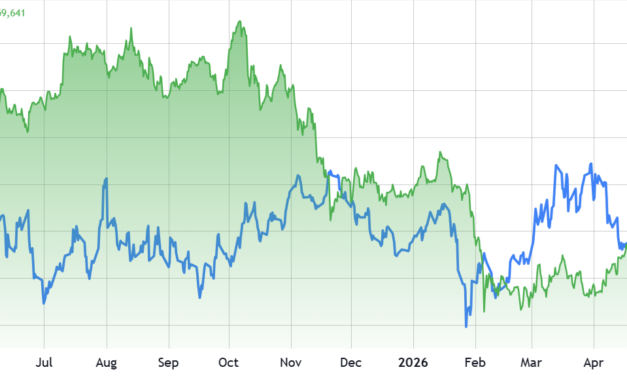
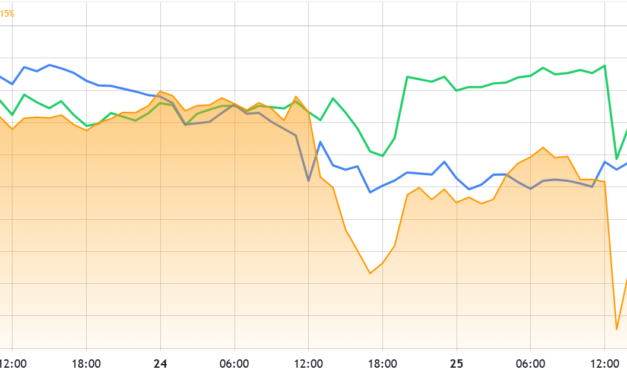
Key takeaways:Surging spot Bitcoin ETF outflows and a put-heavy options expiry point to fading institutional demand.Risk-reward shifts toward tech stocks, leaving crypto traders to seek catalysts beyond macroeconomic tailwinds.Bitcoin (BTC) traded down 9% in three days, hitting its lowest level since September 2024. The $58,000 retest triggered over $1 billion in liquidations across bullish BTC leveraged positions. Despite a modest recovery to $59,500, Bitcoin traders remain uneasy as the S&P 500 index and gold prices fully erased their intraday losses.Bitcoin/USD (orange) vs. gold/USD & Nasdaq 100 futures (green). Source: TradingViewThe market downturn on Thursday lined up with the release of the US Personal Consumption Expenditures index, which showed a 4.1% increase in May from the prior year. Yet as Crude Brent oil prices pulled back to $75 from $95 just one month earlier, investors grew more confident that inflation had peaked. As a result, the cash freed up by lower energy costs is boosting the stock market.Shares of Micron, Sandisk, Applied Materials. Source: TradingViewThe tech sector kept delivering strong surprises, with Micron Technology (MU) jumping 16% after solid quarterly earnings and Sandisk (SNDK) riding along with an 18% gain. Applied Materials (AMAT) rose 10% thanks to its new chipmaking tools. Investors’ renewed faith in the sector also mirrors the US government administration’s recent emphasis.Fixed income offers a more compelling hedge alternativeEven if Bitcoin does not directly compete with the artificial intelligence sector, traders’ risk-reward views have likely tilted toward stocks. This shift followed the US government taking a 9.9% stake in Intel, proposing $2 billion for quantum computing firms, opening federal lands for data center projects, and setting a framework for “frontier models” releases.Investors worried about inflated AI valuations after Elon Musk’s SpaceX (SPCX) shares fell 32% from their peak can find comfort in 5-year US Treasuries yielding 4.15%. Demand for non-yielding assets like Bitcoin faded as traders now see an 80% chance of US interest rate hikes by December, up from 68% a month ago, according to the CME FedWatch Tool.US-listed spot Bitcoin ETFs daily net flows, USD. Source: SoSoValueBitcoin’s appeal also took a hit from the massive $469 million net outflows in spot BTC exchange-traded funds (ETFs) on Wednesday. The metric serves as a key proxy for institutional demand. Sentiment worsened further as Strategy (MSTR) now sits on a huge unrealized loss after buying $64.1 billion worth of Bitcoin since 2020.Related: 21shares trims 2026 crypto forecasts despite institutional adoption gainsStrategy (MSTR) Bitcoin reserves and cash position, USD. Source: StrategyThe upcoming $13 billion Bitcoin options expiry on Friday heavily favors put (sell) instruments. Most neutral-to-bullish strategies will likely expire worthless, since 78% of call (buy) options are priced at $72,000 or above. Put options open interest on Deribit will exceed call options by $3.4 billion.Bitcoin’s price momentum shows little tie to stocks due to heavy ETF outflows, a bearish options expiry skew and Strategy’s mounting unrealized losses. Bitcoin traders must now hunt for unique catalysts beyond equity market tailwinds to spark a turnaround.

Čítaj viac

Bitcoin options traders hedge downside as uncertainty lingers, Anchorage says

Bitcoin options traders remain heavily positioned for downside protection, with both crypto-native and exchange-traded fund investors showing elevated demand for downside hedges, according to new research by Anchorage Digital’s head of research, David Lawant.The report analyzed options activity across Deribit, BlackRock’s iShares Bitcoin Trust (IBIT) and Strategy (MSTR), saying the three markets together provide a broader view of crypto-native, institutional and retail investor sentiment than any single options market alone. Both Deribit and IBIT options markets showed elevated put skew, indicating traders are paying a premium for downside protection rather than positioning for further gains. The report found defensive positioning ranked in the 82nd percentile of IBIT’s history and the 84th percentile of Deribit’s five-year history.Anchorage also found that Bitcoin (BTC) options markets have spent nearly half of 2026 pricing higher implied volatility over the next week than over the next month, an unusual inversion that has historically been episodic and short-lived. The report attributed the pattern to a succession of macroeconomic, geopolitical and crypto-specific catalysts that have kept traders focused on near-term risks.Bitcoin options 30-day/7-day implied volatility ratio. Source: Anchorage Digital reportTaken together, the findings suggest options traders remain focused on managing near-term risks rather than positioning for a clear directional move. Lawant said he is watching for one-month implied volatility to once again exceed one-week implied volatility, a shift he said would indicate markets are becoming more comfortable looking beyond immediate risks.Related: Bitcoin price is down over 40% since STRC launched: Is Strategy ‘fine’?Options market not signaling Strategy crisisThe analysis from Anchorage Digital also suggests investors remain cautious but are not pricing a severe downside scenario for Strategy despite recent weakness in the company’s preferred and common shares.Strategy’s perpetual preferred stock, STRC, fell as low as $82.53 on June 22, or about 17% below its $100 par value, before partially recovering after the company disclosed it had increased its fiat reserves to $1.3 billion. As of Thursday, it was trading around $77, roughly 23% below par.The weakness has extended beyond STRC. Strategy’s common shares (MSTR) were down about 78% over the past year and traded around $87 on Thursday, according to Yahoo Finance data.Strategy stock. Source: Yahoo Finance Despite the sell-off, Anchorage found that Strategy’s options market remains well below stress levels seen during previous market corrections. While traders continue to hedge against downside risk, put skew has not reached levels typically associated with fears of forced deleveraging or a broader crisis, according to the report.Strategy, led by Executive Chairman Michael Saylor, pioneered the corporate Bitcoin treasury model in 2020 and remains the world’s largest corporate holder of Bitcoin, with 847,363 BTC on its balance sheet.30-day risk reversals in Strategy (MSTR) options markets. Source: Anchorage Digital reportMagazine: Bitcoin decouples from tech stocks, Ether eyes ‘selling wave’: Market Moves

Čítaj viac

Bitcoin may fall lower but BTC power-law frames crash to $58K as ‘normal’

Bitcoin’s (BTC) drop to $58,000 has pushed the price into a zone that long-term power-law models have historically associated with cycle bottoms. The data does not confirm a bottom range, though it shows BTC trading in a price range that has repeatedly marked major lows since 2014. Derivatives data and liquidation levels highlight $55,000 as the next key support level and the $65,000-$68,000 range as the next major upside area of interest. Bitcoin power-law puts $58,000 in historical rangeGiovanni’s Bitcoin power-law model places the network’s long-term trend price near $135,000, making the recent drop to $58,000 roughly 54% below the all-time high and 1.22 standard deviations beneath that trend.According to the analyst, the key takeaway is straightforward: the previous cycle lows in 2012, 2015, 2019, 2020, and 2022 all fell within a similar statistical range. By that measure, the latest decline falls within a territory that has historically marked the deep bear-market lows rather than a break in Bitcoin’s long-term growth path.Bitcoin price deviation based on the power-law trend. Source: XThe model estimates the commonly referenced “-1σ” support near $68,000, while the stronger historical floor sits closer to $55,000. Giovanni also noted that Bitcoin would need to trade below roughly $17,000 for more than a year before the power-law itself could be considered invalid.A second metric points in the same direction. Bitcoin’s power-law quantile has fallen to 6.2%, indicating the asset is cheaper than roughly 94% of its historical observations when measured against the power-law model. The chart highlights similar readings during the 2015, 2020, and 2023 cycle lows, with the current market now revisiting that historically rare valuation zone.Bitcoin power-law quantile regression chart. Source: CheckonchainRelated: Bitcoin drops to $58K on high US PCE inflation as trader sees ‘manipulation’Key BTC price levels to watchBitcoin fell to a new yearly low of $58,000 after aggressive selling swept through Binance. The hourly taker sell volume reached $2.1 billion, followed by another $1.9 billion in the next hour after the New York market open, marking the exchange’s largest hourly sell pressure since May 4.Bitcoin taker sell volume on Binance. Source: CryptoQuantThe flush liquidated more than $300 million in long BTC positions before the price rebounded toward $60,000. That level now carries added significance. A daily close back above $60,000 preserves the developing relative-strength index (RSI) bullish divergence across the one-hour, four-hour, and daily time frames which signals that selling momentum is fading even as the price prints lower lows.BTC/USDT, one-day chart. Source: Cointelegraph/TradingViewFutures trader Byzantine General shared a similar outlook, saying the move to $58,000 cleared out leveraged longs while drawing in fresh short sellers. In his view, a daily close above $60,000 would strengthen the case that Bitcoin has printed a local bottom for now. That would also shift attention toward a large pocket of upside liquidity. More than $4 billion in short liquidations cluster near $65,000, compared with about $1 billion below $55,000, creating a four-to-one imbalance. A relief rally could then target internal liquidity near $68,000, where a daily fair-value gap adds another area of interest for traders. BTC liquidation map. Source: CoinGlassMeanwhile, a daily close below $60,000 reinforces the bearish bias on both the short-term and long-term charts. The next area of interest then shifts to $55,000, where Bitcoin’s September 2024 weekly range low converges with its realized price near $54,000. The realized price, which tracks the average cost basis of all onchain coins, has historically provided support at every major Bitcoin bear-market bottom since 2014. That trend makes the $54,000-$55,000 region a key level for traders to watch if selling pressure continues. Bitcoin’s realized price. Source: XRelated: Bitcoin drop to $58K brings out bears: Is BTC’s next stop below $50K?

Čítaj viac

21shares trims 2026 crypto forecasts despite institutional adoption gains

Asset manager 21shares has scaled back several of its bullish forecasts for the crypto industry this year, saying institutional adoption continues to strengthen even as weak market conditions and muted retail participation have slowed the pace of growth.In its midyear outlook, the asset manager said the industry’s underlying infrastructure has advanced more quickly than prices. Areas such as exchange-traded funds (ETFs), stablecoin regulation, tokenization and prediction markets have continued to mature, but weaker crypto prices, major DeFi exploits and slower-than-expected enterprise adoption have pushed several of its 2026 targets out of reach.One of the report’s clearest conclusions was that Bitcoin’s (BTC) four-year market cycle remains intact, despite signs the asset class is becoming more institutionally driven.“After peaking at around $126,000 in October 2025, Bitcoin pulled back sharply and has continued to trade in line with prior post-halving patterns,” the analysts wrote, arguing that institutional ownership has softened market drawdowns but has not fundamentally altered Bitcoin’s cyclical behavior.Bitcoin’s predictable four-year cycle continues to be a major driver of market conditions. Source: 21sharesFormer 21shares co-founder Ophelia Snyder, who departed the company following its acquisition by FalconX in 2025, recently made a similar observation about how institutional investors have reshaped crypto markets.“The investor base is larger, more institutional, and more connected to the broader financial system,” Snyder wrote in a recent Substack post. “As a result, competing narratives, geopolitical developments, and macroeconomic shifts all have a much larger impact on crypto pricing than they once did.”Prediction markets expected to outperformAmong the sectors outperforming expectations, 21shares singled out prediction markets as one of crypto’s strongest growth areas, projecting annual trading volume will surpass $100 billion this year.The report also highlighted consolidation as a defining trend across the industry. Public companies holding crypto on their balance sheets are beginning to diverge, with many smaller treasury players trading below the value of their digital asset holdings, pointing to further consolidation in the sector.A similar pattern is emerging across Ethereum’s layer-2 ecosystem, where a handful of dominant rollups continue to gain market share while dozens of smaller networks struggle to attract meaningful users and liquidity.Related: Bitcoin miners need billions to fund AI ambitions, led by IREN’s $21B gapCrypto ETFs show resilience despite outflowsThat resilience is also evident in crypto exchange-traded products, which have continued attracting long-term institutional investors despite weaker market conditions.While US spot Bitcoin ETFs have recorded roughly $3 billion in net outflows this year, 21shares said those figures don’t tell the full story. Holdings remain just above 1.25 million BTC, near an all-time high in for the token, suggesting many investors have held onto their positions through the downturn.“Investors are holding through volatility or quietly building strategic positions, even with Bitcoin trading well below its highs,” the analysts wrote.Crypto ETP assets have fallen from their peak, but cumulative investor inflows have remained resilient. Source: 21sharesThe analysts also pointed to improving regulatory clarity in the United States, citing the Securities and Exchange Commission’s generic listing standards that have helped convert a backlog of crypto ETF applications into a steady stream of new product launches beyond Bitcoin and Ether.“Hyperliquid stands out,” the analysts wrote. “US spot ETFs tracking the asset attracted over $150 million in net inflows in under a month, evidence that traditional capital continues to flow toward digital assets.”Related: CBOE weighs converting BTC, ETH continuous futures into perpetual futures: Report

Čítaj viac

Bitcoin drops to $58K on high US PCE inflation as trader sees 'manipulation'

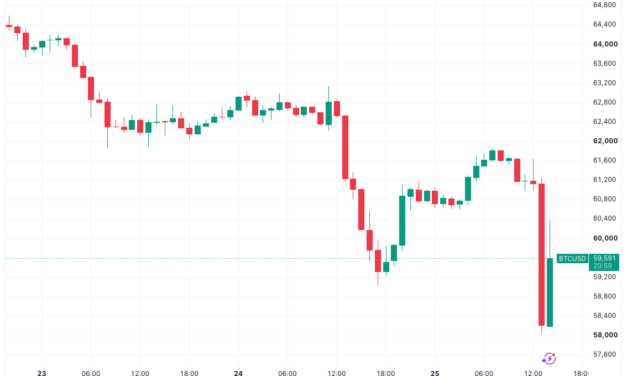
Bitcoin (BTC) hit new 21-month lows at Thursday’s Wall Street open as high US inflation unsettled stock markets.Key points:Bitcoin returns to its lowest level since September 2024, dropping to $58,000.US PCE inflation rocks equities, with the Nasdaq 100 shedding 2% in just 30 minutes.BTC’s correction mirrors the price action seen throughout the 2022 bear market.Crypto liquidations pass $600 million in an hour as BTC price dropsData from TradingView showed BTC/USD dropping to $58,035 on Bitstamp — a level it last traded at in September 2024.BTC/USD one-hour chart. Source: Cointelegraph/TradingViewThe May print of the US Personal Consumption Expenditures (PCE) index came in at 4.1%, setting a new three-year record.“From the preceding month, the PCE price index for May increased 0.4 percent. Excluding food and energy, the PCE price index increased 0.3 percent,” a data release from the Bureau of Economic Analysis (BEA) stated. “From the same month one year ago, the PCE price index for May increased 4.1 percent. Excluding food and energy, the PCE price index increased 3.4 percent from one year ago.”US PCE one-month % change (screenshot). Source: BEAStocks reacted with volatility, with the Nasdaq Composite Index down 0.5% at the time of writing, while the S&P 500 managed to eke out a gain.The Nasdaq 100, meanwhile, saw a larger snap decline of 2% in just 30 minutes at the open.“What a chart,” trading resource The Kobeissi Letter responded on X.Bitcoin itself sparked considerable long position liquidations, with CoinGlass putting the cross-crypto liquidation total at $600 million over a single hour.Crypto liquidation history (screenshot). Source: CoinGlassCommenting, market participants suggested that price moves were being artificially managed to squeeze positions.“$BTC is in the manipulation phase,” pseudonymous trader Killa told X followers. “Every time $BTC trades sub-$60K, that is our manipulation beneath the significant $60K swing low on the weekly and quarterly. Precisely the reason why the orderbook is stacked below us.”Source: Killa/XNiels Klaver, cofounder of crypto platform STABL Agency, suggested that BTC/USD “seems to be going for its final leg down of this bear market.” “$55K remains the target,” he added, referring to an increasingly popular short-term price goal.BTC/USDT one-week chart. Source: Niels Klaver/XBitcoin analysis sees new resistance near $65,000As BTC price action attempted a modest rebound, trader and analyst Rekt Capital had already described $60,000 support as “clearly weakening.”Related: BTC price four-year trend calls for $76K as analysis says Bitcoin ‘not broken’“Once June Monthly Closes, we’ll know from which price July will be able to potentially spring into a post-breakdown relief rally,” an X post read.BTC/USD one-month chart. Source: Rekt Capital/XRekt Capital maintained that the market was acting similarly to 2022, with the 50-month exponential moving average (EMA) tipped to become new resistance next.BTC/USD one-month chart. with 50EMA. Source: Cointelegraph/TradingView

Čítaj viac

Bitcoin nearly loses $59K as DXY surges: Are traders bracing for more pain?

Key takeaways:Cooling oil prices and a multi-month high for the US dollar are keeping intense pressure on non yield-bearing assets.Spot Bitcoin ETF outflows paired with Strategy’s slowest buying pace in 18 months signal short-term downside risks.Bitcoin (BTC) traded down to $59,060 on Wednesday despite the sharp retreat in oil prices. Inflationary pressures eased following a memorandum of understanding between the US and Iran, which temporarily reopened the Strait of Hormuz. Bitcoin traders fear that the bounce back to $60,000 might not last long as the US dollar strengthened.US dollar strength index (left) vs. Bitcoin/USD (right). Source: TradingViewThe US dollar jumped to its highest level against a basket of foreign currencies in 13 months, indicating growing confidence in the US economy. Typically, this metric shows a negative correlation with Bitcoin’s price, as some investors view the cryptocurrency as a hedge against inflationary pressures traditionally driven by high oil prices.Gold (left) vs. Brent Crude oil, USD. Source: TradingViewGold prices fell below $4,000 for the first time in 7 months as Brent crude oil plummeted below $74, nearing levels seen prior to the conflict in Iran. Investors signaled lower demand for scarce assets despite moderate anxiety about tech-sector cash flows amid increased capital expenditure by AI hyperscalers.Bitcoin investment thesis weakened by reduced inflation perspectives and AI sector growthInflation will take time to cool down to the US Federal Reserve (Fed) target of 2%, leading traders to anticipate interest rates remaining higher for longer, which ultimately favors fixed-income investments. The latest US Labor Department unemployment benefit claims data fell by 4,000 from the prior week, further confirming that the economy is not slowing.US expanded Monetary Base (M2), USD. Source: Fed St LouisRegardless of investors’ risk assessments of the profitability of AI infrastructure investments, US government debt has been driving up liquidity over the past 3 years. Data released on Tuesday revealed that the US expanded Monetary Base (M2) increased to $23.05 trillion in May, up from $22.8 trillion the prior month.Related: Lyn Alden tips Bitcoin outperforming gold over next ‘two to three years’While there is no short-term correlation between the amount of money in circulation and Bitcoin’s price, investors will eventually seek gains elsewhere if higher demand for fixed income causes diminished yields. For now, the tech sector remains investors’ largest bet, weakening the case for alternative scarce assets such as Bitcoin.Micron (MU US), the computer memory and data storage manufacturer, reported strong quarterly earnings on Wednesday. Micron’s market capitalization has grown to $1.16 trillion, following a 265% gain over 6 months. More impressively, chipmakers SK Hynix and Samsung now account for 40% of the entire South Korean stock market, according to CNBC.Strategy (MSTR US) Bitcoin reserve changes, BTC. Source: StrategyThe slowdown in Strategy’s Bitcoin acquisition pace has likely contributed to the weaker market sentiment. The company, led by Michael Saylor, reported adding 520 BTC during the week ending June 21, marking its lowest weekly intake in 18 months. Moreover, $300 million of the net proceeds from MSTR’s stock issuance during the period were used to replenish its cash position.Bitcoin’s negative performance on Wednesday partly reflects macroeconomic conditions, with gold prices also affected. However, heavy net outflows from spot Bitcoin exchange-traded funds (ETFs) and disappointment that Strategy’s stock trades below its Bitcoin reserve acquisition cost have added significant pressure. Thus, further downside from the $59,000 level should not be ruled out.

Čítaj viac

Bitcoin falls under $60K, but traders anticipate 15% bounce

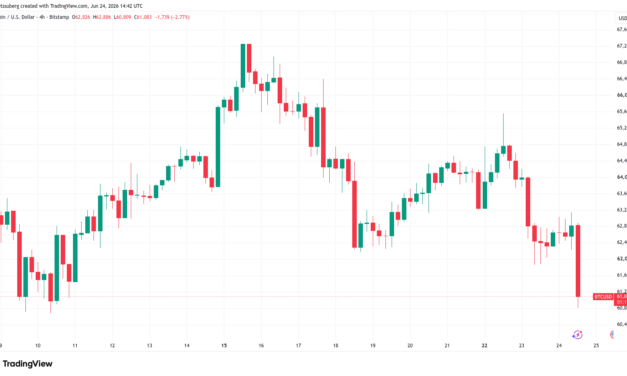
Bitcoin (BTC) hit new two-week lows at Wednesday’s Wall Street open as traders predicted a rally to a “poor” lower high.Key points:Bitcoin price action edges closer to range lows, which traders still see holding.A relief bounce should enter soon, they say, with targets closer to $70,000.US-Iran peace progress has little bullish impact on risk assets, with US stocks flat at the open.BTC price nears range lows: Is $70,000 next?Data from TradingView showed BTC price action dropping below $60,000 for the first time since June 10.BTC/USD four-hour chart. Source: Cointelegraph/TradingViewTraders had warned of increasing short interest with rising funding rates, boosting the odds of a capitulatory move lower.“It’s time to start bouncing soon on the LTF,” trader Killa wrote in ongoing commentary on X, referring to low time frames. “Range bound till proven otherwise.”BTC/USD chart segment. Source: Killa/XKilla uploaded a further chart showing a relief bounce toward $70,000, being due following the bounce.BTC/USD chart segment. Source: Killa/XFellow trader RektProof had a broadly similar forecast, seeing BTC/USD trading in a range with $60,000 as its floor “for the rest of the month.”“Overall, a move to supply and back down to the EQ lows before forming back to poor highs + 70k,” he added.BTC/USDT one-hour chart. Source: RektProof/XStocks tread water as Hormuz oil transit progressesOn a macro level, US stocks appeared to have already priced in relief from the US-Iran peace deal.Related: BTC price four-year trend calls for $76K as analysis says Bitcoin ‘not broken’Upside was limited at the open despite US President Donald Trump offering further details of mutual cooperation between the two sides.Trump specifically made reference to the Strait of Hormuz oil transit route, writing in a post on Truth Social that there would be “no tolls, no insurance costs, & no other charges of any kind being sought or received by Iran on ships traveling” via the route.Source: Truth SocialThe S&P 500 traded up 0.4% at the time of writing, while the Nasdaq Composite Index even turned slightly negative on the day.Earlier, Cointelegraph reported on several factors keeping risk-asset enthusiasm in check, including forward earnings guidance by tech giant Micron Technologies and the May print of the Personal Consumption Expenditures (PCE) index, due out on Wednesday and Thursday, respectively.

Čítaj viac

CryptoQuant warns on Strategy's dividend coverage as cash reserve falls 38%

After Strategy’s dividend coverage fell to 14 months from seven years, CryptoQuant said the company led by Michael Saylor should pause Bitcoin purchases and focus on replenishing its cash reserve that’s down 38% year-to-date.Strategy’s dividend obligations have nearly quadrupled to $1.2 billion, as the company issued substantial new STRC preferred stock, which carries an 11.5% yield. “They should pause Bitcoin purchases, rebuild cash reserves, and adopt a systematic framework for purchase timing,” wrote the market data analytics provider’s CEO Ki Young Ju in a Wednesday X post, adding that the biggest public Bitcoin treasury holder should also create a “disciplined selling framework” for the next bull market.Strategy’s cash reserve fell 38% after the company repurchased $1.5 billion of its 2029 senior notes at a discount, Cointelegraph reported on May 26. Those coffers have since recovered to $1.4 billion after it sold $335.5 million in MSTR shares, which added $300 million to its US dollar reserve on Monday, although it is near a record-low of 14 months’ of funds available to pay dividends. STRC preferred shares hit by BTC correction Strategy’s income-generating preferred stock, STRC, fell to $82.50 last week, a record 17.5% below its $100 par value. CryptoQuant’s report attributed it to the Bitcoin bear market correction and the “simultaneous depletion” of its cash reserve.STRC is one of Strategy’s main mechanisms to fund its Bitcoin accumulation. Trading below par limits Strategy’s ability to raise funds through STRC sales. It may also force the company to increase its nominal dividend rate to attract buyers and protect STRC’s price.The company said it plans to “continue replenishing” its USD reserve to “support the credit quality of its Digital Credit securities,” according to a Monday X post. Cointelegraph’s request for comment on Strategy’s plans to replenish the cash reserve and whether this could help STRC’s price recover was not immediately replied to by the company.Strategy cash reserve and dividend coverage in months. Source: CryptoQuantNo obligation to sell Bitcoin to support STRC priceCryptoQuant said Strategy is not “obligated” to sell Bitcoin to maintain STRC’s price, as the company can also deploy other tools to defend the stock, such as raising the current 11.5% dividend yield or issuing MSTR stock to “signal its ability to continue paying dividends,” adding:“However, the path back to $100 is not straightforward.[…] Rebuilding the cash reserve to ~$2.8 billion (24 months of coverage) is a necessary condition for STRC to recover.” Strategy’s Bitcoin holdings only provide a “limited emergency cushion,” as the company is sitting on about $10.6 billion in unrealized losses, meaning that a forced BTC sale at current rates would “crystallize large losses and destroy shareholder value,” CryptoQuant said. Related: Capital B shareholders approve up to $120B in financing capacity for Bitcoin strategyAhead of Wednesday’s Nasdaq market open, STRC shares were little changed after closing at $87.31 on Tuesday. That extended the preferred stock’s 12% decline in the past month, according to Yahoo Finance data.STRC/USD, 1-month chart. Source: Yahoo Finance CryptoQuant’s head of research, Julio Moreno, attributed STRC’s decline to a “deterioration in Strategy’s fundamentals,” including its falling dividend cash coverage caused by the depletion of its cash reserve and a fourfold increase in STRC’s annualized dividend obligations so far in 2026. Magazine: Bitcoin, the ‘canary in the coal mine,’ XRP transaction demand falls 91.5%: Market Moves

Čítaj viac

BTC price four-year trend calls for $76K as analysis says Bitcoin 'not broken'

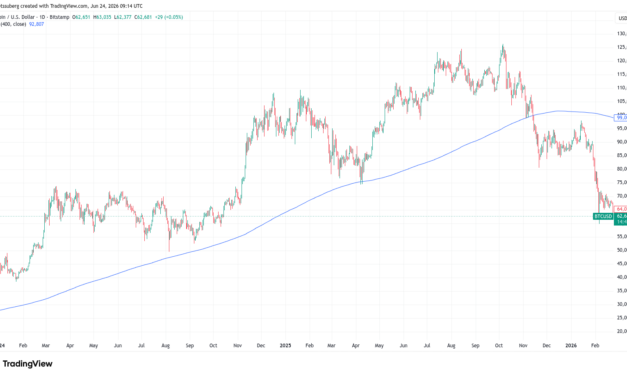
Bitcoin (BTC) is “compressed” at low levels but its classic cycles remain intact, say new research.Key points:Bitcoin is acting just like in prior cycles as it circles a key four-year trend line.Analysis says that BTC price action is currently “compressed” as it trades below a $76,400 target.A new estimate put the bear market as just over 70% complete.Analysis on $62,000 BTC price: Bitcoin “not broken”In an X post on Wednesday, analyst David Eng said that BTC price action still “runs on two clocks.”“400-day clock, $BTC looks cyclical. ~4-year clock, the cycle noise gets filtered out and the adoption structure appears,” he summarized.Marking time for Eng are the 400-day simple moving average (SMA), as well as its four-year equivalent. The former is notable for its ability to act as support throughout Bitcoin bull markets, seeing no daily candle closes below it this cycle or last.BTC/USD one-day chart with 400SMA. Source: Cointelegraph/TradingViewOn four-year time frames, meanwhile, a cleaner uptrend emerges, with price fluctuating above and below the trend line depending on its position in the cycle.“The point is that Bitcoin keeps stretching away from this adoption structure and then reverting back toward it,” Eng summarized.Currently, the four-year trend line suggests a fair price of around $76,400, making BTC/USD undervalued by around 20%. A chart uploaded by Eng also shows Bitcoin’s Power Law price, this now well into uncharted territory at nearly $135,000.“$BTC is not broken,” he concluded. “It is compressed below its adoption structure.”Bitcoin bear market losses could resume in AugustAs Cointelegraph reported, historical comparisons suggest that Bitcoin’s current bear market will continue for some months yet.Related: US dollar strength hits highest since May 2025: Five things to know in Bitcoin this weekThe latest estimates from trader and analyst Rekt Capital put the current downtrend at around 71% complete.His analysis continues to focus on the fate of the 50-month exponential moving average (EMA), currently at $63,900.“At this stage, if June Monthly Closes just like this at $62k then that would confirm the breakdown from the 50-Month EMA. So it July turns into a green month, then that could see price turn the 50 EMA into new resistance,” he told X followers. “Then August would cancel out July and send Bitcoin into downside continuation.”BTC/USD one-day chart with 50-month EMA. Source: Cointelegraph/TradingView

Čítaj viac

Sweden's H100 shareholders greenlight acquisition deal to triple Bitcoin holdings

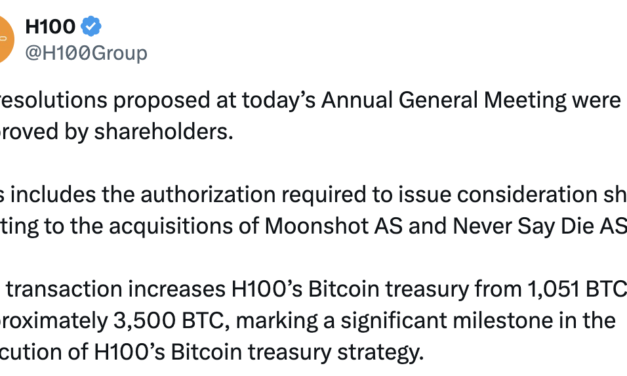
Shareholders of Sweden’s H100 approved the issuance of shares needed to complete the company’s acquisition of Moonshot AS and Never Say Die AS, clearing a key condition for a transaction that would increase its Bitcoin holdings from 1,051 BTC to approximately 3,500 BTC.The approval allows H100, a Nordic SME-listed health technology company, to acquire the two Norwegian investment firms, which collectively hold about 2,450 Bitcoin, in exchange for newly issued H100 shares. Under terms announced in March, the owners of Moonshot and Never Say Die would become majority shareholders of H100, owning roughly 70% of the combined company following the transaction.Source: H100GroupThe deal is structured as a share-for-share transaction with no cash consideration, with ownership of the combined company based on the amount of Bitcoin (BTC) contributed by each party.If completed, the acquisition would increase H100’s Bitcoin treasury to approximately 3,500 BTC, likely making it Europe’s second-largest publicly traded Bitcoin treasury company behind Germany’s Bitcoin Group SE, according to data from BitcoinTreasuries.com. H100 shares closed 9.6% higher on Tuesday. Despite the gain, the stock remains down about 30% since the start of 2026, per Yahoo Finance data.Related: Multi-year Bitcoin holder selling falls to 19-month low as halving model flags new market bottom dateBTC treasury companies face pressureH100’s planned expansion comes as Bitcoin treasury companies face a more challenging market environment following months of declining cryptocurrency prices and signs of strain in some of the financing models used to fund BTC purchases.In May, France-based semiconductor maker Sequans Communications said it would abandon the Bitcoin treasury strategy it adopted less than a year earlier and gradually liquidate its remaining holdings to refocus on its core Internet of Things semiconductor business. The company held 658 Bitcoin at the time and said it would monetize the remaining holdings over time.Strategy, the world’s largest corporate Bitcoin holder, has also faced challenges in recent months. Earlier this month, its preferred stock STRC fell below its intended $100 par value and traded at a steep discount to its liquidation preference.The company’s pace of Bitcoin accumulation has also slowed in recent months. After purchasing more than 34,000 BTC in a single week in April and nearly 25,000 BTC in a week in May, the company added roughly 1,500 BTC in each of the first two weeks of June. Market data analytics provider CryptoQuant on Wednesday said the company led by Michael Saylor should pause Bitcoin purchases and focus on replenishing its cash reserve, which is down 38% year-to-date.“They should pause Bitcoin purchases, rebuild cash reserves, and adopt a systematic framework for purchase timing,” wrote the market data analytics provider’s CEO Ki Young Ju in a Wednesday X post, adding that the biggest public Bitcoin treasury holder should also create a “disciplined selling framework” for the next bull market.Source: Strategy.com Magazine: AI is banking the unbanked in Africa… faster than crypto

Čítaj viac

Bitcoin teases $62K breakdown as analysis sees Micron earnings volatility next

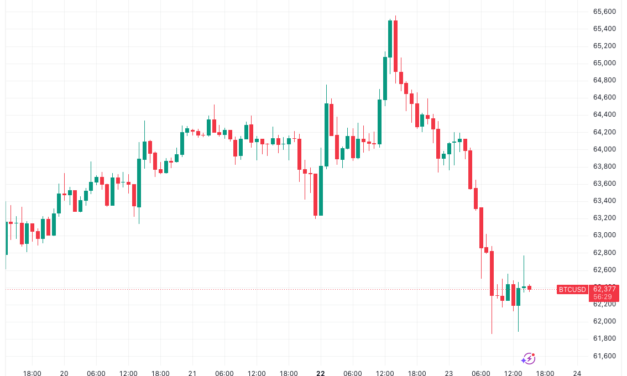
Bitcoin (BTC) stayed uncertain at Tuesday’s Wall Street open as US stocks responded to an earlier Asia tech sell-off.Key points:Bitcoin bulls attempt to avoid a deeper drop below local lows amid risk-asset volatility.Multiple factors are blamed for the current weakness and stocks reset, with Micron earnings due on Wednesday.Rolling crypto liquidations pass $1 billion over 24 hours.BTC price on the edge amid stocks volatilityData from TradingView showed indecisive BTC price moves on low time frames with $62,500 now a focus.BTC/USD one-hour chart. Source: Cointelegraph/TradingViewAsia market weakness sparked two dips below the $62,000 mark on the day, with equities seeing major losses. The US reaction was less intense, with the S&P 500 and Nasdaq Composite Index down 1% and 1.3%, respectively, at the time of writing.S&P 500 one-hour chart. Source: Cointelegraph/TradingViewDiscussing the current landscape, trading resource The Kobeissi Letter added expectations over tech giant Micron Technologies’ Q3 earnings guidance to the volatility mix, this due out on Wednesday.“Speculation over Micron’s earnings is a key factor driving this volatility,” it wrote in a post on X. “The stock is now worth over $1.2 trillion and driving a broader momentum-based rally that is largely dependent on sentiment around Micron’s stock.”Micron Technologies stock one-day chart. Source: Cointelegraph/TradingViewKobeissi attributed Korea’s market drop to legal concerns over unrealized gains, as well as increased leveraging among traders.“The result is amplified volatility in both directions, which also explains why the S&P 500 is already up +60 points from its opening low,” it added.“When you zoom out, the broader AI narrative has only strengthened and market volatility is completely normal after the run we just saw.”VIX volatility index one-day chart. Source: Cointelegraph/TradingViewBitcoin fuels major crypto liquidation surgeStill in a narrow range, BTC price action thus surfed patches of nearby liquidity, with both long and short positions paying.Related: US dollar strength hits highest since May 2025: Five things to know in Bitcoin this weekData from CoinGlass put 24-hour crypto liquidations at nearly $700 million.“$65K did indeed not end up holding which quickly moved this down to grab the liquidity below $62K,” trader Daan Crypto Trades commented while analyzing the numbers.Crypto liquidations (screenshot). Source: CoinGlassAnalytics account CryptoReviewing described the liquidity imbalance between long and short as “ridiculous,” noting that the rolling 24-hour tally had reached up to $1 billion on Tuesday.“Bulls might enjoy what happens next,” it forecast alongside an X video update. 

Čítaj viac
Načítava

Získaj BONUS 8 € v Bitcoinoch

nakup bitcoin z karty

Registrácia Binance

Burza Binance

Aktuálne kurzy