Slováci hromadne menia kryptoburzu: Na týchto platformách už nenakúpite
Tento príspevok bol pôvodne publikovaný na stránke...
Čítaj viac

Tento príspevok bol pôvodne publikovaný na stránke...
Čítaj viac
Tento príspevok bol pôvodne publikovaný na stránke...
Čítaj viac
Tento príspevok bol pôvodne publikovaný na stránke...
Čítaj viac
Tento príspevok bol pôvodne publikovaný na stránke...
Čítaj viac
Bitcoin’s (BTC) drop to $58,000 has pushed the price into a zone that long-term power-law models have historically associated with cycle bottoms. The data does not confirm a bottom range, though it shows BTC trading in a price range that has repeatedly marked major lows since 2014. Derivatives data and liquidation levels highlight $55,000 as the next key support level and the $65,000-$68,000 range as the next major upside area of interest. Bitcoin power-law puts $58,000 in historical rangeGiovanni’s Bitcoin power-law model places the network’s long-term trend price near $135,000, making the recent drop to $58,000 roughly 54% below the all-time high and 1.22 standard deviations beneath that trend.According to the analyst, the key takeaway is straightforward: the previous cycle lows in 2012, 2015, 2019, 2020, and 2022 all fell within a similar statistical range. By that measure, the latest decline falls within a territory that has historically marked the deep bear-market lows rather than a break in Bitcoin’s long-term growth path.Bitcoin price deviation based on the power-law trend. Source: XThe model estimates the commonly referenced “-1σ” support near $68,000, while the stronger historical floor sits closer to $55,000. Giovanni also noted that Bitcoin would need to trade below roughly $17,000 for more than a year before the power-law itself could be considered invalid.A second metric points in the same direction. Bitcoin’s power-law quantile has fallen to 6.2%, indicating the asset is cheaper than roughly 94% of its historical observations when measured against the power-law model. The chart highlights similar readings during the 2015, 2020, and 2023 cycle lows, with the current market now revisiting that historically rare valuation zone.Bitcoin power-law quantile regression chart. Source: CheckonchainRelated: Bitcoin drops to $58K on high US PCE inflation as trader sees ‘manipulation’Key BTC price levels to watchBitcoin fell to a new yearly low of $58,000 after aggressive selling swept through Binance. The hourly taker sell volume reached $2.1 billion, followed by another $1.9 billion in the next hour after the New York market open, marking the exchange’s largest hourly sell pressure since May 4.Bitcoin taker sell volume on Binance. Source: CryptoQuantThe flush liquidated more than $300 million in long BTC positions before the price rebounded toward $60,000. That level now carries added significance. A daily close back above $60,000 preserves the developing relative-strength index (RSI) bullish divergence across the one-hour, four-hour, and daily time frames which signals that selling momentum is fading even as the price prints lower lows.BTC/USDT, one-day chart. Source: Cointelegraph/TradingViewFutures trader Byzantine General shared a similar outlook, saying the move to $58,000 cleared out leveraged longs while drawing in fresh short sellers. In his view, a daily close above $60,000 would strengthen the case that Bitcoin has printed a local bottom for now. That would also shift attention toward a large pocket of upside liquidity. More than $4 billion in short liquidations cluster near $65,000, compared with about $1 billion below $55,000, creating a four-to-one imbalance. A relief rally could then target internal liquidity near $68,000, where a daily fair-value gap adds another area of interest for traders. BTC liquidation map. Source: CoinGlassMeanwhile, a daily close below $60,000 reinforces the bearish bias on both the short-term and long-term charts. The next area of interest then shifts to $55,000, where Bitcoin’s September 2024 weekly range low converges with its realized price near $54,000. The realized price, which tracks the average cost basis of all onchain coins, has historically provided support at every major Bitcoin bear-market bottom since 2014. That trend makes the $54,000-$55,000 region a key level for traders to watch if selling pressure continues. Bitcoin’s realized price. Source: XRelated: Bitcoin drop to $58K brings out bears: Is BTC’s next stop below $50K?
Čítaj viac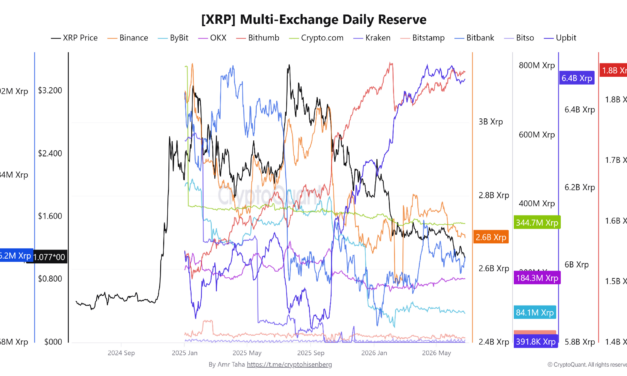
XRP is trading just above $1, leaving the token at its weakest price level of the year, but onchain data paints a different picture. The exchange-held XRP supply continues to fall, Binance withdrawals have exceeded deposits for seven straight days, whale flows are holding positive and spot XRP exchange-traded funds (ETFs) have attracted $243 million in inflows since April.The improving onchain data points to healthy network positioning, even as XRP continues to search for a price bottom. XRP supply on exchanges continues to shrinkCrypto analyst Amr Taha noted that Binance’s XRP reserve has fallen to its lowest level since March after roughly 100 million XRP left the exchange over the past month. Binance’s balance stood at about 2.68 billion XRP on June 25, down from 2.78 billion XRP on May 12, accounting for the largest outflow among major trading platforms.XRP multi-exchange daily reserve. Source: CryptoQuantOther exchanges also posted smaller declines. Upbit’s reserve fell to 2.48 billion XRP on June 25 from 2.51 billion XRP on May 31, while Bybit’s holdings declined to 82 million XRP from 92 million XRP on June 2. Binance led in absolute outflows, while Bybit recorded the steepest percentage decline.Taha also highlighted a significant shift in Binance transaction activity. XRP withdrawal transactions have exceeded deposits for seven consecutive days since June 17. The seven-day withdrawal share climbed to 53.8% on June 23, its highest reading since June 2024, while deposits fell to 46.1%, the weakest level since 2024.XRP daily deposit/withdrawal transactions (%) on Binance. Source: CryptoQuantThe metric tracks transaction count rather than XRP volume. This indicates users are moving coins off Binance more frequently than sending them to the exchange, marking the longest withdrawal-led stretch in roughly a year.Large XRP holders supported the trend. XRP whale flow on the 90-day moving average has stayed positive throughout the quarter at 5.143 million XRP per day, showing consistent net accumulation by large wallets instead of distribution. XRP whale flows. Source: CryptoQuantInstitutional demand has also added support. Spot XRP ETFs recorded $2 million in net inflows on June 24, lifting June’s total netflows to $31 million. Since April, the total cumulative inflows have reached $243 million.Related: SBI to acquire Bitbank in $289M deal creating Japan’s biggest crypto exchangeXRP price approaches a major demand zoneFrom a technical standpoint, the higher-time-frame market structure remains bearish for the altcoin. XRP touched $1.01 on Thursday, its lowest price of 2026, leaving the token close to its first move below $1 since November 2024. The decline has pushed XRP down 43% year-to-date.XRP/USDT, one-week chart. Source: Cointelegraph/TradingViewThe next key area for XRP sits within the fair value gap between $1 and $0.63, an unfilled price gap created during the sharp rally in late 2024 that could attract buying interest if the decline extends in the coming weeks. Black Swan Capitalist founder Versan Aljarrah continues to focus on the longer-term chart. The analyst said XRP has spent years building a large accumulation range with higher lows on both weekly and monthly timeframes.XRP/USD, one-month chart analysis by Versan Aljarrah. Source: XAljarrah argued that extended consolidations often produce stronger breakout moves once the price eventually breaks out of the range, with the analyst targeting $10, i.e., a 900% increase from the current price. Related: HYPE down 22% from record highs: Will spot demand revive the uptrend?
Čítaj viac
Binance has notified European Union users that access to key services will be restricted after the exchange failed to secure Markets in Crypto-Assets (MiCA) authorization from a member state before a July 1 deadline.Those restrictions include halting onboarding new EU users and limiting certain services for EU-based accounts effective July 1, according to exchange notices shared by users on social media.The notices said users will still be able to withdraw their assets after that date, stating that “all digital assets are still available for withdrawal,” in line with applicable regulatory requirements.The move marks one of the first major transitions under the EU’s MiCA framework after Binance announced it withdrew its MiCA license application in Greece on Wednesday.Cointelegraph approached Binance for comment on its plans but did not receive a response prior to the time of publication.Binance advises moving funds to self-custodial wallets or other exchangesIn circulating notices, Binance told users they may move assets to self-custody wallets or transfer funds to other crypto asset service providers (CASPs).The exchange operator said the transition is intended to be an “orderly process” aimed at minimizing disruption to users, with services reduced to position management and withdrawals after the deadline.Source: IT_Tech_PLMultiple MiCA-licensed CASPs including Revolut and OKX have been actively recruiting new users in EU member states ahead of next week’s deadline.Users seek clarity on staking and tradingSome Binance users have raised concerns over how specific services will be handled once EU service restrictions take effect after the MiCA transition ends.In public replies on social media, users asked what will happen to staked crypto assets on Binance after the deadline, reflecting uncertainty around whether yield-generating positions will be affected by the upcoming service changes.Source: FilipebinanceIn response, a Binance representative said user balances “remain available and safe as always,” but did not provide specific details on how staking rewards or active positions will be treated under the restricted-services phase.Community divides over Binance user impactViews across the crypto industry differ on how significant the upcoming MiCA transition will be for existing Binance users in the European Union.Dominik Tomczyk, CEO of SIA AlphaRoute, operating as Kanga Exchange EU, told Cointelegraph that non-licensed platforms may still continue serving existing users under the legal concept of “reverse solicitation.” He said that, from a user perspective, “nothing will change,” apart from restrictions on marketing and user acquisition within the EU.Sławomir Zawadzki, co-CEO of Kanga Exchange, said existing users are unlikely to see major disruptions. He also suggested that much of the concern around MiCA-related changes is being overstated, adding that competitive positioning may be shaping parts of the public narrative.Mixed response from usersOne Binance EU user told Cointelegraph they were not overly concerned about the MiCA deadline, pointing to Binance’s liquidity and proof-of-reserves reporting. “I’ll honestly continue using Binance until I see evidence of a potential enforcement action,” the person said.Another user said the impact on Binance EU users would depend on how heavily they rely on the platform. They noted that their primary use of the platform is as a trading gateway and would switch to another exchange if needed, while suggesting the biggest disruption would likely affect active traders and users with large balances on the platform.Related: EUR trading accounts for 1% of Binance spot volume, CryptoQuant saysAccording to media reports, Binance’s global client base counts at least 300 million customers, while the app was downloaded more than 4 million times in the EU last year. Magazine: How crypto laws changed in 2025 — and how they’ll change in 2026
Čítaj viac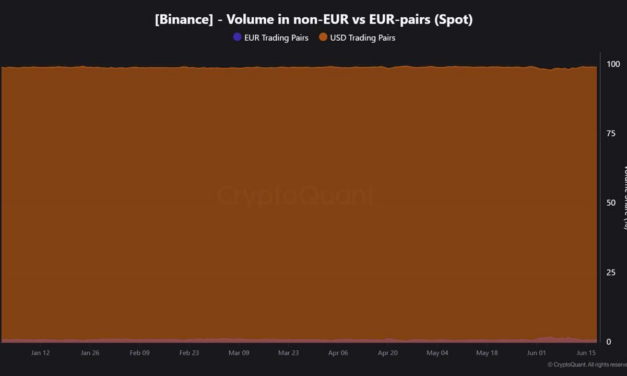
Crypto exchange Binance reportedly plans to seek a different route to authorization in the European Union after its licensing application in Greece encountered a setback.Speaking to Reuters, Gillian Lynch, Binance’s head of Europe and the United Kingdom, said the exchange is “not leaving Europe” and would pursue authorization in another EU jurisdiction if its application in Greece does not move forward.Lynch said Binance contacted other regulators but submitted a formal application only in Greece. The exchange reportedly held talks with Ireland, Latvia and Greece but encountered resistance over its past money-laundering penalties, international structure and what officials viewed as a risk-taking culture. Binance has days to secure authorization before the Markets in Crypto-Assets Regulation (MiCA) transitional period ends on July 1, a key deadline for crypto firms seeking to operate across the EU. The European Securities and Markets Authority (ESMA) said on Tuesday that crypto service providers that remain unauthorized by the deadline must take “immediate” steps to wind down their EU activities.On June 16, Binance pushed back against a Reuters report that EU regulators were preparing to reject its MiCA application, saying Greece’s Hellenic Capital Market Commission had reviewed the application and considered it compliant, subject to further review by ESMA. The exchange said at the time that it expected the process to advance toward authorization.Binance told Cointelegraph it would provide additional information but had not done so by publication.MiCA deadline puts Binance’s European reach at risk On Monday, CryptoQuant analyst Maartunn told Cointelegraph that euro-denominated pairs account for about 1% of Binance’s global spot trading volume, suggesting that a European licensing setback may have a limited effect on the business.Source: CryptoQuantHowever, Binance remains a significant trading venue for European users, handling between about $100 million and $250 million in daily euro-pair volume in 2026, with occasional spikes of about $600 million. Binance held an estimated 18.5% share of euro-denominated spot trading during the year, placing it second behind Kraken’s 43.3% share, according to CryptoQuant’s data.Exchanges emerge as MiCA compliance gatekeepersBinance’s licensing difficulties could also affect token issuers, as authorized exchanges increasingly prepare and notify MiCA white papers for assets they list.In a LinkedIn post, Ryan King, creator of the EU Crypto Register, said at least 380 of 867 white-paper entries he tracked were notified by third parties rather than token issuers. He said Kraken, LCX, OKX and Bitstamp accounted for 271 notifications, or about 31% of the total.Related: Binance’s Yi He warns of alleged impersonation scam, CoinUp denies tiesKing told Cointelegraph that the model was “symbiotic” because exchanges employ MiCA-trained compliance teams, maintain regulator relationships and retain large law firms. He added that exchanges increasingly request white papers during onboarding and may offer to prepare them, even for tokens covered by transitional arrangements. “They also use standard templates,” King told Cointelegraph, recalling that one exchange told a token project to “fill it in and we’ll handle the rest.”Magazine: Japanese pension fund tips 1% in crypto, G7 urges action on NK hackers: Asia Express
Čítaj viac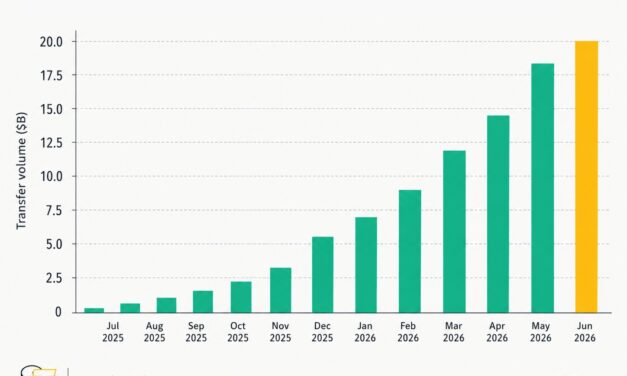
How the $1B SpaceX offering exposed crypto’s blind spotFor retail investors shut out of private markets, tokenized SpaceX shares offered an unusual route into one of the world’s most coveted private companies. The blockchain-based tokens allowed investors to seek exposure without a conventional brokerage account and before any potential public listing.Then practical limits got in the way.In June 2026, xStocks indicated customer demand had surpassed $1 billion for tokenized SpaceX shares. Crypto platforms such as Bybit, Binance Wallet and Bitget Wallet highlighted access to the offering, creating considerable excitement among users keen to obtain exposure to Elon Musk’s aerospace venture.Several investors ultimately secured no allocation.A number of platforms withdrew their initiatives and returned funds after being unable to obtain the necessary underlying SpaceX shares to support the tokens. The incident quickly became a significant practical test for tokenized equities. It highlighted a core reality in blockchain-driven investment: Tokenization may convert ownership into digital form, yet it cannot generate assets that are unavailable.Growth of tokenized stocksThe outcome of the tokenized SpaceX share offeringA potential SpaceX Initial Public Offering (IPO) had long been expected to draw attention. The aerospace firm sits at the center of several major trends: commercial space travel, Starlink satellite connectivity, defense technology and Elon Musk’s global profile. Many investors had sought a direct stake for years.To address this interest, xStocks introduced SPCXx, a tokenized representation of SpaceX shares. The product aimed to offer blockchain-based exposure to the company, allowing trading through crypto platforms instead of standard brokerages.Demand surged sharply.Reports indicated that subscriptions topped $1 billion before final allocation decisions. Binance Wallet alone reportedly drew more than half a billion dollars in commitments. Participants saw the opportunity as a rare way to gain exposure to one of the world’s most valuable private companies.Binance Wallet’s $557M SpaceX campaignThen allocations were announced.Several platforms involved said they had not obtained the required underlying shares to support token issuance. Without actual shares to back the product, the tokenized offering could not move forward.This led to widespread cancellations and refunds.How tokenized stocks workTokenized stocks are blockchain-based versions of traditional equity holdings. Rather than buying shares through a standard brokerage, investors purchase digital tokens that represent ownership or an economic interest tied to real shares held off-chain.The process usually works as follows:A regulated custodian obtains the actual shares.A tokenization provider creates blockchain tokens backed by those shares.Investors buy and trade the tokens.The token’s value is designed to track the performance of the underlying stock.The potential advantages are clear, although they come with important trade-offs.Tokenized equities offer around-the-clock trading, global access, fractional ownership and easier use with crypto wallets and decentralized finance tools.For investors in regions with limited access to US financial markets, tokenization offers a possible route to assets that were previously difficult or impossible to reach.Did you know? The idea of tokenized securities predates blockchain. Financial institutions experimented with digital versions of stocks and bonds for decades, but blockchain made global, peer-to-peer ownership transfers easier and more transparent.How xStocks planned to give investors SpaceX exposureThe SPCXx offering was built on a straightforward idea. For each token created, xStocks would obtain corresponding SpaceX shares to serve as collateral for the digital assets traded by participants.From the investor’s standpoint, the process seemed simple. Users transferred funds, joined the subscription and expected to receive tokenized SpaceX exposure after allocation decisions.The structure had special appeal because many retail participants believed tokenization could expand access to select IPOs historically reserved for institutional players and high-net-worth individuals.What many overlooked was that the tokenization process still required genuine shares to be secured before the tokens could be issued. This dependency became the decisive limitation.Why demand outpaced available supplyThe problem was not tokenization itself. It was the shortage of actual SpaceX shares needed to back the tokens. When investor interest in a company is exceptionally strong, only a finite number of shares can be distributed. Not every investor can receive the amount they want.Traditional IPOs regularly face this constraint. Brokerages often receive fewer shares than clients request. Institutional investors compete aggressively for allocations. Retail investors often receive smaller stakes or no allocation at all.The SpaceX case intensified this pattern.Through blockchain infrastructure, xStocks greatly expanded the base of interested buyers. Tokenization extended participation beyond a limited group of brokerage clients to a global crypto audience.Demand expanded sharply, while supply remained limited. The actual shares remained governed by traditional equity market restrictions. This gap ultimately became impossible to overcome.Why tokenization cannot create shares that do not existA common misconception about tokenized stocks is that blockchain somehow removes scarcity. But that is not true.Blockchain can improve settlement, broaden access and make trading more efficient. It can digitize ownership records and support fractional holdings. It cannot, however, create extra legal ownership in a company.Each properly backed tokenized share requires a matching underlying asset. If a tokenization provider cannot acquire the shares, it cannot issue valid tokens.This matters because tokenization is often presented as a major solution to limits in financial markets.The SpaceX episode showed that some constraints still exist in the real world. No amount of blockchain technology can create more SpaceX shares when supply has run out.Did you know? SpaceX remains one of the most actively traded private companies in secondary markets. Employees, early investors and venture funds often trade shares privately, creating an active private secondary market before the company’s public listing.What went wrong for Bybit, Bitget Wallet and other partnersThe challenges faced by partner platforms also point to another key issue in tokenized finance: reliance on long operational chains.Bybit, Bitget Wallet, Binance Wallet and other distribution partners did not have direct control over the allocation process. Instead, they relied on xStocks and other infrastructure providers to acquire the underlying shares.Once those shares were not available, the full distribution network stopped. Users often believed they were dealing directly with the asset itself.Several intermediaries operated behind the arrangement:The tokenization providerThe custodian holding the sharesThe allocation sourceThe exchange or wallet distributing accessIf any part of that sequence breaks, the overall user experience can suffer as well. In this case, the disruption happened before any tokens were issued.How refunds protected users but exposed platform risksTo their credit, participating platforms generally processed refunds without delay. Some went further by offering additional compensation, rewards or fee refunds to reduce the setback.Financially, most customers avoided direct losses. From a reputational standpoint, however, the situation was more complicated. Investors learned that advertised “access” did not mean guaranteed participation.Many had viewed promotional efforts as confirmation that shares would become available. The cancellations made clear that acquiring inventory remained uncertain until final allocations were completed.This lesson could shape how investors assess future tokenized offerings. Trust is one of the most important elements in financial markets, and cases like this can weaken it even when refunds are issued.Did you know? Fractional ownership is not unique to crypto. Traditional brokers have offered fractional shares of expensive stocks such as Amazon and Berkshire Hathaway for years, allowing investors to buy part of a share rather than a whole unit.Tokenized shares vs. conventional sharesA further takeaway from the SpaceX case concerns clarity over what tokenized shares actually represent. Many investors assume that buying a tokenized stock is the same as holding a standard share.That is not always the case.Depending on the structure, token holders may not receive:Voting rightsDirect shareholder communicationsParticipation in corporate governanceCertain shareholder privilegesInstead, tokenized products may provide economic exposure to price movements rather than full legal shareholder status. This difference becomes especially important during corporate events, mergers, dividends or regulatory issues.Investors should review the legal framework behind any tokenized equity offering before committing funds.Key risks retail investors should understandThe SpaceX episode brought several risks into sharper focus. These risks go beyond this particular offering:Allocation risk: Popular assets often draw more demand than the available supply.Counterparty risk: Investors rely on issuers, custodians, exchanges and tokenization providers.Regulatory risk: Rules for tokenized equities continue to change across many jurisdictions.Liquidity risk: Trading activity can vary sharply from one product to another.Redemption risk: Investors need clarity on how tokens can be redeemed and what rights come with ownership.None of these risks are unique to tokenized finance. However, the blockchain format can sometimes make them less obvious to investors with limited experience.What the SpaceX episode reveals about tokenized equitiesAlthough the effort fell short, the wider lesson may still be encouraging for the tokenization sector. Demand above $1 billion showed strong investor interest in blockchain-based access to traditional assets.The market clearly wants tokenized equities.Participants like the idea of managing stocks through crypto wallets. They value around-the-clock trading, global reach and lower entry barriers.The difficulty lies in reliably linking that interest to actual assets in the real economy.Future tokenized offerings could benefit from:Stronger sourcing agreementsMore transparent allocation processesBetter disclosure of inventory limitsClearer explanations of investor rightsThe underlying technology largely worked as planned.What fell short was the ability to obtain enough of the underlying asset.
Čítaj viac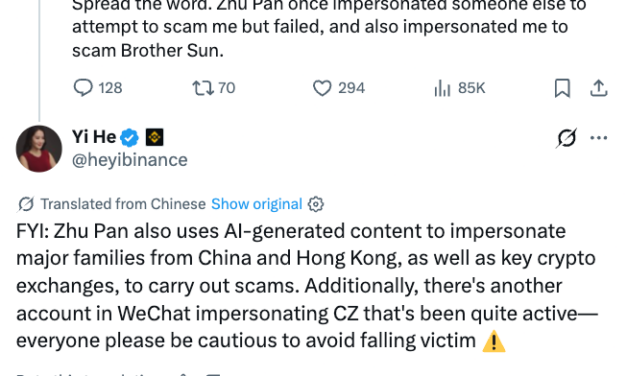
Binance co-founder Yi He has warned against an alleged scammer and impersonator, prompting the crypto derivatives trading platform CoinUp to issue a statement distancing itself from the individual.Binance’s He took to X on Monday to warn against the individual referred to as “Zhu Pan,” whom she said had impersonated her in failed scam attempts, urging users to spread awareness.The comments were made in response to a widely shared Chinese-language X post that alleged CoinUp was linked to the individual, claims CoinUp later disputed.“Zhu Pan is not a member of the CoinUp platform and does not participate in core operational management or related work for the CoinUp platform,” CoinUp responded in a statement on Tuesday.The incident underscores how fast-moving social media allegations can pull exchanges and high-profile figures into disputes, amplifying reputational risk in crypto markets where project ties are often unclear.Who is the mysterious Zhu Pan?Public information about the individual referred to as “Zhu Pan” remains limited and disputed, with different accounts circulating in Chinese-language crypto communities.According to a report by Chinese outlet Pencil News, a person identified as Zhu Pan was previously linked to the 2018 ZJLT initial coin offering project, which later faced investor backlash over losses and accusations of fraud. Zhu reportedly denied being a founder or operator of the project.Source: Yi HeCointelegraph contacted Binance for further comment on the allegations and identity of the individual referred to as “Zhu Pan” but did not receive a response prior to publication.Yi He alleged that “Zhu Pan” impersonated her in an attempt to scam Tron founder Justin Sun. Sun later said her account was “absolutely true.”CoinUp denies operational ties and cites market selling pressureAlthough CoinUp denied Zhu’s involvement in its core operations or management, the company said the individual is linked to a project listed on its platform.“Associating his personal actions, past project experiences, or market rumors directly with the CoinUp platform entity constitutes an inaccurate interpretation,” CoinUp said.Related: China pays closer attention to stablecoins as cross-border role expandsThe exchange also addressed the volatility of the CoinUp token (CPX), the native utility and ecosystem token for CoinUp, which reportedly posted all-time highs above $0.829 last Friday, according to Lookonchain.CoinUp said recent sharp price swings were caused by concentrated market selling pressure and said it was investigating the cause of the volatility. It added that its security review found no evidence of hacking, data breaches or system vulnerabilities.Magazine: China’s 107 Bitcoin memory thief, Bithumb CEO booked: Asia Express
Čítaj viac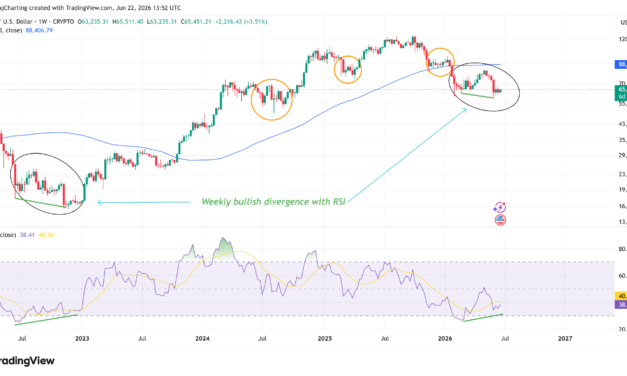
Bitcoin (BTC) continues to exhibit a strong technical setup after holding a weekly close above $63,000 for three consecutive weeks since tagging a new 2026 low near $59,000. This pattern closely resembles a bottom-building phase seen in previous trend reversals in bearish periods.At the same time, Bitcoin futures open interest has fallen 19.5% from its June peak, funding rates have cooled to 0.02% from 0.1%, and spot Bitcoin exchange-traded fund (ETF) outflows have slowed sharply to $540 million over the past two weeks from $5.5 billion the prior month. Together, the data points to a market that is shedding excess selling pressure while holding near a key support zone for BTC. Bitcoin’s weekly chart echoes prior market bottomsBitcoin’s recent weekly price action resembles a pattern seen several times since 2023. Once a local bottom is established, the price often trades close to that range for weeks before a sustained uptrend develops. One exception came in November 2025, when the price spent roughly 10 weeks moving sideways above $88,000 before breaking lower to the $60,000 level. BTC/USD, one-week chart. Source: Cointelegraph/TradingViewThe current setup also resembles the price from late 2022 and early 2023. During that period, the weekly relative strength index (RSI) entered oversold territory, recovered, and later formed a higher low, while the BTC price printed a lower low, creating a bullish divergence. That bullish divergence marked a key turning point, preceding the broader uptrend that developed during 2023. The focus is now on the $63,000 area, where the price has formed a positive RSI divergence. The repeated weekly closes above $63,000, keeps Bitcoin trading above its recent low at $59,000 rather than extending towards it. The behavior fits a range-building phase that has appeared near previous turning points, as identified in the chart. Related: US dollar strength hits highest since May 2025: Five things to know in Bitcoin this weekBTC futures turn less crowded as ETF sell-pressure eases Bitcoin derivatives markets have become notably less crowded over the past three weeks. Bitcoin funding rates cooled to 0.02% from 0.1% at the start of June, reducing signs of aggressive long positioning.Bitcoin funding rate on all exchanges. Source: CryptoQuantCrypto analyst Woominkyuu noted that total Bitcoin open interest across exchanges peaked at $25.96 billion on June 1, then fell to $20.89 billion by June 21. The 19.5% decline exceeded Bitcoin’s 11.4% price drop during the same period.The simultaneous decline in the price and open interest typically signals that existing positions are being closed or liquidated rather than new leveraged bets entering the market. This indicates a significant reduction in excess leverage. It also points to limited evidence of aggressive new short positioning at current levels.Spot Bitcoin ETF flows show a similar shift with $5.5 billion leaving the spot ETFs between May 15 and June 11. The outflows over the past two weeks total about $540 million, marking a sharp slowdown in selling activity.Weekly spot BTC ETF netflows. Source: SoSoValueOnchain data paints a mixed but constructive picture. Bitcoin researcher Axel Adler Jr. highlighted that long-term holders’ realized supply recently reached 12.42 million BTC, a level associated with supply maturation and coins moving into stronger hands. At the same time, Bitcoin’s sales pressure metric has stayed inactive for 1,256 consecutive days, the longest stretch on record. The data points to continued supply maturation alongside other signs that Bitcoin may be stabilizing near a potential cycle low.Bitcoin LTH realized supply. Source: Axel Adler Jr.Related: Strategy adds $300M to USD Reserve, acquires 520 BTC
Čítaj viac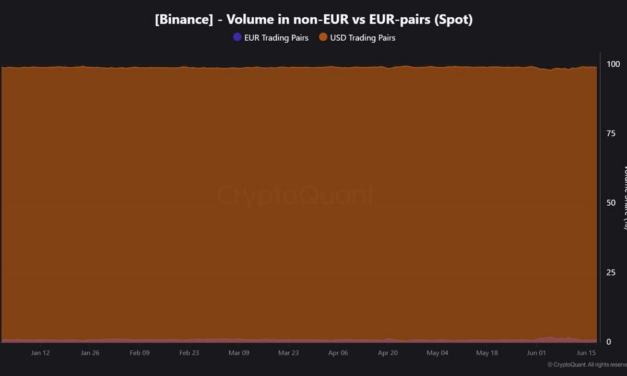
Euro-denominated trading accounts for only a small share of Binance’s activity, as the exchange faces uncertainty over its European licensing prospects under the Markets in Crypto-Assets Regulation (MiCA).Euro (EUR) trading accounts for around 1% of Binance’s spot volume, CryptoQuant analyst Maartunn told Cointelegraph.“Binance’s inflows remain globally distributed, which may limit the impact of potential MiCA-related setbacks,” Maartunn said, pointing to the exchange’s diversified user base across regions.Source: CryptoQuantThe data comes as Greek regulators are reportedly preparing to reject Binance’s licensing application ahead of MiCA’s transitional deadline on July 1, a move that could complicate the exchange’s ability to serve EU residents.Binance ranks among Europe’s biggest crypto exchangesEven though EUR trading represents only about 1% of Binance’s global spot volume, the exchange still processes hundreds of millions of dollars in euro-denominated trades.According to CryptoQuant data, Binance’s daily EUR-pair volumes have ranged from roughly $100 million to $250 million in 2026, with occasional spikes above $600 million.Source: CryptoQuantAccording to a December 2024 report by Kaiko, Binance, alongside Bitvavo, Kraken and Coinbase, accounted for more than 85% of all euro-denominated crypto trading volume.Related: WhiteBIT secures MiCA license in Austria ahead of July 1 EU deadlineUnlike Binance, Bitvavo, Kraken and Coinbase are among the major exchanges that have already secured MiCA authorization, allowing them to offer services across the EU under the framework’s passporting regime.83% of CASPs have yet to receive a MiCA licenseBinance’s licensing uncertainty comes as many crypto asset service providers (CASPs) are still adapting to MiCA’s requirements.According to estimates based on European Securities and Markets Authority (ESMA) data cited by market analyst Merlijn Geurds, only around 210 of more than 1,200 firms operating under pre-MiCA registration regimes have obtained full authorization under the new framework.Source: Merlijn GeurdsGeurds told Cointelegraph the gap reflects the cost and complexity of compliance, which requires governance standards, compliance controls and operational safeguards that many smaller firms lack.“The result is consolidation by design,” Geurds said, adding: “A smaller group of well-capitalized, licensed players gets a passport to all 27 states, while a long tail faces forced migrations or cutoffs.”Cointelegraph contacted Binance for comment on the size of its European business and the potential impact of MiCA-related restrictions but had not received a response by publication.Magazine: SBF will never get a pardon, Trump peace deal boosts Bitcoin: Hodlers Digest June 14-21
Čítaj viac

