Autor Zoltan Vardai

Ethereum faces core development funding crisis, former contributor warns

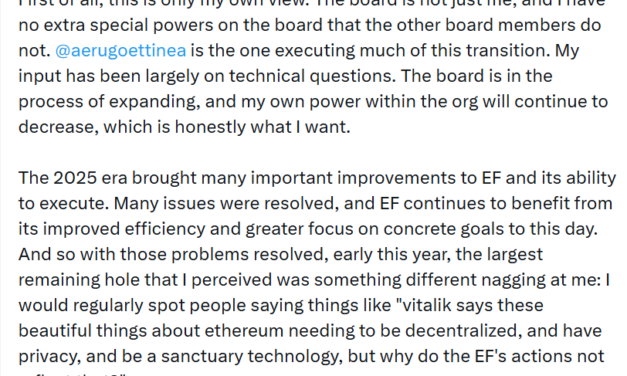
Former Ethereum Foundation contributor Trenton Van Epps warned that Ethereum is facing a core development funding crisis that will highlight the need for new funding sources in the next three to nine months.The former contributor wrote in a blog post on Thursday that the Ethereum Foundation’s spending reduction and the expiration of the Client Incentive Program in April left the network’s core development ecosystem requiring about $30 million in annual funding.Citing recent conversations with core development contributors, Epps said Ethereum risks entering a “slow-burning funding crisis.”Van Epps’ article follows a wave of departures from the Ethereum Foundation, including co-executive director Hsiao-Wei Wang’s announcement on Thursday that she would step down from her role, bringing the estimated number of layoffs and departures at the organization to 19 so far this year.Related: Ethereum can quantum-proof accounts for just 7 cents, says Ethereum’s Kohaku leadCointelegraph was unable to independently verify the estimated $30 million annual funding requirement and reached out to the Ethereum Foundation for comment.Ethereum Foundation shifts treasury policyIn a May 24 X post, Ethereum co-founder Vitalik Buterin said the Ethereum Foundation’s resources were limited, noting that the organization held only about 0.16% of Ether’s (ETH) total supply, far below the share controlled by foundations associated with some other blockchain networks.Buterin said the Ethereum Foundation was originally designed to fulfill a limited scope of work, including developing Ethereum’s core software and helping the network progress through its major roadmap milestones, which he said were largely completed by 2022.“And so today, the EF is choosing to use its remaining resources to pursue longevity over breadth (yes, this means we sell less ETH),” Buterin wrote.Source: Vitalik ButerinThe Ethereum Foundation unstaked 17,000 ETH in late April and another 21,270 ETH (then worth $50 million) in early May, shortly after nearly surpassing 70,000 ETH staked earlier this year. The foundation also sold 10,000 ETH to the largest corporate ETH holder, Bitmine, in an OTC deal on May 1.  Blockchain analytics platform Arkham said the unstaking may have occurred due to the foundation’s need for funds to further develop the network.The transactions marked another adjustment to the Ethereum Foundation’s treasury strategy. The foundation said in a June 2025 policy update that increasing its staking participation would help fund protocol development while limiting future ETH sales after community backlash over earlier disposals.Magazine: Why is Ethereum Foundation selling? BTC futures warning signs: Market Moves

Čítaj viac
Capital B shareholders approve up to $120B in financing capacity for Bitcoin strategy

France-listed Bitcoin treasury company Capital B’s shareholders approved a delegation of new capital-raising instruments that may bring up to 105 billion euros ($120.4 billion) in funding to fuel the company’s Bitcoin acquisitions.Over 95% of shareholders approved the establishment of up to 5 billion euros in capital increases, equivalent to as many as 125 billion new shares at the current nominal value, as well as the issuance of up to 100 billion euros in credit instruments, Capital B announced on Wednesday.The company said the issuance of the new capital instruments will “accelerate its Bitcoin accumulation strategy, focused on increasing the number of Bitcoin per fully diluted share over time.”During its general meeting on Wednesday, Capital B reported 300.65 million in total shares with voting rights. If fully exercised, issuing 125 billion in new shares would result in existing shareholders being diluted to about 0.24% of the company’s ownership.Shareholders also approved changing the company’s name from The Blockchain Group to Capital B, aligning its corporate name with the commercial brand adopted in 2025.Source: Capital BCapital B shares were little changed following the announcement, according to Yahoo Finance data.Crypto treasury companies take different approachesCapital B is Europe’s second-largest Bitcoin treasury company, holding 3,139 BTC, currently valued at $200 million. It ranks behind Germany-based Bitcoin Group SE, which holds 3,604 Bitcoin, currently worth $230 million, Bitcoin Treasuries data shows.To date, Capital B said it raised about $325 million in capital, following its $17.8 million raise from strategic investors, including Blockstream CEO Adam Back and Paris-based asset manager TOBAM.Related: Mystery Bitcoin burn destroys 107 BTC worth about $8.5M The fundraising initiative contrasts with moves by some treasury companies to reduce or actively manage their Bitcoin exposure.On May 28, France-based semiconductor company Sequans Communications said it had concluded its previously announced crypto treasury strategy. The company held 658 Bitcoin and said it would “monetize remaining holdings over time,” which led to a share price increase of about 14.5%. Magazine: Bitcoin, the ‘canary in the coal mine,’ XRP transaction demand falls 91.5%: Market Moves

Čítaj viac

Aztec hit by second $2.1M exploit in less than week: SlowMist

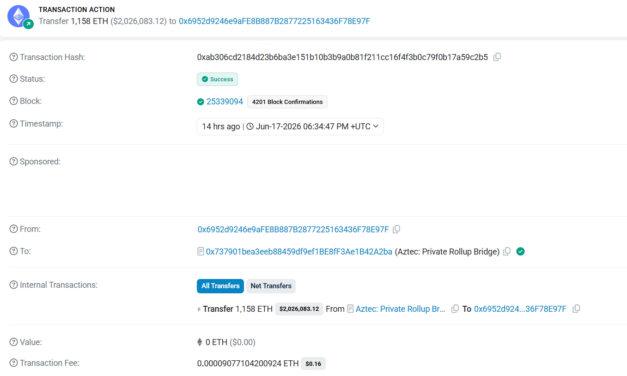
Deprecated Aztec infrastructure has suffered a second exploit within days, adding to concerns about the security of abandoned smart contract infrastructure.Aztec’s private rollup bridge was exploited on Thursday for 1,158 Ether (ETH), 150,000 Dai (DAI) and 0.46 renBTC (RENBTC), totaling about $2.15 million, according to Cos, the co-founder of cybersecurity company SlowMist.His preliminary analysis found that the attacker used a false rollup proof to trick the protocol into releasing assets from its reserves to the attacker’s address.Aztec Labs confirmed the exploit, adding that about $2 million was transferred from an immutable smart contract of a payment product deprecated in 2022, for which Aztec Labs held no admin keys or ability to pause transactions.Aztec Labs said the incident is separate from the $2.1 million stolen from Aztec Connect’s smart contract on Sunday. Aztec Connect was a privacy-focused rollup that was deprecated in March 2023, with the team halting deposits and shifting resources to the next-generation Aztec Network.Cointelegraph reached out to Aztec Labs for additional details about the vulnerability but had not received a response by publication.Etherscan record of the Thursday exploit transaction. Source: EtherscanRelated: AI models led to a ‘vulnerability apocalypse’ in crypto security: Immunefi CEOOld smart contracts raise new security concernsThe two Aztec exploits, along with the $1.3 million stolen from decentralized exchange Raydium earlier in June, renewed concerns about deprecated smart contracts, as the three incidents stemmed from vulnerabilities in abandoned infrastructure.“Old contracts continue to be bug bounties available to any hackers. With protocols removing their responsibility to maintain them, they can become even more tempting,” wrote risk analysis platform Blockful in a Tuesday X post.Despite Aztec Connect being deprecated, the attacker extracted over $2.1 million in the initial exploit as the immutable contract was still holding legacy user assets, wrote SlowMist in a post-mortem analysis of the incident.First Aztec exploit, attack overview. Source: SlowMistFor protocols with deprecated smart contracts that still hold legacy assets, SlowMist advised an orderly asset migration to eliminate the risks of ongoing cybersecurity exposure.Magazine: The legal battle over who can claim DeFi’s stolen millions 

Čítaj viac

Inveniam to acquire Mantra after turbulent year marked by OM crash

Data infrastructure company Inveniam Capital Partners announced plans to acquire layer-1 blockchain Mantra and its affiliated entities, deepening its push into tokenized real-world assets (RWAs).The transaction follows a $20 million strategic investment made by Inveniam in Mantra in August 2025, according to a Tuesday announcement.On May 13, Inveniam launched NVNM Chain, a layer 2 blockchain on Mantra designed to support asset verification without exposing confidential information.The acquisition expands Inveniam’s presence in infrastructure at the intersection of RWA tokenization and AI.Cointelegraph reached out to Mantra for additional details about the deal but had not received a response by publication.Related: Hyperliquid’s $10B open interest coincides with growth in equity-linked markets: TalosA turbulent period for MantraIn January, the company announced layoffs and a restructuring after what CEO John Patrick Mullin described as the most challenging year in its history, following the collapse of the OM token and prolonged market pressure.On April 13, 2025, the Mantra (OM) token suffered a 90% decline within hours, wiping out over $5 billion in market capitalization, according to CoinMarketCap data. OM/USD, all-time chart. Source: CoinMarketCapIn an X post, Mullin blamed the decline on “reckless forced closures initiated by centralized exchanges on OM account holders.””To be clear, this dislocation was not caused by the team, the MANTRA Chain Association, its core advisors, or MANTRA’s investors selling tokens. Tokens remain locked and subject to the published vesting periods,” Mullin added.Inveniam seeks to expand into digital private marketsThrough the acquisition, Inveniam is seeking to expand its presence in digital private markets, according to chairman and CEO Patrick O’Meara.“This acquisition positions us to be value-additive to the global private markets ecosystem faster,” he said. “This is what will allow our global ecosystem to deliver digital private markets to market operators, asset owners, and institutional private markets investors alongside global DeFi markets.”O’Meara said the company’s earlier investment in Mantra reflected its view that regulated blockchain infrastructure and AI-ready private market data should be integrated, which later led to the launch of NVNM Chain.Magazine: Altcoin season to hit in Q2? Mantra’s plan to win trust: Hodler’s Digest, April 13 – 19

Čítaj viac

Hyperliquid's $10B open interest coincides with growth in equity-linked markets: Talos

Hyperliquid’s perpetual futures open interest recently exceeded $10 billion as the platform expanded into equity-linked products, commodities and synthetic pre-IPO trading.Hyperliquid is now the third-largest perpetual futures exchange, with growth driven primarily by crypto assets and supported by expanding trading in equities, commodities and indexes through Hyperliquid Improvement Proposal-3 (HIP-3), according to digital asset infrastructure provider Talos.Talos said in a Tuesday report that about $4 billion of open interest is attributable to HIP-3 builder-deployed perpetual markets. The report highlighted oil, the Nasdaq 100 and technology stock-linked contracts as some of the most actively traded products, while pre-IPO markets drew more than $250 million in open interest on June 12 ahead of SpaceX’s expected public listing. Nearly half of S&P 500 perpetual volume and more than 60% of oil perpetual volume occurred outside traditional US market hours.HIP-3 perpetuals, daily volume by asset class. Source: TalosHyperliquid’s growth reflects a broader push by crypto trading venues to expand beyond digital assets and offer exposure to traditional financial markets through blockchain-based derivatives.Related: SpaceX tokenized IPO campaign draws $557M on Binance ahead of debutHyperliquid’s rise draws TradFi attentionHyperliquid’s growth has also drawn attention from traditional financial firms exploring round-the-clock trading. On May 27, Jeffrey Sprecher, the CEO of Intercontinental Exchange, the parent company of the New York Stock Exchange (NYSE), urged regulators to create a “level playing field” for launching 24/7 onchain perpetual futures contracts, arguing that regulators are “prohibiting us from doing this when it’s already happening.”Sprecher’s comments came after discussions with Hyperliquid, which he cited as an example of a crypto-native platform enabling around-the-clock derivatives trading. A day earlier, Hyperliquid launched canonical prediction markets for offchain events, adding another product category to its trading ecosystem.Top DeFi protocols by weekly fees. Source: DefiLlamaHyperliquid is also one of the crypto’s largest fee-generating protocols. The platform generated more than $15.6 million in fees during the past week, making it the third-largest protocol by weekly fees behind the industry’s stablecoin issuers Tether and Circle, according to DefiLlama data.Magazine: Can Robinhood or Kraken’s tokenized stocks ever be truly decentralized?

Čítaj viac

Získaj BONUS 8 € v Bitcoinoch

nakup bitcoin z karty

Registrácia Binance

Burza Binance

Aktuálne kurzy