
Autor Zoltan Vardai

Enso launches RWA app and trading for over 500 tokenized assets

Switzerland-based Web3 development platform Enso has launched a real-world asset (RWA) application offering access to more than 500 tokenized assets through integrations with xStocks, Ondo Finance and Anchorage Digital’s Porto.Through Enso’s execution layer, users can access tokenized stocks, ETFs, Treasurys, commodities and stablecoins. Ondo will provide tokenized equities, treasury products and capital markets infrastructure, while xStocks will enable access to tokenized equities and ETFs, according to a Monday announcement shared with Cointelegraph.Available assets include major US companies such as Apple, Microsoft, Nvidia, Amazon, Alphabet, Meta, Tesla and SpaceX.Enso said bringing these assets under a unified distribution and execution layer would simplify access to tokenized assets across multiple venues and improve the user experience.The launch adds Enso to a growing field of European crypto firms expanding into tokenized traditional assets. Earlier this year, Austria-based Bitpanda expanded its offering to roughly 10,000 stocks and ETFs, while a number of European digital asset firms have moved to capitalize on growing demand for tokenized securities.Enso expands access to tokenized assets. Source: EnsoTokenized US equities have attracted significant demand from investors outside the US, particularly in Europe, Enso co-founder and CEO Connor Howe told Cointelegraph:The demand concentrates in two places: tokenized access to US markets, with the around-the-clock trading traditional venues can’t match, and yield-bearing dollar assets.”Tokenized asset holders rise 13% amid growing demandThe launch comes amid growing demand for tokenized assets. The number of tokenized asset holders rose 13.4% over the past 30 days to 930,612, according to data from RWA.xyz. The total value of tokenized assets, however, fell 0.9% during the same period.Total RWA value onchain, all-time chart. Source: RWA.xyz US Treasury debt was the largest tokenized asset category with $15 billion in onchain value, followed by tokenized commodities at $4.6 billion and asset-backed credit at $2.2 billion. Tokenized stocks accounted for $1.6 billion in total onchain value, ranking fifth among tokenized asset categories.Related: Franklin Templeton, BNP Paribas see tokenization boosting EU’s capital efficiencyTokenized stocks first crossed $1 billion in total onchain value on March 10, when Ondo accounted for about 58% of the market and xStocks about 24%.Magazine: Can Robinhood or Kraken’s tokenized stocks ever be truly decentralized?

Čítaj viac
Social trading platform Fomo raises $75M, reaches $550M valuation

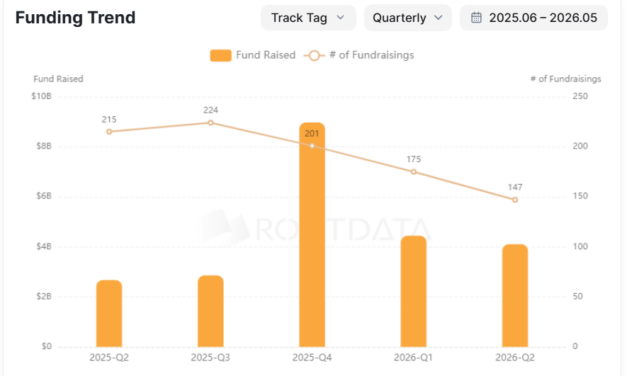
Crypto startup Fomo has raised $75 million in a Series B funding round led by venture capital firm Index Ventures, which valued the social trading and token discovery platform at $550 million.The funding round also received participation from Union Square Ventures and the company’s existing investor, Benchmark, along with angel investors including Zynga co-founder Mark Pincus, Eventbrite co-founder Kevin Hartz, Discord CEO Humam Sakhnini, Nexos AI co-founder Tomas Okmanas and others, Fomo announced on Monday.Fomo allows users to trade assets across multiple blockchains without having to manually bridge funds or handle gas fees. The company said it has attracted more than 625,000 traders since launching a year ago, generating $4 billion in trading volume and 110 million social interactions.The raise adds to a growing list of crypto venture deals in 2026, even as digital asset prices remain below recent highs. According to RootData, crypto startups raised $4.1 billion across 147 funding rounds during the second quarter.Crypto and Web3 funding by quarterly sum. Source: Root DataFomo says 68,000 users made first crypto purchase on platformFomo said more than 68,000 users made their first cryptocurrency purchase on the platform using Apple Pay, representing roughly $25 million in transaction volume.Related: Kalshi in early IPO talks with investment banks: ReportCrypto research firm Delphi Digital said in a December X post that the platform’s social features may be helping attract users by making trading feel “more like scrolling a feed than sitting at a terminal.”“In November, @fomo_family generated more monthly fees than Moonshot, despite being a younger product with lower fees,” Delphi Digital wrote.Source: Delphi DigitalFomo allows users to view trades made by other users in real time and execute similar trades across multiple blockchains without manually bridging assets or managing separate wallets.Other crypto exchanges offering copy-trading features include Binance, Bybit, OKX, Bitget, BingX, MEXC, Gate.io, KuCoin, Phemex and BitMart.On June 11, Fomo launched perpetual futures contracts powered by Hyperliquid for users outside the United States. On June 2, the company said it had surpassed $2 million in referral fees paid to users.Magazine: The legal battle over who can claim DeFi’s stolen millions 

Čítaj viac

Q2 2026 emerges as most-hacked quarter on record with 83 incidents

The second quarter of 2026 has already become the most-hacked quarter on record by incident count, with 83 exploits targeting cryptocurrency protocols, according to analysis by market insights platform Unfolded based on DefiLlama data.However, the $755.3 million stolen during the quarter so far is significantly lower than the $3.56 billion lost in the fourth quarter of 2020, which remains the costliest quarter on record for crypto hacks.KelpDAO’s $293 million hack and Drift Protocol’s $280 million exploit were the largest incidents of the quarter.The figures suggest hacking activity is becoming more frequent, even as total losses remain below previous record levels.Cryptocurrency hacks by monthly sum, all-time chart. Source: DefiLlamaThe rising incident count and lower aggregate losses may reflect a smaller pool of value available to attackers, according to Dmytro Tarasiuk, product director at risk intelligence platform CORE3 and crypto security rating platform CER.live. He noted that total value locked in DeFi has fallen from $164 billion before the Oct. 10 liquidation event to about $73 billion at press time.The industry’s most pressing vulnerability remains that protocols are re-engineered faster than their underlying risk management complexity, which often means that projects “declare a [three-of-six] multisig [and] store [three] keys on one laptop,” leading to more operational vulnerabilities, he told Cointelegraph.Bridge exploits emerged as the leading attack vector in Q2 2026Cross-chain bridge exploits emerged as the biggest attack vector of the quarter, with $351 million in value hacked from bridges alone.The LayerZero OFT bridge exploit, which led to the $293 million KelpDAO hack, accounted for more than 38% of the value stolen during the quarter. Compromised admin attacks and fake token price manipulation accounted for 37% of losses, while private key compromises represented 5.66%.Total hacked by technique in Q2 2026. Source: DefiLlamaEthereum layer-2 blockchain Taiko was the latest network to suffer an exploit on one of its bridge protocols, as hackers stole $1.7 million by compromising Taiko’s chain state verification mechanism.Related: Humanity Protocol’s $36M loss tied to suspected North Korean hackers: QuantstampOther notable incidents of the past quarter include the $36 million stolen from Humanity Protocol on June 8 and the $10.7 million exploit on THORChain on May 15.Other recent incidents include two exploits on Aztec Connect’s abandoned smart contracts, each resulting in $2.1 million stolen and $1.3 million stolen from decentralized exchange Raydium earlier in June.The incidents add to the ongoing debate about whether the development of new artificial intelligence models has reshaped the crypto industry’s security landscape, concerns that arose from the series of exploits in April.During a recent interview, Mitchell Amador, the CEO of bug bounty platform Immunefi, told Cointelegraph that the proliferation of new AI models has shifted the cybersecurity playing field in favor of attackers, causing a “vulnerability apocalypse” that led to the resurgence in exploits.Magazine: Coinbase hack shows the law probably won’t protect you — Here’s why

Čítaj viac

Q2 2026 emerges as most-hacked quarter on record with 83 incidents

The second quarter of 2026 has already become the most-hacked quarter on record by incident count, with 83 exploits targeting cryptocurrency protocols, according to analysis by market insights platform Unfolded based on DefiLlama data.However, the $755.3 million stolen during the quarter so far is significantly lower than the $3.56 billion lost in the fourth quarter of 2020, which remains the costliest quarter on record for crypto hacks.KelpDAO’s $293 million hack and Drift Protocol’s $280 million exploit were the largest incidents of the quarter.The figures suggest hacking activity is becoming more frequent, even as total losses remain below previous record levels.Cryptocurrency hacks by monthly sum, all-time chart. Source: DefiLlamaThe rising incident count and lower aggregate losses may reflect a smaller pool of value available to attackers, according to Dmytro Tarasiuk, product director at risk intelligence platform CORE3 and crypto security rating platform CER.live. He noted that total value locked in DeFi has fallen from $164 billion before the Oct. 10 liquidation event to about $73 billion at press time.The industry’s most pressing vulnerability remains that protocols are re-engineered faster than their underlying risk management complexity, which often means that projects “declare a [three-of-six] multisig [and] store [three] keys on one laptop,” leading to more operational vulnerabilities, he told Cointelegraph.Bridge exploits emerged as the leading attack vector in Q2 2026Cross-chain bridge exploits emerged as the biggest attack vector of the quarter, with $351 million in value hacked from bridges alone.The LayerZero OFT bridge exploit, which led to the $293 million KelpDAO hack, accounted for more than 38% of the value stolen during the quarter. Compromised admin attacks and fake token price manipulation accounted for 37% of losses, while private key compromises represented 5.66%.Total hacked by technique in Q2 2026. Source: DefiLlamaEthereum layer-2 blockchain Taiko was the latest network to suffer an exploit on one of its bridge protocols, as hackers stole $1.7 million by compromising Taiko’s chain state verification mechanism.Related: Humanity Protocol’s $36M loss tied to suspected North Korean hackers: QuantstampOther notable incidents of the past quarter include the $36 million stolen from Humanity Protocol on June 8 and the $10.7 million exploit on THORChain on May 15.Other recent incidents include two exploits on Aztec Connect’s abandoned smart contracts, each resulting in $2.1 million stolen and $1.3 million stolen from decentralized exchange Raydium earlier in June.The incidents add to the ongoing debate about whether the development of new artificial intelligence models has reshaped the crypto industry’s security landscape, concerns that arose from the series of exploits in April.During a recent interview, Mitchell Amador, the CEO of bug bounty platform Immunefi, told Cointelegraph that the proliferation of new AI models has shifted the cybersecurity playing field in favor of attackers, causing a “vulnerability apocalypse” that led to the resurgence in exploits.Magazine: Coinbase hack shows the law probably won’t protect you — Here’s why

Čítaj viac

Kalshi in early IPO talks with investment banks: Report

Prediction market Kalshi is reportedly in early, informal talks with investment banks about an initial public offering (IPO), despite increasing regulatory scrutiny over sports betting contracts on these platforms.Kalshi is in early-stage talks to go public via an IPO after the platform surpassed $2 billion in annualized revenue, unidentified sources familiar with the matter told news outlet The Informant, according to a Friday report.A spokesperson for Kalshi declined to comment on the matter.The reported IPO discussions come as sports betting contracts account for more than half of Kalshi’s weekly notional trading volume, even as those markets face mounting legal challenges from US states.Sports betting contracts were the leading category on Kalshi, representing about 53% of its weekly notional trading volume, according to Dune data. Sport-related betting was also the leading category on Polymarket, accounting for about 69% of its weekly trading volume.Kalshi doubled its valuation to reach $22 billion after closing a $1 billion Series F funding round led by Coatue Management, Cointelegraph reported on May 7.Kalshi weekly notional volume by category. Source: DuneUS regulators are cracking down on sports-related prediction market contractsKentucky became the latest state to sue five prediction markets, including Kalshi and Polymarket, accusing them of “operating unlicensed and illegal sports betting and gambling platforms,” Cointelegraph reported on Thursday.Related: Polymarket users cry foul after Strategy sale market resolves to ‘no’At least 17 other states have taken prediction market operators to court, attracting the involvement of the US Commodity Futures Trading Commission (CFTC).State authorities argue that sports event contracts require state-level licenses, while prediction markets claim their event contracts are swaps regulated under federal commodities law.The CFTC also argued that event contracts qualify as “swaps” as they are based on binary events. On May 14, the CFTC issued a no-action letter seeking to ease event contract reporting rules.CFTC no-action letter on prediction markets. Source: CFTC.govThe CFTC has sued at least five states in a bid to cement its authority over prediction markets, including Wisconsin, New York, Arizona, Connecticut and Illinois.Magazine: The legal battle over who can claim DeFi’s stolen millions  

Čítaj viac

Získaj BONUS 8 € v Bitcoinoch

nakup bitcoin z karty

Registrácia Binance

Burza Binance

Aktuálne kurzy

