Autor Zoltan Vardai

CBOE debuts prediction market with S&P 500 contracts

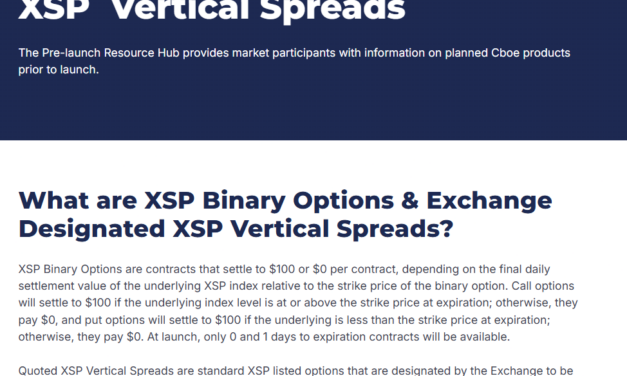
Market operator Cboe Global Markets has entered the prediction markets business with the launch of Cboe Predicts, a platform debuting with binary contracts tied to the S&P 500.The contracts are now available through Interactive Brokers and are expected to launch at Charles Schwab and other retail brokerage platforms in the coming months, according to a Tuesday press release.The contracts allow traders to take “yes” or “no” positions on whether the S&P 500 will close above or below a specified price level.Cboe is the latest traditional finance firm to expand into prediction markets as investor interest in outcome-based contracts grows. The launch comes days after reports that Charles Schwab was seeking to enter the sector through a partnership with Cboe that would offer customers similar S&P 500-linked contracts.Contracts tied to the S&P 500’s daily closing price are already available on prediction market platforms such as Polymarket and Kalshi.Cboe launches XSP Binary Options in prediction markets offering. Source: CboeTraders seek more binary event contractsCboe’s customers are showing more demand for shorter-dated, outcome-based trading opportunities, which led to the debut of the prediction market offering, according to JJ Kinahan, head of retail expansion and alternative investment products at Cboe. Cboe’s new contracts are security options that will trade within the same regulatory framework as US-listed options, providing “institutional-grade liquidity” and transparency, Cboe said.Related: Kalshi adds India to growing list of restricted jurisdictionsMeanwhile, prediction market platforms have drawn increased regulatory scrutiny over political betting and sports-related event contracts.Kentucky was the latest state to sue five prediction market platforms, including Kalshi and Polymarket, accusing them of “operating unlicensed and illegal sports betting and gambling platforms,” as Cointelegraph reported on Thursday.In January, US lawmakers proposed legislation aimed at restricting political prediction market trading by government officials after a Polymarket user netted over $400,000 on a contract related to the removal of then-Venezuelan President Nicolás Maduro, fueling insider trading concerns.Magazine: Should users be allowed to bet on war and death in prediction markets? 

Čítaj viac

CryptoQuant warns on Strategy's dividend coverage as cash reserve falls 38%

After Strategy’s dividend coverage fell to 14 months from seven years, CryptoQuant said the company led by Michael Saylor should pause Bitcoin purchases and focus on replenishing its cash reserve that’s down 38% year-to-date.Strategy’s dividend obligations have nearly quadrupled to $1.2 billion, as the company issued substantial new STRC preferred stock, which carries an 11.5% yield. “They should pause Bitcoin purchases, rebuild cash reserves, and adopt a systematic framework for purchase timing,” wrote the market data analytics provider’s CEO Ki Young Ju in a Wednesday X post, adding that the biggest public Bitcoin treasury holder should also create a “disciplined selling framework” for the next bull market.Strategy’s cash reserve fell 38% after the company repurchased $1.5 billion of its 2029 senior notes at a discount, Cointelegraph reported on May 26. Those coffers have since recovered to $1.4 billion after it sold $335.5 million in MSTR shares, which added $300 million to its US dollar reserve on Monday, although it is near a record-low of 14 months’ of funds available to pay dividends. STRC preferred shares hit by BTC correction Strategy’s income-generating preferred stock, STRC, fell to $82.50 last week, a record 17.5% below its $100 par value. CryptoQuant’s report attributed it to the Bitcoin bear market correction and the “simultaneous depletion” of its cash reserve.STRC is one of Strategy’s main mechanisms to fund its Bitcoin accumulation. Trading below par limits Strategy’s ability to raise funds through STRC sales. It may also force the company to increase its nominal dividend rate to attract buyers and protect STRC’s price.The company said it plans to “continue replenishing” its USD reserve to “support the credit quality of its Digital Credit securities,” according to a Monday X post. Cointelegraph’s request for comment on Strategy’s plans to replenish the cash reserve and whether this could help STRC’s price recover was not immediately replied to by the company.Strategy cash reserve and dividend coverage in months. Source: CryptoQuantNo obligation to sell Bitcoin to support STRC priceCryptoQuant said Strategy is not “obligated” to sell Bitcoin to maintain STRC’s price, as the company can also deploy other tools to defend the stock, such as raising the current 11.5% dividend yield or issuing MSTR stock to “signal its ability to continue paying dividends,” adding:“However, the path back to $100 is not straightforward.[…] Rebuilding the cash reserve to ~$2.8 billion (24 months of coverage) is a necessary condition for STRC to recover.” Strategy’s Bitcoin holdings only provide a “limited emergency cushion,” as the company is sitting on about $10.6 billion in unrealized losses, meaning that a forced BTC sale at current rates would “crystallize large losses and destroy shareholder value,” CryptoQuant said. Related: Capital B shareholders approve up to $120B in financing capacity for Bitcoin strategyAhead of Wednesday’s Nasdaq market open, STRC shares were little changed after closing at $87.31 on Tuesday. That extended the preferred stock’s 12% decline in the past month, according to Yahoo Finance data.STRC/USD, 1-month chart. Source: Yahoo Finance CryptoQuant’s head of research, Julio Moreno, attributed STRC’s decline to a “deterioration in Strategy’s fundamentals,” including its falling dividend cash coverage caused by the depletion of its cash reserve and a fourfold increase in STRC’s annualized dividend obligations so far in 2026. Magazine: Bitcoin, the ‘canary in the coal mine,’ XRP transaction demand falls 91.5%: Market Moves

Čítaj viac

Kalshi adds India to growing list of restricted jurisdictions

Prediction market Kalshi has added India to its list of restricted jurisdictions, according to a members’ agreement document updated on Wednesday.The document now lists a total of 55 restricted jurisdictions whose residents are blocked from accessing the platform.India’s Ministry of Electronics and Information Technology warned virtual private network (VPN) providers in April to stop facilitating access to “illegal and blocked online betting and prediction market platforms.”The development adds to growing regulatory pressure on prediction markets. In May, Spanish authorities blocked access to Polymarket and Kalshi over local gambling laws, while Indonesia blocked access to Polymarket after the platform listed contracts on whether President Prabowo Subianto would leave office before the end of his term.Other countries, including Singapore, Poland, Portugal, Hungary, Ukraine and Brazil, have also blocked or prohibited prediction market platforms such as Kalshi and Polymarket.Kalshi updated the members’ agreement document. Source: KalshiPrediction markets face scrutiny over sports and political contractsPolitical betting and sports-related event contracts have drawn increased regulatory scrutiny.In January, US lawmakers proposed legislation aimed at restricting political prediction market trading by government officials after a Polymarket user netted over $400,000 on a contract related to the removal of then-Venezuelan President Nicolás Maduro, fueling insider trading concerns.Kentucky was the latest state to sue five prediction market platforms, including Kalshi and Polymarket, accusing them of “operating unlicensed and illegal sports betting and gambling platforms,” as Cointelegraph reported on Thursday.Related: Kalshi in early IPO talks with investment banks: ReportKalshi and Polymarket are two of the largest prediction market platforms, with $3.7 billion and $3.2 billion in weekly trading volume, respectively.Kalshi and Polymarket, key stats, top categories. Source: Defirate.com Sports betting was the largest category on both platforms, accounting for $328 million in daily volume for Kalshi and $196 million for Polymarket, according to data from Defirate.Magazine: Should users be allowed to bet on war and death in prediction markets?

Čítaj viac

Former BIS chief softens stance on stablecoins, backs coexistence with fiat

Agustín Carstens, former general manager of the Bank for International Settlements (BIS) and a member of the Global Finance & Technology Network’s international advisory board, praised stablecoins for their ability to promote financial inclusion and innovation.“I have come to appreciate what stablecoins can do to promote financial innovation, inclusion and to reduce costs,” said Carstens during a welcome address at Point Zero Forum on Tuesday. “We should try to establish conditions where we can live with fiat money and stablecoins.”The remarks reflected a softer stance on stablecoins than Carstens took during his time at the BIS, when he was among the most prominent crypto critics. In a January 2022 speech, he said that stablecoins may not function as “sound money” because issuers have incentives to invest reserve assets in a “risky manner” to generate returns.In one of his final speeches as BIS general manager in June 2025, Carstens also warned that stablecoins could emerge as a source of liquidity risk and still fell short of the three key tests money must fulfill to serve society.Agustín Carstens during a livestreamed welcome address at the Point Zero Forum. Source: Point Zero ForumWhile Carstens has taken a more favorable view of stablecoins, current BIS officials have remained critical of their role in the broader financial system.Carstens’ successor and current BIS general manager, Pablo Hernández de Cos, said in April that the stablecoin market remains “small” and that its structural features constrain its ability to function as money.Related: JPMorgan, Citi-backed Clearing House plans tokenized deposit network in 2027: WSJThe BIS reiterated that view in a preview released Tuesday ahead of its Annual Economic Report 2026, arguing that current stablecoin designs fall short of key properties that underpin trust in money and warning that widespread adoption could create challenges for financial stability, bank funding and monetary sovereignty.However, the BIS endorsed bringing tokenization into the two-tier banking system, arguing that digital representations of assets could enable new forms of programmable finance while preserving trust in money.Stablecoins need global regulation to flourishThe traditional financial system can benefit from stablecoins, distributed ledger technology and tokenization, but a coordinated global regulatory framework is needed to strengthen trust in stablecoin issuers, according to Carstens, who added:“If we really want a global system where stablecoins can interact with global currency, this has to be a cooperative effort worldwide. And I see this lagging behind.” He said that more regulations and a level playing field for issuers could help stablecoins “flourish in a dramatic way.”Several major jurisdictions have already introduced stablecoin-specific rules. The GENIUS Act created the first federal regulatory framework for payment stablecoins in the US. Signed into law in July 2025, it requires 100% reserves in high-quality liquid assets such as cash and short-term US Treasurys.In the European Union, stablecoin issuers are regulated under the Markets in Crypto-Assets Regulation (MiCA). The framework requires issuers to obtain authorization, publish an approved white paper, maintain full reserve backing and segregate reserve assets from company funds.Magazine: Kraken’s $600M stablecoin firm, Huione scandal deepens: Asia Express

Čítaj viac

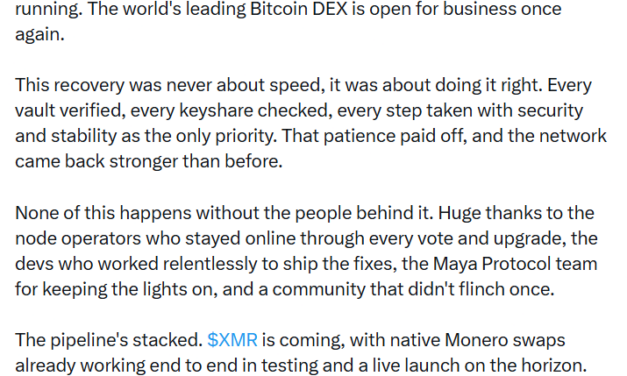
THORChain resumes trading more than a month after $10M exploit

THORChain has resumed activity after over a month of security verifications and upgrades, following a $10.7 million exploit that prompted a trading halt on May 15.In a Tuesday X post, THORChain said it restored its network, including trading, signing, swaps and liquidity provider actions.On Sunday, the protocol said it had confirmed the safety of most of its vaults through the KeyVerify protocol and retired the remaining legacy vaults as part of a migration to a new set of vaults. THORChain called the upgrade the “most significant milestone” in its recovery process. It also said it completed verification of every node’s keyshare on Friday.THORChain is one of the crypto industry’s largest cross-chain trading protocols, enabling swaps between networks such as Bitcoin and Ethereum. The protocol has drawn scrutiny from blockchain investigators because hackers have used it to move stolen funds between blockchains.Source: THORChainTHORChain ships security upgrades and migrates old vaultsTHORChain attributed the exploit to a vulnerability in its GG20 threshold signature scheme, which is used to secure protocol vaults by distributing key control across multiple node operators. According to the protocol, the flaw allowed a malicious node operator to reconstruct a full private key through what it described as “progressive key material leakage,” enabling the theft of $10.7 million.Related: Kelp DAO exploiter launders nearly all 75,700 in stolen ETH through THORchainThe protocol implemented an emergency patch on May 20 to protect the remaining vaults before releasing an upgrade on June 9, which included a fix for the exploited vulnerability. A follow-up upgrade was rolled out on June 11 with additional stability improvements and fixes to the KeyVerify protocol.THORChain network overview, node upgrades. Source: THORChain ExplorerWith the recovery process largely complete, THORChain has also outlined plans for new network integrations.THORChain said it will launch native swaps and vaults for privacy-preserving cryptocurrency Zcash (ZEC) within the next two weeks, followed by Monero (XMR).It also plans to launch support for the Bittensor (TAO) token in about six weeks after the network’s restart.Magazine: 53 DeFi projects infiltrated, 50M NEO tokens could be ‘given back’: Asia Express  Cointelegraph is committed to independent, transparent journalism. This news article is produced in accordance with Cointelegraph’s Editorial Policy and aims to provide accurate and timely information. Readers are encouraged to verify information independently.

Čítaj viac

Získaj BONUS 8 € v Bitcoinoch

nakup bitcoin z karty

Registrácia Binance

Burza Binance

Aktuálne kurzy