Autor Turner Wright

CME Group sues CFTC over crypto perpetual futures

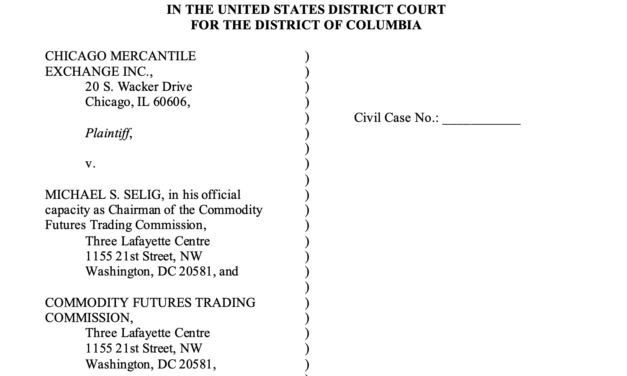
The Chicago Mercantile Exchange (CME) Group said it was taking legal action against the US Commodity Futures Trading Commission (CFTC) over cryptocurrency perpetual futures.In a Thursday filing in the US District Court for the District of Columbia, CME filed a complaint against the CFTC and its chair Michael Selig over the agency’s regular approvals of perpetual futures tied to crypto. The lawsuit stemmed from a May 29 notice from the CFTC approving perpetual futures contracts tied to the spot price of Bitcoin (BTC) for prediction markets platform Kalshi and issuing a no-action position for similar products on cryptocurrency exchange Coinbase.According to CME’s filing, the CFTC’s approval of such products went against directives from the US Congress by treating “futures” as “swaps” with expiration dates. The company alleged that the agency was in violation of the Commodity Exchange Act and a court should vacate its actions over perpetual futures, noting that Selig had unilaterally acted without a full panel of five CFTC commissioners.“With one stroke of his pen, [Selig] overrode Congress’s definition of the term ‘swap’ and circumvented the regulatory regime Congress required for that form of derivative,” said the complaint, adding:“The CFTC’s failure to evenhandedly, consistently, and correctly apply the CEA risks harming competition and destabilizing derivatives markets.”Source: PACERThe lawsuit came just one day after CME CEO Terrence Duffy said that the company would be taking legal action against the CFTC. In a Monday CNBC interview, Selig said that perpetual futures contracts “trade very similarly” to others, describing the CFTC’s position as “good for investors” and claiming that the Commodity Exchange Act “does not define the term ‘futures contract.’”A CFTC spokesperson told Cointelegraph that CME had engaged in “lawfare” against the agency and the administration’s crypto policies, calling the complaint “frivolous.”Related: ICE, CME press US regulators to ‘rein in’ Hyperliquid energy trading: ReportKraken also announced the launch of perpetual futures trading for US users through CFTC-regulated platform Bitnomial. CME CEO Terry Duffy. Source: CNBC Fast MoneySelig acts alone on prediction markets, perpetual futures, CFTC agendaConfirmed by the US Senate in December 2025, Selig remains the chair and sole commissioner at the CFTC in a leadership panel intended to consist of a bipartisan group of five people. As of Thursday, US President Donald Trump had not announced any nominations to fill the seats, despite urging from many members of Congress to do so.Magazine: OpenAI files for IPO, SEC scraps 611 rule and Hungary overhauls crypto: Hodlers Digest June 7-13Cointelegraph is committed to independent, transparent journalism. This news article is produced in accordance with Cointelegraph’s Editorial Policy and aims to provide accurate and timely information. Readers are encouraged to verify information independently.

Čítaj viac
Gaming groups urge Congress to ban prediction markets sports betting in CLARITY Act

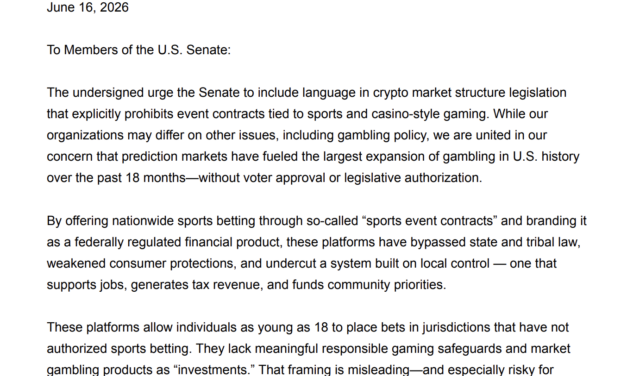
Several national gaming and tribal organizations and labor groups have reportedly called on the US Senate to add language “that explicitly prohibits event contracts tied to sports and casino-style gaming” in the Digital Asset Market Clarity (CLARITY) Act.According to a Wednesday Semafor report, groups tied to sports betting, including the Indian Gaming Association and American Gaming Association have united against what they called gambling on prediction markets. They requested that the US Congress use the CLARITY Act now under consideration in the Senate to affirm that “sports betting falls outside the [Commodity Futures Trading Commission’s] remit and cannot be offered through prediction market platforms.”“While our organizations may differ on other issues, including gambling policy, we are united in our concern that prediction markets have fueled the largest expansion of gambling in US history over the past 18 months — without voter approval or legislative authorization,” said the letter.Source: SemaforThe pushback from the groups comes as the Commodity Futures Trading Commission (CFTC) under Chair Michael Selig has claimed “exclusive jurisdiction” over prediction markets. Selig has led the financial regulator in supporting platforms like Kalshi and Polymarket against lawsuits by state-level gaming authorities.“The CFTC was created to oversee commodities and derivatives markets, not gambling and not sports wagering,” said the letter. “It lacks both the expertise and the infrastructure to police nationwide sports betting, particularly when robust state and tribal regulatory systems already exist.”The American Gaming Association reported that as of Wednesday, state gaming authorities had lost about $1.08 billion in tax dollars “since prediction markets began offering sports event contracts.”Related: Kalshi adds software partner as it looks to boost prediction market surveillanceSome lawmakers expect the CLARITY Act, aimed at transferring some of the authority in regulation and enforcement of digital assets from the Securities and Exchange Commission (SEC) to the CFTC, to be passed out of Congress by August. The bill passed the House of Representatives in July 2025, but has faced delays due to concerns over stablecoin yield, ethics and tokenized equities. Legal fight could land in US Supreme CourtSome experts and industry advocates anticipate that with Selig and the CFTC threatening to take any state-level authorities to court over crackdowns on prediction markets, the dispute between federal and state regulators could eventually be heard by the US Supreme Court. The country’s highest court gave individual states the authority to regulate sports gambling in its 2018 decision in Murphy v. National Collegiate Athletic Association. However, Kalshi, Polymarket and the CFTC have largely argued that event contracts on prediction market platforms are “swaps” only subject to the agency’s jurisdiction.Magazine: The end of anon? AI could unmask crypto’s hidden identities

Čítaj viac

Crypto-backed GOP candidate wins Alabama Senate runoff with June primaries looming

More than $12 million in crypto-aligned political action committee (PAC) media buys helped propel Barry Moore to victory in Tuesday’s Alabama Republican US Senate runoff over Barry Moore.The runoff was necessary after neither candidate was able to secure a majority of the vote on May 19, Moore will be the Republican candidate for a US Senate seat in Alabama, facing off against Democrat Everett Wess. Moore won with 55.8% of the vote to Hudson’s 44.2%, giving him an opportunity to replace outgoing Republican Senator Tommy Tuberville. Filings with the Federal Election Commission (FEC) showed that the Defend American Jobs PAC, a committee affiliated with the cryptocurrency company-backed Fairshake, spent more than $12 million on media and ads to back Moore’s candidacy in the May 19 primary and Tuesday’s runoff. The Coinbase-affiliated advocacy organization Stand With Crypto rated Moore as “strongly supports crypto,” based on public statements and his voting record while representing Alabama’s 1st Congressional district.“Our biggest spend of the cycle yielded yet another pro-innovation champion in the Senate, and with nearly $150 million cash on hand we are ready to continue driving the construction of the largest pro-crypto caucus in history,” said Fairshake spokesperson Geoff Vetter.Source: NBC NewsRelated: US lawmakers warn against presidential pardon for Sam Bankman-FriedBased on Vetter’s statement, Fairshake and its affiliates may have spent more than $40 million across several US states in an attempt to support what it considers “pro-crypto” candidates for the next session of Congress. The PAC reported holding a $193 million war chest as of January.More primaries set for next week before November general electionThe Alabama runoff was the latest vote that’s seen industry PACs spending millions of dollars on media for candidates facing primaries in several US states, including South Carolina, Texas, California, South Dakota and New Jersey. Fairshake affiliate Protect Progress also reported spending about $5.2 million and $587,000 in media buys for House seats, respectively, for Maryland Democrat Adrian Boafo and fellow party member Ritchie Torres in New York, scheduled to hold primaries on June 23.Magazine: The end of anon? AI could unmask crypto’s hidden identitiesCointelegraph is committed to independent, transparent journalism. This news article is produced in accordance with Cointelegraph’s Editorial Policy and aims to provide accurate and timely information. Readers are encouraged to verify information independently.

Čítaj viac
US lawmakers warn against presidential pardon for Sam Bankman-Fried

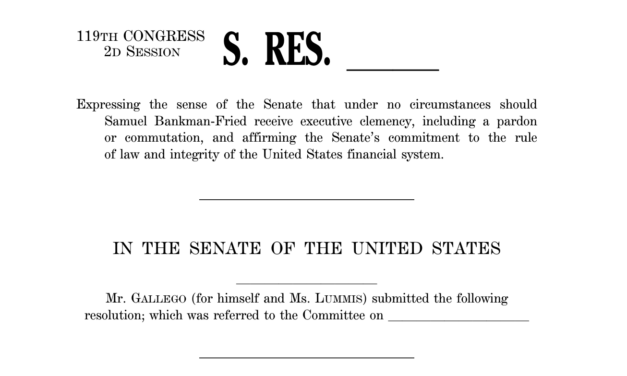
Two US lawmakers on opposite sides of the political aisle are backing a resolution that “under no circumstances should Samuel [SBF] Bankman-Fried receive executive clemency, including a pardon or commutation.”In a resolution to be introduced Wednesday, Republican Senator Cynthia Lummis and Democratic Senator Rubén Gallego warned that should US President Donald Trump grant SBF’s request for a pardon, it would “erase [his] conviction […] weaken deterrence, and send a deeply damaging message that perpetrators of large-scale financial fraud can escape permanent accountability.” The resolution would be non-binding, as a US president’s pardon power is enshrined in the Constitution.“[The US Senate] affirms that the 25-year sentence imposed upon Bankman-Fried reflects the extraordinary scale and deliberateness of his crimes, his lack of remorse, and the catastrophic harm inflicted upon millions of victims, and that such a sentence serves the interests of justice,” read the resolution.Source: Senator Rubén GallegoThe resolution came after Bankman-Fried formally applied for a pardon from Trump of his conviction on seven felony counts related to the misuse of FTX user funds. Last week, a federal appeals court upheld that conviction and sentence, leaving his only legal path forward a presidential pardon or an appeal to the US Supreme Court.Bankman-Fried was convicted in November 2023 following the collapse of cryptocurrency exchange FTX a year earlier, which resulted in investor losses totaling billions of dollars. He was later sentenced to 25 years in prison. Related: Onchain, in court: What happened in crypto legal news this weekFollowing his sentencing in March 2024, the former CEO posted several messages to social media aligning with Trump’s political agenda, including US military actions in Venezuela and Iran. However, in a January interview with the New York Times, the president said he had no plans to pardon Bankman-Fried.Source: Sam Bankman-FriedCointelegraph sought comment from Gallego’s office but did not receive an immediate response. A spokesperson for Lummis said that the senator “wants him to know that her and her colleagues think Mr. Fried is right where he belongs” by introducing the resolution.Other FTX figures still serving timeAlthough some of the former executives of the defunct cryptocurrency exchange were sentenced to time served in exchange for their cooperation and testimony at SBF’s trial, one is still in federal prison, and another was released earlier this year. Caroline Ellison, the former CEO of Alameda Research, received a two-year sentence in 2024 and was given an early release in January after 14 months. FTX former engineering director Nishad Singh and co-founder Gary Wang were both sentenced to time served. All testified against SBF at trial.Ryan Salame, the co-CEO of FTX Digital Markets, was sentenced to 90 months in prison related to unlawful political contributions and conspiracy to operate an unlicensed money-transmitting business. His wife, Michelle Bond — though not an FTX employee — was recently indicted on charges related to her 2022 run for Congress allegedly financed with illegal campaign contributions from the crypto exchange.Magazine: The end of anon? AI could unmask crypto’s hidden identities

Čítaj viac

Onchain, in court: What happened in crypto legal news this week

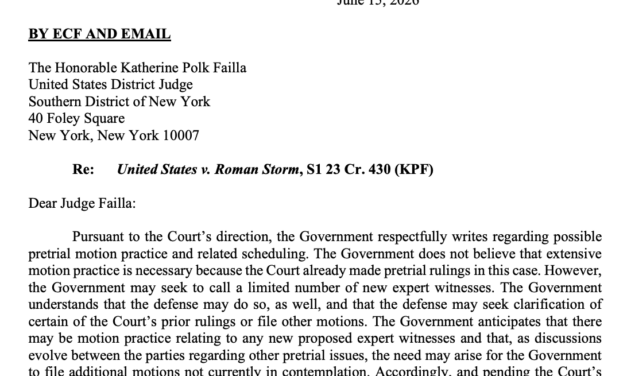
US prosecutors propose late 2026 retrial for Tornado Cash co-founderFederal prosecutors on Monday submitted a proposed schedule for the potential retrial of Tornado Cash co-founder and developer Roman Storm to begin later this year. Storm was found guilty on one of three charges related to illegal money transmitting in 2025, but a jury deadlocked on two other charges, setting the stage for a potential retrial.US Attorney for the Southern District of New York (SDNY) Jay Clayton Clayton proposed an Oct. 20 final pretrial conference in Storm’s case, signaling a potential trial start date of late October or November 2026. The filing noted that the timeline was subject to the court’s decision on a Rule 29 motion filed by Storm requesting acquittal of the remaining charges.Source: PACERStorm’s case continues to draw attention from many in the crypto industry given the implications for developers potentially being held criminally liable for code they write. Should a retrial be scheduled, the Tornado Cash co-founder could face the two remaining charges of conspiracy to commit money laundering and conspiracy to violate sanctions again.Judge sets 60-day deadline for prosecutors to respond to Celsius CEO’s motion to vacate sentenceAlex Mashinsky, the former CEO of cryptocurrency lending platform Celsius who said he would be representing himself in court, could receive an answer to his pro se motion to vacate his 12-year sentence before the end of the year.In a Saturday filing in the US District Court for SDNY, Judge John Koeltl granted a motion giving prosecutors until mid-August to respond to Mashinsky’s request to vacate his sentence. The 60-day deadline followed the former Celsius CEO requesting the judge vacate his May 2025 sentence, which resulted in Mashinsky reporting to federal prison.Mashinsky, once one of the most recognizable figures in the crypto industry, was indicted in 2023 with his cohort Roni Cohen-Pavon on charges related to fraud and market manipulation. Celsius filed for bankruptcy in 2022 amid the crypto market downturn that resulted in the collapse of exchanges including FTX and Voyager Digital.Related: Sam Bankman-Fried loses appeal to overturn 25-year prison sentenceThe former CEO was ordered to pay $48 million in forfeiture as part of his criminal case. Cohen-Pavon was sentenced to time served but ordered to pay more than $1 million and a $40,000 fine.Judge sets December 2026 trial for US soldier in Polymarket insider trading caseGannon Ken Van Dyke, the US soldier charged after allegedly making more than $400,000 on a Polymarket event contract related to the capture of Venezuela President Nicolás Maduro, is looking at a December 2026 trial after his April arrest. In a June 10 SDNY filing, Judge Margaret Garnett ordered pretrial motions for US prosecutors and defense attorneys in Van Dyke’s case, culminating in jury selection scheduled for Dec. 7. The soldier allegedly used nonpublic information to profit off the removal of Maduro in January, when US forces entered his residence in Caracas and extradited him to the United States to face criminal charges.The Van Dyke case carries potential implications for Polymarket and other prediction markets platforms facing scrutiny from US lawmakers calling for elected officials to be barred from potentially betting on events with classified or nonpublic information. Van Dyke has pleaded not guilty to all charges.Magazine: Bitcoin, the ‘canary in the coal mine,’ XRP transaction demand falls 91.5%: Market Moves

Čítaj viac

Získaj BONUS 8 € v Bitcoinoch

nakup bitcoin z karty

Registrácia Binance

Burza Binance

Aktuálne kurzy