

Autor Turner Wright

Andrew Cuomo to lead joint TradFi-crypto venture between OKX and Intercontinental Exchange

Cryptocurrency exchange OKX and the Intercontinental Exchange (ICE), parent company of the New York Stock Exchange, announced that former New York Governor Andrew Cuomo would co-lead a joint venture focused on digital assets.In a Monday notice, OKX and ICE said Cuomo, who lost his bid to be New York City’s mayor in 2025, would co-chair the joint project between the two companies “focused on building next-generation infrastructure for tokenized and digitally native financial products.” The venture, which the companies said would allow OKX users to “access ICE futures and NYSE tokenized equities markets,” is subject to regulatory approval. Cuomo has largely been out of the public eye since his failed 2025 mayoral run, in which he said he intended to make New York City the “global capital for cryptocurrency.” He had the endorsement of the crypto-aligned Innovate NY political action committee (PAC), but lost to Democratic candidate Zohran Mamdani, who secured more than 50% of the vote. The former governor began working with OKX in 2023.The joint venture notice followed a partnership between ICE and OKX announced in March in which the former invested an undisclosed amount in the exchange at a $25 billion valuation. ICE’s ventures into the crypto industry also included a $2 billion investment pledge into prediction markets platform Polymarket.Related: NYSE owner ICE to launch oil-linked futures with OKXSince taking office on Jan. 1, Mamdani has not announced any significant policies related to crypto or blockchain. He confirmed in January that he holds no digital assets as New York City mayor.New York to hold party primaries on TuesdayOn Tuesday, New York, Utah and Maryland will hold primaries to determine candidates for US House of Representatives and Senate seats in the November general election. Cryptocurrency-aligned PACs, including Fairshake, have poured money into advertising and other campaign efforts to support candidates they view as favorable to the digital asset industry.Magazine: Bitcoin decouples from tech stocks, Ether eyes ‘selling wave’: Market MovesCointelegraph is committed to independent, transparent journalism. This news article is produced in accordance with Cointelegraph’s Editorial Policy and aims to provide accurate and timely information. Readers are encouraged to verify information independently.

Čítaj viac
Charles Schwab to enter prediction markets with S&P 500 wagers: WSJ

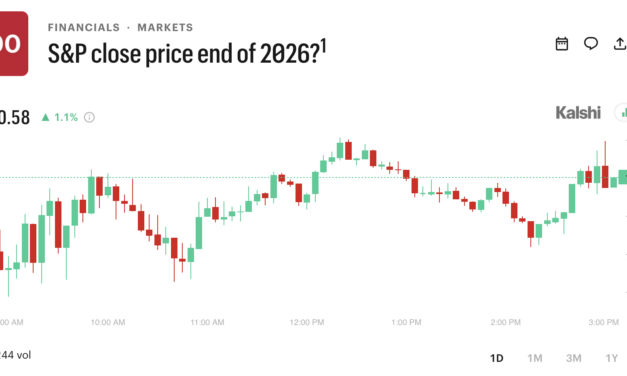
Financial services giant Charles Schwab will reportedly enter the prediction markets business by offering customers wagers on the S&P 500.According to a Friday Wall Street Journal report, Charles Schwab is planning to launch options contracts allowing users to place yes-or-no wagers on the performance of the S&P 500 stock market index. The move, expected to roll out in a matter of months as part of a partnership with Cboe Global Market, could mark the company’s first into prediction markets.Source: KalshiWhile prediction market platforms like Kalshi and Polymarket offer a variety of event contracts based on the outcome of events, including those tied to politics, sports, weather and companies, the Charles Schwab product will reportedly only include yes-or-no bets on whether the S&P 500 closes above or below a target price. Cryptocurrency exchanges like Coinbase have also moved closer to prediction offerings with many projecting the market will reach $1 trillion in annual volume by 2030.In May, Charles Schwab announced the launch of spot Bitcoin and Ether trading for retail clients, marking the company’s move deeper into digital asset services. The company reported a net income of $2.5 billion for the first quarter of 2026.Related: Republican lawmaker proposes prediction markets insider trading ban, not including White House officialsBoth Polymarket and Kalshi already offer similar event contracts related to predictions on the S&P 500. Prediction markets are still under scrutiny by lawmakersAlthough the market continues to grow, many state-level authorities and members of US Congress are calling for oversight of platforms like Kalshi and Polymarket. In addition to the potential for elected officials to profit from using nonpublic information on the platforms, many state gaming authorities have challenged their ability to offer event contracts related to sports.The US Commodity Futures Trading Commission (CFTC) under Chair Michael Selig has taken the position that event contracts on prediction markets qualify as “swaps” and the agency has exclusive jurisdiction for regulation and enforcement. Many of the cases connected to Kalshi, Polymarket, the CFTC, and state authorities continue to be litigated.Magazine: Should users be allowed to bet on war and death in prediction markets?Cointelegraph is committed to independent, transparent journalism. This news article is produced in accordance with Cointelegraph’s Editorial Policy and aims to provide accurate and timely information. Readers are encouraged to verify information independently.

Čítaj viac
Republican lawmaker proposes prediction markets insider trading ban, not including White House officials

Wisconsin Representative Bryan Steil, who chairs the House subcommittee on digital assets, introduced a law to prevent certain public officials from “wagering on public policy issues and political outcomes,” notably without mentioning lawmakers in the White House.In a Thursday notice, Steil said he had introduced the Stop Lawmakers from Predicting Act, which could bar “members of Congress, their spouses, and dependent children” from using policy-aligned event contracts on prediction markets platforms like Kalshi and Polymarket. The bill proposed that elected officials in violation pay a $2,000 fee or 10% of the value of the prohibited bets on the platforms.Source: Committee on House AdministrationThe proposed law did not specifically bar US lawmakers from using prediction markets platforms or making bets on sporting events, but prohibited wagers on specific government policies, government actions and “political outcomes,” presumably including election results. If passed by Congress and signed into law by the president, the law could take effect in 180 days after enactment.Steil’s bill was the latest attempt by members of Congress to address lawmakers potentially using insider information to profit on event contracts. The issue drew attention from many in the public after an incident involving a soldier who allegedly made more than $400,000 betting on the removal of Venezuela President Nicolás Maduro, who was ousted by US forces in January.Related: Polymarket weighs KYC requirements amid global crackdown on prediction marketsAlthough the proposed law follows attempts from other lawmakers to crack down on insider trading on prediction markets, Steil’s legislation did not extend to White House officials, including President Donald Trump and Vice President JD Vance. Trump’s son, Donald Trump Jr., is a strategic adviser to Kalshi and an adviser to Polymarket, which was also a sponsor of the UFC Freedom 250 event at the White House on Sunday. Cointelegraph reached out to Steil’s office for comment but did not receive an immediate response.Federal regulator still fighting for control of prediction marketsUnder Trump, the Commodity Futures Trading Commission (CFTC) and its chair Michael Selig have claimed that the federal agency has “exclusive jurisdiction” in the regulation and enforcement around prediction markets. The CFTC has already filed multiple lawsuits against state-level authorities restricting or banning the platforms, claiming that under the Commodity Exchange Act, event contracts can be regulated as “swaps” and not bets.Some experts believe that the legal fight could be headed to the Supreme Court next. Magazine: The end of anon? AI could unmask crypto’s hidden identities

Čítaj viac

US regulators push user ID requirements for stablecoin issuers akin to regulated banks

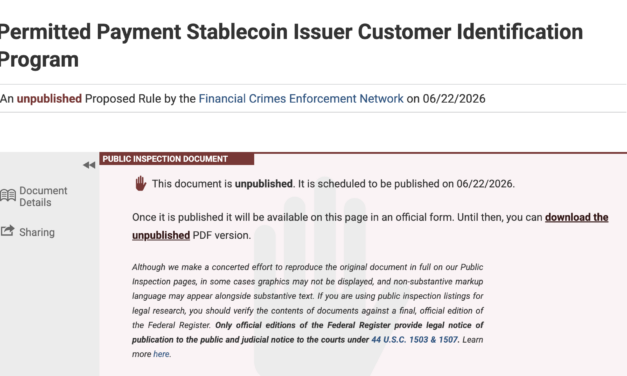
Several US government agencies responsible for financial regulation have issued a proposed rule as part of the implementation of stablecoin-focused legislation, pushing for similar identification guidelines for issuers as banks under federal law.The Federal Deposit Insurance Corporation (FDIC), Federal Reserve, Office of the Comptroller of the Currency (OCC), National Credit Union Administration and the US Treasury’s Financial Crimes Enforcement Network (FinCEN) on Thursday proposed that stablecoin issuers be treated as regulated financial institutions in regard to verifying users’ identities. The proposed rule comes as part of the implementation of the Guiding and Establishing National Innovation for US Stablecoins (GENIUS) Act, signed into law in July 2025.Source: Federal RegisterThe proposed rule, which will be open to public comment for 60 days after it is officially filed in the US Federal Register on Monday, is intended to address Anti-Money Laundering (AML) and Countering the Financing of Terrorism (CFT) requirements for stablecoin providers through the GENIUS Act. The minimum standards under the Bank Secrecy Act for financial institutions — potentially applied to stablecoin issuers under GENIUS — include “verifying the identity of any person seeking to open an account,” maintaining records of that information, and determining if the individual is a suspected terrorist or part of any terrorist organization.The agencies’ actions were the latest implementation related to GENIUS, largely championed by US stablecoin issuers. The law is expected to go into effect 18 months after it was signed or 120 days after federal authorities finalize regulations for implementation.Related: Banking group asks for more time to comment on US stablecoin billTreasury has already proposed AML and CFT requirements targeting illicit finance under GENIUS. In April, the FDIC suggested that rules providing insurance for corporate deposits of stablecoin issuers not extend to holders.GENIUS passed, CLARITY still being weighedAfter the passage of the GENIUS Act last year, the US Congress still has no defined timeline on addressing the Digital Asset Market Clarity (CLARITY) Act, a bill intended to redefine financial agencies’ roles in regulating and enforcing crypto rules. While many in the White House and Congress expect the bill to pass by the August recess, concerns voiced by Democrats over potential conflicts of interest from lawmakers and elected officials could slow progress.Magazine: The end of anon? AI could unmask crypto’s hidden identitiesCointelegraph is committed to independent, transparent journalism. This news article is produced in accordance with Cointelegraph’s Editorial Policy and aims to provide accurate and timely information. Readers are encouraged to verify information independently.

Čítaj viac
Získaj BONUS 8 € v Bitcoinoch

nakup bitcoin z karty

Registrácia Binance

Burza Binance

Aktuálne kurzy

