Autor Martin Young

StarkWare introduces 'Private KYC' to address personal data breaches

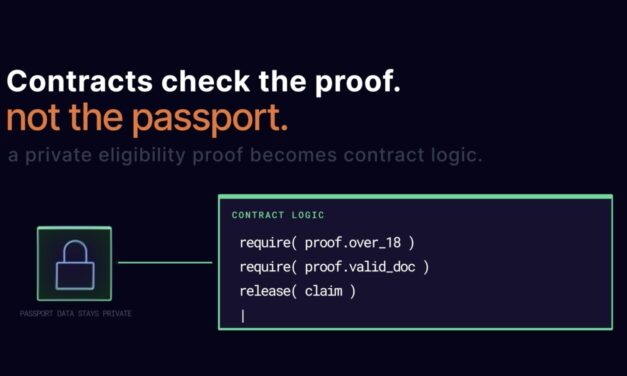
Zero-knowledge scaling company StarkWare has introduced Private KYC on Starknet, enabling users to complete know-your-customer requirements without revealing their full personal information. The system, announced Tuesday as a demo, uses STRK20 privacy features and zero-knowledge STARK proofs to let users prove specific attributes, such as being older than 18 or holding valid credentials, without revealing their full passport details or address.“Whether you need to prove you’re over 18, hold a valid credential or meet an eligibility rule, verification should only confirm the precise fact,” StarkWare said. Corporations should not collect the full identity behind it, “because every identity database becomes a liability the moment it exists.”KYC compliance involves handing over personal information and trusting companies to keep it safe. The rollout comes as the US hit a record 3,322 data compromises in 2025, a 79% increase over five years, and the global average cost of a data breach is $4.4 million, according to StationX. StarkWare users start by scanning their passport on their phones, using the camera and NFC chip to read and confirm the document is genuine and signed by its issuing authority.They can then encrypt identity data to their Starknet wallet, register attributes in a public onchain registry, and submit zero-knowledge proofs for selective checks. Verifiers can confirm eligibility by reading the public registry without ever seeing the actual identity data. Related: Privacy push as StarkWare and Sui move toward compliance-ready confidential transfers“Private KYC shows that verification and privacy aren’t a trade-off,” StarkWare said. “An institution can confirm exactly what it needs without assembling another copy of someone’s identity it then has to defend.”Contracts check the proofs, not the passports. Source: StarkWare“Identity checks today ask for your whole document when they only need one fact,” the Starknet team said. The system is similar to Sam Altman’s World ID (Worldcoin), which uses zk-proofs to verify humanness via iris scans on hardware orbs. However, World ID faced backlash over centralized biometric custody, whereas StarkWare’s self-custody model aims to address that issue. Data breaches cost millions According to Axis Intelligence, more than 1 billion health care records have been breached, with an average cost of $7.42 million, as of 2026. In the US, 772 large health care data breaches were confirmed in 2025, the highest annual total ever recorded. The largest and most damaging data breach in the crypto industry occurred at hardware wallet provider Ledger, which suffered a massive database hack in 2020, resulting in the leak of more than 270,000 customer records and a wave of phishing attacks that continue to this day. Magazine: Japanese pension fund tips 1% in crypto, G7 urges action on NK hackers: Asia Express

Čítaj viac

US Senate passes housing bill with CBDC ban until 2030

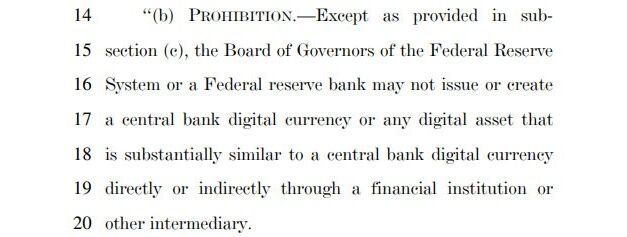
The US Senate has passed housing legislation that includes a ban on the Federal Reserve creating or working on a central bank digital currency (CBDC) until 2030, which is expected to be quickly taken up and passed by the House.The Senate on Monday voted 85-5 to pass the 21st Century Road to Housing Act, which aims to increase the housing supply after a bipartisan group of House and Senate leaders reached a deal last week to move forward with the legislation. The bill has included a CBDC ban since the Senate first passed a version of the bill in March, which outlines that the Fed may not, directly or indirectly, “issue or create a central bank digital currency or any digital asset that is substantially similar to a central bank digital currency.”Crypto advocates have long criticized CBDCs, which they see as an attempt by governments to bring digital currency under central bank control, and the bill is set to be a win for Republicans who have for years attempted to ban CBDCs.The bill will now be sent to the House for a vote, where it is expected to pass quickly with the deal struck by House leaders last week, before it’s then sent to the president to sign it into law.The CBDC clause in the bill became wrapped into the housing package as a political sweetener to secure support from House Republicans and the administration for faster passage.Related: South Carolina governor signs bill protecting Bitcoin miners, banning CBDCThe ban makes a carve-out for stablecoins, or any “dollar-denominated currency that is open, permissionless, and private,” and that even after the CBDC ban lifts in 2030, the Fed can’t act on a CBDC without explicit congressional authorization.A section of the housing bill banning the Federal Reserve from creating a CBDC. Source: Senate Banking CommitteeMeanwhile, other nations are charging ahead with their plans for a CBDC.Reuters reported on June 16 that China signed up 26 financial institutions to its digital yuan (e-CNY) cross-border payment platform.Three countries have officially launched a CBDC, while 41 are in the pilot phase, 33 are in development, and 40 are still researching, according to the think tank Atlantic Council.Magazine: Bitcoin decouples from tech stocks, Ether eyes ‘selling wave’: Market Moves

Čítaj viac

Trump signs orders for quantum computer, cryptography upgrades

US President Donald Trump signed two executive orders on Monday to push to build a quantum computer and to focus on creating cryptography that can resist quantum attacks.The orders aim to take a “cohesive, whole-of-government approach” to accelerate the deployment and commercialization of quantum computing and “protect sensitive technologies and work with allies to ensure adversaries cannot use QIST [Quantum Information Science and Technology] to undermine national security.”The orders come as China ramps up its quantum computing ambitions following the announcement of its “Five-Year Plan” in March, which aims to expand investment in scalable quantum computers and the development of an integrated space-earth quantum communication network. Source: The White HouseTrump’s orders state that within 180 days, relevant agencies must update the National Quantum Strategy to support commercialization and industry partnerships. Various agencies are also tasked with identifying implications of increasing scale and performance of commercial quantum computers, “such as the implications for the migration to post-quantum cryptography.”Related: Researchers say quantum computers could, in theory, be ready by 2030The order also establishes Quantum Computer for Application Development and Discovery Science (QC-ADDS), a national effort to pursue the development of a quantum computer at a scale intended to “initiate the era of quantum-enabled scientific discovery.”Focus on post-quantum cryptographyThe other executive order aims to secure the US against quantum-assisted cryptographic attacks and is more focused on upgrading to post-quantum cryptography.“We’re going to be investing in American quantum leadership like never before to stay ahead of the pack,” Trump said.The order directs the Office of Management and Budget and the National Cyber Director to lead an accelerated, nationwide migration to post-quantum cryptography, ensuring the nation’s data stays secure as quantum technology evolves. “The advent of large-scale quantum computers, particularly in the hands of adversaries, will pose a significant threat to widely used cryptographic security systems,” the order said. Major crypto blockchains such as Ethereum and Solana have already started working on post-quantum roadmaps, while the Bitcoin community is still divided on how to approach securing old coins against the quantum threat.Magazine: Nobody knows if quantum secure cryptography will even work 

Čítaj viac

Bitmine, Sharplink and Joe Lubin back Ethereum R&D nonprofit

Former Ethereum Foundation contributors and Ether treasury firms Bitmine and Sharplink have backed a new research and development nonprofit that aims to make Ethereum ready for institutional use.Sharplink said on Monday that the organization, Ethlabs, was formed to “ready Ethereum for the next phase of institutional adoption,” with the company pitching in with Bitmine, Ethereum co-founder Joe Lubin and other Ethereum contributors on its funding effort.“As stablecoins, tokenized real-world assets, funds and autonomous AI commerce move on-chain, they are converging on Ethereum as the neutral, credibly permissionless settlement layer for the global economy,” Sharplink said. “Ethlabs exists to ensure the network is ready to absorb that demand at scale.”The launch comes days after former Ethereum Foundation contributor Trenton Van Epps warned that Ethereum is facing a core development funding crisis and amid an ongoing wave of departures from the Foundation, most recently co-executive director Hsiao-Wei Wang, who left last week.Source: EthlabsSharplink’s announcement said Ethlabs brings together “technologists who have guided the network through its most consequential upgrades over the past decade. This initiative gives that work a dedicated institutional home with stable, long-term funding.”Ethlabs was co-founded by five former senior Ethereum Foundation researchers: Ansgar Dietrichs, Barnabé Monnot, Caspar Schwarz-Schilling, Josh Rudolf and Julian Ma.Related: Ethereum bull David Hoffman explains why he sold his ETHLubin said in a statement that Ethereum “is entering its next stage of evolution” and that there should be “a number of steward nodes of Ethereum” that should work to grow the utilization of the blockchain.“By providing a long-term, independent home to researchers and developers advancing Ethereum’s core technology and values, Ethlabs will be instrumental in preparing the network for the next major wave of adoption,” he added.Ethereum Foundation crisis deepens In May, Ethereum co-founder Vitalik Buterin said the Ethereum Foundation’s resources were limited, noting that the organization only held about 0.16% of the total supply of Ether (ETH).Former EF contributor Trenton Van Epps warned last week that Ethereum risks entering a “slow-burning funding crisis,” amid continued selling of the asset by the Foundation. “The EF is intentionally leaving a power vacuum for new structures to step up and influence the direction of Ethereum,” said Ethereum educator David Hoffman. “I think the Ethlabs direction holds the brightest future for Ethereum.”Ether is trading 65% down from its peak at around $1,700, levels last seen in October 2023 and April 2025, as sentiment remains at crypto winter lows.Magazine: Bitcoin decouples from tech stocks, Ether eyes ‘selling wave’: Market Moves

Čítaj viac

Taiko urges users to withdraw as bridge exploit drains $1.7M

Taiko, an Ethereum layer-2 blockchain, has urged its users to withdraw assets from the network’s bridges after an exploit on one of its bridge protocols saw attackers make off with $1.7 million in the latest decentralized finance hack this month. “We have confirmed a compromise of Taiko’s chain state verification mechanism,” Taiko posted to X early on Monday. “As a result, the security assumptions of all bridges deployed on Taiko can no longer be relied upon.”“We strongly advise all users to withdraw their funds from all bridges deployed on Taiko immediately,” it added.It is the latest in a series of crypto protocol exploits this month, which now number at least 23, according to DeFiLlama. The Humanity Protocol and Syscoin Bridge, which lost over $30 million and $8 million, respectively, have been the largest two exploits so far in June.Source: TaikoTaiko said it was coordinating partners to contain the incident and had paused affected systems.Crypto security firm Blockaid said that the root cause appears to be a flaw in how the Taiko bridge validated source signals.It said that message proofs were accepted as valid on Ethereum without corresponding legitimate proofs on the Taiko blockchain.“This allowed the attacker to register and later retrieve fraudulent bridge messages, resulting in unauthorized asset releases from the ERC20 vault,” Blockaid said.Blockaid estimated that at least $1 million had been stolen, while Lookonchain and PeckShield suggested the value of assets stolen could be as high as $1.7 million.The exploiter has already transferred 1.99 million Taiko (TAIKO) tokens worth around $189,000 to MEXC, stated PeckShield. TAIKO is currently trading down 98% from its 2024 peak at $0.084, according to CoinGecko. Related: Secret Network bridge exploited for $4.7M with ‘infinite mint’ bugBlockchain intelligence firm Arkham shows Taiko exploiter wallets holding around $1.5 million, primarily in Ether (ETH). The Taiko exploiter account holds more than $1.5 million in ETH. Source: Arkham IntelligenceExploits in June are mounting upThe attack comes just days after the discovery on Friday of a smart contract exploit on the Secret Network, which resulted in the theft of $4.67 million worth of assets. On Saturday, around $1.1 million was drained from the OLPC/LABUBU liquidity pool on PancakeSwap. LABUBU is a memecoin inspired by the popular toys of the same name.Other notable exploits in June include Aztec Connect, RetoSwap, Raydium AMM, and the largest one so far this month, Humanity Protocol. Magazine: Bitcoin decouples from tech stocks, Ether eyes ‘selling wave’: Market Moves

Čítaj viac

Získaj BONUS 8 € v Bitcoinoch

nakup bitcoin z karty

Registrácia Binance

Burza Binance

Aktuálne kurzy