Autor Jesse Coghlan

Celsius’ Mashinsky gets permanent trading ban in CFTC settlement

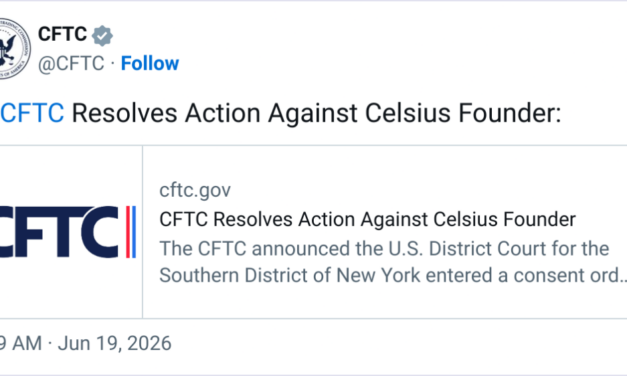
The US Commodity Futures Trading Commission has resolved its action against Celsius Network founder Alex Mashinsky, permanently banning him from trading in markets the commodities regulator oversees.The CFTC said Thursday that a court consent order also bars Mashinsky from ever registering with the regulator and ends the enforcement action it first filed in 2023.“Mashinsky and Celsius engaged in a scheme to defraud hundreds of thousands of customers by mispresenting the safety, profitability, and regulatory compliance of Celsius’ digital asset-based finance platform,” the regulator said.The latest order means Mashinsky will never be able to trade US commodities, futures and derivatives. Earlier this year, the CFTC and the US Securities and Exchange Commission issued guidance saying they considered most major cryptocurrencies to be commodities.Source: CFTCThe settlement also puts an end to the CFTC’s first case against a digital asset lending platform and marks the end of one of the last remaining regulatory actions pending against Mashinsky.Mashinsky was sentenced to 12 years in prison in May 2025 after pleading guilty to securities and commodities fraud for misleading Celsius’ customers about the safety of the crypto lending platform, which collapsed during a major market drawdown in 2022.The CFTC alleged that Celsius received about $20 billion in funds and made risky investments to meet the returns it promised. Related: Onchain, in court: What happened in crypto legal news this weekMashinsky has already been banned from ever working in crypto or finance after settling a Federal Trade Commission complaint in April that permanently barred him from working with any product or service that can be used to “deposit, exchange, invest, or withdraw assets.”Mashinsky is still facing charges filed by the SEC in July 2023, accusing him of making an unregistered securities offering, misrepresenting Celsius’ business and safety and manipulating the price of its Celsius (CEL) token.The SEC told a federal court in late May that it has “engaged in substantive settlement discussions” with Mashinsky, but no agreement had been reached, with the court granting the regulators’ request for another 60 days to continue discussions.Mashinsky filed on May 26 to vacate his 12-year criminal sentence, claiming his lawyers were ineffective, that evidence was tainted by authorities’ misconduct and that FTX co-founder and convicted fraudster Sam Bankman-Fried was to blame for the manipulation of the CEL token.A court on Saturday ordered prosecutors to respond to Mashinsky’s request by mid-August.Magazine: Big Questions: Do we really only need 2–5 cryptocurrencies?

Čítaj viac

Ryan Salame’s wife to face charges over FTX-funded congressional run

Michelle Bond, the wife of former FTX executive Ryan Salame, will face illicit campaign finance charges after a judge rejected her argument that prosecutors promised Salame that she would be cleared if he pleaded guilty.Manhattan federal judge George Daniels on Wednesday denied Bond’s bid to dismiss an indictment that alleged she illegally took money from the now-bankrupt crypto exchange FTX to help bankroll her unsuccessful run for Congress in 2022.Daniels wrote there was “no ambiguity” in the terms of Salame’s written plea agreement. “As the evidence made clear, all parties, including the defendants and their counsel, were aware that the Government had not promised Bond’s immunity by the time Salame entered his guilty plea,” he said.FTX’s high-profile collapse in 2022 shook the cryptocurrency industry. The order could set up the last of the criminal trials tied to FTX, closing a chapter on one of crypto’s biggest blowups in history. Michelle Bond (left) and Ryan Salame (right) leaving a Manhattan courthouse in August 2024. Source: YouTubeSalame, who was the co-CEO of FTX’s Bahamian subsidiary, FTX Digital Markets, was sentenced to seven and a half years in prison in May 2024 after pleading guilty to conspiring to make illegal political contributions and operating an illegal money transmitter.Bond claimed that then-Manhattan US Attorney Danielle Sassoon told her and Salame’s lawyer in a 2023 meeting that “without making promises outside the four corners of the plea agreement,” if Salame pleaded guilty, then prosecutors would “conclude the aspects of our investigation that concern RS (Ryan Salame), but not SBF (Sam Bankman-Fried).”However, Daniels wrote that the evidence “undisputably indicates that the Government did not promise to not prosecute Bond in exchange for Salame’s guilty plea.”He added that Bond’s former lawyer, Gina Parlovecchio, “admitted as much under oath — testifying that, regardless of what discussions were had, she did not believe Sassoon’s statement was a promise at the time it was made.”Prosecutors first alleged in August 2024 that after Bond launched a bid for a House seat in 2022, Salame orchestrated a consulting agreement between Bond and FTX, where she was paid $400,000.Related: US lawmakers warn against presidential pardon for Sam Bankman-FriedThe government alleges Bond then used those funds to illegally finance her congressional campaign, along with hundreds of thousands of dollars in additional funds that Salame wired to her between June and August 2022.Prosecutors claimed that Bond attempted to conceal the source of the payments and made false statements to a congressional committee and the Federal Election Commission.Bond is facing charges of conspiring to cause unlawful political contributions, causing and receiving a straw donor contribution, along with causing and accepting excessive campaign contributions and an unlawful corporate contribution.Each of the four charges Bond is facing carries a maximum of five years in prison.Magazine: Are DeFi devs liable for the illegal activity of others on their platforms?

Čítaj viac

Kentucky sues Kalshi, Polymarket, joining prediction market legal battle

Kentucky has sued five prediction market platforms, including Kalshi and Polymarket, adding to a wave of US states launching legal fights with prediction markets over sports event contracts.State Attorney General Russell Coleman said in a statement Wednesday that his office filed lawsuits in state court against Polymarket and Kalshi — also naming Kalshi partners Coinbase, Robinhood and Webull — accusing them of “operating unlicensed and illegal sports betting and gambling platforms.”“Kalshi and Polymarket are operating illegal sportsbooks in Kentucky and breaking our laws,” Coleman said. “These multi-billion dollar corporations and their legal fictions don’t pass the sniff test. As one of our state legislative leaders said it best, ‘If it looks like a duck and quacks like a duck…’”Kalshi and Polymarket together recorded $25 billion in monthly trading volume in May, per Token Terminal. Lawsuits from multiple US states risk locking them out of some of the largest markets in the US.Kentucky Attorney General Russell Coleman gives a speech in April. Source: YouTubeAt least 17 other states have taken prediction market operators to court, attracting the involvement of the US Commodity Futures Trading Commission and the White House.Multiple state authorities have argued that event contracts tied to sports are sports betting and require state-level licenses. Prediction markets have argued that their event contracts are swaps regulated under federal commodities law.That position is backed by the CFTC, which has sued eight states after they took action against prediction markets, claiming they were stepping on its authority.Kentucky’s lawsuits claimed that Polymarket, Kalshi and their partners are “doing business without a Kentucky gaming license or following state regulations” and that their sports event contracts “fall squarely within the definition of ‘sports wagering’ under Kentucky law.”The state also alleged the platforms offer users “few or no resources” to identify or seek help for a gambling problem as required by state law. A Polymarket spokesperson told Cointelegraph Kentucky’s action “runs counter to the CFTC’s established framework for regulating prediction markets. We look forward to addressing these claims through the appropriate legal process.”Kalshi spokesperson Jacki McGavick told Cointelegraph that “Kalshi is a federally regulated exchange — the CFTC is our regulator, not the states. Courts have already recognized this, and we’re confident they will here too.”The CFTC did not immediately respond to a request for comment.Related: Prediction market battle gets closer to Supreme CourtKalshi and Polymarket, through a coalition of platforms, are already tied up in legal action with Kentucky after suing the state on Friday to claim its first-in-the-country 14.25% tax on prediction market transaction fees is discriminatory and oversteps federal law.Kentucky’s action comes after authorities in Montana, Nevada, Utah, Iowa, Illinois, Ohio, Tennessee, New York, New Jersey, Connecticut and Maryland had issued cease-and-desist letters to prediction markets and were subsequently sued by the platforms.Washington, Arizona, New Mexico, Wisconsin, Michigan, Massachusetts and Kentucky have also chosen to sue prediction market platforms, including Kalshi.Some of the legal battles have so far reached appeals courts and have seen mixed results. On Wednesday, a Michigan federal judge ruled against Polymarket in its lawsuit against the state, finding that its sports event contracts are not swaps under the CFTC’s authority.Other courts have also sided with prediction markets, such as the Third Circuit Court of Appeals’ ruling in April that New Jersey regulators could not prevent Kalshi from offering sports event contracts in the state.US President Donald Trump, whose son Donald Trump Jr. is on the advisory board for Polymarket and is an adviser to Kalshi, said in May that it was “critically important that the CFTC’s exclusive authority over Prediction Markets is maintained.”Magazine: Should users be allowed to bet on war and death in prediction markets?

Čítaj viac

Congress reaches deal on housing bill with CBDC ban until 2030

The US House and Senate have reached a deal to move forward with a housing bill that includes a ban on the Federal Reserve creating a central bank digital currency (CBDC) until 2030.A bipartisan group of House and Senate leaders released an updated version of the 21st Century Road to Housing Act on Tuesday, which aims to address housing affordability and bans institutional investors from buying existing single-family homes to rent out.The bill has included a CBDC ban since the Senate passed it in March. The House also passed its version of the bill with strong support in May, but the House and Senate disagreed on some aspects. The Senate has now added further amendments that will be put before the House for a final vote.The bill is likely to pass quickly and would hand a win to Republicans who have tried to pass a CBDC ban for years, as earlier standalone bills had stalled in Congress. Crypto advocates have long criticized CBDCs, which they see as an attempt by governments to repurpose crypto technology to a centrally-controlled asset.Source: US Senate Banking Committee GOPThe deal also means Congress can focus on passing other legislation before the August recess and the November midterm elections, in particular, the crypto-regulating CLARITY Act that many lawmakers have been pushing to advance.House Republican leaders plan to put the bill up for a vote after the House returns from recess on June 23, two people familiar with the plan told Politico.The housing bill includes language that says the Federal Reserve may not, directly or indirectly, “issue or create a central bank digital currency or any digital asset that is substantially similar to a central bank digital currency.”Related: South Carolina governor signs bill protecting Bitcoin miners, banning CBDCIt adds the clause will expire on Dec. 31, 2030, and creates a carveout for crypto stablecoins, or “dollar-denominated currency that is open, permissionless, and private.”The clause revives much of the language from Republican Representative Tom Emmer’s Anti-CBDC Surveillance State Act, which was introduced in June 2025, passed by the House the next month, but was never picked up in the Senate.US President Donald Trump signed an executive order in January 2025 banning federal agencies from all work related to CBDCs, saying they threatened “the stability of the financial system, individual privacy, and the sovereignty of the United States.”Magazine: How crypto laws changed in 2025 — and how they’ll change in 2026

Čítaj viac

Senators urge Treasury ensure state authority in GENIUS application

A bipartisan group of US senators led by Republican Senator Cynthia Lummis has urged the Treasury to ensure that state authorities are given the ability to regulate stablecoin issuers as the department considers how to implement the GENIUS Act.In a letter to Treasury Secretary Scott Bessent on Tuesday, the lawmakers said it was critical that the Treasury implement a section of the law giving a pathway for certain issuers to be regulated by the states “in a manner that preserves and promotes State participation.”The GENIUS Act allows issuers that have a stablecoin with a market value of $10 billion or less to be regulated by a state authority if that state has laws largely similar to the bill.Currently, that would mean all stablecoins but three, Tether (USDt), USDC (USDC) and USDS (USDS), formerly Dai (DAI), could be regulated by the states, as all have a market value above $10 billion, according to CoinGecko.In April, the Treasury sought public input for how it plans to implement the GENIUS Act at the state level, rules that President Donald Trump signed into law in July that regulate stablecoins and their issuers.President Donald Trump signing the GENIUS Act in July 2025. Source: The White House“Congress clearly sought to preserve the dual banking system and the crucial role of State banking agencies in supervising this market,” the senators said in their letter.They added that the Treasury’s proposal “did not address the timeline and procedural requirements related to State certification.” They argued this created “uncertainty for States” and could be interpreted as the process being “a one-time window that effectively bars future certifications.”The lawmakers said that state legislatures vary, and a flexible certification framework was needed to ensure that states can participate when they have rules implementing the GENIUS Act.Related: Anchorage backs Treasury’s GENIUS AML rules, seeks secondary-market sanctions clarity“States must be able to develop and seek certification of stablecoin regulatory regimes as demand for these charters materializes and as legislative schedules permit,” the letter said. Republican Senators Bill Hagerty, Kevin Cramer and Pete Ricketts, along with Democratic Senators Kirsten Gillibrand, Angela Alsobrooks, and Catherine Cortez Masto, also signed the letter.Public comments on the Treasury’s proposal closed on June 2, and it will now draft a final rule for publication in the Federal Register.Magazine: Guide to the top and emerging global crypto hubs: Mid-2026

Čítaj viac

Získaj BONUS 8 € v Bitcoinoch

nakup bitcoin z karty

Registrácia Binance

Burza Binance

Aktuálne kurzy