Autor Jesse Coghlan

US nears ban on CBDCs until 2030 as housing bill goes to Trump

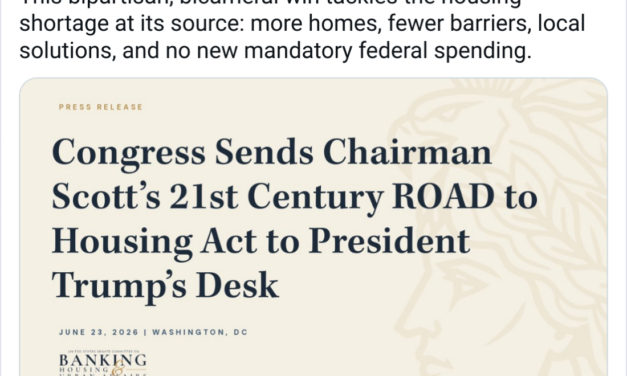
The US House has passed a major housing bill that includes a ban on central bank digital currencies until 2030, in what is set to be a major win for Republicans who have long pushed for such a measure.The House voted 358-32 on Tuesday to pass the 21st Century ROAD to Housing Act, a day after the Senate voted 85-5 to pass the bill, which largely aims to tackle housing affordability. The bill now heads to US President Donald Trump, who has signaled support for the measure and is expected to sign it into law on Wednesday. “Today, Congress delivered a major win for families working toward the American Dream,” said Senate Banking Committee Chairman Tim Scott. “I look forward to President Trump signing it into law.”CBDCs are a representation of fiat currency issued by a central bank on a ledger. The signing of the bill will be a win for Republicans who have tried to pass a CBDC ban for years, and for crypto advocates who see CBDCs as an attempt to repurpose technology made for decentralized assets into a centrally controlled asset. The housing bill includes language that the Federal Reserve may not, directly or indirectly, “issue or create a central bank digital currency or any digital asset that is substantially similar to a central bank digital currency,” a clause that expires on Dec. 31, 2030.Source: US Senate Banking Committee GOPThe bill’s quick passage comes after House and Senate leaders reached a deal to move forward with the housing bill last week, after previously disagreeing over multiple aspects of the legislation.The bill has included the CBDC ban since the Senate passed a version of it in March. It also features a carve-out for crypto stablecoins, allowing “dollar-denominated currency that is open, permissionless and private.”The CBDC ban revived language from Republican Representative Tom Emmer’s Anti-CBDC Surveillance State Act. That bill was introduced in June 2025 and passed the House a month later, but it never saw movement in the Senate.Related: Crypto lobby urges Congress to pass staking and mining tax bill as isWith the bill off lawmakers’ agenda, Congress can now focus on passing other legislation before the August recess and the November midterm elections.One bill that has garnered particular interest is the Senate’s crypto market structure bill, dubbed the CLARITY Act, which many lawmakers have been pushing to advance.Despite months of talks between lawmakers and crypto and banking lobbyists, the CLARITY Act is still seeing pushback, and the odds of it being passed this year have slipped.Earlier this month, Galaxy Digital lowered its estimate of the Senate passing the bill before the end of the year, giving it a 60% chance as the congressional calendar tightens.Magazine: How crypto laws changed in 2025 — and how they’ll change in 2026

Čítaj viac

Senate Dems urge probe into $500M crypto deal between Trumps, UAE

A group of US Senate Democrats is urging Senate Republican leaders to hold hearings into a reported $500 million deal between the Trump family’s crypto firm and Abu Dhabi royalty.In a letter on Tuesday, the Democrats told Republicans, who control the Senate, lead its committees and decide on hearings, that they should “immediately hold hearings” into the deal and have Trump administration officials testify about it under oath.The Wall Street Journal reported in January that an Abu Dhabi investment company backed by Sheikh Tahnoon bin Zayed Al Nahyan, the United Arab Emirates’ national security adviser, signed a deal in January 2025 to buy a 49% stake in World Liberty Financial, the crypto platform tied to US President Donald Trump.Months later, in May 2025, the Trump administration made a major arms and artificial intelligence chip deal with the UAE, which the Democratic senators said came “despite concerns raised by US national security officials that China could access the chips.” Trump has said he wasn’t aware of the World Liberty deal.The letter is the Democrats’ latest bid to probe World Liberty Financial’s dealings and its possible ties to decisions the president has made. Both Trump critics and supporters have criticized the perceived conflict of interest posed by the Trump family’s sprawling crypto interests amid Trump’s push to deregulate the sector.Donald Trump (right) meeting with Tahnoon bin Zayed Al Nahyan (centre) at the White House in March 2025. Source: The White House“We are deeply concerned about this series of events, which raise questions about what more the UAE may receive — or may have already received — at the expense of US national security after investing in the Trump family crypto company,” the Democrats wrote.“Congress has a responsibility to investigate the details of the reported investment and whether it influenced subsequent actions by President Trump and the Trump Administration,” they added.The senators said that they’re also concerned about the Trump administration’s “steps to weaken enforcement” by exempting crypto service providers from financial services regulations and disbanding the Justice Department’s crypto enforcement team.Senators Elizabeth Warren, Richard Blumenthal, Gary Peters, Dick Durbin and Ron Wyden signed the letter.Related: Crypto isn’t the problem with the US economy, says senatorWarren has called for an investigation into the UAE deal before, urging Treasury Secretary Scott Bessent in February to determine if the deal should be subject to a Committee on Foreign Investment probe.Earlier this year, Democrats pressed Securities and Exchange Commission Chair Paul Atkins over the decision to drop a fraud case against Justin Sun, a major World Liberty Financial backer.In May, Democratic Senator Peter Welch and Representative Dave Min launched a probe into Trump’s pardons, including that of Binance co-founder Changpeng Zhao.The pardon came after Binance accepted a $2 billion investment from an Abu Dhabi fund in early 2025 and agreed for the funds to be paid in World Liberty Financial’s stablecoin, USD1.Magazine: Trump’s crypto ventures raise conflict of interest, insider trading questions

Čítaj viac

Crypto lobby urges Congress pass staking and mining tax bill as is

A group of crypto lobbying organizations has urged Congress to pass a bill on crypto staking and mining taxes without changes, saying it would provide clarity on crypto rewards taxes and ensure blockchains “can be secured by Americans in America.”The Blockchain Association, the Crypto Council for Innovation and The Digital Chamber said in a letter on Sunday to House Ways and Means Committee Chair Jason Smith and its top Democrat, Richard Neal, that the Tax Clarity for Mining and Staking Act should be passed “as introduced.”“After years of uncertainty about how mining and staking rewards are taxed, the bill provides a durable compromise that innovators can support while addressing concerns raised by some lawmakers,” the group wrote.The bill seeks to address what the crypto industry has long said is an unfair tax code that views mining and staking rewards as taxable income when received, which the letter argued is a “taxation of phantom income” that can cause liquidity issues.The bill would allow miners and stakers the choice of paying taxes on crypto rewards either when they receive them or when they sell the assets, which the lobbyists wrote “ensures income is recognized while avoiding immediate taxation before taxpayers can monetize the asset.”It was introduced earlier this month ahead of a legislative hearing, but has not advanced past the Ways and Means Committee. Democratic Representative Steven Horsford filed an amendment to limit the deferral of crypto reward taxes to five years.Crypto Council for Innovation CEO Ji Hun Kim posted to X on Monday that Horsford’s amendment would “break” the bill and raise “negligible revenue.”“We greatly appreciate his engagement, but there have already been significant concessions made in framing this as an election,” he added.Source: Ji Hun KimThe bill has seen pushback from the banking lobby, with the American Bankers Association earlier this month saying it would give “a significant advantage over nearly every other way Americans save, invest and earn returns today.”Related: Illinois governor approves crypto transaction tax despite industry uproar“When a company pays a dividend, shareholders receive the value of the dividend and pay tax that year,” the ABA said. “The Tax Clarity for Mining and Staking Act, would work very differently — and show clear favoritism for cryptocurrencies over other asset classes.”The crypto lobby argued that renegotiating any agreed-upon compromise in the bill “would risk reviving the very problems the bill resolves and stalling a bipartisan result that is finally within reach.”The bill adds to another crypto tax-focused bill before Congress, the so-called PARITY Act, which was introduced in May and directs the Internal Revenue Service to study what exemptions it can give for small crypto transactions.The crypto industry has called on Congress to exempt small crypto transactions from tax. Kraken said in April that it sent 56 million tax forms to the Internal Revenue Service, where nearly a third were for transactions worth less than $1, while over 75% were for transactions less than $50.Magazine: Crypto scammers face death, Aussie CGT makes Asian hubs attractive: Asia Express 

Čítaj viac

Morgan Stanley amends Ethereum, Solana ETFs to reveal record cheap fees

Morgan Stanley has updated its filings for its Ether and Solana exchange-traded funds, revealing that it plans to charge the lowest fees among its rivals.The company filed amended Form S-1 statements with the Securities and Exchange Commission for each ETF on Thursday, showing it plans to undercut the current market offerings and charge fees of 0.14% for each of its products.The current lowest-fee spot Ether (ETH) ETF in the US is the Grayscale Ethereum Staking Mini ETF (ETH) at 0.15%, while Franklin Templeton’s spot Solana (SOL) ETF, the Franklin Solana ETF (SOEZ), charges the lowest fee among its competitors at 0.19%, according to Farside Investors.It is the second time that Morgan Stanley has updated its ETF filings since it first filed for the ETFs in January, with amendments typically a signal that the SEC is close to approving the products for trading, which would make them the 11th spot Ether ETF and seventh spot Solana ETF to launch in the US.Bloomberg ETF analyst Eric Balchunas posted to X on Friday that the fees make them “the cheapest in [the] US and [the] world.”Source: Eric BalchunasLow fees have been a tactic for Morgan Stanley as it looks to make a late entry into the spot crypto ETF market dominated by issuers such as BlackRock and Fidelity. Its Bitcoin (BTC) ETF, which launched in April, set its fees at 0.14%, below Grayscale’s 0.15% fee on its mini Bitcoin ETF.Related: Grayscale HYPE ETF ‘likely imminent’ as new update shows competitive fee: AnalystThat fee likely helped Morgan Stanley’s Bitcoin fund to record a respectable first-day inflow of $30.6 million. The ETF has since seen total inflows of $331 million, surpassing ETFs from Invesco, Franklin Templeton and CoinShares, which all launched in January 2024.Morgan Stanley’s latest filings also show that Figment, Galaxy Blockchain Infrastructure and Coinbase Canada will provide the staking services for each of the ETFs, with each fund having a 5% staking fee for the rewards earned by the product.The Ethereum ETF, called the Morgan Stanley Ethereum Trust, will feature the ticker “MSSE,” while the Solana ETF, dubbed the Morgan Stanley Solana Trust, will trade under MSOL. Magazine: Does ‘Paper Bitcoin’ mean there’s an unlimited supply of BTC?

Čítaj viac

Algorand plans ‘broad quantum resilience’ by 2027

The layer-1 blockchain Algorand has released its plan to tackle the potential threat of quantum computing, with a roadmap to update the network’s infrastructure by the end of 2027.Algorand Foundation technology chief Bruno Martins said Thursday that the updates will aim to give the network broad quantum resilience, a threat it has been researching and preparing for several years.“Governments, standards bodies, and security experts around the world are already preparing for a future where quantum computers may break many of the cryptographic systems that protect today’s digital infrastructure,” Martins said. Algorand is the latest crypto project to plan for quantum computing as users share increasing concerns that the technology could soon break the encryption underpinning the ecosystem, putting billions of dollars worth of value at risk of exploitation.Quantum computers, a technology set to be vastly more powerful than today’s supercomputers, are only in their early stages, but Google researchers said in a paper in March that they may need fewer resources than previously estimated to break the cryptography protecting blockchains.That paper also noted that Algorand was likely the most quantum-ready blockchain, while Ethereum and Solana are also actively exploring solutions to be prepared for quantum computers.Algorand’s Martins said the roadmap includes new accounts based on its signature scheme, Falcon, designed with quantum-resistant cryptography.Source: AlgorandHe added that the blockchain will also update its consensus mechanism from its current cryptography, which is not quantum-resistant. It will also update how accounts participating in consensus operate and is researching options, including a “hybrid mix” of classic and quantum-resistant signatures.Related: Nearly 10% of Bitcoin supply is ‘structurally unsafe’ from quantum breakthrough: GlassnodeQuantum threats to cryptography are a growing concern among governments and businesses, with many companies putting plans in place before quantum computers are powerful enough to break encryption, which could happen as soon as 2030. France’s cybersecurity agency ANSSI said on Tuesday that it will stop certifying security products that lack quantum-resistant encryption to encourage businesses to create only quantum-safe products by 2030.The US National Security Agency has also required all new national security systems to use its quantum-resistant algorithms starting Jan. 1, 2027, while nonquantum-resistant systems must be phased out by the end of 2030. Google has set a deadline for 2029 to be ready for the event due to rapid progress in quantum computing hardware and error correction.Last month, Tezos launched a prototype blockchain for payments designed to resist quantum computing attacks, and stablecoin issuer Circle released a roadmap in April for its Arc blockchain to become quantum-ready.California Institute of Technology researchers have also theorized that a functional quantum computer may require far fewer resources than previously believed, and one could be deployed before 2030.Magazine: Nobody knows if quantum-secure cryptography will even work

Čítaj viac

Získaj BONUS 8 € v Bitcoinoch

nakup bitcoin z karty

Registrácia Binance

Burza Binance

Aktuálne kurzy