

Autor Helen Partz

BitGo courts crypto firms awaiting MiCA approval amid Binance licensing concerns

BitGo, a crypto custody company, is moving into Europe’s tighter regulatory landscape as exchanges race to maintain access ahead of a key licensing deadline.BitGo Europe launched a crypto-as-a-service platform aimed at meeting the European Union’s Markets in Crypto-Assets Regulation (MiCA), the company said in a statement shared with Cointelegraph on Wednesday.BitGo CEO Mike Belshe said companies shouldn’t leave users waiting during licensing delays, arguing that regulated infrastructure can keep platforms active in the meantime. “We can help keep you moving safely and compliantly,” he said.The launch comes with the EU’s July 1 MiCA deadline approaching, requiring crypto companies to obtain authorization to continue serving customers across the bloc. Reports on Tuesday suggested Greek regulators may reject Binance’s MiCA license application, adding uncertainty to the EU regulatory status of the world’s largest crypto exchange by trading volume.BitGo targets exchanges with MiCA-ready toolsBitGo Europe’s MiCA service launch comes more than a year after the company secured authorization under the framework. Germany’s Federal Financial Supervisory Authority (BaFin) issued the license in May 2025.BitGo’s platform allows exchanges and fintech companies to connect to regulated custody, trading, onboarding and wallet systems through APIs. Instead of building full compliance systems in-house, crypto service providers can plug into BitGo’s infrastructure while keeping control of their customer-facing products.Source: Mike BelsheThe system includes tools for programmatic Know Your Customer (KYC) checks, transaction controls and settlement of supported digital assets. BitGo also supports euro payments through Single Euro Payments Area (SEPA) rails in eligible regions, enabling fiat on- and off-ramps within a regulated setup.Exchange pressure builds as MiCA transition tightensBitGo did not say whether its infrastructure could help companies such as Binance continue operating in the EU if regulators ultimately reject a license. Cointelegraph reached out to BitGo for clarification but did not receive a response by publication time.The company said the shift is especially urgent in markets such as Poland and Lithuania, where older national registration regimes are being phased out under the new system.Related: Polish president vetoes crypto bill for third time ahead of MiCA deadlineIn Lithuania, the transition period for legacy virtual asset service providers ended on Dec. 31, 2025. In Poland, implementation remains unresolved, adding uncertainty for companies still operating under national approvals as the EU-wide framework takes effect.“We believe Europe is moving toward a more unified and durable regulatory framework for digital assets,” CEO Belshe said. “BitGo was built for moments like this […] With BitGo Europe, we are giving businesses a way to meet the MiCA standard while continuing to serve the market with confidence,” he added.Magazine: China’s 107 Bitcoin memory thief, Bithumb CEO booked: Asia Express

Čítaj viac
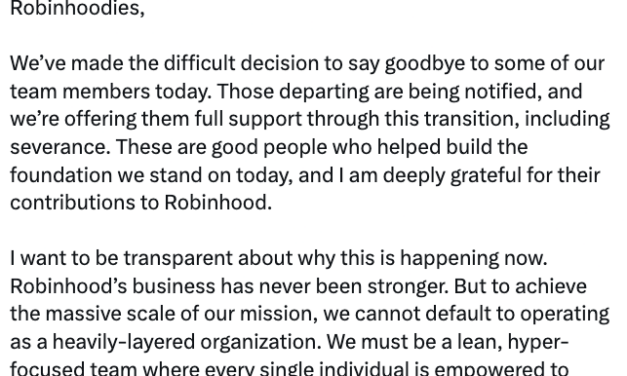

Robinhood cuts 10% of workforce as Tenev touts business strength

Stock and crypto trading platform Robinhood is cutting 10% of its workforce as it restructures its organization, a move the company said will improve efficiency.CEO Vlad Tenev told staff the company is reducing 10% of its full-time employees as part of “flattening” its org structure, according to a statement on X by Robinhood on Tuesday.In an internal memo, Tenev said the company cannot “default to operating as a heavily-layered organization” if it wants to scale its mission, adding that Robinhood must “continuously raise” its performance bar.The rationale mirrors explanations offered by major crypto companies such as US exchange Coinbase and Jack Dorsey’s Block, which have also linked layoffs this year to reducing management layers and improving efficiency.Layoffs to affect around 290 employeesThe layoffs are expected to affect about 290 employees, as Robinhood currently has approximately 2,900 full-time employees, a spokesperson for the company told Cointelegraph.Robinhood previously reported roughly 2,900 in full-time staff as of Dec. 31, 2025, according to its Form 10-K filing with the US Securities and Exchange Commission.In a separate Form 8-K filed on Tuesday, the company said the reduction in force also includes the closure of a small number of remaining open roles across the company.Source: Robinhood CommsRobinhood estimated it will incur about $28 million in total restructuring-related charges, including roughly $20 million for employee severance and benefits and about $8 million in share-based compensation costs. The company said it expects to recognize these charges in the second quarter of 2026.Tenev says business “has never been stronger” despite weak Q1 resultsRobinhood said it is taking the action “from a position of business strength,” pointing to June month-to-date average daily trading volumes at record levels across equities, options and prediction markets.Tenev said that the company’s business “has never been stronger,” adding that the workforce reduction is a proactive move aimed at improving execution and focus.Related: Robinhood enters Canada after $180 million WonderFi acquisitionThe announcement did not specifically mention artificial intelligence-driven restructuring, but said the company will continue hiring selectively, invest in top-tier talent and “utilize frontier technologies” to improve performance.The move comes after first-quarter results missed analyst expectations, with revenue and earnings coming in below forecasts. Crypto trading was a key drag, with volumes down roughly 50% year-on-year, underscoring ongoing volatility in transaction-based revenue streams.Magazine: China’s 107 Bitcoin memory thief, Bithumb CEO booked: Asia Express

Čítaj viac

Bitcoin doesn't need Ethereum-style yield, says Strategy's Michael Saylor

Strategy executive chairman Michael Saylor said Bitcoin does not need staking, inflation or protocol-based yield mechanisms, arguing returns should come from financial products built around BTC.In an X post on Tuesday, Saylor outlined a five-layer “Digital Asset Stack” positioning Bitcoin (BTC) as the base for credit, money, yield and equity structures.Saylor said Bitcoin should remain “pure digital capital” and that it “does not need to become Ethereum” to generate investor returns.The framework reinforces Strategy’s approach to Bitcoin as a treasury reserve asset, where returns are generated through financial products built around the company’s Bitcoin holdings, the largest among publicly listed firms.Digital credit and yield layerSaylor’s framework is centered around “digital credit” as financial instruments built around Bitcoin holdings, designed to generate returns while reducing exposure to BTC price volatility.Under this structure, Bitcoin serves as collateral, while equity absorbs most of the price risk and credit instruments receive more stable returns.Source: Michael SaylorSaylor repeatedly referenced Strategy-style securities such as STRC, the company’s perpetual preferred stock, positioning them as a key example of “digital credit.” In this framing, STRC-like instruments are not just company products but examples of a broader asset class built on top of Bitcoin through capital markets engineering.Saylor argues credit instruments can smooth Bitcoin’s price swingsSaylor said Bitcoin’s volatility is “not a flaw,” framing it as a natural feature of “high-energy capital” that can move sharply because it is scarce, global and traded around the clock. In his model, instruments like STRC are designed to damp those price swings by sitting above Bitcoin in the capital structure.While Saylor did not directly discuss STRC’s volatility in the X post, he said credit instruments can experience varying levels of risk depending on factors such as market stress, liquidity and investor demand.Related: Saylor’s Strategy buys 1,587 BTC for $100M, holdings hit 846.8K“The important point is not that digital credit always has one fixed volatility number. It does not,” Saylor said.Strategy’s preferred stock STRC closed at $95.20 on Monday, down 1.45%, according to Nasdaq data. The stock has a $100 stated par value and is structured to trade near that level.Cointelegraph’s Ciaran Lyons (left) and Strategy founder Michael Saylor (right) at BTC Prague. Source: Cointelegraph/YouTubeThe remarks reinforce Saylor’s framing of Bitcoin as “digital capital” and Strategy’s role in issuing “digital credit” built around it, including the view that Bitcoin sales are sometimes required to support the structure.“If the company’s policy is that we won’t sell the Bitcoin, then the credit won’t have value and the equity won’t have value,” Saylor told Cointelegraph at the BTC Prague conference last week.Magazine: Bitcoin, the ‘canary in the coal mine,’ XRP transaction demand falls 91.5%: Market Moves

Čítaj viac

Získaj BONUS 8 € v Bitcoinoch

nakup bitcoin z karty

Registrácia Binance

Burza Binance

Aktuálne kurzy
