
Autor Helen Partz

South Korea pushes Travel Rule expansion for smaller crypto transfers

Financial regulators in South Korea are pushing for broader reporting requirements on crypto transfers to further align with global Anti-Money Laundering standards for digital assets.South Korea’s Financial Intelligence Unit (FIU) raised proposals to expand the Financial Action Task Force’s (FATF) Travel Rule requirements to smaller crypto transfers during a plenary meeting in Paris last week, according to an announcement on Monday.The crypto Travel Rule is a global AML standard that requires crypto exchanges to share sender and recipient information for transfers above certain thresholds. It is designed to improve the traceability of funds moving between platforms.South Korea already applies Travel Rule requirements to crypto transfers above 1 million won ($650), and the latest proposal calls for extending those obligations to smaller transactions.Ongoing gaps in global oversight and DeFi risksThe FIU said Travel Rule obligations should apply to both originating and receiving crypto asset service providers (CASPs) to close gaps in cross-border transfers.The FIU also called for stronger action against offshore and unregistered crypto platforms, citing increased misuse in illicit finance cases and risks of regulatory arbitrage.FIU Commissioner Lee Hyung Ju at the FATF plenary session in Paris. Source: FIUBeyond the Travel Rule discussion, FATF also approved a new report examining risks associated with decentralized finance (DeFi), according to the FIU.Related: South Korea police raid Bithumb over lawmaker hiring favoritism probe: reportFIU Commissioner Lee Hyung Ju welcomed the adoption of a DeFi-related report during FATF discussions. However, he said regulatory arbitrage across jurisdictions mainly stems from differences in licensing, supervision and offshore oversight.Seven years after FATF extended Travel Rule scope to cryptoThe proposal was part of broader discussions on the implementation of FATF Recommendation 15, the international standard updated in 2019 to apply AML measures to crypto assets and CASPs.Seven years after FATF extended its AML framework to cover crypto assets, global implementation of Recommendation 15 remains uneven, according to a targeted update by FATF in 2025.Source: FATFThe FATF assessment found that 49% of jurisdictions were only partially compliant with requirements for CASPs, while 21% remained non-compliant as of April 2025, leaving only about 29% of jurisdictions rated largely compliant or compliant.Magazine: China’s 107 Bitcoin memory thief, Bithumb CEO booked: Asia Express

Čítaj viac

South Korea pushes Travel Rule expansion for smaller crypto transfers

Financial regulators in South Korea are pushing for broader reporting requirements on crypto transfers to further align with global Anti-Money Laundering standards for digital assets.South Korea’s Financial Intelligence Unit (FIU) raised proposals to expand the Financial Action Task Force’s (FATF) Travel Rule requirements to smaller crypto transfers during a plenary meeting in Paris last week, according to an announcement on Monday.The crypto Travel Rule is a global AML standard that requires crypto exchanges to share sender and recipient information for transfers above certain thresholds. It is designed to improve the traceability of funds moving between platforms.South Korea already applies Travel Rule requirements to crypto transfers above 1 million won ($650), and the latest proposal calls for extending those obligations to smaller transactions.Ongoing gaps in global oversight and DeFi risksThe FIU said Travel Rule obligations should apply to both originating and receiving crypto asset service providers (CASPs) to close gaps in cross-border transfers.The FIU also called for stronger action against offshore and unregistered crypto platforms, citing increased misuse in illicit finance cases and risks of regulatory arbitrage.FIU Commissioner Lee Hyung Ju at the FATF plenary session in Paris. Source: FIUBeyond the Travel Rule discussion, FATF also approved a new report examining risks associated with decentralized finance (DeFi), according to the FIU.Related: South Korea police raid Bithumb over lawmaker hiring favoritism probe: reportFIU Commissioner Lee Hyung Ju welcomed the adoption of a DeFi-related report during FATF discussions. However, he said regulatory arbitrage across jurisdictions mainly stems from differences in licensing, supervision and offshore oversight.Seven years after FATF extended Travel Rule scope to cryptoThe proposal was part of broader discussions on the implementation of FATF Recommendation 15, the international standard updated in 2019 to apply AML measures to crypto assets and CASPs.Seven years after FATF extended its AML framework to cover crypto assets, global implementation of Recommendation 15 remains uneven, according to a targeted update by FATF in 2025.Source: FATFThe FATF assessment found that 49% of jurisdictions were only partially compliant with requirements for CASPs, while 21% remained non-compliant as of April 2025, leaving only about 29% of jurisdictions rated largely compliant or compliant.Magazine: China’s 107 Bitcoin memory thief, Bithumb CEO booked: Asia Express

Čítaj viac
Binance’s MiCA fight raises questions over ECB influence

Binance’s faltering European Union Markets in Crypto-Assets Regulation (MiCA) license application in Greece has raised questions about whether the bloc’s central bank may have played an informal role in the process, despite not having formal authority over licensing decisions.Even though MiCA assigns approval of crypto-asset service provider (CASP) licenses to national competent authorities (NCAs), lawyers told Cointelegraph that its wording does not prevent other EU institutions, including the European Central Bank (ECB), from communicating with those regulators during the review process.“Nothing in the MiCA framework would prevent a third party like the ECB from offering its opinion to that national authority on Binance’s application,” David Lesperance, founder at Lesperance & Associates, told Cointelegraph.The Big Whale reported on Wednesday, citing unnamed sources, that ECB President Christine Lagarde had signaled to Greek Prime Minister Kyriakos Mitsotakis that Binance was not welcome in Europe. The report followed a Reuters story on Tuesday that Greece’s market regulator was set to reject Binance’s MiCA application.The reports surfaced less than two weeks before the end of MiCA’s transitional period on July 1, a deadline that will determine which crypto firms can continue operating across the EU under its licensing regime.Who actually decides under MiCA?Under MiCA, CASP licenses are granted by national regulators, not by EU-level institutions like the ECB. In Binance’s case in Greece, that authority sits with the Hellenic Capital Market Commission (HCMC). The exchange said in January that it had applied for a MiCA license in Greece.“Our understanding is that the HCMC completed its review of the application and considered it compliant with MiCA requirements. Our understanding is also that the application was subject to review at the European Securities and Markets Authority (ESMA) level,” Binance wrote in a blog post following the Reuters report.A Binance spokesperson told Cointelegraph that the company believed ESMA intended to advance the application and authorize it at an upcoming board meeting. The company did not respond to an additional request for clarification. The ESMA does not itself authorize CASP licenses under MiCA.Yuriy Brisov, a lawyer at Digital & Analogue Partners, said the HCMC hasn’t published a decision on Binance’s application.Related: BitGo courts crypto firms awaiting MiCA approval amid Binance licensing concernsBrisov said MiCA “contains nothing that stops the ECB from talking to, advising, or sharing concerns” with a national regulator. However, he noted that ECB involvement is explicitly defined only in certain parts of MiCA, particularly rules governing stablecoin issuers, not CASP licenses such as exchanges like Binance.Source: EUR-Lex“That’s a concern that MiCA parks in the stablecoin chapter, not in the exchange-license one,” Brisov added.Stablecoins raise the political stakesThe ECB has consistently voiced concerns about privately issued stablecoins, favoring tokenized financial infrastructure anchored by central bank money instead. According to The Big Whale, Lagarde’s reported intervention was tied to stablecoins.Lagarde has argued that Europe should prioritize regulated settlement systems rather than rely on private stablecoins, while ECB Executive Board member Isabel Schnabel has warned that stablecoins could even reinforce US dollar dominance.At the same time, market data underscores Binance’s position as the world’s largest stablecoin exchange and the dominant hub for stablecoin liquidity.Source: BinanceAccording to CryptoQuant data reported in February, Binance held approximately $47.5 billion in USDT and USDC combined, representing about 65% of total stablecoin reserves across centralized exchanges. That figure was up from roughly $35.9 billion a year earlier.Related: AllUnity debuts SEKAU, a fully reserved Swedish krona stablecoinThe Big Whale also reported that France could be Binance’s remaining route, though no formal French application had been filed.ESMA and HCMC did not immediately respond to Cointelegraph’s requests for comment. The ECB and French regulator Autorité des marchés financiers (AMF) declined to comment.Magazine: Crypto wanted to overthrow banks, now it’s becoming them in stablecoin fight

Čítaj viac

AllUnity debuts SEKAU, a fully reserved Swedish krona stablecoin

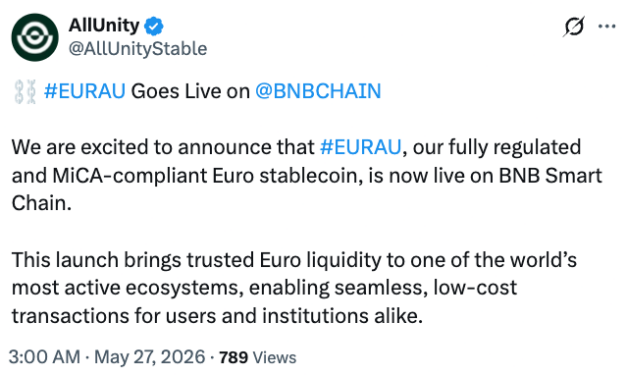
Digital asset company AllUnity is launching SEKAU, a Swedish krona-backed stablecoin issued under the European Union’s Markets in Crypto-Assets Regulation (MiCA).The new token operates as an e-money token under MiCA, according to a statement shared with Cointelegraph on Friday. It is backed by segregated Swedish krona reserves and targets institutional settlement and cross-border payments.The launch follows AllUnity’s Swiss franc stablecoin rollout, extending its multi-currency stablecoin strategy under the EU’s MiCA framework.Banking Circle among SEKAU partners The launch of SEKAU is supported by a growing ecosystem of partners.Banking Circle, a regulated business-to-business bank and financial infrastructure company based in Luxembourg, will hold and manage the reserves backing the token, while Swedish Marginalen Bank supports the rollout as a banking partner.Trust Anchor Group, a local digital asset infrastructure and technology company, provides infrastructure integration for broader ecosystem access to the stablecoin.Swedish krona stablecoin launches on multiple networksSEKAU debuts across five blockchain networks, including Ethereum, Solana, Base, Tempo and Polygon.AllUnity said the multi-chain rollout is designed to improve access, interoperability and liquidity across major blockchain ecosystems. The company added that it plans to expand SEKAU to additional blockchain networks later in 2026.By contrast, AllUnity’s Swiss franc stablecoin CHFAU initially launched exclusively on Ethereum in February before expanding to Tempo. The company also operates EURAU, a euro-backed stablecoin launched in 2025.Source: AllUnitySince launch, EURAU has reached a market capitalization of $1.4 million and ranks as the 16th largest euro stablecoin among 23 tracked tokens, according to CoinGecko. The euro stablecoin market totals about $883 million in combined value at the time of writing.AllUnity stressed that SEKAU is the first fully reserved Swedish krona-denominated stablecoin aligned with MiCA, issued as a regulated EMT backed 1:1 by SEK reserves.“SEK exposure has previously existed mainly through early-stage concepts, which are not confirmed as a MiCA-authorized, fully regulated EMT,” a spokesperson for AllUnity told Cointelegraph.Related: Tether winds down gold-backed derivative stablecoin aUSDTThe representative also mentioned that Swedish banking and fintech pilots have explored tokenized deposit money and settlement systems, but these remain “closed, experimental infrastructures” rather than publicly redeemable stablecoins. AllUnity said the most relevant initiative is Sweden’s e-krona project by the Riksbank, a central bank digital currency exploring tokenized payments infrastructure, but it is fundamentally different from a stablecoin. Riksbank communicated earlier this year that there were no stablecoins in Swedish kronor.Magazine: Crypto wanted to overthrow banks, now it’s becoming them in stablecoin fight

Čítaj viac

Ready USDC card halts non-EEA service after issuer change, users report

Ready, a self-custodial crypto wallet and payments company, has reportedly restricted card access for users outside the European Economic Area, according to multiple user reports.Ready has restricted USDC card functionality for users outside the European Economic Area following a change in its card provider, according to notices shared by users on social media.Several users shared screenshots of an in-app notice from Ready stating: “Your Ready Card will be deactivated within the next hour,” citing changes affecting users “primarily outside the EEA.”The reported changes left some users questioning how quickly access to crypto-linked payment cards can be restricted when providers change.Users question speed of restriction and communicationSeveral users criticized the short notice period before the changes took effect, saying they lost access to the card within hours.One user, who uses the X handle TapSatoshi, said in a post that they were frustrated with the company’s product roadmap, citing delayed features such as Apple Pay support and prioritizing the addition of a “Rewards” section.Source: ngjupengScreenshots of Ready’s message also stated that users would receive automatic refunds for any remaining subscription period within 10 business days.It remains unclear which company will serve as the new card provider for the Ready Card or what prompted the change. The previous issuer-side partner linked to the program was Kulipa, according to publicly available documentation.Related: BitGo courts crypto firms awaiting MiCA approval amid Binance licensing concernsCointelegraph contacted Ready for comment regarding the issue but did not receive a response by publication time.USDC at the center of the Ready CardFormerly known as Argent, Ready is a wallet built for the Starknet ecosystem, an Ethereum layer-2 scaling network using zero-knowledge rollups.While Ready’s wallet supports multiple crypto assets, including Bitcoin (BTC) and Ether (ETH), the Ready Card is primarily built around USDC, which users spend directly from their wallet balance at checkout.Source: ReadyAccording to Ready documentation, the system checks a user’s USDC balance in real time when a purchase is made and processes the transaction through Mastercard’s payment network, converting crypto into fiat at the point of sale. The card issuer acts as the bridge between the self-custodial wallet and traditional payment rails.This structure allows users to retain full control of their assets in the wallet, while the card only provides a spending layer on top of those funds. If card access is restricted, users can still hold and transfer USDC onchain without interruption.Magazine: The end of anon? AI could unmask crypto’s hidden identities

Čítaj viac

Získaj BONUS 8 € v Bitcoinoch

nakup bitcoin z karty

Registrácia Binance

Burza Binance

Aktuálne kurzy

