Autor Helen Partz

EU committee advances digital euro bill after key vote

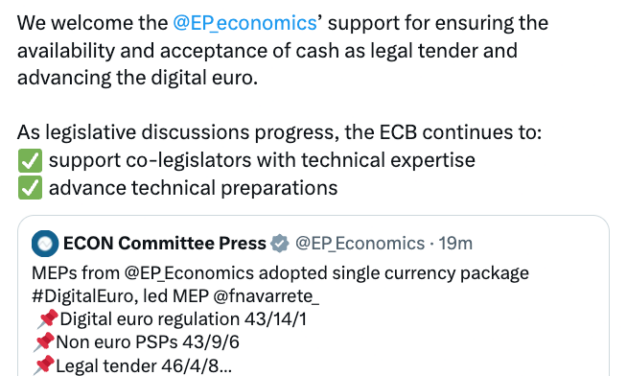
The creation of an EU-issued digital euro moved a step closer Tuesday after a key European Parliament committee vote.The EP’s Economic and Monetary Affairs Committee (ECON) approved its position on the digital euro package with a 43–14 vote, according to an official announcement on Tuesday.Fernando Navarrete Rojas, a member of the European Parliament (MEP), said the package “protects citizens’ freedom to choose how they pay,” adding that the digital euro would “complement cash, never replace it.”The vote marks a key step in shaping the rules for the EU’s potential central bank digital currency (CBDC), as the European Central Bank (ECB) targets a 2029 digital euro launch.Privacy and offline payments at coreUnder the approved draft, the digital euro would be issued by the ECB and function both online and offline.Online payments would use an account-based system, while offline payments would operate through local device storage, similar to cash in terms of user control.“The offline functionality would be equivalent to using physical cash, as losing the device would mean losing the offline money with no refund possible,” the announcement read.Source: ECBThe proposal includes privacy-by-design features, including technologies such as zero-knowledge proofs (ZKPs) to verify transactions without exposing personal data. “The ECB would not have access to personal identification data,” the announcement said.Digital euro won’t pay interestThe draft also introduces holding limits to protect financial stability, with caps on how much digital euro individuals can hold. These limits would be set by the European Commission based on ECB recommendations and reviewed regularly.The currency would not pay interest, and businesses would only be allowed to hold digital euros temporarily to accumulate incoming payments for up to 24 hours. Businesses would generally be required to accept the digital euro, with some exceptions for very small firms and self-employed operators who do not already accept digital payments.Related: ECB signs standards deals to cut digital euro integration costsBasic services such as account access and payments would be free, while additional services could carry capped fees for providers. Offline transactions would remain free under the proposal.Wider rollout and institutional rolesThe legislation also outlines a broader distribution model involving banks, payment providers and regulated crypto firms. Post offices and e-money providers could also distribute the digital euro across the eurozone.Before launch, the ECB would need to finalize technical rules, run pilot tests and coordinate with payment providers. A rollout period of at least two years would follow approval of the final law.Related: ECB official says stablecoins risk importing old market flawsThe latest approval marks clearing a key hurdle to rollout of digital euro after the ECB laid groundwork for a CBDC in 2020.The project has faced repeatedly delays due to unfinalized legislation, with ECB Executive Board member Piero Cipollone projecting as recently as September that the digital euro would likely not launch until 2029.EU consortium moves ahead with regulated stablecoinLast month, Qivalis, a European banking consortium developing a regulated euro stablecoin, expanded to 37 member institutions after adding 25 new banks across 15 countries.The new members include ABN AMRO, Rabobank, Nordea and Intesa Sanpaolo. The Amsterdam-based consortium is targeting a second-half 2026 launch, according to a statement shared with Cointelegraph.“We are not merely building payment rails; we are ensuring that European principles around data protection, financial stability and regulatory rigour are embedded into the next generation of digital money,” said Howard Davies, chairman of Qivalis’ supervisory board.The move comes as European institutions race to establish alternatives to US dollar-dominated stablecoins, which currently account for 98% of the market, according to CoinGecko.“Europe does not have to choose between the digital euro and successful private payment solutions. We need both to work together,” MEP Rojas said in an email response to Cointelegraph’s query. “The agreement recognizes the right dual approach: existing standards and infrastructure should be reused wherever possible and, where new standards are necessary, they should be open and accessible to banks, payment providers and innovative solutions.”Magazine: Clarity Act risks repeat of Europe’s mistakes, crypto lawyer warns

Čítaj viac
Binance’s Yi He warns of alleged impersonation scam, CoinUp denies ties

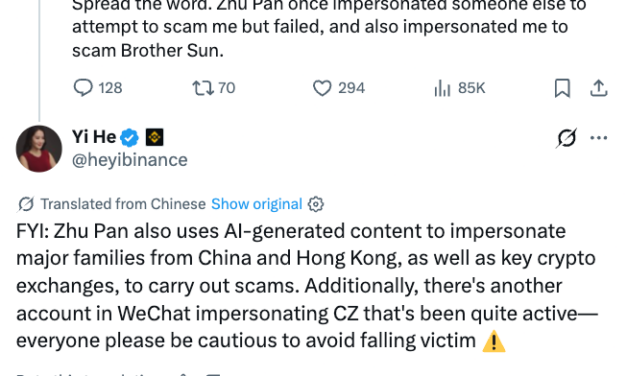
Binance co-founder Yi He has warned against an alleged scammer and impersonator, prompting the crypto derivatives trading platform CoinUp to issue a statement distancing itself from the individual.Binance’s He took to X on Monday to warn against the individual referred to as “Zhu Pan,” whom she said had impersonated her in failed scam attempts, urging users to spread awareness.The comments were made in response to a widely shared Chinese-language X post that alleged CoinUp was linked to the individual, claims CoinUp later disputed.“Zhu Pan is not a member of the CoinUp platform and does not participate in core operational management or related work for the CoinUp platform,” CoinUp responded in a statement on Tuesday.The incident underscores how fast-moving social media allegations can pull exchanges and high-profile figures into disputes, amplifying reputational risk in crypto markets where project ties are often unclear.Who is the mysterious Zhu Pan?Public information about the individual referred to as “Zhu Pan” remains limited and disputed, with different accounts circulating in Chinese-language crypto communities.According to a report by Chinese outlet Pencil News, a person identified as Zhu Pan was previously linked to the 2018 ZJLT initial coin offering project, which later faced investor backlash over losses and accusations of fraud. Zhu reportedly denied being a founder or operator of the project.Source: Yi HeCointelegraph contacted Binance for further comment on the allegations and identity of the individual referred to as “Zhu Pan” but did not receive a response prior to publication.Yi He alleged that “Zhu Pan” impersonated her in an attempt to scam Tron founder Justin Sun. Sun later said her account was “absolutely true.”CoinUp denies operational ties and cites market selling pressureAlthough CoinUp denied Zhu’s involvement in its core operations or management, the company said the individual is linked to a project listed on its platform.“Associating his personal actions, past project experiences, or market rumors directly with the CoinUp platform entity constitutes an inaccurate interpretation,” CoinUp said.Related: China pays closer attention to stablecoins as cross-border role expandsThe exchange also addressed the volatility of the CoinUp token (CPX), the native utility and ecosystem token for CoinUp, which reportedly posted all-time highs above $0.829 last Friday, according to Lookonchain.CoinUp said recent sharp price swings were caused by concentrated market selling pressure and said it was investigating the cause of the volatility. It added that its security review found no evidence of hacking, data breaches or system vulnerabilities.Magazine: China’s 107 Bitcoin memory thief, Bithumb CEO booked: Asia Express

Čítaj viac

Ripple gains preliminary MiCA license ahead of July 1 EU deadline

Luxembourg’s financial regulator granted Ripple preliminary approval for a crypto asset service provider (CASP) license under the European Union’s Markets in Crypto-Assets Regulation (MiCA), the company said Tuesday.Ripple said in a statement that the approval, once finalized, would allow it to offer regulated crypto services to banks, fintechs and other businesses across all 30 countries in the European Economic Area (EEA) through a single regulatory passport.The move builds on Ripple’s existing Electronic Money Institution (EMI) license in Luxembourg, which allows it to provide regulated cross-border payments and electronic money services across the EEA. The update comes just days before the July 1 transitional deadline, when EU countries begin fully applying MiCA rules.Cointelegraph reached out to Luxembourg’s Commission de Surveillance du Secteur Financier but did not receive an immediate response.Full crypto asset and stablecoin payments infrastructure compliant with MiCARipple said its pending CASP license, combined with the EMI license issued in February 2026, would enable a “full crypto asset and stablecoins payments infrastructure” through a single integration for the first time.The company added that the approval also positions Ripple to expand into broader crypto asset activities in Europe, which is “already a leading region” for its products.Source: Cassie Craddock“MiCA has helped to unlock a new wave of institutional digital assets adoption, and we are seeing that demand accelerate across the region,” said Cassie Craddock, managing director of the UK and Europe at Ripple.Europe becomes the regulatory battlegroundRipple’s CASP approval comes as Europe emerges as a key regulatory test case for the crypto industry as the MiCA framework takes effect.Related: EUR trading accounts for 1% of Binance spot volume, CryptoQuant saysCrypto companies are racing to secure MiCA authorization ahead of the July 1 deadline, but major exchanges, including Binance, are still awaiting approval under the new regime. Media reports have indicated that Greek regulators may be preparing to deny Binance’s application.Ripple currently holds more than 75 regulatory licenses globally, including a UK license from the Financial Conduct Authority received in January 2026.Magazine: SBF will never get a pardon, Trump peace deal boosts Bitcoin: Hodlers Digest June 14-21

Čítaj viac

Strategy adds $300M to USD Reserve, acquires 520 BTC

Michael Saylor’s Strategy has expanded its Bitcoin holdings and increased its US dollar reserve after its perpetual preferred stock STRC slipped below $90.Strategy acquired 520 Bitcoin (BTC) for $34.9 million between June 15 and Sunday, according to a Monday 8-K filing with the US Securities and Exchange Commission. The purchase was made at an average price of $67,068 per BTC, bringing Strategy’s total Bitcoin holdings to 847,363 BTC. Strategy’s cumulative purchases now total $64.1 billion, giving the company an average acquisition cost of $75,651 per Bitcoin.Strategy said on X that it added $300 million to its US dollar reserve, bringing the total to $1.4 billion. According to the company’s 8-K filing, the figure includes expected cash proceeds from its at-the-market (ATM) share sales that had not yet settled.Source: StrategyStrategy’s financing decisions are closely watched because the company is the largest corporate holder of Bitcoin and one of the market’s most active buyers. The firm’s funding model has also become a template for a growing number of Bitcoin treasury companies.MSTR share sales fund Bitcoin purchase and USD reserveStrategy funded its latest Bitcoin purchase and liquidity reserve using proceeds from sales of its Class A common stock (MSTR). The company raised $335.5 million through its ATM equity program during the reporting period.While $34.9 million of the proceeds was used to buy 520 Bitcoin, $300 million was allocated to Strategy’s US dollar reserve, which is designed to support dividend payments and debt obligations.Source: SEC“Strategy plans to continue replenishing the USD Reserve over time based on market conditions to support the credit quality of its Digital Credit securities,” the company said in the 8-K filing.MSTR and STRC tumble at Thursday’s closeOngoing volatility in Strategy’s shares and preferred stock continued to draw market attention, particularly as STRC, which is designed to trade near $100, fell below $90 last week.MSTR dropped 3.46% to $112.53 at Thursday’s close ahead of Friday’s market holiday, according to Yahoo Finance data. STRC, the company’s perpetual preferred stock, slipped 0.46% to $88.59 at Thursday’s close. It traded at $90.59 during Monday’s premarket session. Bitcoin advocate Samson Mow said on X on Monday that STRC has a “self-repairing mechanism” that activates when the security trades below its $100 reference level. He said that when the price falls below that level, the company stops issuing new shares through its ATM program, which limits new supply.Related: Bitcoin doesn’t need Ethereum-style yield, says Strategy’s Michael SaylorMow added that lower prices effectively increase the yield for buyers relative to their purchase price, which can encourage demand and help push the price back toward $100. He described the structure as relying on market incentives rather than active intervention from Strategy to maintain stability.Magazine: Bitcoin decouples from tech stocks, Ether eyes ‘selling wave’: Market Moves

Čítaj viac

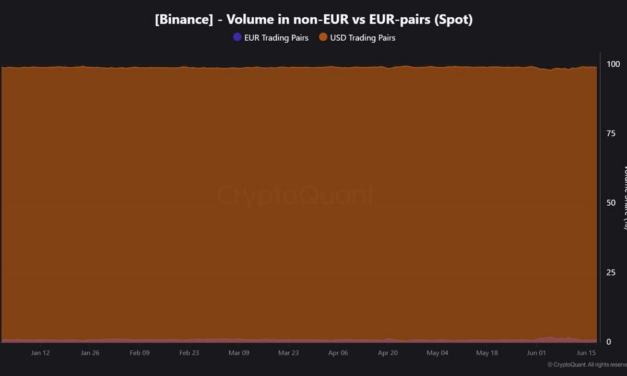
EUR trading accounts for 1% of Binance spot volume, CryptoQuant says

Euro-denominated trading accounts for only a small share of Binance’s activity, as the exchange faces uncertainty over its European licensing prospects under the Markets in Crypto-Assets Regulation (MiCA).Euro (EUR) trading accounts for around 1% of Binance’s spot volume, CryptoQuant analyst Maartunn told Cointelegraph.“Binance’s inflows remain globally distributed, which may limit the impact of potential MiCA-related setbacks,” Maartunn said, pointing to the exchange’s diversified user base across regions.Source: CryptoQuantThe data comes as Greek regulators are reportedly preparing to reject Binance’s licensing application ahead of MiCA’s transitional deadline on July 1, a move that could complicate the exchange’s ability to serve EU residents.Binance ranks among Europe’s biggest crypto exchangesEven though EUR trading represents only about 1% of Binance’s global spot volume, the exchange still processes hundreds of millions of dollars in euro-denominated trades.According to CryptoQuant data, Binance’s daily EUR-pair volumes have ranged from roughly $100 million to $250 million in 2026, with occasional spikes above $600 million.Source: CryptoQuantAccording to a December 2024 report by Kaiko, Binance, alongside Bitvavo, Kraken and Coinbase, accounted for more than 85% of all euro-denominated crypto trading volume.Related: WhiteBIT secures MiCA license in Austria ahead of July 1 EU deadlineUnlike Binance, Bitvavo, Kraken and Coinbase are among the major exchanges that have already secured MiCA authorization, allowing them to offer services across the EU under the framework’s passporting regime.83% of CASPs have yet to receive a MiCA licenseBinance’s licensing uncertainty comes as many crypto asset service providers (CASPs) are still adapting to MiCA’s requirements.According to estimates based on European Securities and Markets Authority (ESMA) data cited by market analyst Merlijn Geurds, only around 210 of more than 1,200 firms operating under pre-MiCA registration regimes have obtained full authorization under the new framework.Source: Merlijn GeurdsGeurds told Cointelegraph the gap reflects the cost and complexity of compliance, which requires governance standards, compliance controls and operational safeguards that many smaller firms lack.“The result is consolidation by design,” Geurds said, adding: “A smaller group of well-capitalized, licensed players gets a passport to all 27 states, while a long tail faces forced migrations or cutoffs.”Cointelegraph contacted Binance for comment on the size of its European business and the potential impact of MiCA-related restrictions but had not received a response by publication.Magazine: SBF will never get a pardon, Trump peace deal boosts Bitcoin: Hodlers Digest June 14-21

Čítaj viac

Získaj BONUS 8 € v Bitcoinoch

nakup bitcoin z karty

Registrácia Binance

Burza Binance

Aktuálne kurzy