Autor Helen Partz

Bitcoin ETFs post June's biggest daily outflows as BTC falls below $60K

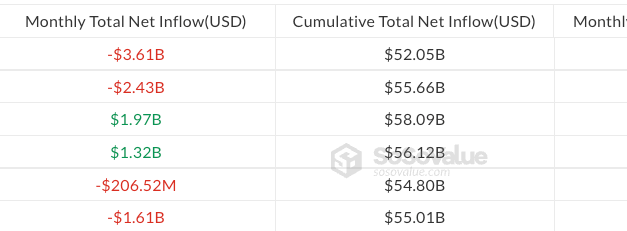
US-listed spot Bitcoin exchange-traded funds (ETFs) recorded their largest daily net outflows of June on Thursday as Bitcoin fell below $60,000.Spot Bitcoin ETFs shed $696.3 million, surpassing the previous monthly high of $519.2 million logged on June 2, according to SoSoValue data.The latest withdrawals pushed June’s total outflows to $3.61 billion, bringing year-to-date net outflows to $4.6 billion.Monthly flows in US spot Bitcoin ETFs as of Friday. Source: SoSoValue The ETF outflows coincide with signs that other large sources of institutional Bitcoin demand are also slowing. Strategy, the world’s largest corporate Bitcoin holder, has reduced its accumulation pace in June, prompting debate over whether the company should conserve cash during the market downturn.ETF assets down 57% from 2025 peakUS-listed spot Bitcoin ETFs have seen total net assets fall below $73 billion for the first time since late 2024, as recent outflows and a roughly 50% drop in Bitcoin’s price from its October peak weigh on the sector.According to SoSoValue, total net assets in US spot Bitcoin ETFs reached a record $169.5 billion in October 2025. As of Friday, that figure stood at about $72.6 billion, a decline of roughly 57%.BTC holdings for US spot Bitcoin ETFs as of market close on Tuesday. Source: Wallet PilotSeparate data from WalletPilot shows the funds held a combined 1.24 million BTC as of Tuesday, with about 63,500 BTC leaving the products over the past 30 days.Strategy slows Bitcoin buying in June to about 3,600 BTC amid criticismSome analysts argue that Strategy should pause BTC purchases and rebuild its cash reserves.Saylor’s Strategy bought roughly 3,600 Bitcoin so far in June, down from about 25,000 BTC in May and more than 50,000 BTC in April, according to company filings.The slowdown also included a net sale of 32 BTC earlier in the month, one of the few times the company has sold Bitcoin during its accumulation period.Related: Strategy adds $300M to USD Reserve, acquires 520 BTCStrategy’s perpetual preferred stock, STRC, has come under pressure, trading below its intended $100 level. STRC closed at $75.69 on Thursday, down 6.37%.Source: Julio MorenoThe move has fueled debate over Strategy’s Bitcoin-buying model. CryptoQuant analysts have raised concerns about the company’s timing and risk management.On the other hand, Bitcoin advocate Samson Mow said STRC has a “self-repairing mechanism” that activates when it trades below its $100 benchmark. He noted that the company pauses new share issuance through its ATM program at that level, which limits new supply.Magazine: Bitcoin slides to $58K, XRP hits $1 but onchain data promising: Market Moves

Čítaj viac
Binance faces EU service limits next week as MiCA rules take effect

Binance has notified European Union users that access to key services will be restricted after the exchange failed to secure Markets in Crypto-Assets (MiCA) authorization from a member state before a July 1 deadline.Those restrictions include halting onboarding new EU users and limiting certain services for EU-based accounts effective July 1, according to exchange notices shared by users on social media.The notices said users will still be able to withdraw their assets after that date, stating that “all digital assets are still available for withdrawal,” in line with applicable regulatory requirements.The move marks one of the first major transitions under the EU’s MiCA framework after Binance announced it withdrew its MiCA license application in Greece on Wednesday.Cointelegraph approached Binance for comment on its plans but did not receive a response prior to the time of publication.Binance advises moving funds to self-custodial wallets or other exchangesIn circulating notices, Binance told users they may move assets to self-custody wallets or transfer funds to other crypto asset service providers (CASPs).The exchange operator said the transition is intended to be an “orderly process” aimed at minimizing disruption to users, with services reduced to position management and withdrawals after the deadline.Source: IT_Tech_PLMultiple MiCA-licensed CASPs including Revolut and OKX have been actively recruiting new users in EU member states ahead of next week’s deadline.Users seek clarity on staking and tradingSome Binance users have raised concerns over how specific services will be handled once EU service restrictions take effect after the MiCA transition ends.In public replies on social media, users asked what will happen to staked crypto assets on Binance after the deadline, reflecting uncertainty around whether yield-generating positions will be affected by the upcoming service changes.Source: FilipebinanceIn response, a Binance representative said user balances “remain available and safe as always,” but did not provide specific details on how staking rewards or active positions will be treated under the restricted-services phase.Community divides over Binance user impactViews across the crypto industry differ on how significant the upcoming MiCA transition will be for existing Binance users in the European Union.Dominik Tomczyk, CEO of SIA AlphaRoute, operating as Kanga Exchange EU, told Cointelegraph that non-licensed platforms may still continue serving existing users under the legal concept of “reverse solicitation.” He said that, from a user perspective, “nothing will change,” apart from restrictions on marketing and user acquisition within the EU.Sławomir Zawadzki, co-CEO of Kanga Exchange, said existing users are unlikely to see major disruptions. He also suggested that much of the concern around MiCA-related changes is being overstated, adding that competitive positioning may be shaping parts of the public narrative.Mixed response from usersOne Binance EU user told Cointelegraph they were not overly concerned about the MiCA deadline, pointing to Binance’s liquidity and proof-of-reserves reporting. “I’ll honestly continue using Binance until I see evidence of a potential enforcement action,” the person said.Another user said the impact on Binance EU users would depend on how heavily they rely on the platform. They noted that their primary use of the platform is as a trading gateway and would switch to another exchange if needed, while suggesting the biggest disruption would likely affect active traders and users with large balances on the platform.Related: EUR trading accounts for 1% of Binance spot volume, CryptoQuant saysAccording to media reports, Binance’s global client base counts at least 300 million customers, while the app was downloaded more than 4 million times in the EU last year. Magazine: How crypto laws changed in 2025 — and how they’ll change in 2026

Čítaj viac

Polish crypto exchange Kanga secures MiCA license in Latvia

Kanga, a crypto exchange founded in Poland, said it has obtained a Markets in Crypto-Assets Regulation (MiCA) license in Latvia, allowing it to passport its services across the European Union.The exchange’s operator, SIA AlphaRoute, received a Class 3 MiCA license from the Bank of Latvia after its Supervisory Committee approved the authorization, according to a Wednesday statement shared with Cointelegraph.The license was granted on June 18 and authorizes the company to provide services, including crypto custody, trading and transfers, across the EU, said the exchange.Kanga’s approval comes as Poland remains without MiCA implementation legislation ahead of the EU’s July 1 transitional deadline, with lawmakers still trying to break a deadlock following three presidential vetoes.Source: KangaKanga’s path to EU-wide operationsKanga began the pre-licensing process in Latvia in November 2025 after reviewing several jurisdictions, according to SIA AlphaRoute CEO Dominik Tomczyk.“From the very beginning, we knew that we had to use the transitional period provided for under the MiCA regulation to prepare the organisation to operate within the new regulatory framework,” Tomczyk said.Related: Binance withdraws Greece-filed MiCA applicationThe company said it will provide customers with additional details about operational changes and service terms through its official communication channels.Poland’s MiCA deadlockPresident Nawrocki vetoed a government-backed crypto bill for a third time on June 11, saying successive versions failed to address his objections, including provisions he considered overly burdensome for crypto companies.Members of the Poland 2050 party, part of Prime Minister Donald Tusk’s governing coalition, have since reportedly submitted a new proposal incorporating several changes requested by the president.According to the bill’s sponsors, the proposal would reduce some fees, remove certain regulatory provisions and make the framework less restrictive for crypto companies. Poland 2050 reportedly called for the legislation to be fast-tracked through parliament.Poland’s crypto sector also faces heightened scrutiny following a fraud investigation into Zonda, the country’s largest crypto exchange, where prosecutors estimate customer losses exceed 350 million zlotys (about $92.7 million).Magazine: Bitcoin decouples from tech stocks, Ether eyes ‘selling wave’: Market Moves

Čítaj viac

SecondFi traces Cardano wallet exploit to address-level issue

A vulnerability in Cardano-based wallet SecondFi allowed attackers to drain user funds, resulting in major losses.SecondFi on Wednesday confirmed it had identified the root cause of the exploit and is now engaging with Cardano ecosystem platforms and blockchain investigators to address the issue.The company also said it triggered emergency measures that secured roughly 129 million ADA, which is being transferred to an independent third-party custodian and held for affected users pending verification.The platform on Tuesday estimated that around 16 million ADA, or $2.4 million, was affected across 374 addresses. Cardano founder Charles Hoskinson said SecondFi is not an Input Output Global product and stressed that there is no ownership, control, or business relationship between the wallet and IOG.SecondFi traces exploit to an address-level issueSecondFi has not released a comprehensive post-mortem as of publication, but has issued multiple statements confirming a security breach caused by a vulnerability in its Cardano web wallet generation software.It said the root cause of the incident was an issue at the address level that affects users when they sign transactions.Source: SecondFi“SecondFi’s wallet software exposed the private keys it generated,” Mitchell Amador, CEO of security company Immunefi, told Cointelegraph.Amador said that while the blockchain remained secure, the code that generates the keys is the “part nobody audits like a contract.” He added that attackers have increasingly shifted focus toward infrastructure that creates or stores crypto keys rather than blockchain protocols.Related: AI models led to a ‘vulnerability apocalypse’ in crypto security: Immunefi CEO“Recovery to another platform or wallet does not mitigate the risk,” SecondFi said, advising users not to restore their recovery phrases into new Cardano wallets. The guidance differed from recommendations by some community members, who urged users to migrate affected wallets and move funds to newly created addresses.“We didn’t write the code,” says HoskinsonSecondFi is a self-custodial platform built on Cardano that rebranded from the Yoroi wallet in April 2026. Yoroi was developed by Emurgo, which describes itself as the “for-profit arm of Cardano,” and was launched as the first open-source light wallet for the Cardano blockchain.Hoskinson said IOG’s incident response team has been in contact with SecondFi since Monday and that the platform requested an independent security audit.Source: Charles HoskinsonIn a Tuesday video posted on X, Hoskinson stressed that IOG “is not Emurgo,” adding that the company has no influence over Emurgo and cannot speak on its behalf regarding the exploit.“We didn’t write the code and we’re not connected to it,” he said.Magazine: Japanese pension fund tips 1% in crypto, G7 urges action on NK hackers: Asia Express

Čítaj viac

OpenPayd secures MiCA license as stablecoin adoption grows in Europe

Financial infrastructure provider OpenPayd said Wednesday that it has secured authorization under the European Union’s Markets in Crypto-Assets Regulation (MiCA), allowing it to offer crypto services across the European Economic Area (EEA) via passporting.The license lets OpenPayd operate as a crypto asset service provider (CASP) to offer services such as fiat-to-stablecoin on-ramping and off-ramping, the company said in a statement seen by Cointelegraph.“Stablecoins are rapidly becoming part of mainstream financial infrastructure,” OpenPayd CEO Iana Dimitrova said, adding that MiCA gives businesses greater confidence to use digital asset technology for payments, treasury operations and growth.The license was issued by the Malta Financial Services Authority (MFSA), an OpenPayd spokesperson told Cointelegraph. The regulator has also granted MiCA licenses to crypto companies, including OKX and Gemini.The approval comes days before a July 1 MiCA transitional deadline, as crypto companies race to secure authorization under the bloc’s crypto rules. On Tuesday alone, Bitcoin Suisse secured a MiCA license in Liechtenstein and Ripple announced preliminary CASP approval in Luxembourg.OpenPayd counts Kraken, OKX among its clientsOpenPayd’s MiCA authorization comes about a year after the company launched its stablecoin infrastructure, which allows businesses to manage fiat currencies and digital assets through a single platform.The company said it processes more than $240 billion in annualized transaction volume for over 1,100 businesses worldwide, including Kraken, eToro, OKX and B2C2.Source: OpenPaydOpenPayd was founded in London in 2018 by Ozan Ozerk, a fintech entrepreneur who also founded European Merchant Bank, a Lithuania-based digital bank.Related: EU committee advances digital euro bill after key voteOpenPayd eyes Nasdaq debutOpenPayd’s MiCA license news comes as the company is pursuing a public listing in the US.Earlier in June, OpenPayd announced a proposed merger with special purpose acquisition company Titan Acquisition Corp, a deal that would see its shares trade on Nasdaq under the ticker “OP” if approved.The transaction values OpenPayd at about $1.1 billion and is expected to close in the fourth quarter of 2026, subject to shareholder and regulatory approvals.Magazine: Bitcoin decouples from tech stocks, Ether eyes ‘selling wave’: Market Moves

Čítaj viac

Získaj BONUS 8 € v Bitcoinoch

nakup bitcoin z karty

Registrácia Binance

Burza Binance

Aktuálne kurzy