Autor Felix Ng

Sharplink buys ETH after 8-month pause as token hits 2026 low

Ether treasury company Sharplink has bought Ether for the first time in eight months as the token sank to its lowest price this year on Thursday.On-chain data from Arkham shows a wallet associated with Sharplink received 5,000 Ether (ETH), worth $7.85 million, from crypto prime brokerage FalconX on Thursday. The last time it received Ether from FalconX was on Oct. 26, when it bought $78.3 million worth of ETH. The purchase comes as Ether hit $1,537 on Thursday, its lowest price in 2026. The latest purchase could suggest a revival of the company’s active Ether accumulation strategy.”I’m seeing genuine corporate accumulation conviction holding strong amid subdued price action,” Andri Fauzan Adziima, the research lead at Bitrue Research Institute, told Cointelegraph. Sharplink CEO Joseph Chalom told Cointelegraph in May that he saw three catalysts that could spur growth in the price of Ether.The first was the passage of the CLARITY Act in the US, while the second was a return to market risk appetite, which will depend on an easing in geopolitical tension and cooling of the artificial intelligence investment thesis. Chalom’s third catalyst was the continued growth of real-world asset tokenization. The Senate is yet to vote on its version of the CLARITY Act, and the House Financial Services Committee said it would hold a hearing on the bill on July 17. The US and Iran are working toward a final peace agreement to end months of conflict and tokenized real-world assets have now reached a distributed asset value of $31.55 billion, close to its highest level this year.Sharplink now holds 876,285 ETHSharplink was founded in 2019 as an affiliate marketing service provider to the sports betting and gambling industries, but pivoted to become an Ethereum treasury company in June 2025, with Consensys co-founder and CEO Joe Lubin named as chairman.It became the largest publicly traded corporate holder of ETH, but lost the title to Bitmine in August, just two months after Bitmine launched its own Ether buying strategy. Related: Bitmine, Sharplink and Joe Lubin back Ethereum R&D nonprofitThe company now holds 876,285 ETH and ETH equivalents, which it has accumulated over time through active ETH purchases and staking rewards. Its competitor, Bitmine, holds 5.67 million ETH after acquiring another 52,203 ETH last week. Source: Sharplink“We continue to maintain a steady pace of accumulation throughout 2026. We believe we are in the early stages of crypto spring,” Bitmine chairman Tom Lee said. Sharplink added to the Russell indexesThe purchase also comes just days before Sharplink is expected to join the Russell 2000 and Russell 3000 indexes on Monday. Inclusion in the indexes is widely viewed as positive because many active and passive funds, including exchange-traded funds, typically buy stocks from them.Chalom in May said that joining the Russell indexes would broaden the company’s shareholder base and strengthen its access to capital markets.Magazine: Guide to the top and emerging global crypto hubs: Mid-2026

Čítaj viac
Kalshi seeks funding at $40B valuation, nearly doubling last raise: FT

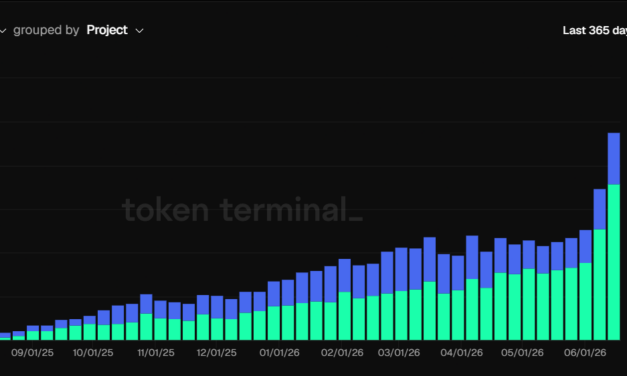
US-based prediction market platform Kalshi is reportedly in talks to raise funds at a $40 billion valuation, nearly doubling its $22 billion valuation in May.The company could close the new funding round as soon as the third quarter of this year, the Financial Times reported on Wednesday, citing people familiar with the matter. Kalshi closed a $1 billion Series F in May, led by Coatue Management, with participation from Andreessen Horowitz, Sequoia Capital, Morgan Stanley and Ark Invest. Its $22 billion valuation at the time was double the company’s $11 billion valuation in December and more than four times its $5 billion valuation in October. If the new funding round closes at a $40 billion valuation, Kalshi’s value would have increased eightfold in less than a year, underscoring a surge in investor interest in prediction markets. The valuation would also far surpass Polymarket’s last reported valuation of $15 billion in April. Kalshi declined to comment. Kalshi was founded in 2018 by Tarek Mansour and launched publicly in July 2021, with prediction markets gaining significant momentum in 2024 in the run-up to the US presidential election. While Polymarket was the clear leader in trading volume in 2024, the two prediction market platforms flipped around September last year as Kalshi partnered with Robinhood to let users trade on outcomes of NFL and college football games. Notional weekly trading volumes of Kalshi (green) and Polymarket (blue). Source: Token TerminalThe gap has continued to widen over the last nine months. As of May, Kalshi’s monthly notional trading volume was $17.9 billion, compared with Polymarket’s $7.1 billion, according to data from Token Terminal. The success of prediction markets has reportedly drawn interest from social media and tech giant Meta, with CEO Mark Zuckerberg directing staff to create a prediction markets mobile app called “Arena” to challenge Kalshi and Polymarket, according to the New York Times. Related: Kalshi in early IPO talks with investment banks: Report Meanwhile, market operator Cboe Global Markets on Tuesday entered the prediction markets business with the launch of Cboe Predicts, a platform debuting with binary contracts tied to the S&P 500. Prediction markets have been pulled into legal battles across the US, with several states arguing that their event contracts tied to sports are sports betting regulated by state gaming authorities. Kentucky was the latest state to take action, suing five prediction market platforms last week, including Kalshi and Polymarket, to accuse them of “operating unlicensed and illegal sports betting and gambling platforms.” The US Commodity Futures Trading Commission has claimed it has exclusive authority over prediction markets, arguing they are registered with the agency.The CFTC has sued multiple state authorities that have taken action against prediction markets, including Kentucky on Tuesday, in a bid to block states’ attempts to police the platforms.Magazine: AI is banking the unbanked in Africa… faster than crypto

Čítaj viac

CFTC sues Kentucky after state’s prediction market lawsuits

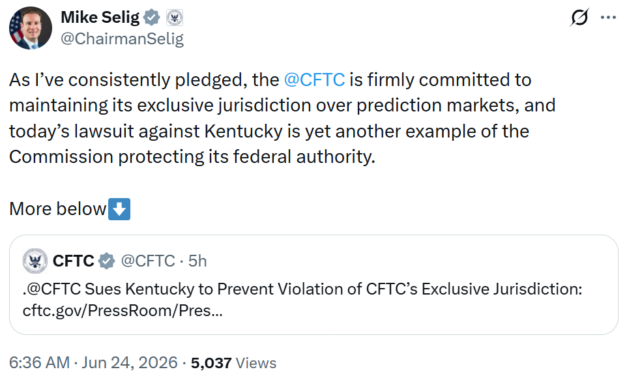
The US Commodity Futures Trading Commission filed a lawsuit against Kentucky on Tuesday after the state sued prediction market operators last week, accusing them of operating unlicensed and illegal gambling platforms.The lawsuit, filed in federal court, seeks to block Kentucky’s legal action against five prediction markets filed on Wednesday last week, calling for declaratory and injunctive relief. It names Kentucky Governor Andrew Beshear, Attorney General Russell Coleman and the Kentucky Horse Racing and Gaming Corporation, among others.“Kentucky is the latest state attempting to shut down federally-regulated event contracts,” CFTC Chair Mike Selig said in a statement. “As I’ve consistently pledged, the CFTC is firmly committed to maintaining its exclusive jurisdiction over prediction markets, and today’s lawsuit against Kentucky is yet another example of the Commission protecting its federal interests.”The CFTC has been ramping up its effort to maintain authority over prediction markets since Selig was appointed as chair in December. Kentucky is now the ninth state that the CFTC has sued over state authorities taking action against prediction markets.Source: Mike SeligKentucky sued Polymarket and Kalshi, along with Kalshi partners Coinbase, Robinhood and Webull, claiming they are “doing business without a Kentucky gaming license or following state regulations” and that their sports event contracts “fall squarely within the definition of ‘sports wagering’ under Kentucky law.”Sports betting has been under the jurisdiction of the Kentucky Horse Racing and Gaming Corporation since 2023.Related: Mark Zuckerberg ordered Meta staff to develop moneyless prediction market: NYTThe state also alleged the platforms offer users “few or no resources” to identify or seek help for a gambling problem as required by state law.  In its lawsuit, the CFTC argued that Kalshi and Polymarket are designated contract markets under its authority, and their event contracts are “swaps” under federal commodities law. It argued that Coinbase, Robinhood and Webull are CFTC-registered futures commission merchants that can offer event contracts in partnership with a designated contract market.The regulator also took aim at Kentucky’s recent law that imposed a 14.25% excise tax on prediction market transaction fees, arguing it was an attempt to make prediction markets economically unviable in the state.“This tax essentially makes it impossible for prediction markets to operate in Kentucky,” the CFTC argued.The lawsuit comes just weeks after CFTC similarly sued New Mexico to block the state’s efforts to apply state gaming laws to Kalshi.In May, US President Donald Trump gave the CFTC moral support, saying it was “critically important” that the regulator was the authority on prediction markets.Source: Donald TrumpTrump’s son, Donald Trump Jr., has invested in and is on the advisory board for Polymarket and is an adviser to Kalshi.Magazine: Bitcoin decouples from tech stocks, Ether eyes ‘selling wave’: Market Moves

Čítaj viac

Goldman Sachs cuts year-end gold target by $500, doubting rate cuts

Goldman Sachs lowered its year-end gold forecast by $500 an ounce, citing expectations that the US Federal Reserve won’t cut interest rates this year. The revised target places gold at $4,900, down from earlier estimates of $5,400. It comes on the assumption that the next Fed cuts could be pushed to March 2027 and December 2027. “Our gold price views remain structurally constructive but tactically cautious, with near-term downside risk and medium-term upside risk,” Goldman Sachs commodity analysts Lina Thomas and Daan Struyven said, according to Bloomberg. A delay in US interest rate cuts could also weigh on cryptocurrencies, as lower interest rates tend to be favorable for digital assets such as Bitcoin. The war in Iran has also taken its toll on the assets. Bitcoin has fallen 28.3% since January, and gold has declined more than 22% since its January all-time high of $5,327 per ounce. Gold is now just $135 away from dipping below $4,000, a level not seen since November, according to GoldPrice.Gold price one-year chart. Source: GoldPriceRelated: Bitcoin’s deeply discounted versus AI-stocks, but hawkish Fed risk lingers: BitwiseLast week, analysts cautioned that Bitcoin and gold may face further headwinds this year following a 4.2% annual increase in the US Consumer Price Index in May, coupled with the conflict in the Middle East.Since gold pays no yield, rising rates could mean that holding gold becomes more expensive relative to bonds or cash, and the market may be repricing the entire “easy money” thesis that drove gold to record highs earlier this year.“Only when inflation drops, rate cuts become viable, and liquidity improves alongside lower capital costs, will the overall risk appetite truly reverse,” HashKey Group senior researcher Tim Sun told Cointelegraph.  CME’s FedWatch tool shows a high chance of rates staying the same or rising in the remaining months of 2026, compared with the current target rate of 3.5% to 3.75%. Magazine: The end of anon? AI could unmask crypto’s hidden identities

Čítaj viac

France to stop certifying products lacking quantum-resistant encryption

France’s national cybersecurity agency ANSSI said Tuesday that it will stop certifying security products that lack quantum-resistant encryption, reflecting growing concern among governments about quantum threats to cryptography. ANSSI Chief of Staff Samih Souissi said at the France Quantum 2026 Summit that it would halt such certifications in 2027 and that businesses should buy only quantum-safe products by 2030, Reuters reported.“ANSSI has been telegraphing this move for years,” Marin Ivezic, the founder of consulting firm Applied Quantum, said in a post on LinkedIn. “What changed yesterday is that ANSSI’s chief of staff said it publicly at a major conference, in front of the French quantum ecosystem, with Reuters in the room. The guidance became a commitment.”ANSSI certification is a prerequisite for use across French government agencies and critical infrastructure operators. The move would force vendors to demonstrate post-quantum cryptography capability by 2027 or lose access to government contracts.“It’s not only a technical issue,” Souissi said. “It’s a matter of ​governance, industrial planning, regulation, and sovereignty.”ANSSI Chief of Staff Samih Souissi speaking at Orange OpenTech 2025 Source: YouTubeFrance’s 2027 cutoff aligns with a move from the US National Security Agency (NSA) to require all national security systems to use its suite of quantum-resistant algorithms, known as CNSA 2.0, by 2027. Under CNSA 2.0, all new national security system acquisitions are required to support the approved algorithms by Jan. 1, 2027. Noncompliant systems must be phased out by the end of 2030, and by the end of 2031, all national security systems must use CNSA 2.0 algorithms.“Two of the world’s most demanding cryptographic certification authorities, serving two of the world’s largest defense and government technology markets, have independently converged on the same year to make PQC [post-quantum cryptography] a pass-fail requirement,” Ivezic said. Crypto grapples with quantum threat Quantum threats to cryptography has also been a growing concern within the cryptocurrency industry. In May, data analytics platform Glassnode estimated that nearly 10% of the total supply of Bitcoin (BTC), around 1.92 million BTC, is considered “structurally unsafe” in the event of a quantum computing breakthrough. Related: Researchers say quantum computers could, in theory, be ready by 2030In April, Coinbase warned that proof-of-stake blockchains, including Ethereum and Solana, may be at greater risk from quantum computing because of the signature schemes validators use to secure the network.However, Coinbase also acknowledged that many blockchains have already begun work to harden their systems against quantum threats. Coinbase said layer-1 blockchain Algorand has a “staged roadmap toward full quantum readiness” and is among the first networks to have deployed cryptography designed to be secure against quantum computers. It also said Aptos, a competing layer-1 blockchain, was “well-positioned for the transition to post-quantum secure transactions.” Solana and Ethereum have also created clear roadmaps to address quantum threats, including upgrading signatures to be quantum-resistant. Magazine: The end of anon? AI could unmask crypto’s hidden identities

Čítaj viac

Získaj BONUS 8 € v Bitcoinoch

nakup bitcoin z karty

Registrácia Binance

Burza Binance

Aktuálne kurzy