
Autor Cointelegraph

Bitcoin, Ether extend relief rallies as extreme fear meets renewed ETF buying

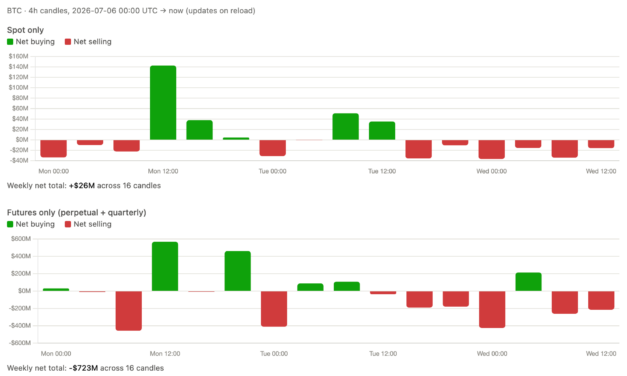
Bitcoin (BTC) rallied, $50 short of $63,000, on July 3, and Ether (ETH) outperformed the wider market, pushing to $1,775. The end-of-week rally comes a few days after BTC fell to a 21-month low and ETH sank to fresh year-to-date lows. Highlighting the negative sentiment, the Crypto Fear & Greed index registered “Extreme Fear” at 11 out of 100. Crypto Fear & Greed Index. Source: Alternative.meThat gap between the “Extreme Fear” reading and Friday’s bullish market activity is worth noting. On July 2, US spot Bitcoin exchange-traded funds (ETFs) took in a net $221.7 million, their largest single-day inflow since early May and a break from 10 consecutive days of outflows. Spot Bitcoin ETF netflows. Source: SoSoValue.comFutures markets fuel Bitcoin and Ether gainsThe leverage side of the crypto market looks more one-sided than the spot buying data alone would suggest. “Funding,” the periodic payment traders holding bets on higher prices make to traders betting on lower prices when the market leans bullish, has stayed positive for the past eight days and has been climbing throughout this period. Bitcoin open interest, funding rate. Source: HyblockThe total amount of outstanding leveraged Bitcoin positions is also near its highest level in the past several days, even though the price has mostly moved sideways. Leverage building up without price making much progress is generally viewed as a caution sign rather than confirmation that a rally is underway. Related: Bitcoin holds $61K after US jobs data report, AI sector weakness: Did BTC bottom?Can bulls keep their pace? Looking at the next few trading sessions, a few reference points stand out. On the cautious side, whether Bitcoin holds above roughly $61,000, where a large cluster of leveraged buy positions sits, matters, and so does whether Wednesday’s ETF inflow turns out to be a one-day event or the start of a new trend. On the more encouraging side, a move back above $62,500 would put Bitcoin within reach of price levels where leveraged short positions become more exposed, and continued positive buying activity alongside a still-growing pool of leveraged positions would extend the pattern seen over the past few days. Bitcoin liquidation heatmap. One-month view. Source: HyblockThe overall market read is mixed rather than clearly bullish or bearish. Spot buying and a rebound in ETF flows suggest sentiment may be improving faster than the fear-and-greed number implies, but a market this deeply fearful and this leveraged toward higher prices tends to be more fragile. The upcoming US holiday-weekend stretch of typically thinner trading adds another layer of uncertainty to the current setup.

Čítaj viac

Bitcoin ETFs shed a record $6.4B in 30 days amid crypto winter chill

US-listed spot Bitcoin exchange-traded funds recorded their largest 30-day net outflow since launching in January 2024 amid a crypto bear market. According to data from Galaxy Research, US Bitcoin ETFs saw $6.35 billion in net outflows over a trailing 30 trading days. It also comes as they registered their sixth week of outflows last week, bringing their cumulative net flow to $53.4 billion, down from their $63 billion peak in October 2025.Galaxy Research said the daily outflows are “still deepening day over day.” The outflows could reflect waning sentiment from institutional investors for Bitcoin. However, BlackRock US head of equity ETFs Jay Jacobs told Cointelegraph on Thursday that there are many other reasons why outflows occur day to day.Source: Galaxy Research“What I think is maybe sometimes misunderstood by the market is that if we see a day of outflows, there could be a million reasons why. It could be someone selling IBIT and buying BITA,” Jacobs said, referring to its iShares Bitcoin Premium Income ETF (BITA), which launched on Wednesday.Bitcoin is trading at $64,167 at the time of writing, down 17.4% over the past month. The asset has been pressured by macroeconomic factors, including an increase in US inflation, along with the ongoing war between the US and Iran. Related: Bitcoin activity nears record highs on microtransaction surgeHowever, Jacobs said the volatility hasn’t impacted BlackRock’s view of Bitcoin as a global, decentralized, nonsovereign monetary alternative. “Every asset class has volatility… we have over 450 exchange-traded funds within iShares,” said Jacobs, referring to the family of ETFs and index mutual funds managed and marketed by BlackRock.“So we see inflows and outflows every day across a wide range of assets from large cap, small cap, Bitcoin, gold, etc. So in the short term, it’s absolutely not something that changes the way we view the asset or the utility of the asset.”Magazine: Bitcoin decouples from tech stocks, Ether eyes ‘selling wave’: Market MovesCointelegraph is committed to independent, transparent journalism. This news article is produced in accordance with Cointelegraph’s Editorial Policy and aims to provide accurate and timely information. Readers are encouraged to verify information independently.

Čítaj viac

Notorious ‘sandwich attack’ bot Jaredfromsubway.eth exploited for $7.5M

One of the most successful MEV bots in crypto, Jaredfromsubway.eth, has been drained for more than $7.5 million, with an attacker exploiting the bot’s automated systems, the same ones that have netted it hundreds of millions over the years. According to Blockaid, the incident on Saturday resulted from attacker-controlled contracts tricking Jaredfromsubway.eth’s automated MEV execution system into granting token approvals that were later used to drain funds.“This is not a classic phishing attack and not a traditional smart-contract vulnerability in the victim contract,” Blockaid said on X.It’s a rare comeuppance for MEV (maximal extractable value) bots like Jaredfromsubway.eth, which are automated programs that monitor unconfirmed transactions on blockchain networks and manipulate their order to extract profit, a kind of “invisible tax” on DeFi users. Cointelegraph Research previously found that sandwich attacks on Ethereum have resulted in about $60 million in annual losses for traders. The research also found that between November 2024 and October 2025, there were 60,000 to 90,000 sandwich attacks per month, with roughly 70% of them associated with Jaredfromsubway.eth.How Jaredfromsubway.eth was exploited“This was a counter-MEV honeypot attack, as it specifically targeted the automated, trust-minimized decision-making logic that MEV bots utilize,” Blockaid chief technology officer Raz Niv told Cointelegraph.Over several weeks, the attacker deployed 66 fake token contracts that mimicked the names and interfaces of Wrapped ETH, USDC, and USDt and then paired that with fake liquidity pools, said Niv. The fakes were designed to look like profitable trades, the kind MEV bots are programmed to chase. This lulled Jaredfromsubway’s bot into doing what it was designed to do, approving certain attacker-controlled helper contracts to spend real money on its behalf. “Ironically, in the process, it provided the attacker the keys to millions in the bot’s treasury,” he added. “And then in a single transaction, the attacker called all 66 backdoors and swept all the ETH, USDC, and USDT at these addresses, amounting to millions of dollars.”In May, Ethereum co-founder Vitalik Buterin was sandwich attacked by Jaredfromsubway.eth while swapping 26,544 DigitalBits (worth $2.11 at the time of writing). The losses were minimal, but they show that even the smallest transactions can be a target for MEV bots. “We shouldn’t be happy about this; no one should celebrate … but if you’ve ever been sandwiched by this … I’m pretty sure you’re not upset about this news,” crypto investor and commentator David Gokhshtein said.Magazine: The end of anon? AI could unmask crypto’s hidden identities

Čítaj viac

Crypto kidnappers who robbed a Minnesota family of $8M plead guilty

Two brothers accused of kidnapping a Minnesota family at gunpoint last year to steal $8 million in cryptocurrency pleaded guilty in connection with the armed robbery. Isiah Angelo Garcia and Raymond Christian Garcia, on Thursday, entered guilty pleas for Interference with Commerce by Robbery, facing a maximum of 20 years in federal prison, according to the US Attorney’s Office of the District of Minnesota. “The guilty pleas entered today reflect our commitment to holding the defendants accountable for the choices they made,” US Attorney Daniel Rosen said.  Global crypto wrench attacks have skyrocketed in recent years. In February, CertiK found that the number of crypto-related assaults and kidnappings increased 75% in 2025 from the previous year. Estimated losses in the first four months of 2026 from such attacks have already reached $101 million. Garcia brothers steal $8 million in cryptoProsecutors said on Sept. 19, 2025, the two brothers traveled to Minnesota from Texas to hold a victim and his family at gunpoint, forcing him to transfer cryptocurrency from his online accounts and hardware wallets. The ordeal left the victim’s wife and son held for nine hours in their family home, while the victim was taken to a family cabin about three hours away and was ultimately forced to transfer $8 million in cryptocurrency. Isiah Angelo Garcia (left) and Raymond Christian Garcia (right). Source: Waller County, Texas, Sheriff’s OfficePolice were alerted to the kidnapping after the victim’s son was able to make an emergency call, which was answered by Washington County sheriff’s deputies. Deputies later found a rifle and a shotgun, which, along with surveillance footage and other evidence, connected the brothers to the burglary. Crypto attackers plead guilty In their guilty pleas, both defendants admitted to using firearms to threaten the victims in order to rob them. They have agreed to pay more than $8 million in restitution. Sentencing hearings have not yet been scheduled. The latest development adds a win for US prosecutors in a global fight against criminals who target crypto owners. Related: Accused attackers of Sandbox exec’s wife tried to flee via UberIn May, US authorities unsealed an indictment against three men accused of stealing at least $6.5 million in a “violent robbery spree targeting cryptocurrency owners.” The robberies involved the three defendants allegedly posing as delivery drivers to force their way into residences and use violence to extract cryptocurrency from their victims.  The increase in global attacks has drawn the attention of the French government. During Paris Blockchain Week in April, Jean-Didier Berger, Minister Delegate to the Interior Minister of France, said his office has taken “preventive measures” against crypto wrench attacks, including launching a prevention platform that has drawn thousands of sign-ups.  Magazine: The end of anon? AI could unmask crypto’s hidden identities

Čítaj viac

S token drops 5% as 3 former execs resign from Sonic Labs board

The S token, the native utility asset behind the Sonic blockchain, dipped on Friday after Sonic Labs announced the resignation of three former executives from its board. The S token fell to 0.031, down 5% over 24 hours. The resignations include Michael Kong, a former CEO of the Fantom Foundation and director at Sonic Labs; David Richardson, who served as executive chairman of Sonic Labs; and Andre Cronje, who previously served as its chief technology officer. Statement from Andre Cronje about his resignation from the board. Source: Andre Cronje“These are the people who built what Sonic is today. They remain invested in Sonic’s success and are handing off their responsibilities the right way, in full. From here, they will no longer make business decisions for the organization,” Sonic Labs said as it announced Matt Visser as its new CEO and Kosta Kourkoumelis as chief operating officer.Sonic Labs is overhauling its leadership and governance structure as it attempts to address growing community dissatisfaction and a prolonged decline in its S token, which has fallen 97% since launching in January 2025 as part of a network upgrade. “We are not going to open with a victory lap. The token is down. Community sentiment is down. We see both clearly, we are not spinning it, and we are not asking anyone to pretend otherwise,” said Sonic Labs. Related: Ethereum faces core development funding crisis, former contributor warnsSonic Labs, the research and development organization behind the Sonic EVM-compatible layer-1 blockchain, is the successor to the Fantom Foundation, which was founded in 2018. The blockchain is focused on speed, claiming to provide 10,000 transactions per second and subsecond finality. Its rebrand from Fantom to Sonic introduced a major structural and technical upgrade to the network as it replaced its legacy Fantom Opera network. Sonic Labs said the leadership change will also come with a commitment to more transparent governance, clear communication about project updates, and the creation of a dedicated risk and compliance committee. The leadership shuffle comes just days after Ethereum Foundation co-executive director Hsiao-Wei Wang announced that she had stepped down on Thursday, adding to a list of 19 layoffs and departures from the foundation this year. Magazine: The end of anon? AI could unmask crypto’s hidden identities

Čítaj viac

Získaj BONUS 8 € v Bitcoinoch

nakup bitcoin z karty

Registrácia Binance

Burza Binance

Aktuálne kurzy

