Autor Cointelegraph by Zoltan Vardai

South Korean funeral company records $33M unrealized loss on leveraged ETH ETFs

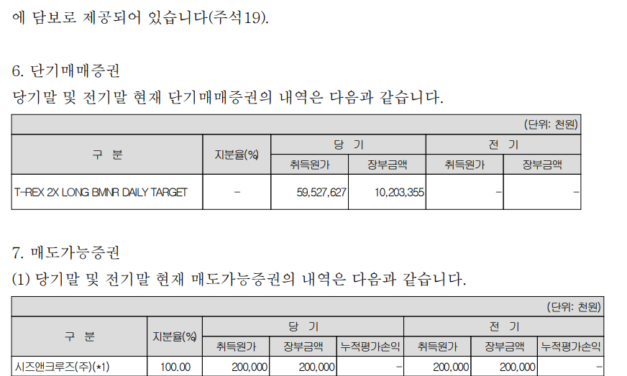
South Korean funeral service company Bumo Sarang is sitting on roughly 49.3 billion won ($32.7 million) in unrealized losses after investing about $40 million in customer funds into leveraged crypto exchange-traded funds (ETFs).Bumo Sarang invested in the T-REX 2X Long BMNR Daily Target ETF (BMNU), which doubles the daily returns of Ether (ETH) treasury company Bitmine, according to the company’s audit report for 2025.Another funeral service company, Christian Funeral Family of Faith, recorded a $331,700 net loss last year, according to Korea Economic Daily.The findings renewed scrutiny over South Korea’s funeral mutual aid industry, which is supervised by the Fair Trade Commission (FTC) instead of financial regulators, despite managing large pools of customer prepaid funds.Korea Economic Daily reported that about 43% of local funeral service providers held fewer assets than customer advance payments, raising concerns about whether some of them could repay customers in the event of mass cancellations.Bumo Sarang audit report for 2025. Source: FTCA spokesperson for Bumo Sarang told the local outlet that the company is only facing a “short-term unrealized loss due to global market volatility,” which remains “sufficiently controllable within the company’s financial buffer.”Cointelegraph reached out to Bumo Sarang and Family of Faith for comment but did not receive a response before publication.Related: South Korea’s Shinhan Card taps Solana to test real-world stablecoin paymentsSouth Korean capital piled into Ether-linked stocks in 2025A large chunk of South Korean retail capital rotated out of tech stocks and into Ethereum treasury companies last year.“There’s around $6 billion of Korean retail capital propping up the Ethereum treasury companies,” wrote Samson Mow, the CEO of Bitcoin tech company JAN3, in an Oct. 6 X post. He added that some of those retail buyers didn’t understand the risks of investing in Ether.ETH, BMNR, year-to-date chart. Source: Cointelegraph/TradingViewEther’s price fell over 28% year to date in 2026 and was trading above $2,118 at the time of writing. Bitmine’s stock price fell nearly 40% during the same period to $18.7, TradingView data shows.Bitmine chairman Tom Lee described Ether’s drop below $2,200 as an “attractive opportunity” after the treasury company bought another 71,672 Ether, according to Cointelegraph reporting earlier Tuesday.Magazine: Singapore isn’t a ‘crypto hub’ — it’s something better: StraitsX CEO

Čítaj viac
Wallet cluster earned $2.4M with 98% win rate on Polymarket military bets: Bubblemaps

Blockchain data platform Bubblemaps said it identified a cluster of Polymarket wallets that collectively earned $2.4 million with a 98% win rate on contracts tied to US military operations.Nine wallets placed all their major bets just before major military developments, including the Feb. 28 attack on Iran, the killing of Iranian Supreme Leader Ayatollah Ali Khamenei and the US-Iran ceasefire agreement, Bubblemaps wrote in a Monday X post.The accounts were all funded through centralized cryptocurrency exchanges in a tight timeframe and made some minor losing bets on Feb. 20, which likely served to “avoid attention,” according to Bubblemaps. Four of them each made around $400,000 in profit on their bets that the US would strike Iran on Feb. 28.The investigation highlights the growing insider trading concerns tied to decentralized prediction markets such as Polymarket and Kalshi. It aimed at curbing insider trading on prediction markets.Source: BubblemapsWhile the data platform doesn’t have definitive proof that the accounts belonged to insiders, the onchain trail is “symptomatic of someone with an unfair informational advantage,” Nicolas Vaiman, the CEO of Bubblemaps, told Cointelegraph. He added:“We cannot say with certainty that this was an attempt to hide, but it is suspicious that funds were routed through CEXs and third-party services before funding new Polymarket accounts, effectively covering their tracks.”US lawmakers seek stricter regulations on war-related prediction market contractsUS lawmakers have previously proposed new laws to fight the growing insider trading concerns tied to military contracts on prediction markets.On March 10, US Democratic Party Senator Adam Schiff introduced the DEATH BETS Act, which seeks to ban federally regulated prediction markets from listing contracts tied to war, terrorism, assassination and individual deaths.DEATH BETS Act. Source: Schiff.senate.govThe bill came shortly after six Polymarket traders netted $1 million by betting on the US strike against Iran.Separately, in late March, California Governor Gavin Newsom signed an executive order to curb public servants from insider trading on prediction markets tied to political or economic events they can influence.Related: CFTC no-action letter eases event contract reporting rulesPolymarket, Kalshi, notional volume per category, weekly. Source: Dune Politics-related contracts are currently the third-largest category on Polymarket, accounting for 12% of notional trading volume, and the fifth-largest on Kalshi, where they account for 0.7% of weekly trading volume, according to Dune data.Magazine: Inside a 30,000 phone bot farm stealing crypto airdrops from real users 

Čítaj viac

Capital B boosts Bitcoin reserves with $15.2M purchase

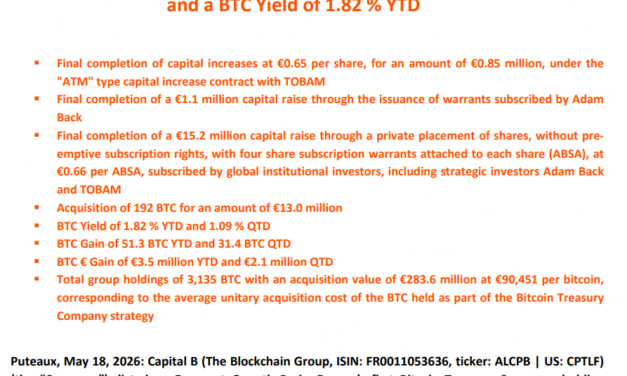
France-listed Bitcoin treasury company Capital B announced Monday that it acquired 192 BTC for 13 million euros ($15.2 million), bringing its total holdings to 3,135 BTC.Capital B purchased its latest tranche at an average price of about $78,948 per Bitcoin, Alexandre Laizet, Bitcoin strategy director at Capital B, said on X.The acquisition comes a week after the company announced a $17.8 million raise from strategic investors, including Blockstream CEO Adam Back and Paris-based asset manager TOBAM. Capital B also raised $1.28 million from Back on May 4.Capital B is one of four crypto treasury companies to publicly disclose Bitcoin purchases in May so far. Strategy, the largest publicly traded Bitcoin holder, announced it acquired $43 million last Monday, while Strive added $33 million in BTC on May 4 and The Smarter Web Company purchased $4.9 million in BTC.The purchase reflects continued interest in Bitcoin treasury strategies by a handful of public companies, even as Bitcoin remains well below its October 2025 all-time high.Capital B acquired 192 BTC. Source: Capital BCapital B shares fall after Bitcoin acquisition announcementCapital B shares fell around 2.4% after the announcement Monday and traded at about 0.62 euros at the time of writing.The company’s shares are down 17% year-to-date and more than 68% over the past year, according to data from Yahoo Finance. Capital B shares price in euros, 1-year chart. Source: Yahoo Finance.Capital B ranks as the 25th-largest Bitcoin treasury firm by holdings and as Europe’s second-largest following Germany’s Bitcoin Group SE, which holds 3,605 BTC, currently worth about $277 million, according to BitcoinTreasuries data. Related: Strategy’s Bitcoin engine faces $28B STRC ceiling: Delphi DigitalSome Bitcoin treasury firms turn defensive amid downturnOther Bitcoin treasury companies are seeking to reduce the balance sheet risks associated with Bitcoin, which is currently down 39% from its $126,198 all-time high.On April 24, Nasdaq-listed Bitcoin treasury company Nakamoto announced an actively managed Bitcoin derivatives program aimed at generating recurring income from volatility and hedging part of its corporate BTC holdings against downside exposure. The company reported it sold 284 Bitcoin (worth about $20 million at the time) in a March 30 filing. In February, Genius Group reported the sale of its remaining treasury holdings of 84 BTC for about $5.7 million to repay an $8.5 million debt obligation.Magazine: Bitcoin vs. the quantum computer threat — Timeline and solutions (2025–2035)  

Čítaj viac

South Korea plans July rules for tokenized securities

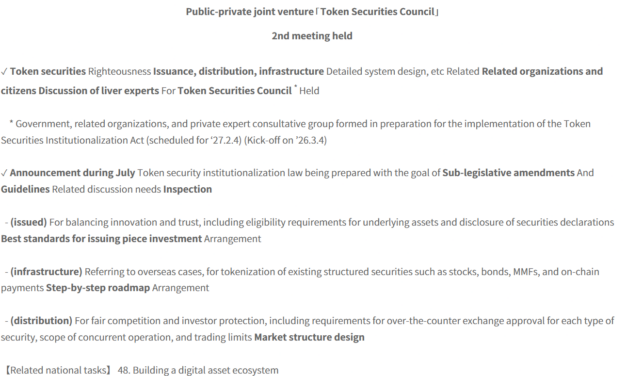
South Korea’s Financial Services Commission (FSC) plans to release detailed tokenized securities rules in July as the country prepares to bring blockchain-based securities under its capital markets framework in 2027.The measures are expected to include a roadmap for tokenizing stocks, bonds and money market funds, possible changes to over-the-counter trading limits and rules allowing some fractional investment products to pool similar underlying assets, the FSC announced on Friday at the second meeting of its public-private tokenized securities council, which was launched in March to design issuance, trading, infrastructure and settlement rules before the framework takes effect in 2027.“The goal is to make an announcement in July,” said FSC Vice Chairman Kwon Dae-young, adding that the new rules will serve for the “institutionalization” of tokenized securities.The July package will be an important test of how far South Korea is willing to open regulated capital markets to distributed ledger infrastructure while keeping tokenized securities inside existing investor-protection rules.The announcement followed the new Bank of Korea Governor, Hyun-Song Shin, who voiced support for tokenized deposits in his first public address, as Cointelegraph reported on April 21.A week earlier, on April 16, South Korea’s Ministry of Economy and Finance announced a pilot project that will use tokenized deposits to execute government operational spending, with a full rollout set for the fourth quarter of 2026.The Second Public-Private Joint Tokenized Securities Council. Source: FSC.go.krFSC accelerates tokenized regulation efforts ahead of 2027 rolloutThe news comes amid the planned implementation of the amended Capital Markets Act and Electronic Securities Act, the country’s first tokenized securities framework, which is scheduled to take full effect on Feb. 4, 2027.The implementation will mark the launch of South Korea’s first regulated environment for issuing, distributing and trading tokenized securities on distributed blockchain ledgers.Related: South Korea’s Shinhan Card taps Solana to test real-world stablecoin paymentsThe framework will legally recognize blockchain-ledgers as valid securities registries, bringing tokenized assets under the FSC’s jurisdiction out of their current experimental stage.The FSC first announced the incoming amendments to the legislation on Jan. 15, 2026, setting a one-year preparatory period for lawmakers.Magazine: Singapore isn’t a ‘crypto hub’ — it’s something better: StraitsX CEO

Čítaj viac
THORChain pauses trading after suspected $10M exploit

Decentralized liquidity protocol THORChain halted trading after blockchain investigator ZachXBT flagged a suspected exploit of more than $10 million.A THORChain alerts Telegram channel showed all trading and signing halted, with a global node pause extended until block 26191149, or roughly 12 hours and 42 minutes. The halt came shortly after ZachXBT said the protocol had likely been exploited across Bitcoin, Ethereum, BNB Chain and Base.A wallet labeled by Arkham as the THORChain exploiter showed $10.8 million in holdings, transferred across several smaller transactions in the 30 minutes before 10:11 am UTC.The suspected exploit adds to the mounting security concerns around decentralized finance (DeFi) protocols, after hackers stole over $634 million during April, marking the highest monthly sum since the $1.46 billion in February 2025, when hackers staged the record $1.4 billion hack on Bybit exchange, DefiLlama data shows.Cointelegraph reached out to THORChain for comment. The protocol had not publicly confirmed the exploit at the time of publication, though ZachXBT and PeckShield flagged suspicious activity, and THORChain alerts showed trading and signing had been halted.Thorchain exploiter-tagged wallet. Source: ArkhamRUNE price falls 13% after suspected exploit THORChain’s RUNE token fell by around 13% following the suspected exploit and traded near $0.51 at the time of writing, according to CoinGecko data.RUNE/USD, one-day chart. Source: CoinGeckoThe latest correction adds additional pressure to the token’s price action, which is down 72% during the past year.Related: Kelp DAO exploit prompts DeFi protocols to rethink oracle providersAs a non-custodial cross-chain protocol, THORChain has repeatedly been used by malicious actors to swap stolen funds, though it is not a cryptocurrency mixer like Tornado Cash.Earlier in April, the attacker behind the $293 million Kelp DAO exploit swapped 75,700 Ether (ETH) through THORChain, generating about $910,000 in revenue for the protocol.The majority of the $1.4 billion stolen during the Bybit hack, or about $1.2 billion, was also moved through THORChain by hackers, who swapped it from Ether to Bitcoin, according to Bybit co-founder and CEO Ben Zhou.

Čítaj viac

Získaj BONUS 8 € v Bitcoinoch

nakup bitcoin z karty

Registrácia Binance

Burza Binance

Aktuálne kurzy