Autor Cointelegraph by Zoltan Vardai

Polymarket team says user funds safe as exploit losses climb above $600K

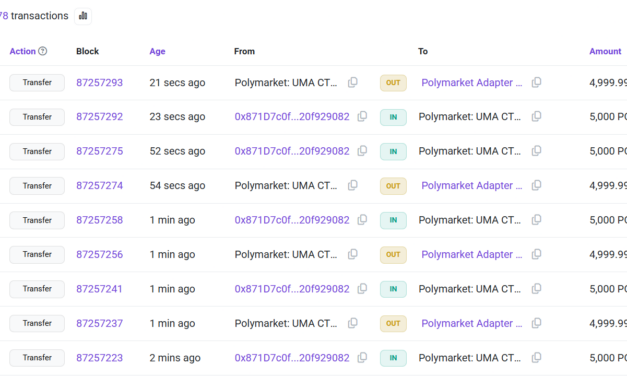
Polymarket confirmed a security exploit affected part of its infrastructure, pointing to a possible private key compromise involving a wallet used for top-up operations, while saying user funds and market resolution were safe.In a Friday X post, Polymarket developers said contracts and core infrastructure were unaffected. Polymarket product lead Akanshu Jain and multiple other Polymarket employees also said user funds and market resolution are safe.Blockchain investigator ZachXBT first flagged the exploit as a compromise to the Polymarket-linked UMA Conditional Tokens Framework (CTF) Adapter contract on Polygon, with the exploiter draining at least $520,000.However, Josh Stevens, Polymarket’s vice president of engineering, said the contracts were safe and that the exploit was limited to a six-year-old private key used for internal top-up operations. All permissions tied to the key have been revoked, he said.The UMA CTF adapter is an oracle contract used to help resolve Polymarket prediction markets through UMA’s Optimistic Oracle. Polymarket is the world’s second-largest prediction market with $3.7 billion in monthly trading volume, according to DefiLlama. Polyscan data reviewed by Cointelegraph showed more than 100 small transfers into the alleged attacker wallet. Most were worth up to 5,000 Polygon (POL) tokens.Address of the alleged Polymarket adapter contract attacker. Source: PolygonscanExploit losses climb past $600,000Multiple blockchain data platforms reported similar onchain activity tied to the suspected exploit.Blockchain data visualization platform Bubblemaps said in a Friday X post that the attacker continues to remove about 5,000 POL tokens every 30 seconds, amassing about $600,000 in stolen funds so far.Source: BubblemapsBlockchain data platform Lookonchain estimated that about $660,000 was drained from the Polymarket-linked contract as of 9:01 am UTC on Friday.Related: Crypto VC funding plunges to $659M in April, hits near two-year lowPolymarket integrated UMA’s optimistic oracle solution on Feb. 3, 2022, enabling automated and decentralized resolution for its prediction market contracts.Cointelegraph contacted Polymarket and UMA for comment but had not received a response by publication.Magazine: The legal battle over who can claim DeFi’s stolen millions 

Čítaj viac
Verus bridge exploiter returns $8.5M after bounty offer

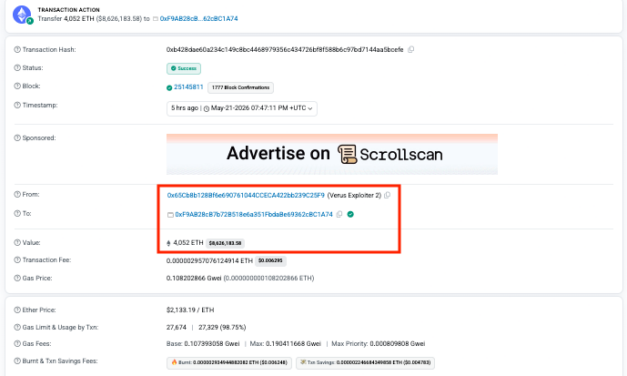
The attacker behind the Verus bridge exploit has returned 4,052 Ether, worth about $8.5 million, to the project’s team wallet after Verus offered a 1,350 ETH bounty for the recovery of most of the stolen funds.The return represents about 75% of the stolen funds, with the exploiter retaining 1,350 Ether (ETH), worth about $2.8 million as a bounty, according to blockchain security firm PeckShield on Friday.Verus had offered the bounty a day earlier, saying it would treat the retained ETH as a reward if the exploiter returned 4,052.4 ETH to the team address within 24 hours.The recovery shows how some crypto projects try to negotiate directly with exploiters to recover stolen funds, though such deals do not necessarily prevent law enforcement or third parties from taking action.The recovery comes days after the Verus-Ethereum bridge was drained in a forged cross-chain transfer exploit, adding to a string of bridge and decentralized finance (DeFi) attacks that have kept crypto security concerns high in 2026.Source: PeckShieldDeFi hacks topped $600 million in AprilDeFi hacks surged to a cumulative $634 million worth of value stolen in April, data aggregator DefiLlama shows. The $280 million Drift Protocol exploit and the $293 million Kelp exploit represented the largest incidents of the month. Total hacked by monthly sum, all-time chart. Source: DefiLlamaLosses have fallen sharply in May, with DefiLlama data showing roughly $38 million stolen so far this month.Related: Crypto VC funding plunges to $659M in April, hits near two-year lowStill, cryptocurrency hacks remain one of the biggest hurdles halting mainstream blockchain adoption.During the past decade, crypto hackers stole over $17 billion across 518 recorded incidents, with the majority stemming from compromised private keys, alongside phishing and other credential-based attacks, Cointelegraph reported on April 21. Magazine: The legal battle over who can claim DeFi’s stolen millions Cointelegraph is committed to independent, transparent journalism. This news article is produced in accordance with Cointelegraph’s Editorial Policy and aims to provide accurate and timely information. Readers are encouraged to verify information independently.

Čítaj viac

US sanctions Sinaloa cartel-linked Ethereum addresses

The US Department of the Treasury’s Office of Foreign Assets Control (OFAC) sanctioned six Ethereum addresses tied to a Sinaloa Cartel-linked money laundering network that allegedly converted drug proceeds into cryptocurrency.OFAC added the addresses to its Specially Designated Nationals list (a US sanctions list of people, entities and assets subject to blocking restrictions) on Wednesday as part of sanctions against 11 individuals and two entities connected to two Sinaloa Cartel financial networks.Treasury said one network, led by Armando de Jesus Ojeda Aviles, collected bulk cash in the US from fentanyl and other drug sales before allegedly converting the money into cryptocurrency for transfer to the cartel in Mexico.The action highlights how cartel-linked money laundering networks are using digital assets alongside cash couriers and front businesses, raising sanctions compliance risks for crypto exchanges and other virtual asset service providers.OFAC adds six new Ethereum addresses to sanctions list. Source: OFACCartel cash moved into cryptoThe Sinaloa Cartel is allegedly using blockchain technology to launder its illicit fiat money proceeds, according to OFAC.Cointelegraph contacted OFAC for more details surrounding the Sinaloa Cartel’s money laundering operations.Related: Kelp DAO attacker moves $175M in Ether after exploit: ArkhamTreasury did not identify which crypto platforms or protocols were allegedly used by the network. The listed Ethereum addresses, however, create sanctions exposure for exchanges, wallet providers and other crypto firms that screen blockchain transactions.Looking at some of the biggest cryptocurrency hacks, attackers laundered the majority of the $1.4 billion stolen during the Bybit hack, or about $1.2 billion, through THORChain, swapping funds from Ether to Bitcoin, according to Bybit co-founder and CEO Ben Zhou. Attackers behind the recent $293 million Kelp DAO hack also primarily used THORChain to swap the Ether for Bitcoin, generating about $910,000 in fee revenue for the protocol, Cointelegraph reported on April 23.Magazine: 53 DeFi projects infiltrated, 50M NEO tokens could be ‘given back’: Asia Express  

Čítaj viac

Jane Street accused of using Terra Telegram backchannel before UST crash

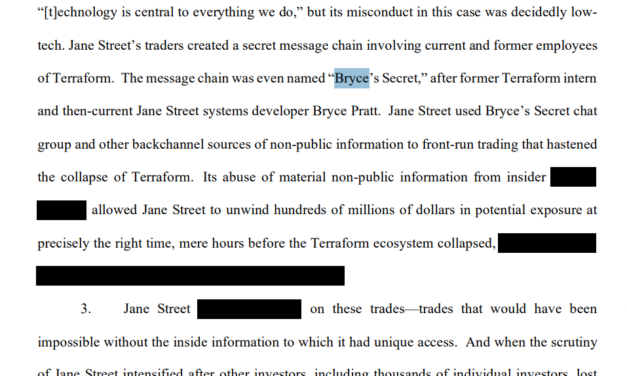
A newly unsealed court filing in the Terraform Labs bankruptcy case alleges Jane Street used a private Telegram channel with former Terraform intern Bryce Pratt to obtain nonpublic information before the collapse of TerraUSD. Pratt is currently a systems developer at Jane Street. The channel, called “Bryce’s Secret,” allegedly gave the quantitative trading firm a backchannel to Terraform insiders as Jane Street unwound exposure to TerraUSD (UST) shortly before the algorithmic stablecoin lost its dollar peg in May 2022, according to the filing. “Jane Street used Bryce’s Secret chat group and other backchannel sources of non-public information to front-run trading that hastened the collapse of Terraform,” the filing states.The claims renew scrutiny of who profited from Terra’s $40 billion collapse, one of the crypto industry’s largest failures, and could test how traditional insider trading and market manipulation theories apply to decentralized finance markets.On Feb. 23, Todd Snyder, Terraform’s court-appointed administrator, sued Jane Street, its co-founder Robert Granieri, and employees Bryce Pratt and Michael Huang in Manhattan federal court, accusing them of “misappropriating confidential information and manipulating market prices.” Two months later, Jane Street filed a motion to dismiss the lawsuit, arguing that Terraform attempted to “extract cash from Jane Street to foot the bill for a fraud that Terraform itself perpetrated on the market,” Cointelegraph reported on April 23.A spokesperson for Jane Street told Cointelegraph that the lawsuit was a transparent attempt to “extract money when it is well-established that the losses suffered by Terra and Luna holders were the result of a multi-billion dollar fraud perpetrated by the management of Terraform Labs.”Terraform Labs court filing in the lawsuit against Jane Street. Source: cloudfront.netCurve trade raises new UST concernsThe timing of a particular UST trade has raised more concerns, suggesting potential access to insider information by an unknown entity.On May 7, 2022, Terraform quietly withdrew about $150 million in UST from the Curve 3pool liquidity pool.Less than 10 minutes after Terraform’s withdrawal, Curve 3pool saw its largest single swap of $85 million, precipitating a steep sell-off in UST, which the filing said “ultimately led to the collapse of the Terra ecosystem.”Related: Analysts reject Jane Street ‘10 a.m. dump’ claims, say Bitcoin isn’t easily manipulatedThe heavily redacted filing does not identify the entity behind the swap.Terraform Labs court filing in the lawsuit against Jane Street. Source: cloudfront.netSnyder seeks to recover alleged wrongful gains from Jane Street, plus compensation for additional damages to distribute to Terraform creditors and investors who lost funds in the 2022 collapse.Jane Street is the world’s leading quantitative trading firm by net trading revenue, with $39.6 billion generated in 2025, reported Reuters.Cointelegraph reached out to Terraform’s court-appointed administrator for comment but had not received a response by publication.Magazine: How to fix suspected insider trading on Polymarket and Kalshi

Čítaj viac

Nearly 10% of Bitcoin supply is ‘structurally unsafe’ from quantum breakthrough: Glassnode

Nearly 10% of the total Bitcoin supply is considered “structurally unsafe” due to a quantum computing breakthrough, as their output type reveals the public key by design, regardless of address management practices, according to data analytics platform Glassnode.Totaling about 1.92 million Bitcoin (BTC), the group includes BTC from early Satoshi-era Pay-to-Public-Key (P2PK) outputs, legacy multi-sig structures such as Pay-to-Multisig (P2MS) and modern Pay-to-Taproot (P2TR) outputs, which reveal the public key or public key-equivalent by design, wrote Glassnode in a Wednesday X post.Bitcoin creator Satoshi Nakamoto’s coins represent about 1.1 million or 5.5% of the vulnerable supply, following another 620,000 Satoshi-era coins or 3.1% of the supply and about 200,000 coins or 1% of the supply in Taproot addresses.Choosing how to implement PQC [post-quantum cryptography] and deploy it on-chain should remain decoupled from the question of what to do about coins that remain quantum vulnerable. Yet the two matters often are conflated, the controversy around the latter often clouding discussions of the former – ARK InvestThe findings underscore the need to implement a quantum-proof path for Bitcoin, such as the adoption of BIP-360’s proposed Pay-to-Merkle-Root (P2MR) output type, which seeks to remove Taproot’s quantum-vulnerable key path spend, though it does not itself add post-quantum digital signatures. While 9.6% of the total supply remains structurally exposed, a significant part of this exposure “could be reduced if wallet infrastructure, address standards, and user behavior evolve,” added Glassnode.However, this supply would only be vulnerable to quantum theft if quantum computers can break Bitcoin’s elliptic curve cryptography (ECC), which would require about 2,330 logical qubits and tens of millions to billions of quantum gates, according to a March white paper published by US investment manager Ark Invest.Source: GlassnodeNearly 70% of Bitcoin’s supply is safe from quantum computing threatGlassnode estimates that about 13.99 million Bitcoin, representing 69.8% of the total supply, remain unexposed to a quantum computing threat, which is largely in line with Ark Invest’s figures, which show that 65% of the supply was safe, Cointelegraph reported in March.Still, the analytics provider notes that about 4.12 million BTC, or 20.6% of the total supply, are “operationally unsafe,” meaning that these coins are exposed due to a key or address management issue.Source: GlassnodeEntity-level data shows that the holdings of some large corporate entities are exposed. This includes 100% of BTC held by Franklin Templeton, WisdomTree and Robinhood, 99% of neobank Revolut’s Bitcoin, 52% of Grayscale’s holdings and just 2% of Fidelity’s Bitcoin stash.Related: Bernstein says Bitcoin market already priced in quantum riskLooking at the exposed tokens of cryptocurrency exchanges, only about 5% of BTC held on Coinbase is exposed, compared to 85% of Binance’s BTC and about 100% of the holdings on Bitfinex exchange.To reduce exposure, exchanges and custodians are advised to reduce key reuse, improve address hygiene and plan a migration into a quantum-proof format to position for a future quantum breakthrough, wrote Glassnode.Magazine: Bitcoin vs. the quantum computer threat — Timeline and solutions (2025–2035)

Čítaj viac

Získaj BONUS 8 € v Bitcoinoch

nakup bitcoin z karty

Registrácia Binance

Burza Binance

Aktuálne kurzy