

Autor Cointelegraph by Zoltan Vardai

Bubblemaps flags MYSTERY token over 90-wallet launch sniping cluster

Blockchain analytics platform Bubblemaps said 90 newly funded wallets bought 90% of Mystery (MYSTERY) memecoin supply at launch, raising concerns about coordinated sniping.The wallets were all funded by wallet “0x544E,” which previously withdrew and distributed 20 Ether from crypto exchange Binance. After buying up 90% of the supply at launch, the wallet cluster sold about $100,000 worth of tokens and still holds 40% of the supply, said Bubblemaps in a Tuesday X post. The analytics company described the pattern as a “textbook scam.”Sniping refers to using bots or automated trading tools to buy newly launched tokens immediately after trading opens, often before ordinary traders can react. The findings highlight how automated buying and coordinated wallet clusters can dominate thinly traded memecoin launches, leaving later buyers exposed to sharp losses if early holders sell.A fair launch is meant to give all participants an equal chance to buy a token when trading opens, without insiders or coordinated wallet clusters gaining early control of supply. The concentration flagged by Bubblemaps would undermine that principle if the wallets were acting together.Source: BubblemapsMystery token down 75% from peakThe Mystery token rose to a peak of $7.5 million market capitalization on April 28, before falling around 75% to a $1.9 million market capitalization at the time of writing, Dexscreener data shows.Mystery/WETH, all-time chart. Source: DexscreenerThe memecoin project brands itself as a free-spirited frog from Matt Furie’s “The Night Riders” and claims to have acquired the official HEDZ NFT and related IP rights from Furie, according to a Monday X post.Cointelegraph was unable to contact Mystery for comment.Related: Kaiko flags possible front-running before Robinhood token listingsSniping activity has been a long-standing value-extraction issue in the memecoin space.In February 2025, a cryptocurrency sniper made nearly $28 million on the Broccoli (BROCCOLI) memecoin, shortly after Binance co-founder and former CEO, Zhangpeng Zhao, revealed that his Belgian Malinois was named “Broccoli,” sparking a wave of community-driven memecoin listings on launchpad Pump.fun.In November 2025, Bubblemaps claimed that a cluster of about 160 wallets accumulated 30% of decentralized lending protocol Edel Finance’s (EDEL) token supply at launch, worth over $11 million. James Sherborne, the co-founder of Edel Finance, denied the allegations, claiming the team planned to acquire 60% of the token supply.Magazine: Bitcoiners eye ‘sell in May,’ SBF’s bid for new trial shut down: Hodler’s Digest, April 26 – May 2 Cointelegraph is committed to independent, transparent journalism. This news article is produced in accordance with Cointelegraph’s Editorial Policy and aims to provide accurate and timely information. Readers are encouraged to verify information independently.

Čítaj viac
Coinbase faces lawsuit over frozen funds from $55M crypto theft

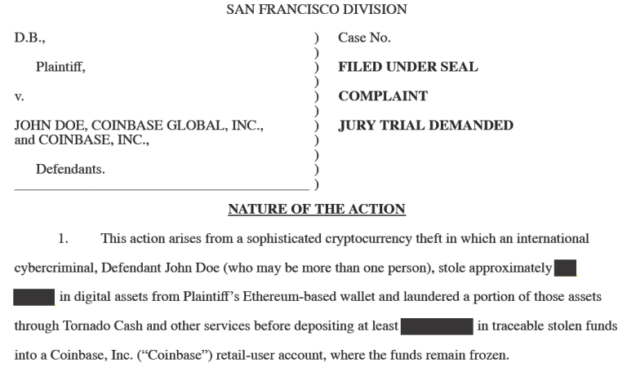
Cryptocurrency exchange Coinbase was sued in California federal court over frozen crypto allegedly tied to a $55 million DAI phishing theft from August 2024.The complaint, filed Monday in a San Francisco federal court, alleges that after laundering the proceeds through crypto mixer Tornado Cash, the attacker deposited part of the “traceable stolen funds” into a Coinbase retail user account, where the funds remain frozen. The Puerto Rico-based plaintiff is asking the court to declare him the rightful owner of the frozen assets and order Coinbase to return them. The lawsuit also names an unknown John Doe defendant accused of carrying out the theft.The lawsuit questions the responsibility of cryptocurrency exchanges in handling stolen funds that were traceably sent to these platforms after an exploit. The complaint claims that Coinbase has “acknowledged” that it holds these traced funds and has “indicated that a court order adjudicating ownership is required before it will release the frozen assets.”The case highlights a problem in crypto theft recovery where exchanges may freeze suspected stolen funds after receiving alerts, but often require a court order before releasing assets to a claimant.The lawsuit comes nearly two years after an exploiter stole $55 million in Dai stablecoins through a sophisticated phishing attack that deceived the victim into clicking a malicious link to a fraudulent DeFi Saver login, authorizing the attacker to gain access to his account and wallets.Cointelegraph has reached out to Coinbase for more details surrounding the stolen funds and the path towards user recovery.Coinbase sued for funds linked to the $55 million DeFi Saver hack. Source: CourtListenerCrypto wallet drainer was used to facilitate $55 million exploitThe $55 million exploit was carried out using the malicious Inferno Drainer platform, which offers a scam-as-a-service malware for malicious actors seeking to facilitate digital asset theft without the need to exploit code-level protocol vulnerabilities.In addition to notifying law enforcement, the victim contracted crypto analytics platforms Zero Shadow and Five Stones intelligence to trace the stolen crypto. The companies found evidence linking the laundering of the funds to Ukrainian citizen Okelsiy Oleksandrovych Gorelikhin.On Nov. 30, 2024, Zero Shadow notified Coinbase that stolen funds linked to the theft had been deposited into a Coinbase address, asking the exchange to conduct due diligence and freeze the assets.On Dec. 2, 2024, Coinbase confirmed that the address belongs to a Coinbase retail user and that it implemented “friction measures” preventing dissipation of those funds pending investigation.The court filing argued that the stolen cryptocurrency held in the Coinbase account was “identifiable property traceable to Plaintiff’s stolen assets” and added that the defendant had previously demanded the return of the assets.Related: Arbitrum voters consider $71M ETH release for Kelp recoveryThe year 2024 was a breakout year for scam-as-a-service tools, with usage of Inferno Drainer tripling in the first half of the year, rising from roughly 800 malicious decentralized applications created at the start of the year to over 2,400 by the end of it, according to blockchain security firm Blockaid.Magazine: AI-driven hacks could kill DeFi — unless projects act nowCointelegraph is committed to independent, transparent journalism. This news article is produced in accordance with Cointelegraph’s Editorial Policy and aims to provide accurate and timely information. Readers are encouraged to verify information independently.

Čítaj viac

Kaiko flags possible front-running before Robinhood token listings

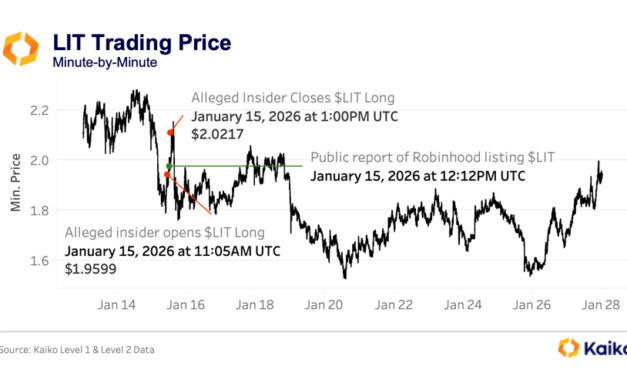
Open interest in perpetual futures markets and onchain trading patterns suggest some traders may have positioned ahead of Robinhood crypto listing announcements, according to a Monday report from analytics provider Kaiko.One of the clearest examples was wallet address ‘0xa1E,’ which Kaiko said opened a long position on Lighter (LIT) on decentralized exchange Hyperliquid at 11:05 am UTC on Jan. 15, about an hour before Robinhood announced the token’s listing at 12:12 pm The wallet closed the position at 1:00 pm, shortly after the announcement.Kaiko said the same address later opened a short position on a HOOD-linked perpetual contract on April 28, hours before Robinhood reported first-quarter revenue that missed analyst expectations. The trader closed the short later that day after HOOD moved lower.The trading patterns raise questions about whether some market participants had access to non-public listing information or had developed a reliable method for detecting public signals before announcements. Kaiko also said sophisticated traders may have been reacting to funding-rate spikes, volume increases and open-interest changes rather than inside information.Multiple other wallets made similar moves just before a listing was made public, raising the question of whether “more than one participant had access to the same information ahead of the announcement,” wrote Laurens Fraussen, a research analyst at Kaiko.LIT trading price, listing time, minute-by-minute. Source: KaikoHyperliquid data points to unusual pre-listing tradesKaiko pointed to multiple cryptocurrency listings that led to a surge in open interest and funding rates just ahead of Robinhood’s public listing announcements, including Zcash (ZEC), Synthetix (SNX) and the Near Protocol (NEAR) tokens, among other assets.Hourly price drift ahead of Robinhood listing announcements for LIT, SNX and ZEC. Source: KaikoAll three tokens recorded a pre-announcement price drift, with each coin averaging abnormal returns in the hours leading up to and following the listing announcement, explained the report.Related: Crypto VC funding plunges to $659M in April, hits near two-year lowWhile the data raises concerning signs of potential insider activity, it may also indicate that some of the smartest traders are positioning based on funding or volume increases, Kaiko’s Fraussen told Cointelegraph.“Traders that know how microstructure works could have noticed the funding spikes, increase in volumes and open interest spikes, and position based on that.”Still, derivatives metrics show that this type of positioning was statistically consistent and repeated across multiple asset listings, reflecting either “privileged access to Robinhood’s listing pipeline” or an “exceptionally reliable front-running methodology built on public signals.”Magazine: Bitcoiners eye ‘sell in May,’ SBF’s bid for new trial shut down: Hodler’s Digest, April 26 – May 2Cointelegraph is committed to independent, transparent journalism. This news article is produced in accordance with Cointelegraph’s Editorial Policy and aims to provide accurate and timely information. Readers are encouraged to verify information independently.

Čítaj viac
Europe should weigh tokenized SEPA payments, Bank of Italy official says

European financial institutions should assess whether the Single Euro Payments Area (SEPA) can be extended into tokenized payments, Bank of Italy Deputy Governor Chiara Scotti said, as policymakers look for ways to keep euro-denominated settlement central to digital finance.Scotti called a tokenized extension of SEPA an “important area for reflection” during a Monday speech at the Digital Assets and Monetary Policy Transmission workshop in Rome, saying Europe’s existing payments framework offers scale, shared standards and interoperability.Her comments come as the Eurosystem prepares a pilot for Pontes, a distributed ledger technology settlement initiative designed to link market DLT platforms with TARGET Services and settle transactions in central bank money. The pilot is expected by the third quarter of 2026.The European Central Bank (ECB) is also developing Appia, a longer-term roadmap for Europe’s tokenized financial ecosystem that is expected to conclude in 2028, as policymakers weigh how tokenized deposits, stablecoins and central bank money should coexist.The ECB said it was exploring ways to bring central bank money onto DLT due to concerns over the adoption of a non-euro stablecoin, which may have “serious consequences for Europe’s monetary sovereignty,” such as diminishing the euro’s role and creating a dependency on foreign settlement assets.Banca d’Italia, ECB, EABCN, and CEPR Workshop on‘Digital Assets and Monetary Policy Transmission.’ Source: Bank of ItalyECB says stablecoin adoption may shift bank depositsThe ECB has previously outlined concerns related to widespread stablecoin adoption.In a report published in November 2025, the ECB said that widespread stablecoin adoption may see households replace some of their bank deposits with stablecoin holdings, leading to significant bank deposit outflows.“Significant growth in stablecoins could cause retail deposit outflows, diminishing an important source of funding for banks and leaving them with more volatile funding overall.”In a working paper published on March 4, 2026, the ECB highlighted further risks, including that stablecoin adoption induces a “deposit-substitution mechanism, whereby funds shift from retail bank deposits to digital assets.”Related: UBS partners with five banks for Swiss franc stablecoin sandboxLater on March 23, Piero Cipollone, a member of the ECB’s Executive Board, said that both tokenized deposits and stablecoins need tokenized central bank money as a public settlement anchor for scaling Europe’s tokenized financial system, Cointelegraph reported.Magazine: Crypto wanted to overthrow banks, now it’s becoming them in stablecoin fight Cointelegraph is committed to independent, transparent journalism. This news article is produced in accordance with Cointelegraph’s Editorial Policy and aims to provide accurate and timely information. Readers are encouraged to verify information independently.

Čítaj viac
Bullish to buy transfer agent Equiniti for $4.2B in tokenization push

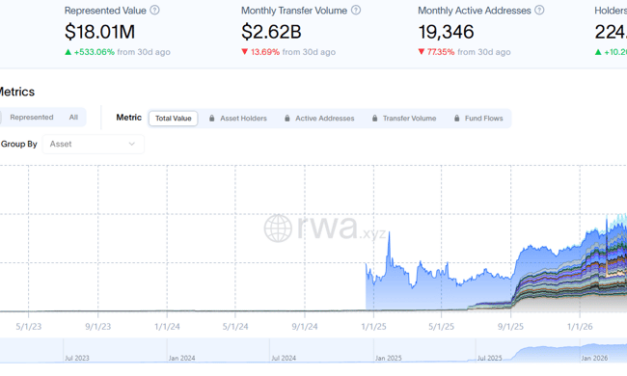
Bullish agreed to acquire transfer agent Equiniti from Siris Capital in a $4.2 billion transaction, giving the crypto exchange a major shareholder recordkeeping business as it pushes deeper into tokenized securities.As part of the deal, Bullish will assume $1.85 billion in debt from Equiniti, according to a Tuesday announcement. The transaction is expected to close in January 2027, pending regulatory approval.The acquisition will allow Bullish to offer 24/7 trading of tokenized securities and stablecoin-based payment and settlement tools. Equiniti is one of the world’s largest transfer agents, servicing nearly 3,000 companies, including the likes of Berkshire Hathaway and Rolls-Royce. Transfer agents are crucial for trading venues, as they are responsible for investor records, issuing ownership certificates and facilitating dividend payments.The acquisition underscores a growing race between crypto exchanges and traditional market infrastructure companies to build tokenized securities products that can support 24/7 trading, stablecoin-based settlement and corporate workflows.The deal comes over a month after the New York Stock Exchange (NYSE) partnered with tokenization platform Securitize to develop blockchain-based trading infrastructure for Wall Street by enabling the minting of tokenized shares of stocks and exchange-traded funds (ETFs), Cointelegraph reported on March 24.Cointelegraph has approached Bullish for more details about its tokenization initiatives.Wall Street participants accelerate tokenization initiativesWall Street participants are accelerating their tokenization initiatives, despite a developing regulatory environment in the US.On Jan. 19, the NYSE’s parent company, the Intercontinental Exchange (ICE), shared plans for a tokenized securities venue designed for 24/7 trading, instant settlement, stablecoin-based funding and onchain settlement. Two months later, on March 18, the US Securities and Exchange Commission (SEC) gave the regulatory greenlight to Nasdaq’s pilot proposal to support the trading of tokenized versions of high-volume stocks and securities. Tokenized stocks are shares of traditional company stocks minted on the blockchain ledger, offering investors exposure to stock prices with advantages including 24/7 accessibility and fractional ownership. Some of the largest crypto exchanges have also launched tokenized stock offerings, including Coinbase, Binance and Kraken.Related: US financial markets ‘poised to move on-chain’ amid DTCC tokenization greenlightMeanwhile, investor demand for tokenized stocks continues to rise.Tokenized stocks, total value onchain, all-time chart. Source: RWA.xyz The value of onchain tokenized stocks rose by 31.4% in the past 30 days to $1.25 billion, while tokenized stock holders increased by 10% during the same period, data from RWA.xyz shows.Still, tokenized stocks are only the fifth-largest asset class of the $30 billion tokenized RWA market. Tokenized US treasury debt ranks first at $15.2 billion, followed by tokenized commodities at $5 billion, asset-backed credit at $2.5 billion and tokenized specialty finance products at $1.6 billion.Magazine: Can Robinhood or Kraken’s tokenized stocks ever be truly decentralized? Cointelegraph is committed to independent, transparent journalism. This news article is produced in accordance with Cointelegraph’s Editorial Policy and aims to provide accurate and timely information. Readers are encouraged to verify information independently.

Čítaj viac
Získaj BONUS 8 € v Bitcoinoch

nakup bitcoin z karty

Registrácia Binance

Burza Binance

Aktuálne kurzy