Autor Cointelegraph by Zoltan Vardai

Kelp DAO exploit prompts DeFi protocols to rethink oracle providers

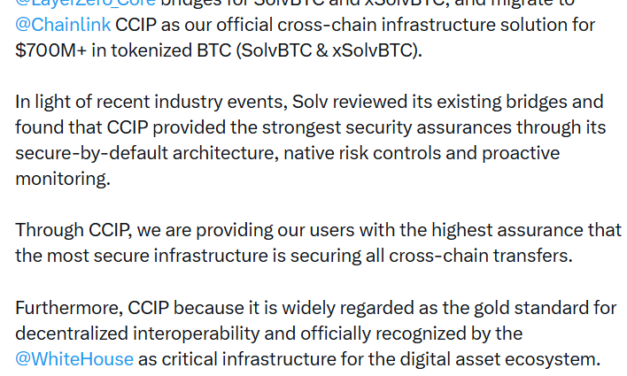
Decentralized finance protocols are reevaluating their blockchain oracle providers’ security after the fallout from the $293 million Kelp DAO exploit last month. Several protocols have announced migrations to Chainlink infrastructure in recent days, citing security concerns around third-party oracle and bridge providers.On Thursday, Bitcoin DeFi platform Solv Protocol announced it would migrate to Chainlink’s Cross-Chain Interoperability Protocol (CCIP) and replace LayerZero bridges, citing an “extensive security review” concluding that CCIP provided the “strongest security assurances.” A day earlier, liquidity protocol Tydro also said it was moving to Chainlink after its previous oracle provider, Chaos Labs, suffered an incident that prompted Tydro to pause markets over concerns about inaccurate price feeds.The migrations come after an April 18 exploit in which attackers drained 116,500 Kelp DAO restaked ETH (rsETH) tokens worth between $290 million and $293 million. Following the exploit, Kelp DAO also migrated its rsETH token to Chainlink, moving away from its previous LayerZero-powered bridge after attributing the incident to weaknesses in its cross-chain setup.Source: Solv ProtocolLayerZero, however, said on April 20 that the exploit resulted from a single point of failure in Kelp DAO’s implementation, which relied on a single LayerZero DVN as the only verified path despite prior warnings against that configuration.DeFi protocols review oracle security after Kelp exploitThe Kelp DAO exploit triggered a “wake-up call” for DeFi providers, according to Zach Rynes, strategic initiatives lead at Chainlink Labs.Related: Aave liquidates Kelp DAO hacker’s rsETH positions on Ethereum, ArbitrumRynes told Cointelegraph that DeFi teams conducting security reviews are increasingly deciding to replace older oracle and bridge systems with Chainlink infrastructure to strengthen baseline security protections, and multiple other DeFi protocols are discussing potential migrations to Chainlink following the exploit.Oracle providers with long operating histories and strong reliability are becoming increasingly important as hacks continue across the sector, Marcin Kazmierczak, co-founder of RedStone, the fourth-largest blockchain oracle provider, told Cointelegraph, adding that RedStone has also kept a “fully reliable track record.”Redstone was also contacted by Tydro as an emergency measure after the Chaos Labs oracle attack and provided support to help restore oracle feeds for the protocol.Source: RedstoneOracle consolidation raises new questions for DeFiFollowing the Kelp DAO exploit, only a smaller group of specialized providers may be able to meet the “demand and reliability requirements” created by growing institutional participation in DeFi, Kazmierczak said.“A smaller set of trusted oracles is forming in the market,” he said, adding that as capital concentrates around providers with proven track records, the risk of oracle-related exploits could decline.When asked about the risks of multiple DeFi protocols depending on fewer providers, Rynes said Chainlink’s infrastructure was designed to withstand extreme market conditions.He pointed to periods including the 2020 Covid market crash, the 2022 FTX collapse and major volatility events in 2025, saying Chainlink continued operating throughout those disruptions.Related: Arbitrum vote to release $71M in frozen Kelp exploit ETH set to passNik Kunkel, founder of Chronicle, the second-largest oracle provider, said that an overreliance on a single infrastructure provider will always present additional risks.“There are risks anytime a large portion of an ecosystem depends on a single piece of infrastructure,” Kunkel told Cointelegraph, adding that reducing those risks also requires data infrastructure to remain independently transparent and verifiable.Top Oracle providers by market share. Source: DefiLlama.comChainlink remains the largest oracle provider with a 58% market share and more than $32 billion in value secured, according to DefiLlama. Chronicle ranks second with $7.6 billion in total value secured, while RedStone holds fourth place with $3.7 billion, representing a 6.7% market share.Magazine: 53 DeFi projects infiltrated, 50M NEO tokens could be ‘given back’: Asia Express

Čítaj viac
Australian police seize $4.1M in Bitcoin tied to darknet market

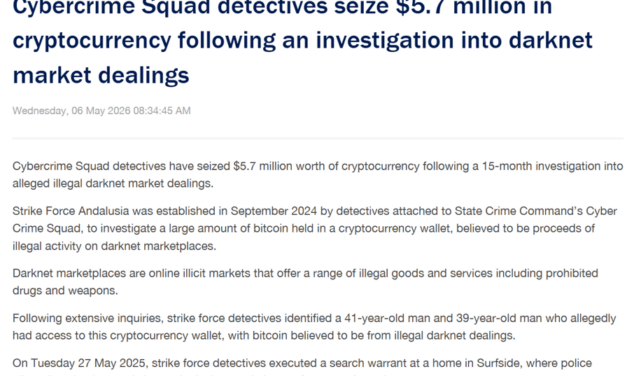
Cybercrime detectives in Australia seized 52 Bitcoin valued at 5.7 million Australian dollars ($4.1 million) in what they said is one of Australia’s largest crackdowns on an illegal darknet marketplace using cryptocurrency. Strike Force Andalusia, a division of the State Crime Command’s Cyber Crime Squad, said they seized $4.1 million worth of cryptocurrency and arrested two suspects related to a darknet marketplace operating from Ingleburn in Sydney following a 15-month investigation, the New South Wales Police Force said Wednesday.Police said two men, aged 41 and 39, allegedly had access to the cryptocurrency wallet. The 41-year-old is scheduled to appear in Campbelltown Local Court on May 13, while the 39-year-old is due in Batemans Bay Local Court on June 15.Detectives executed a search warrant at a home in Ingleburn on May 4, where they seized electronic devices and allegedly uncovered 52.3 Bitcoin that police will allege are proceeds of illegal darknet activity.The operation marks one of the largest reported darknet-related cryptocurrency seizures in Australia. It comes five years after Victoria Police seized cryptocurrency worth $6.2 million from an illegal darknet operation in August 2021, reported local news outlet 9News.“This is one of the biggest cryptocurrency seizures in the nation’s history and a clear reminder that criminal activity on the darknet is not anonymous,” said Detective Superintendent Matt Craft, adding that dark net marketplaces remain “a key enabler of serious criminal activity.”Cointelegraph approached NSW Police to ask whether investigators had obtained access to seed phrases or otherwise recovered control of the seized Bitcoin.Cybercrime squad detectives seize crypto wallets belonging to alleged darknet marketplace operators. Source: NSW PoliceAustralia steps up AML supervision for crypto platformsThe seizure comes as Australia’s financial intelligence and Anti-Money Laundering regulator, the Australian Transaction Reports and Analysis Centre (AUSTRAC), has stepped up the supervision of the country’s digital asset sector.On Friday, AUSTRAC said it launched two campaigns focused on virtual asset service providers (VASPs) offering over-the-counter crypto-to-cash services and local exchanges operating in the country.As part of the reform, Australia also adopted the internationally used VASP term, replacing the previous narrower definition of digital currency exchanges (DCE).Related: Australia fines local Binance unit $6.9M over client onboarding failuresThe campaigns seek to assess and improve AML risk management within Australia’s virtual asset sector. It involves AUSTRAC engaging with 36 crypto businesses and 27 local crypto exchanges to revise and improve business models and the management of AML risks.“AUSTRAC is checking how well crypto businesses in Australia are managing money-laundering risks, ahead of major new laws coming into force,” said AUSTRAC’s CEO, Brendan Thomas.Australia has also passed the Corporations Amendment (Digital Assets Framework) Act 2026, which received Royal Assent on April 8 and will bring digital asset platforms and tokenized custody platforms into the financial services licensing regime from April 9, 2027.Magazine: How crypto laws changed in 2025 — and how they’ll change in 2026 Cointelegraph is committed to independent, transparent journalism. This news article is produced in accordance with Cointelegraph’s Editorial Policy and aims to provide accurate and timely information. Readers are encouraged to verify information independently.

Čítaj viac

Arbitrum vote to release $71M in frozen Kelp exploit ETH set to pass

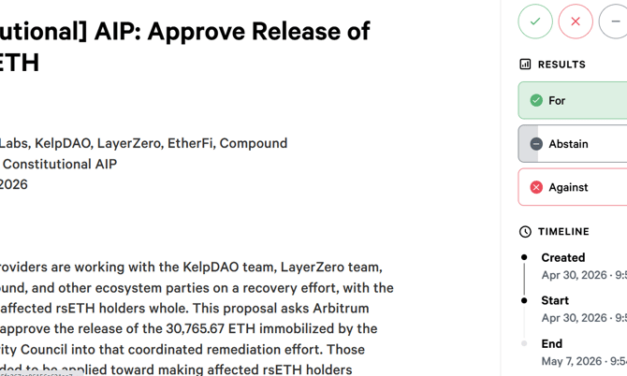
A joint proposal to release the roughly $71 million in Ether frozen after the Kelp DAO exploit is set to pass later on Thursday, moving a cross-protocol recovery effort closer to restoring part of rsETH’s backing.Over 90.5% of the tokens were cast in favor of the motion, representing 173.9 million Arbitrum (ARB) tokens, while 9.4%, or 18.1 million tokens, abstained. Less than 1%, or 1,700 tokens, voted against the proposal before the voting period’s scheduled end at 6:54 pm UTC, according to a Snapshot at the time of writing.Co-authored by Aave Labs, Kelp DAO, LayerZero, EtherFi and Compound, the proposal seeks to unfreeze the 30,765 Ether (ETH) that was frozen by Arbitrum’s Security Council on April 21, days after an attacker drained about 116,500 restaked Ether (rsETH) from Kelp Dao, worth between $290 million and $293 million at the time.The proposal marks the end of the first round of voting, bringing the “DeFi United” recovery effort closer to restoring part of rsETH’s backing and moving the motion to a definitive onchain governance proposal. It comes shortly after Aave Labs liquidated the Kelp DAO hacker’s remaining rsETH positions on Ethereum and Arbitrum, moving one step closer to resolution.“DeFi United” is a recovery effort initiated by DeFi protocols, including Mantle, EtherFi Foundation, Golem Foundation, Lido DAO, Ethena, LayerZero, Ink Foundation and Tydro, who have pledged a cumulative 43,000 Ether (worth about $101 million) to reduce the contagion effect of the Kelp DAO exploit.As the next step, the protocols will conduct a snapshot “temperature check” to gauge delegate sentiment before the proposal is finally submitted onchain via Tally as a Constitutional Arbitrum Improvement Proposal (AIP). Joint proposal to release funds frozen by Arbitrum’s security council. Source: Snapshot.orgSubject to a binding onchain governance vote, the funds would be released in a designated recovery address ‘0xf22’ in a 3-of-4 Gnosis Safe (SAFE) with signers from Aave Labs, Kelp DAO, Certora and EtherFi.However, even if the final governance proposal passes, rsETH’s backing is still facing a shortfall of about 76,127 rsETH, currently worth about $174.5 million. The proposal argued that even partially restoring rsETH’s backing will help stabilize market conditions in the broader DeFi ecosystem.Cointelegraph reached out to Arbitrum and Aave for comment on the next steps in the governance process and the proposed timeline for restoring rsETH’s backing.Related: Aave deposits fall by $15B as Kelp exploit sparks flight from DeFi lender Arbitrum to pass proposal to deploy 6,000 ETH for yieldThe Arbitrum DAO is also poised to approve a separate proposal to move 6,000 ETH, currently worth about $14 million, from the DAO treasury into its Treasury Management Portfolio.The proposal increases the planned ETH allocation from 5,000 ETH to 6,000 ETH after forum feedback, according to the Arbitrum governance forum. It also seeks to transfer about $150,000 worth of idle USDC into the portfolio to generate additional yieldMore than 99.9% of voting power was in favor of the proposal, representing 185.7 million ARB tokens, while 0.1%, or 266,930 ARB, abstained. The voting window is scheduled to close Friday at 2:22 pm UTC, according to Tally.Proposal to transfer 6,000 ETH to Arbitrum DAO’s portfolio. Source: alt.gov.arbitrum.foundation.The 6,000 ETH allocated to yield strategies is projected to generate an additional 288 ETH worth about $625,000 in the next year, assuming an ETH price of $2,200, based on the current 30-day-average annualized rate.Magazine: 53 DeFi projects infiltrated, 50M NEO tokens could be ‘given back’: Asia Express Cointelegraph is committed to independent, transparent journalism. This news article is produced in accordance with Cointelegraph’s Editorial Policy and aims to provide accurate and timely information. Readers are encouraged to verify information independently.

Čítaj viac

Polygon reduces block time to 1.75 seconds as payments push accelerates

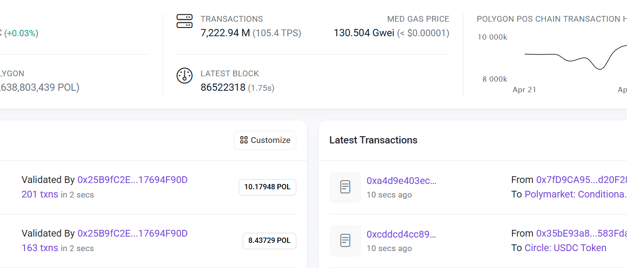
Blockchain layer-2 (L2) network Polygon reduced its average block time by 250 milliseconds to 1.75 seconds, marking its first block-time reduction since genesis as the network pushes deeper into stablecoin payments and settlement infrastructure.Polygonscan shows that the latest blocks on the network were created in 1.75 seconds. The upgrade means that Polygon can process around 14% more payments per second, reaching a maximum theoretical throughput of about 3,260 transactions per second (TPS), according to Polygon software engineer Lucca Martins.Shorter block times can help transaction backlogs clear faster, reducing the duration of network congestion and subsequent transaction fee spikes, which is particularly important for high-frequency use cases such as payments, stablecoins or decentralized finance (DeFi) trading.The upgrade comes as Polygon makes efforts to position itself for use cases targeting more institutional adoption, such as private stablecoin payments. On Tuesday, Polygon introduced a new wallet feature that enables users to privately route stablecoin transactions through a shielded pool verified by zero-knowledge proofs.The upgrade is part of the Polygon Improvement Proposal PIP-86, a two-step motion that seeks to further reduce block time to 1.5 seconds and scale down checkpoint rewards to maintain the Polygon (POL) token emissions at the target 1% after the block time reduction. Polygon blockchain explore, latest blocks, production time. Source: PolygonscanCointelegraph reached out to Polygon for comment on its block time reduction plans, but had not received a response by publication.Related: Morgan Stanley takes on crypto trading rivals with E*Trade pilotPolygon targets private stablecoin payments to onboard institutionsPolygon’s new wallet feature is part of an aim to onboard more institutional users as it hides senders, receivers and amounts onchain while maintaining compliance through Know Your Transaction (KYT) screening and auditable files.The feature introduces more privacy for businesses transacting with stablecoins, according to Polygon community lead Smokey. Despite the upgrade, Polygon’s (POL) token remained stagnant over the past 24 hours and traded at $0.09 at the time of writing. The token is down 54% over the past year, CoinMarketCap data shows.POL/USD, one-year chart. Source: CoinMarketCapPolygon has also integrated with large credit card providers. On April 29, global payments giant Visa expanded its stablecoin pilot to include support for Polygon Base, the Canton Network, Arc and Tempo.Launched by Visa in 2023, the pilot allows partners to settle transactions through stablecoins rather than traditional banking rails, to evaluate whether stablecoins can offer faster settlement.Magazine: Will the CLARITY Act be good — or bad — for DeFi?Cointelegraph is committed to independent, transparent journalism. This news article is produced in accordance with Cointelegraph’s Editorial Policy and aims to provide accurate and timely information. Readers are encouraged to verify information independently.

Čítaj viac

Morgan Stanley takes on crypto trading rivals with E*Trade pilot

Morgan Stanley has rolled out a cryptocurrency trading pilot on its E*Trade platform, charging lower basic retail fees than some of the largest US crypto and brokerage platforms.The Wall Street bank is charging clients 50 basis points on the dollar value of each crypto transaction, undercutting Coinbase, Robinhood and Charles Schwab on standard retail pricing, according to a Tuesday Bloomberg report.The offering is currently in pilot mode, with E*Trade’s 8.6 million clients expected to gain access later this year, Bloomberg reported.The pilot illustrates how major Wall Street firms are moving further into crypto trading as they compete with exchanges and fintech platforms for retail trading revenue. Still, Kraken Pro, Binance US and some Coinbase Advanced tiers offer lower fees for crypto traders. A spokesperson for Morgan Stanley confirmed to Cointelegraph that the details and fee structure described in the Bloomberg report were accurate.The latest crypto push by the bank comes about a month after Morgan Stanley launched a spot Bitcoin ETF (MSBT) that recorded $30.6 million in inflows on its first day of NYSE Arca trading. Related: Crypto VC funding plunges to $659M in April, hits near two-year lowWall Street giants venture into crypto tradingMorgan Stanley is not the only major financial institution expanding its crypto products for retail or institutional clients.Charles Schwab, one of the largest US brokerage firms, announced the launch of spot Bitcoin and Ether trading for retail clients less than a month ago, Cointelegraph reported on April 16. The offering launched with a 75 basis points per transaction fee.Goldman Sachs also filed with the US Securities and Exchange Commission in April to launch the Goldman Sachs Bitcoin Premium Income ETF, a proposed fund that would generate income by selling call options on Bitcoin exchange-traded products rather than investing directly in Bitcoin.Earlier Wall Street crypto infrastructure efforts include BNY Mellon’s digital asset custody platform, which went live in the United States in October 2022 and allowed select clients to hold and transfer Bitcoin and Ether.Magazine: Bitcoiners eye ‘sell in May,’ SBF’s bid for new trial shut down: Hodler’s Digest, April 26 – May 2Cointelegraph is committed to independent, transparent journalism. This news article is produced in accordance with Cointelegraph’s Editorial Policy and aims to provide accurate and timely information. Readers are encouraged to verify information independently.

Čítaj viac

Získaj BONUS 8 € v Bitcoinoch

nakup bitcoin z karty

Registrácia Binance

Burza Binance

Aktuálne kurzy