Autor Cointelegraph By Zhiyuan Sun

Vitalik Buterin gives thumbs down to cross-chain applications

In a Reddit post on Friday, Vitalik Buterin, the co-founder of Ethereum (ETH), outlined critical security concerns surrounding cross-chain bridges in the blockchain ecosystem. As told by Buterin, storing native assets directly-chain (Ethereum on Ethereum, Solana on Solana, etc.) provides a certain degree of immunity against 51% attacks. Even if hackers manage to censor or reverse transactions, they cannot propose blocks to take away one’s crypto.The rule also applies to the Ethereum application. For example, if hackers launch a 51% attack (by controlling 51% of all circulating ETH supply) while an investor swaps 100 ETH for 320,000 DAI stablecoin, the end state remains invariant, i.e., the investor would always get either 100 ETH or 320,000 DAI.However, Buterin continued, that the same level of security does not apply to cross-chain bridges. In the example he raised, if an attacker deposited their own ETH onto a Solana (SOL) bridge to obtain Solana-wrapped Ether (WETH) and then reverted that transaction on the Ethereum side as soon as the Solana side confirmed it, it would incur devastating losses on other users whose tokens are locked in the SOL-WETH contract, as the wrapped tokens are no longer backed by the original on a 1:1 ratio.Buterin further outlined how the security exploit could scale negatively as more bridges are added into a cross-chain network. In a theoretical network comprising 100 chains, the high level of interdepency and overlapping derivatives would mean that a 51% attack on one chain, especially a small-cap one, can cause a system-wide contagion. According to Crypto 51, it costs as much as $1.78 million an hour for hackers to mount a 51% attack vector against the Ethereum network. However, the cost drops to as little as $13,846 per hour for blockchains such as Bitcoin Cash.My argument for why the future will be *multi-chain*, but it will not be *cross-chain*: there are fundamental limits to the security of bridges that hop across multiple “zones of sovereignty”. From https://t.co/3g1GUvuA3A: pic.twitter.com/tEYz8vb59b— vitalik.eth (@VitalikButerin) January 7, 2022Related: Vitalik proposes new ‘multidimensional’ Ethereum fee structure

Čítaj viac

Five coins that saw huge gains in 2021

The year 2021 was unprecedented for crypto, with Bitcoin (BTC) and Ether (ETH) gaining 60.58% and 408.5% throughout the year, respectively. For the latter, the explosion of decentralized finance (DeFi), nonfungible tokens (NFTs), decentralized applications (DApps) and decentralized exchanges (DEXs) built on its blockchain created a whole new digital currency cyberspace encompassing all corners of the world.But, the year was also an auspicious one for altcoins, whose performance far outweighed that of BTC and ETH during the same time period. So, without further ado, let’s look at five cryptocurrencies that went from zero to hero in 2021.1. Shiba Inu Of course, at the top place is the iconic meme token Shiba Inu (SHIB). Originally created as a joke and as a spin-off from Dogecoin (DOGE) in August 2020, SHIB holders recognized a mouth-watering gain of 29,513,624.1% from start to finish in 2021. But the network has evolved far outside of meme status. There is now a ShibaSwap DEX with close to $324.5 million in total value locked (TVL) at the time of publication, with two other native tokens and support for NFT drops.Then again, the memes have also been flying high this entire time. Last October, CEO of AMC Entertainment Adam Aron organized a Twitter poll asking if the well-known movie theatre chain should accept SHIB tokens as payment for movie tickets. The poll garnered 153,100 votes, with 81.4% of users in favor.TWITTER POLL #2: As you know, you can now purchase AMC gift cards using cryptocurrency, and our IT group is writing code so that soon we can accept online payments in Bitcoin, Ethereum, Litecoin and Dogecoin among others. Should we strive to take Shiba Inu too?— Adam Aron (@CEOAdam) October 29, 2021And, loyal to the cause, soldiers of the “Shiba Army” have proven themselves to be ardent defenders of the token when faced against enemies of their blockchain. The past December, Canadian medical Q&A platform Ask the Doctor, a former SHIB influencer, went AWOL and decided to file a lawsuit against Shytoshi Kusama, the volunteer project lead for SHIB, alleging libel. Not only did Kusama fire back (with Tweets), but the Shiba Army launched an all-out attack on the entire (cyber) front. Within hours, Ask the Doctor had lost close to 10,000 out of 58,000 followers on Twitter while its TrustPilot page was flooded with hundreds, if not thousands, of one-star reviews before the platform‘s curators began removing them.Tell your legal team that it is illegal to buy a verified account to use it to scam other people. Tell them it is illegal to take people’s money for a service you never provide. And if you REALLY want to come and get me…COME GET ME. It’s almost time anyway… I’m ready https://t.co/jTnQydUWBt— Shytoshi Kusama™ (@ShytoshiKusama) December 21, 2021

2. SolanaComing in with a gain of 11,120% in 2021, Solana (SOL) managed to live up to its endearing nickname of “Ethereum Killer,” processing 1,847 transactions per second and with an average cost per transaction of less than one penny at the time of publication. Meanwhile, the Ethereum network can only process 15 transactions per second, with gas prices of $133.17 per smart contract execution.Due to its high efficiency, the blockchain has attracted the attention of many developers from FTX-backed game studios and the most successful NFT project originated from Asia to privacy-enhanced browser Brave which has over 42 million users. In December, Twitch co-founder Justin Kan launched a new blockchain gaming-focused NFT marketplace, Fractal, on the Solana network and has amassed over 110,000 members.We are starting with the @solana blockchain, as we see the low cost and high speed of transactions as appealing to game creators who want to have a high number of in-game assets.— Justin Kan ❄️ (@justinkan) December 13, 2021

3. Dogecoin It‘s not often that sequels — being SHIB — out perform the original release, but DOGE is nevertheless still a solid meme token story. Finishing the year off with a gain of 2,910%, DOGE attracted the attention of celebrities, influencers, investors and blockchain enthusiasts alike. But, let‘s face it, most were probably in it for the money (and jokes) rather than the technology.One of the greatest evangelists of DOGE is, of course, Elon Musk. Colloquially known as the “Dogefather,” Musk has repeatedly shilled the meme coin to his 68.9 million followers and has even confirmed that Tesla will accept DOGE for merchandise payments. In a Time Magazine interview, Musk said, “Bitcoin is not a good substitute for transactional currency. Even though it was created as a silly joke, Dogecoin is better suited for transactions. The total transaction flow that you do with Dogecoin, like transactions per day, has much higher potential than Bitcoin.”What’s more, Mark Cuban, the billionaire owner of the Dallas Mavericks, has started a cashback rewards program to incentivize merchandise and ticket payments via DOGE. According to CryptWerk, 1,983 merchants worldwide now accept DOGE as payments, up from 1,206 at the beginning of 2021.Dogecoin is the people’s crypto— Elon Musk (@elonmusk) February 4, 2021

4. Binance Coin Finishing off 2021 with a gain of 1,271% is Binance Coin (BNB). Previously only used as a discount for trading fees on Binance, the largest centralized crypto exchange in the world, BNB has evolved to become a leader in the DeFi ecosystem and is ERC-20 compatible. Since its launch in 2020, Binance Smart Chain (BEP-20) has surpassed 1.5 billion in lifetime transactions with a TVL of $16.61 billion. 32.98% of the TVL comes from DEX and gaming/NFT platform PancakeSwap, where 3,759 coins are available for trading for a total transaction volume of $760.2 million in the past 24 hours.BNB is used to pay for gas fees on both the Binance Chain along BEP-20 and is interchangeable. Binance devotes a portion of its profits to buying back BNB for permanent removal every quarter. During the 17th quarterly burn that took place in October, $639.5 million worth of BNB was burned.The number of total transactions on #BinanceSmartChain crossed 1,500,000,000 just a few hours ago. #BSC community is unstoppable pic.twitter.com/nSoO6sfj0s— Binance Smart Chain (@BinanceChain) October 27, 2021

5. CardanoAccording to a recent report by CryptoRanks and Santiment, Cardano (ADA) was the most developed blockchain in 2021. Over 140,000 GitHub events involving Cardano were reported throughout the year, besting Kusama and Polkadot‘s close second and third place. Last September, Cardano underwent its signature Alonzo Fork, enabling smart-contract functionality on its proof-of-stake (PoS) network.Shortly afterward, the number of ADA wallets surpassed the 2 million mark. At the same time, its founder, Charles Hoskinson, updated enthusiasts on the status of the Hydra upgrade that could theoretically enable the network to process hundreds of transactions per second. In early January, Hoskinson announced plans to transition Cardano into a permanent open-source project gradually. ADA finished the year with a gain of 673.8%.OVER 2 MILLION ADA WALLETS️It wasn’t long ago that we were celebrating hitting our 1 million mark and now we hit a whopping 2 million #ada wallets!#Cardano #CardanoCommunity@F_Gregaard @IOHK_Charles @IOHKMedia @InputOutputHK pic.twitter.com/x40pri9tjN— Cardano Community (@Cardano) November 1, 2021

Čítaj viac

Kazakh government resigns, shuts down internet amid protests, causing Bitcoin network hash rate to tumble 13.4%

On Wednesday, Kazakhstan, the second-largest country in the world when it comes to Bitcoin (BTC) mining hash rate, experienced unprecedented political unrest due to a sharp rise in fuel prices. As a result, the country’s presiding cabinet resigned, but not before the state-owned Kazakhtelecom shut down the nation’s internet, causing network activity to plunge to 2% of daily heights.The move dealt a severe blow to Bitcoin mining activity in the country. As per data compiled by YCharts.com, the Bitcoin network’s overall hash rate declined 13.4% in the hours after the shutdown from about 205,000 petahash per second (PH/s) to 177,330 PH/s. The country accounts for 18% of the Bitcoin network’s hash activity. Just days prior, the Kazakh government removed price caps on liquefied petroleum gas used for car fuel to align with market conditions, which doubled its price overnight, sparking violent protests. At the time of publication, the internet remains inaccessible in Kazakhstan. If extended, the consequences could be severe as internet services aside, the Data Center Industry & Blockchain Association of Kazakhstan expects the country to generate $1.5 billion from legal cryptocurrency mining (and another $1.5 billion in illicit) activities over the next five years.The country’s low energy prices have attracted both domestic and foreign entities to set up shop for Bitcoin mining. According to Global Petrol Prices, electricity in Kazakhstan costs on average just $0.055 per kWh for businesses, a fraction of the $0.12 per kWh paid by U.S. businesses.

Čítaj viac

Evedo seeks to bring event planning to the blockchain

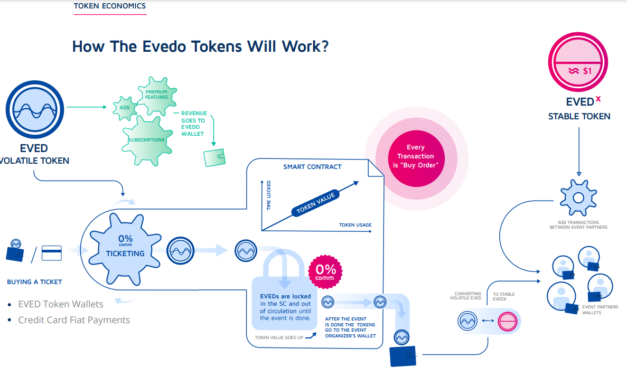
Evedo, a platform consisting of business-to-business, or B2B, & business to consumer, or B2C, marketplaces, seeks to provide blockchain solutions for businesses and participants involved in organizing events.In an exclusive ask-me-anything, or AMA, session with Cointelegraph Markets Pro, Stoyan Angelov, founder & CEO of Evedo & Fragmint, discussed the business dynamics and tokenomics of Evedo.Evedo tokenomics | Source: Evedo Technical Deck CT Markets Pro User: How does Evedo use blockchain technology for the events sector? Will the ecosystem be available for everyone or just artists and big events organizers?Stoyan Angelov: The EVED token is a utility token used to generate smart contracts between ticket buyers and sellers. Even now, we have 1,000+ clients that are working with our platforms to execute events, and we are event agnostic (small, medium, large of any type). So any event organizers are welcome to use the system. This is how the user profile looks like. We already have 5000+ users there, and in the following weeks, we will update and launch the updated marketplace.CT Markets Pro User: How can event planners rely on tokens, considering they have fixed costs to settle?Stoyan Angelov: At the beginning, we will be implementing stablecoins, and the EVED token will be used for premium features such as targeted advertising, community management and access to different tools on the platform. Consequently, the event organizers or other service providers will have the option to choose if they want to accept partial or full payment in EVED.CT Markets Pro User: What is Eve’s business model, considering there is no ticketing sales fee?Stoyan Angelov: Evedo’s business model is based on the additional value in the ecosystem. Keep in mind that we also have a commission from the ticket sales. A0% commission will be if the organizers use the EVED token for sales. FIAT is available now, and with FIAT, we charge a 5% commission.CT Markets Pro User: How will Evedo deal with high Ethereum (ETH) gas fee issues?Stoyan Angelov: We still didn’t implement the EVED payments in the ticketing because of the insane gas fees. Unfortunately, this is a show-stopper adoption on the ticket sales. Our exit plan is to become multi-chain and onboard the first HYDRA blockchain. In that way, we will finally have a chance for the EVED to be implemented. 

Čítaj viac

Cardano became the most developed crypto on Github in 2021 — Santiment

According to data compiled by CryptoRank and Santiment, Cardano (ADA) was the most developed crypto on Github in 2021, with over 140,000 events. Rounding out the top three were Kusama (KSM) and Polkadot (DOT) at second and third places, respectively, with roughly the same number of events over the year. Cardano beat Ethereum’s development activity by a wide margin, with the latter coming in fourth place. Santiment defines a Github event as either creating an issue, creating a pull request, commenting on an issue or pull request, and forking/starring/watching a code repository, among others. The Most Developed Cryptos on @Github in 2021 According to @Santimentfeed, @Cardano, has become the most developed project in the industry, followed by @Kusamanetwork, and @Polkadot. https://t.co/gjKPmOazyB pic.twitter.com/JHXmWSe0YS— CryptoRank Platform (@CryptoRank_io) January 3, 2022In a live Youtube session last week, Cardano founder Charles Hoskinson revealed that there are approximately 127 projects under development on the Cardano blockchain. In addition, Hoskinson expects the number of ADA users to grow ten-fold from the existing 2 million, thanks to the growing popularity of non-fungible tokens.Cardano’s technological advancement is also gaining traction post-Alonzo. One of the blockchain’s notable works in progress is the layer-two Hydra upgrade, which channels transactions off-chain to staking pools without partitioning the ledger itself. Theoretically, it could enable advanced linear scaling of the network with hundreds of “hydra nodes” each processing hundreds of transactions.Related: VCs don’t understand that Cardano has a community: Charles HoskinsonAnother notable mention is a novel fintech funding mechanism, known as the initial stake pool offering (ISPO), that’s unique to the Cardano blockchain. In this setup, blockchain enthusiasts delegate their cryptos in a protocol and receive tokens of the new project they fund as rewards. In contrast, the ADA staking rewards go to the developers. Funds do not leave the delegator’s wallet, making the process rather secure. One such project, Genius Yield, saw its ISPO pools surpass $118 million within 24 hours.

Čítaj viac

Získaj BONUS 8 € v Bitcoinoch

nakup bitcoin z karty

Registrácia Binance

Burza Binance

Aktuálne kurzy