Autor Cointelegraph By Zhiyuan Sun

Stacks ecosystem becomes #1 Web3 project on Bitcoin

On the first anniversary of the launch of Stacks blockchain (STX), which seeks to make Bitcoin (BTC) programmable, the network achieved over 350 million monthly API requests, 40,000 Hiro (development tool for Stacks to build applications on Bitcoin) wallet downloads, and 2,500 Clarity smart contracts. According to a report by Electric Capital, a venture capital firm focused on cryptocurrencies and fintech, these statistics make Stacks the largest project on Bitcoin.More than 11,000 users earned more than 100 BTC rewards per month on Stacks due to its unique proof-of-transfer, or PoX, consensus mechanism. Miners bid BTC to verify transactions, execute smart contracts and mine new blocks on the STX blockchain and earn STX as rewards. Meanwhile, the BTC bids are sent to STX holders as rewards for performing tasks like running nodes. To date, the mechanism has delivered over $50 million worth of BTC rewards and surpassed $1 billion in total value locked.According to the report, there were also decentralized finance, or DeFi, advancements on BTC created through Stacks. These included the launch of wrapped BTC (xBTC), the Arkadiko borrowing and lending protocol, and Bitcoin Lightning decentralized swaps, allowing users to swap STX for Bitcoin, stablecoins and altcoins.The first projects to launch on Stacks were New York City’s and Miami’s CityCoins, generating $50 million for their respective city treasuries. Brittany Laughlin, executive director of the Stacks Foundation, issued the following statement regarding the milestone:The Stacks community has proven the incredible potential of smart contracts for Bitcoin, from DeFi to NFTs, city coins to philanthropic efforts, portable identity to new infrastructure, all in a single year. The technology and resources are all here. What happens next is dictated by visionary builders.

Čítaj viac


CoinMarketCap allegedly lists 3 fake SHIB contract addresses, Twitter firestorm ensues

A bit Twitter drama ensued on Thursday, continuing well into Friday afternoon, when developers behind popular meme token Shiba Inu (SHIB) issued a statement alleging that CoinMarketCap had listed three fake SHIB contract addresses belonging to the Binance Smart Chain (BNB), Solana (SOL), and Terra Luna (LUNA) blockchains. The staff at Shiba Inu claimed that the addresses were unsafe and that CoinMarketCap had refused to correct the alleged mistake. At the time of publication, the contract addresses are still viewable on CoinMarketCap.Official Statement regarding the recent actions by @CoinMarketCap . pic.twitter.com/DXP2wZRhYC— Shib (@Shibtoken) January 13, 2022Earlier in the day, CoinMarketCap issued a response claiming that the contract addresses listed on the page are wormhole addresses designed to facilitate cross-chain transactions. According to the popular crypto price-tracking site, the staff at Shiba Inu did not go through official channels to contact them and have reached out for greater clarification.Please note that the non-ETH contract addresses on this page @shibtoken are wormhole addresses, which are designed to facilitate cross-chain transactions of wrapped versions of this assethttps://t.co/IhbNBJkwnf— CoinMarketCap (@CoinMarketCap) January 14, 2022

While Shytoshi Kusama, volunteer project lead for Shiba Inu, did not comment on the issue, the developer retweeted a post from Twitter user @wenfloat, who said:”If you are going to allow scammers to add false contracts in our page (WE ARE ONLY ERC-20), you should delist SHIB. At least you won’t be collaborating with scams. You’ve ignored us for months; where’s your professionalism?”Shiba Inu is known for its stellar token gains over the past 12 months, as well as its (sometimes overly) enthusiastic investors. Last December, former SHIB influencer and Medical Q&A platform Ask the Doctor filed a lawsuit against Shytoshi Kusama, alleging libel, and threatened to reveal his personal identity in court. In response, the site lost approximately 10,000 followers out of 58,000 within hours and had its Twitter posts buried in a flurry of ridicule, along with hundreds of one-star reviews on TrustPilot (most of which have since been removed).

Čítaj viac

Iota selected for Phase 2A of EU blockchain initiative

On Thursday, the Iota Foundation, which oversees developments in the namesake Internet-of-Things transactions blockchain (IOTA), announced that it had been selected as one of five contractors by the European Commission to develop blockchain and distributed ledger technology in the region. According to the announcement, phase 2A aims to advance European Blockchain Services Infrastructure, or EBSI, in five areas:It will investigate the feasibility of sharding as to exponentially scale the Iota network on EBSI.Develop an approval weight consensus mechanism that will be highly flexible and allow both permissionless and permissioned use cases.Ensure any Iota-based solution for cross-border transfers abides by EBSI governance structures and any regulatory requirements from EU member states.Integrate its GDPR-compliant identity solution with the new framework for EU digital identity on EBSI.Prepare on and off-chain bridges to other protocols in and outside EBSI, including support for Ethereum Virtual Machine.Based on the results of the phase 2A development over the next six months, a minimum of three out of five contractors will be chosen to advance to the next stage, where the European Commission will field-test the capabilities of the newly developed infrastructure and applications. Last September, Iota was one of seven enterprises chosen to support the early-stage innovation of the said European blockchain venture. With its signature decentralized acrylic graphs, the Iota blockchain is known for very little energy consumption and no gas fees. Previously, Assembly, a decentralized layer one smart contract network built within the Iota ecosystem, announced a $100 million capital raise from private investors while receiving praise from Dominik Schiener, Iota Foundation’s co-founder and chairman.

Čítaj viac

TokenBot helps crypto traders build social communities and monetize market knowledge

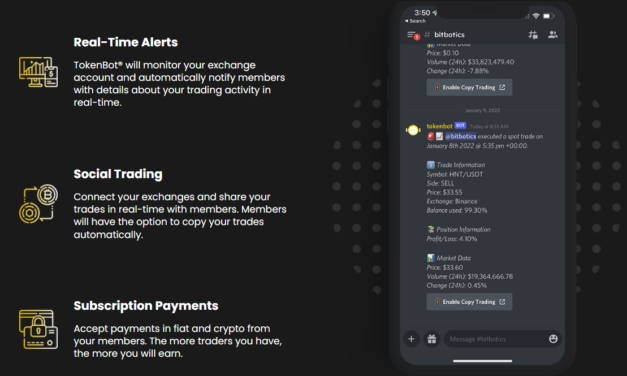
There are many advantages to automating one’s trading tactics instead of pointing and clicking with a mouse. For starters, bots can execute trading decisions free of emotion, are lighting fast, and have far fewer margins of error. According to CNBC estimates, crypto trading bots account for 70% to 80% of the overall trading volume.TokenBot is an automated copy-trading platform designed for social trading groups and communities within messaging apps such as Discord, Telegram, and Slack. Once added to a social media group, TokenBot monitors the admin’s account on an exchange and automatically notifies members of their trading activity details in real-time. The bot has more than 8,000 daily active users and streams close to $100 million per day in trading volume. In an exclusive ask me anything session with Cointelegraph Markets Pro users, TokenBot’s co-founders Anthony Elia and Shaun Newsum shared insight on how the bot could help crypto traders. TokenBot intro and UI | Source: TokenBotCointelegraph Markets Pro User: What crypto exchanges are currently supported on Tokenbot?Anthony Elia and Shaun Newsum: We support all of the significant spot and futures exchanges. Binance, FTX, Bybit, Coinbase, Kraken and BitMEX. We are expanding to Gate.io, OKEX, Huobi shortly. Many of our master traders who use the platform, especially those with leverage trading strategies, use Binance, with FTX coming in at second place. CT Markets Pro User: How does the structure work? I connect my API to the bot, and then the trades are shared through friends/community via Discord/Telegram? What’s the fee for it?AE & SN: Yes, you connect your API key inside the TokenBot.com dashboard, click your Discord/Telegram account and then add to the bot in your group chat. There is no fee to share trades. If users want to copy your trades, you can set your price as low as $29/month, and TokenBot takes anywhere from 10-30% platform depending on the subscription price. TokenBot will automatically copy those trades to the subscriber’s crypto account via their API keys.CT Markets Pro User: Are the trades shared in near real-time, or is there a delay?AE & SN: Are the trades shared in near real-time, or is there a delay? Yes. Our system connects directly to the exchange WebSockets API, and we get near real-time notifications of trades to reduce latency. We have been engineering this system for over three years.CT Markets Pro User: Does the bot support DEXs as well, or only centralized exchanges?AE & SN: Right now, only centralized exchanges. However, if we support DEXs, we will look to support dYdX first, given their on-chain perpetual futures contracts product has gotten a lot of steam with traders.CT Markets Pro User: You mentioned transparency as a big forte of the setup. But what if a trader, say, trades on Coinbase and then transfers coins to Uniswap and then swap/buy/sell there? The bot not be able to pick up the DEX trades right? Are there workarounds?AE & SN: You can cross-copy trades across CEX with TokenBot, but there is no way to tell if the trader you are copying withdrew that coin from the exchange to say, Uniswap and exchanged it there. But you would have a trade left open until the trader sold the position from where it originated. The trader would eventually have to answer to their community about the still open trade. There is no way around the trader manipulating the P&L on their trades.CT Markets Pro User: There have been many phishing exploits lately involving Discord. How secure is Tokenbot from this type of attack?AE & SN: Since we are mainly a CEX/API product, our main security layer is through hardware encryption and IP-restricted API keys “binding.” Most of the API keys in our system can only be used by our servers. For example, you can create an API key for use with TokenBot on Binance, By bit, and Phemex – and that API key is functional ONLY on our servers. This restricts the possibility of any “man-in-the-middle” type attacks.

Čítaj viac

Industry players respond to Vitalik Buterin's thoughts on cross-chain ecosystems

Last week, Vitalik Buterin, Ethereum (ETH)’s co-founder, voiced his disapproval regarding the emergence of cross-chain bridges, citing security vulnerabilities due to their interdependency. In the days that followed, however, developers working on cross-chain technologies largely dismissed his skepticism. In a statement to Cointelegraph, Kadan Stadelmann, chief technology officer of atomic swap blockchain Komodo, responded to Vitalik’s critique:”What we ultimately need is true decentralization. For example, instead of relying on one or two trusted bridges that have a single point of failure, it would be better to work towards a future where we have numerous bridges that are secure, trustless and censorship-resistant.”Erik Ashdown, head of ecosystem growth at data analytics and blockchain indexer Covalent, concurred:Vitalik is a smart cookie who’s clearly done his thinking about the state of bridges. However, his saying that bridges are a bad idea and won’t work is the equivalent of the Bitcoin community in 2015 saying Ethereum and smart contracts were a bad idea.Stadelmann further reiterated that “cross-chain interoperability is the future” and that both multi-chain ecosystem networks like Polkadot (DOT) and Cosmos (ATOM), as well as atomic decentralized exchanges, could disrupt the economic size of Ethereum. In supporting the claim, Stadelmann cites expensive gas fees on the blockchain as to why users would prefer alternatives.Nevertheless, there are unresolved issues surrounding cross-chain blockchains. Ashdown cites one example of the composability of a smart contract, where sending a token across one bridge will not have the same contract address if it crosses from another bridge. This means that anyone else sending a token across another bridge will not be able to interact with the original tokens sent from the main bridge.

Čítaj viac

Získaj BONUS 8 € v Bitcoinoch

nakup bitcoin z karty

Registrácia Binance

Burza Binance

Aktuálne kurzy