Autor Cointelegraph By Zhiyuan Sun

Ukraine finds unlikely ally in efforts to bar Russian access to crypto: the Central Bank of Russia

Recently, Ukraine has called for “sabotage” of everyday Russians’ crypto assets due to an ongoing war between the two countries. Among many, its European allies have also voiced mounting concerns that Russia may use crypto to bypass Western sanctions.But ironically, it appears that one of the greatest proponents of barring everyday Russians and financial institutions from accessing cryptocurrencies is actually the Central Bank of Russia, or CBR, itself. As reported by local news outlet tass.ru on Thursday, the CBR continues to adhere to its position of proposing to ban the issuance, mining, and circulation of cryptocurrencies in the Russian Federation. A CBR official stated: “The Central Bank currently supports the position that was previously announced and published on the official website. Therefore, there is nothing to add today.”During times of war, nations typically need to dramatically increase their spending, such as via the printing of new money, to finance their military efforts. However, this leads to rampant inflation, thereby enticing individuals to exchange their local currencies for foreign currencies (including now, crypto) to protect their savings.But this, in turn, would create heavy selling pressure on the local currency, driving up exchange rates and hamper war financing efforts. As a result, countries typically introduce strict foreign exchange controls during wartimes, as Russia and Ukraine have already done. Thus, the drawbacks of crypto destabilizing the Ruble and, by proxy, crippling Russia’s war efforts, could potentially outweigh the benefits of using crypto to evade sanctions. According to a report published by Arcane Research this week, daily Tether (USDT) to Ruble trading volume on Binance reached an all-time high of $35 million. Russian social media members appear to be deeply concerned about the falling value of the Ruble and how cryptocurrencies can help them protect their savings. User Roman Buchyn wrote: “You need to buy something [cryptocurrencies]; the Ruble will soon be cheaper than toilet paper.”

Čítaj viac


CEXs refuse blanket asset freeze of all Russian users, though questions linger

Centralized exchanges (CEX) and CEOs from companies such as Binance, Coinbase and Kraken have all stated they would only freeze the assets of Russian clients specifically targeted by Western sanctions — not that of everyday Russian users.A few days prior, Mykhailo Fedorov, Ukraine’s minister of digital transformation, had called for “all major crypto exchanges to block [wallet] addresses of Russians” and “also to sabotage ordinary users [by freezing their assets].” In explaining why he was not preemptively banning all Russians (though, Coinbase is not available in Russia), Brian Armstrong, CEO of Coinbase, specifically wrote: “We believe everyone deserves access to basic financial services unless the law says otherwise. Some ordinary Russians are using crypto as a lifeline now that their currency has collapsed. Many of them likely oppose what their country is doing, and a ban would hurt them, too.”However, Armstrong also said that “if the U.S. government decides to impose a ban, we will of course follow those laws.” The sentiments of this statement were echoed by Kraken CEO Jesse Powell, who stated: “Kraken cannot freeze the accounts of our Russian clients without a legal requirement to do so. Russians should be aware that such a requirement could be imminent.”Unsanctioned individuals appear to be feeling the effects of sanctions even so. The day prior, Binance announced that cardholders of sanctioned Russian banks would not be able to use them on its platform. On Friday, Redditor u/Sammy12xyz raised the issue Iranian crypto enthusiasts face amid calls for CEXs to crackd own on Russian customers, claiming: “It’s already happened to Iranian accounts. We’ve been blocked out of Binance for two years, and no one’s said shit. Are we not innocent?”Despite such sanctions, it appears there are several, albeit limited, ways to circumvent them. As one KuCoin moderator wrote:“Users from Iran can use our exchange, but KYC [Know Your Customer] is not supported. If you wish to proceed without doing KYC, you may still perform all functions on our exchange as normal, even if you are not verified. However, there will be a withdrawal limit of 5 BTC per 24 hours for unverified accounts.”In addition, CEX bans on Iranian IP addresses can be allegedly bypassed with VPNs. Although one Iranian crypto enthusiast Cointelegraph spoke to claimed that cryptocurrencies such as Bitcoin (BTC) are needed in the first place to purchase VPNs in Iran, as such services do not accept fiat payments from Iranians due to sanctions. 

Čítaj viac

AMC Entertainment CEO briefs community on crypto, NFT project updates in latest earnings call

During its Q4 2021 earnings call late Tuesday, Adam Aron, CEO of iconic theatre-chain AMC Entertainment, briefed the community on the company’s latest crypto adoption efforts. As told by Aron, AMC will start accepting Dogecoin (DOGE) and Shiba Inu (SHIB) “in a couple of weeks.” AMC began accepting online payments for movie tickets via major cryptocurrencies last year. The company said it is also still exploring options to issue its own coin, an idea that has been in the making for quite some time as it monitors the current cryptocurrency regulatory framework. Aron also shared his praise for the blockchain industry: “We continue to explore how else AMC can participate in the burgeoning crypto universe, and we remain quite intrigued by the potential business opportunity.” Aron then added:”AMC also picked up the capability to accept Apple Pay, Google Pay and PayPal online. Incredibly, in just a few months, these latter three forms of payment, along with cryptocurrency, already constitute more than 15% of our online ticketing activity, as was seen in the fourth quarter of 2021.”But AMC has also been making grounds in the nonfungible tokens, or NFTs, space. Since last November, the company has completed four NFT campaigns, with more than 800,000 NFTs made available to consumers. These include NFTs offered as part of ticket sales for Spider-Man, Dune and The Batman movies, and those given to shareholders as part of AMC investor connect. The company plans to roll out more NFT projects this year, both jointly with studios and on its own, citing its potential to increase attendance at AMC theatres. According to Aron, AMC’s Spider-Man NFTs have sold for as high as $17,000 in secondary markets. 

Čítaj viac

Drawbacks of centralization: Moscow Stock Exchange remains offline amid ongoing Russo-Ukrainian war

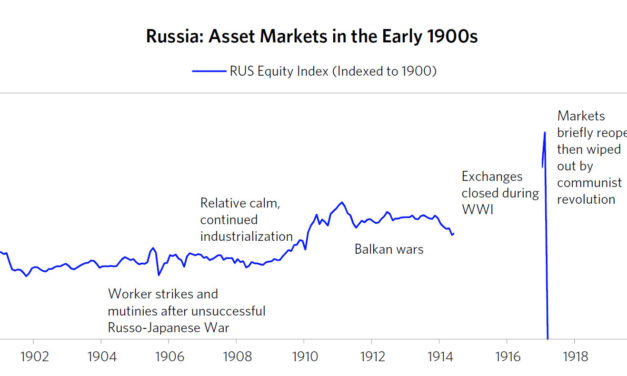
As reported by local news outlet tass.ru, the Central Bank of Russia once again suspended trading on the nation’s leading Moscow Stock Exchange (MOEX) on Wednesday, and will not open the exchange on Thursday. Trading on the MOEX has been halted since Feb. 25, after Russia launched its ongoing military occupation of Ukraine. On a monthly basis, the exchange’s index has lost over 34% of its value (not adjusted for inflation), as Western leaders imposed crippling sanctions on Russia in response to the conflict.In addition, MOEX’s main website has been knocked offline since Monday, with Ukraine’s IT Army allegedly taking credit for the “hack.” Meanwhile, Russia’s Saint Petersburg Stock Exchange (SPB) also remains closed but will open for limited trading tomorrow. In the meantime, the Dow Jones Russia GDR Index, which tracks the value of Russian stocks listed on the London Stock Exchange, has lost 93% of its value in the last five trading days, implying disastrous losses ahead when Russian markets open. Theoretically, whether centralized or decentralized exchanges (CEXs or DEXs), cryptocurrency exchanges would be free from such intervention. In addition to their sheer numbers, CEX servers can be spread out worldwide or do not disclose their server locations. Governments can, therefore, ban exchanges within their borders but cannot enforce a ban on crypto trading. As for DEXs, their peer-to-peer nature typically enables anyone with an internet connection to link their wallets and swap crypto, making it difficult to enforce any type of ban altogether.While Russian financial institutions have the means to weather a stock market catastrophe, the same cannot be said for everyday Russians. More than 17 million retail investors trade on the MOEX alone, and together, retail investors account for more than 40% of the country’s equity trading volume. Coupled with a sharp decline in the ruble’s value, it is likely the retail investor community in Russia, such as that of pensioners and retirees, will suffer severe losses to their savings when markets open. But perhaps there is no better path to understanding the dangers of centralized control over capital markets than through the archives of the SPB, itself. During the imperial era, the SPB was one of the top-performing stock markets in the entire world, even besting the performance of the New York Stock Exchange for much of the latter half of the 19th century. However, trading on the SPB halted with the outbreak of World War I. They opened briefly after the outbreak of the Russian Revolution in 1917. But when the Bolsheviks took over, the SPB was closed down for good, with investors who couldn’t sell in time losing every single kopek (Russian penny). Russian equity index of the 1900s | Source: SNB & CHF  (Author’s note: The “spike” in 1917 resulted from hyperinflation during the Russian Revolution, where stock prices “went up” simply due to the printing of large-denomination ruble notes, in part, to fund military expenditures. Meanwhile, their “real” value as compared to foreign currencies, plunged)

Čítaj viac

EU will cut off 7 Russian banks from SWIFT, with ordinary Russians facing consequences

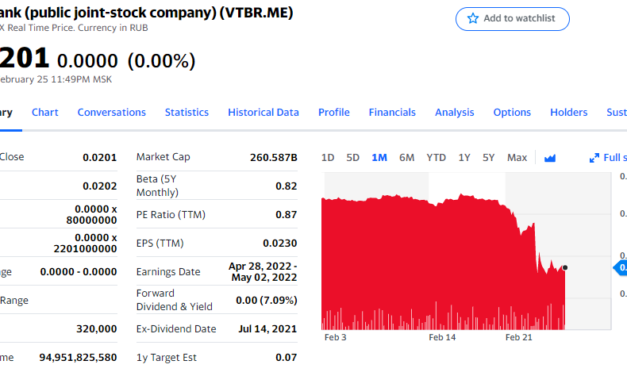
On Wednesday, the European Union announced that within 10 days, it intends to remove seven Russian banks from the Society for Worldwide Interbank Financial Telecommunication, or SWIFT, messaging system.The list of sanctioned banks includes Russia’s second-largest bank, VTB Bank, alongside Bank Otkritie, Novikombank, Promsvyazbank, Bank Rossiya, Sovcombank and VEB. Without access to SWIFT, which is a Belgian messaging system that connects over 11,000 financial institutions worldwide, Russian banks and, by proxy, the Russian economy are likely to endure severe losses. For example, Iran lost 30% of its foreign trade after being banned from SWIFT in 2012.VTB stock price. Source: Yahoo Finance (Note: Trading is currently halted on the Moscow Stock Exchange)But, in context, sanctions have a more devastating impact on a nation’s citizens. Although no one knows for sure, estimates place Russian President Vladimir Putin’s wealth at billions of dollars, meaning that he can still live a relatively lavish life even if the vast majority of his net worth is reduced via these punitive measures.However, the same cannot be said for the Russian people. According to data from XE, the Russian ruble has lost nearly 30% of its value since the invasion of Ukraine began last week. The economic repercussions are said to have devastated the savings of ordinary Russians. To make matters worse, the EU has also prohibited transferring euro banknotes to Russia.RUB-to-USD exchange rate. Source: XECrypto trading volume is surging in part due to high demand from Russia and Ukraine, with both countries suffering severe risks of currency destabilization. Stablecoins, in particular, play a vital role in countries facing mounting sanctions. For example, Venezuelans described to Cointelegraph how they support their families by converting their local salary into Tether (USDT) via an app called Reserve amid ongoing hyperinflation. Similarly, “Ardashir,” a crypto enthusiast based in Iran whose name has been changed to protect their identity, previously described to Cointelegraph how digital currencies had become a vital instrument of accessing services amid sanctions against the country:“We don’t have Visa, Mastercard or any type of credit card here. So, thanks to Bitcoin and crypto, we can buy items like Xbox, Apple gift cards, VPNs, flight tickets, etc.”When asked about whether crypto plays a role in combating the inflation of the Iranian toman, Ardashir added:“If you want to buy, for example, a box of matches today, it’s better to wait until tomorrow when it will be much cheaper as the real value of the toman falls. People thereby want to save the value of their money with digital currencies.”The Russian ruble PLUNGED to a new all-time low of 122.24 RUB/USD while trading today. Conflict with #Ukraine is taking its toll on the ruble, which has now lost as much as 37.7% of its value against the USD since Jan 1, 2022. At present, I measure #Russia’s inflation at 78%/yr. pic.twitter.com/wKO4hylHwA— Steve Hanke (@steve_hanke) March 2, 2022

Čítaj viac

Získaj BONUS 8 € v Bitcoinoch

nakup bitcoin z karty

Registrácia Binance

Burza Binance

Aktuálne kurzy