Autor Cointelegraph By Zhiyuan Sun

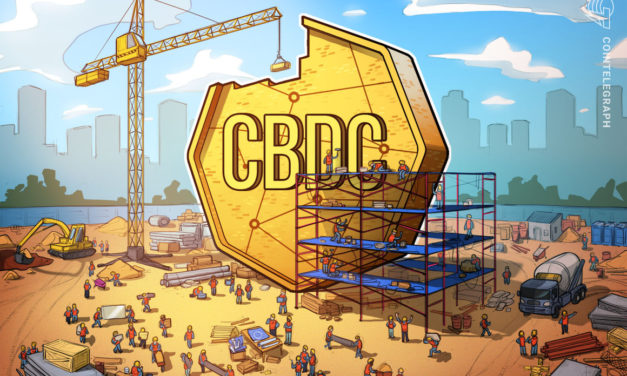
BIS: 90% of Central Banks are researching the utility of CBDCs

In a new annual economic report published by the Bank of International Settlements (BIS), the financial institution revealed that approximately 90% of central banks worldwide are investigating the feasibility of adopting central bank digital currencies, or CBDCs.The BIS report highlighted the ability of current sovereign fiat money to provide (relative) price stability and public oversight while criticizing crypto’s inability to perform “basic fundamental functions of money” and their opacity with regards to accountability to the general public. However, the report did highlight crypto’s programmable nature as well as the borderless elements of decentralized finance (DeFi) as potential benefits that would make a case for integration into CBDCs. There are currently three live retail CBDCs with 28 pilots. The digital yuan issued by the People’s Bank of China currently holds the dominant position with 261 million users. In addition, over 60 jurisdictions have fast retail payment systems.In making a case for the use of centralized digital assets, BIS cited recent adverse developments in the DeFi sector. One such example in the report is the implosion of Terra (LUNA) — now renamed Terra Classic (LUNC) — and Terra USD algorithmic stablecoin. Next, BIS went on to highlight the limited scalability of certain blockchains, such as Ethereum (ETH), causing network congestion and thereby sharp increases in transaction fees.It also raised the question of the feasibility of layer-1 solutions due to the significant fragmentation of such blockchains to address such drawbacks. Finally, the report pointed to a record amount of cryptocurrency hacks in the past year as part of digital assets’ inherent safety risks.

Čítaj viac

Chinese court invalidates 2019 car sale made using now worthless crypto token

Last week, a WeChat post published by the Shanghai Fengxian Court began circulating in crypto circles with regards to its recent ruling on a car sale in May 2019 made using digital currency. At the time, the buyer, identified only as Mr. Huang, signed a sales contract to purchase a 2019 Audi AL6 for CNY 409,800 ($59.477) in exchange for the consideration of 1,281 Unihash (UNIH) tokens with an undisclosed car dealership in Shanghai. Per the original contract, the seller was to deliver the car to Huang within three months’ time.According to the Shanghai Fengxian Court, Mr. Huang paid 1,281 UNIH on the date of the contract signing but did not receive the car within the specified duration nor afterwards. As a result, Mr. Huang took the seller to court, demanding the delivery of the vehicle and the payment of 0.66% daily interest of the transaction amount in damages for everyday that the car went undelivered beyond the original deadline.The case took over three years before a verdict was reached this June. Citing regulations in September 2017 that evolved into what is known now as China’s cryptocurrency ban, the Shanghai Fengxian Court said that digital assets “cannot and should not be used as a currency for circulation in the markets,” and that the use of digital tokens such as UNIH in lieu of fiat money as consideration in everyday contracts was in breach of respective regulation that overrides such contracts themselves. Therefore, the sales contract was ruled to be null and void. The buyer was neither granted damages, delivery of the car, nor a refund of his 1,281 UNIH. It’s unclear as to how the seller agreed to a conversion rate of 1 UNIH = CNY 320 as stipulated in the original contract in the first place. Unihash was supposedly a digital payment token developed for e-commerce in 2018 and was only available to private investors with no public initial coin offering. Shortly after its launch, allegations quickly surfaced on Chinese social media that labeled the project to be a “scam” and that its token metrics, as well as company history, had allegedly been grossly inflated to solicit investors. Currently, the project appears to be abandoned with no link to socials, no market listing, and no further development activity. Moreover, the firm behind UNIH did not accomplish any of its goals listed in its original whitepaper. One such promise made to investors in the document included: “What can be certain is that the Unihash token can appear on several exchanges by Q4 2019.” 

Čítaj viac

Iranian government to cut power supply for the country's legal crypto mining rigs

According to local news outlet Arz Digital, the day prior, Rajabi Mashhadi, a spokesperson for Iran’s Ministry of Energy, said that the entity would be cutting the power supply to all of the country’s licensed crypto mining firms by the beginning of July.Citing an anticipated electricity deficit from the peak-summer season, Mashhadi stated, “There are currently 118 authorized [digital currency] extraction centers in the country, which must cut off their electricity supply from the national grid from the beginning of July.””Last week, the country’s electricity consumption recorded an all-time high of 62,500 megawatts (MW) during peak consumption, which is a significant figure. According to forecasts, this week’s consumption requirement will exceed 63,000 MW, which means we must limit electricity supply.”The move comes after the country’s Ministry of Energy reported a disappointing gain of 1.2 gigawatts (GW) to its power generation capacity in 2021. This was well below the projected gain of 3.5 GW, leading to a power use deficit. Due to international sanctions, Iran lacks the investment needed in power generation capacity and natural gas production to keep up with consumption. On the other side, demand is soaring partly because due to the country’s extremely low electricity prices. Average household electricity in Iran costs as little as $0.005 per kilowatt-hour (kWh), a fraction of the $0.024 per kWh in its neighbor Iraq and $0.159 per kWh in the United States. For political reasons, the Iranian government spends over $60 billion annually in indirect subsidies to depreciate electricity prices. According to Cambridge University, Iran accounted for 0.12% of the Bitcoin (BTC) network’s hash rate and was previously among the top 10 countries in the world by BTC mining productivity. However, its share of the Bitcoin mining market fell from a peak of 4% in the years prior, partly due to a severe power shortage in the summer of 2021. 

Čítaj viac

Bitfrost releases upgraded SALP 2.0 after protocol helped secure $450M via parachain auctions

On Friday, Bitfrost, a Web 3.0 derivatives protocol that provides decentralized cross-chain liquidity for staked assets, launched the updated Slot Liquidity Auction Protocol dubbed “SALP 2.0.” Projects such as Moonbeam, Unique network, OAK network, Polkadex, etc., held their parachain crowdloans on Kusama and Polkadot via the original SALP. A total of 8,834,746 vsKSM ($439 million) and 3,045,564 vsDOT ($21 million) was minted through the protocol.The SALP protocol works by releasing the liquidity of tokens staked during an auction; liquid derivatives such as vsDOT and vsKSM are issued on a 1:1 basis for the tokens staked. Both vsDOT and vsKSM can be used for decentralized finance, or DeFi, applications, and rewards throughout the ecosystem as long as the native tokens remain locked for the duration of the parachain lease.This avoids the opportunity cost of locking their coins. However, the new SALP 2.0 allows users to obtain liquid tokens via direct investment, not just via crowdloan participation. Tyrone Pan, head of development at Bifrost, commented:”The upgrading of SALP 2.0 is generating a Bond market for Crowdloan assets, improving the efficiency of vsToken & vsBond liquidity while lowering the threshold for users. This model not only facilitates Crowdloan users to manage derivatives, but also cleverly combines Crowdloan with DeFi.”Liquid staking is a relatively new phenomenon in the DeFi realm, mainly born to allow users to recover potential opportunity costs while staking their assets. The potential downside is their vulnerability to the changes in underlying assets as they are classified as DeFi derivatives. 

Čítaj viac

High-profile BAYC collector denies allegations of wrongdoing brought by DeFi detective

On Thursday, ZachXBT, a cyber detective in the decentralized finance, or DeFi, realm, accused prominent Taiwanese musician and blockchain personality Jeff Huang, also known as Machi Big Brother, of misconduct in 10 different cryptocurrency projects. Machi Big Brother is known outside of Taiwan as an avid collector of Bored Ape Yacht Club nonfungible tokens (NFTs) and possessed a collection worth an estimated $8.26 million at the peak of the crypto bull market last year. This is misinformation. If he wasn’t anon I’d sue him for defamation.— Machi Big Brother (@machibigbrother) June 16, 2022Though numerous, the main spearhead of the allegations was directed toward Huang’s alleged involvement in the whereabouts of 22,000 Ether (ETH) raised during the initial coin offering for tokens of Formosa Financial (FMF), a Taiwanese treasury management platform built for blockchain companies, in 2018.After the ICO, FMF tokens quickly plunged in price, partly due to the severe cryptocurrency bear market at the time. Jeff Huang had served as an advisor for the company before eventually relinquishing his role. In 2019, Taiwanese news outlet Block Tempo reported that Formosa Financial merged with the Philippines-based crypto exchange CEZEX and ICO crowdfund syndicate Katalyse.io. As told by ZachXBT, on June 22, 2018, just three weeks after the FMF ICO, two withdraws of 11,000 ETH were made out of Formosa Financial’s treasury wallet. At the same time, multiple executives at Formosa Financial allegedly authorized a share buyback of the company.There is significant uncertainty regarding the outflows of the said 22,000 ETH. ZachXBT alleged that the funds went first to George Hsieh, Formosa Financial’s former CEO, and Jeff Huang, and then to wallet addresses allegedly linked to their associates. However, the DeFi detective did not back up their claims with evidence as to how they came to associate the said addresses with Jeff and George.On-chain data can only confirm that two withdrawals of 11,000 ETH took place from what appears to be Formosa Financial treasury on June 22, 2018. To establish a connection between a blockchain transaction and a real-world recipient, either additional know-your-customer (KYC) information or that of doxing would be required. For example, such a link can be established by comparing the recipient’s address with that of a Twitter Verified (where I.D. confirmation is generally required) user’s profile displaying the said address. However, such evidence was not present in ZachXBT’s analysis. Huang, whose public wallet came online only about two years ago, has denounced ZachXBT’s allegations as misinformation. Cointelegraph was not able to independently verify Huang’s alleged role in other projects as the DeFI detective’s report did not present the needed KYC information linking wallet addresses to Huang. However, Huang did give the following remarks regarding Mithril and Cream Finance — both of which are projects mentioned in ZachXBT’s report — in an interview with local news outlet Heaven Raven earlier this year. The excerpt was translated by Cointelegraph: “In 2018, I started out with [decentralized social media platform] Mithril. We even rolled out community mining, encouraging users to upload pictures or videos of their mining rigs. But it was too ahead of the times, and additionally, we were ignorant about many details. As a result, the token price collapsed. It was a pity, but we gained much experience and then moved on to Cream Finance.”Cream Finance is a major DeFi lending platform that suffered a series of flash loan exploits last year. It has vowed to repay users with protocol fees until their lost principal have been recouped. Regarding his involvement in the project, Huang said: “At the time, we lost nearly $140 million during the exploit. But afterwards, we tried to reimburse the clients. And now Cream is steadily profitable. In November 2020, I passed on control of Cream Finance to Andre Cronje. After that, due to the coronavrius pandemic, I mostly stayed at home and began focusing on nonfungible tokens.” Jeff Huang outright denied the allegations against him via a Twitter post on Thursday stating, “This is misinformation. If he wasn’t anon, I’d sue him for defamation.”

Čítaj viac

Získaj BONUS 8 € v Bitcoinoch

nakup bitcoin z karty

Registrácia Binance

Burza Binance

Aktuálne kurzy