Autor Cointelegraph By Zhiyuan Sun

Quebec Pension Fund loses almost entirety of its Celsius investment in less than ten months

According to local news outlet LaPresse on Wednesday, the Caisse de dépôt et placement du Québec (CDPQ), an institutional investor chartered with managing retirement assets in Canada’s predominantly french speaking province of Quebec, wrote off almost the entirety of its CA$200 million ($154.7 million) investment in troubled cryptocurrency lender Celsius Network. The move came just ten months after the CDPQ and growth equity firm WestCap made a joint investment of $400 million into Celsius at a valuation of $3 billion. At that time, Celsius boasted over 1,000 employees, $25 billion in total assets, and $850 million in cumulative interest paid to depositors.However, as an unregulated and centralized entity, depositors’ assets are not protected in the event of losses, nor is the firm subjected to any restrictions on use of leverage. During the onset of this year’s crypto winter, the sudden and violent crash of Bitcoin and other digital assets left a $2.85 billion gap in Celsius’ net assets. As a result, it suspended withdrawals on the accounts of nearly 1.7 million customers in June.Related: Worried about inflation’s impact on your retirement savings? Invest in cryptocurrencyIt appears that the loss on Celsius represents only a negligible fraction of the CDPQ’s portfolio. By June 30, the CDPQ managed a combined CA$391.6 billion in total assets, decreasing by 7.9% in the past six months. The entity is currently evaluating its legal options against Celsius, though it has not shared any details. According to court filings, Celsius is scheduled to run out of money by October.

Čítaj viac


Study: Insider trading occurs in 10% to 25% of cryptocurrency listings

According to a recent study conducted by the University of Technology Sydney, researchers estimated that insider trading occurs in 10% to 25% of cryptocurrency listings.In deriving the conclusion, researchers first sampled 146 token listing announcements on cryptocurrency exchange Coinbase between September 25, 2018, and May 1, 2022. Afterward, researchers examined the price movements of the sampled tokens in the time interval of 300 hours before Coinbase listing announcements up until 100 hours after the announcement, on various exchanges.The hypothesis was that if insider trading was involved, tokens that were also available to trade on decentralized exchanges, or DEXs, before the listing would see abnormal returns compared to those not listed on DEXs. Researchers claim that statistically significant levels of abnormal returns, 10% to 25% of the tokens studied, were observed and that the price patterns on DEXs immediately before the Coinbase listings were similar to “run-ups” witnessed in known cases of stock insider trading.Additionally, a small subset of wallet addresses on the aforementioned DEXs was suspected of strong accumulation and then quick disposition of tokens after the Coinbase listing went live. The study, still in the draft status, has not been peer-reviewed. The scopes of studies are normally limited by their ability to prove causation on top of correlation, or that the abnormal returns in the study can be definitely attributed to traders with non-public information accumulating ahead of time.  Coincidently, around the same time the paper was submitted, the U.S. Department of Justice charged a former Coinbase executive with insider trading. The exec has since pled not guilty. 

Čítaj viac

Ethereum Foundation clarifies that the upcoming Merge upgrade will not reduce gas fees

According to a new clarification by the Ethereum Foundation on Wednesday, the network’s upcoming proof-of-stake transitory upgrade — dubbed the “Merge,” — will not reduce gas fees. Regarding this, the Ethereum Foundation wrote: “Gas fees are a product of network demand relative to the network’s capacity. The Merge deprecates the use of proof-of-work, transitioning to proof-of-stake for consensus, but does not significantly change any parameters that directly influence network capacity or throughput.”The Merge, which seeks to join the existing execution layer of the Ethereum mainnet with its new proof-of-stake consensus layer, the Beacon Chain, will eliminate the need for energy-intensive mining. It is expected to land within the third or final quarter of 2022. While many investors and traders alike have bought Ether in anticipation of the Merge upgrade, some appear to have done so under misconceptions that the network’s capacity will surge once the upgrade is live. For starters, anyone is free to sync their own self-verified copy of Ethereum or to run a node, with no initial Ether staking requirements. With regard to staking, it is not possible to withdraw staked Ether until the following Shanghai upgrade goes live. Though, liquid ETH rewards in the form of fee tips will be available immediately. Validator withdrawals, once live, will be rate-limited to prevent a potential liquidity crisis.Transactions will also not be noticeably faster after the Merge. However, post-Merge APR yields on the network are expected to increase by 50% compared to now to attract capital. Client developers are currently working on a tentative deadline of Sept. 19 to complete the Merge, which is designed for zero downtime during the transition.

Čítaj viac

Bank of China unveils new e-CNY smart contract test program for school education

According to local news outlet Sohu.com, on Tuesday, the state-owned Bank of China announced a new program to bridge primary school education with smart contracts. In a combined partnership with local education and financial authorities, parents residing in the city of Chengdu, located in China’s Sichuan province, will be able to enroll their children in after-school or extracurricular lessons using the digital yuan central bank digital currency, or e-CNY.Under the pilot test, parents start by paying a deposit to a private educational entity for a series of lessons. Afterward, a smart contract binds each lesson on a pro-rata basis to the deposit. This way, should their children miss a lesson, the e-CNY payment is automatically credited back to their account via smart contract. The Bank of China stated:”The program seeks to explore the benefits brought forth by e-CNY smart contracts. One potential use case is replacing the role of regulatory authorities to monitor payment transactions between parents and private education entities. Another is improving transactions’ liquidity via zero transaction fees embedded in the e-CNY design.”Previously, the Bank of China rolled out an e-CNY airdrop program for the residents of the city of Chongqing as part of a local incentive to lower carbon emissions. Users receiving the airdrop can dispense their funds for scooter rides, food deliveries without packaged utensils, recyclable shopping bags and tickets to public transport. Over 4,567,000 merchants across China now accept e-CNY as payment in alignment with the country’s strategy to stimulate and digitize the economy with the aid of emerging technologies such as blockchain.

Čítaj viac

Only 50 or so profiles out of 7,000 Binance employees on LinkedIn are real, says CZ

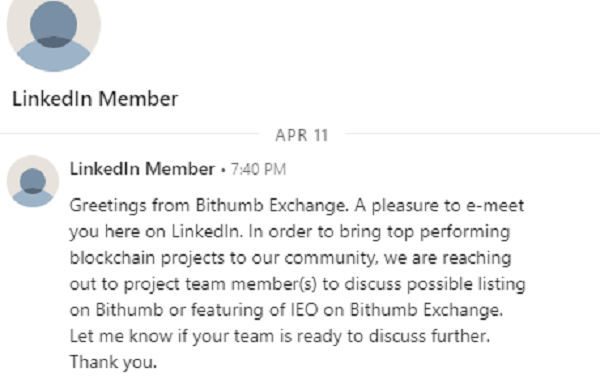
According to a Sunday Twitter post by Binance CEO Changpeng Zhao, also known as CZ, only about 50 out of 7,000 users claiming to be employees of the world’s largest cryptocurrency exchange on Linkedin are real. The crypto executive lamented the lack of a real-ID authentication system on Linkedin, saying:”I wished LinkedIn had a feature to let the company verify people. So, many “hey, I am responsible for listing” scammers on LinkedIn. Be careful.”The LinkedIn crypto scam typically begins as an unsolicited request from an apparent crypto exchange executive to project stakeholders regarding a potential token listing. Profiles are cleverly crafted to show years of experience in the industry, along with, multiple connections, sometimes up to 500-plus, to derive an image of apparent legitimacy.An unsolicited listing offer from a LinkedIn member claiming to be from Bithumb. Source: Zhiyuan Sun After a victim has been found, the scammer then sends a document via email or Telegram containing the details of the listing process along with a required initial security deposit for the “service.” As soon as the victim transfers the requested digital assets to the deposit address, however, the scammer breaks off all contact and pockets the funds.A fake Bitfinex listing document, which alleges to require a deposit of 250,000 USDT to commence the process. Source: Zhiyuan Sun Legitimate exchanges do not generally require initial deposits or listing fees. Instead, a due diligence team reviews the potential token for security, compliance, legal framework and the overall project utility, and then schedules a meeting with the asset issuer to discuss further steps. Depending on the scale of a project, developers can be hassled by so-called fake listing proposals on a daily basis.A fake Binance.US listing proposal. Source: Zhiyuan Sun 

Čítaj viac

Získaj BONUS 8 € v Bitcoinoch

nakup bitcoin z karty

Registrácia Binance

Burza Binance

Aktuálne kurzy