Autor Cointelegraph By Zhiyuan Sun

Panda DAO says it will dissolve and return investor's assets due to internal strife

On Monday, decentralized autonomous organization Panda DAO put forth a new proposal to dissolve itself and return assets back to investors. According to the seven-point referendum, between 500 million and 700 million PANDA tokens out of the 1.292 billion PANDA in circulation would be distributed among investors. Of those remaining, some would be redistributed among liquidity providers. Meanwhile, an estimated 50 million PANDA will be burned, and another 44.56 million PANDA will go toward compensation for eight of the project’s core developers.Should the referendum pass and the dissolution process complete, the Panda dev team plans to remove PANDA from Uniswap, publish all of the project’s open source code and shut down all social media under the Panda DAO umbrella. As for reasons for the dissolution, the Panda DAO team wrote:”Panda DAO has been online for nearly one year. We’ve managed to sidestep numerous market downfalls during that time. Yet, the real crisis we faced was dealing with management issues within our DAO.”One core member, going by the pseudonym “Panda,” lamented that the team faced a long, uphill battle in its project development. “Our community wanted more and more reassurances that Panda was heading in the right direction,” he said, “but developers don’t work for free, and [I think] no one understands how to endure a long, painful bear market.”As told by “Panda,” the internal turmoil within the DAO greatly hampered the efficiency of operations. After raising 1,900 Ether (ETH) at a price of 1 ETH = 500,000 PANDA last year, the community was conflicted about how to best use the funds going forward.”At that time, the [nonfungible token] NFT market was on fire. As a result, many of our users wanted us to create Panda NFTs. But having been through the crypto bear market of 2017–2018, we knew that the market was showing signs of FOMO [Fear of Missing Out], and it was only a matter of time before a crash was coming. Thus, we made the difficult decision to reject the community’s demands for Panda NFTs.””Panda” explained that while nonfungible token, or NFT, drops would generate revenue for the community, it would do so at the expense of the protocol’s credibility. “In the long run, the risks associated with the latter would outweigh that of the former,” he said.Since then, it appears that there had always been a rift between Panda developers and users. “We had a lot of ideas but little capital; our users wanted us to develop Panda Apps and even form a venture capital division, but we had to say no to these ideas.”A buyback proposal was also discontinued for similar reasons. “At the beginning, we bought back 2 million PANDA tokens,” wrote the core team member. “But many voices in the community wanted me to continue the buyback, even though it was not in my power to do so. I’m just one of many stakeholders tasked with managing our treasury.”As time went on, uniting discontented voices became impossible. “One faction wanted developers to focus on short-term profits that were low-risk, such as token buybacks. Another faction wanted long-term gains, refuse all buybacks, and stash the money inside the treasury.””Panda” wrote that it took him many “sleepless nights” to reach the decision. Nevertheless, the developer said that he had no regrets about putting forth the referendum. “We fell shy of many accomplishments, but at least we tried and didn’t throw our community under the bus.” During its one year-tenure, Panda DAO’s protocol went live and became the biggest DAO on the Dework blockchain. In addition, “Panda” says that he hopes the dissolution proves that “code is law” in the blockchain space.”The project succeeded, however briefly, because of smart contracts protecting community agreements. We had one for ERC-721, we have one now for the return of PANDA funds, etc. Without smart contracts, we would have never been able to sidestep so much market turmoil while guaranteeing the surety of our users’ funds.”太多时间在治理问题,太少时间在开发工作,我们曾在ConstitutionDAO的路上继续前行,也希望有人能在我们的路上继续探索。社区寻求更多的保底,但是开发者们不会免费干活。没人能理解当初那漫长的熊市如何度过。既然如此,让它彻底走向代码自治,和People一样全部退款。 pic.twitter.com/9HooAyHB0k— Panda ( ) (@hellopandadao) September 18, 2022

Čítaj viac
South Korean prosecutors apply to revoke Do Kwon and other Terra employees' passports

According to local news outlet gynews.kr, the Seoul Southern District Prosecutors’ Office’s Joint Financial Securities Crime Investigation Team says it will be contacting the country’s Ministry of Foreign Affairs to nullify the passports of Terra Luna co-founder Do Kwon and five other project developers. Prosecutors also plan to contact Interpol and escalate the South Korean arrest warrant issued the day prior into an international arrest warrant. All Terra Luna members named in the warrant reside in Singapore, a country that does not have an extradition treaty with South Korea. Targeted individuals on the warrant include Mo Han and Mo Yu, both of whom are Terra Luna employees staying with Do Kwon in Singapore. Another named individual is Greek national Nicholas Platias, a founding member of Terraform Labs.Since the collapse of the Terra Classic (LUNC) token — formerly known as Terra (LUNA) — and algorithmic stablecoin Terra USD (USTC) in May, police have raided 15 locations of interest, including cryptocurrency exchanges and corporate offices linked to the matter. The charge involves Terra employees, including Do Kwon, alleging the violation of the country’s Capital Markets Act, in which prosecutors consider Terra Luna ecosystem tokens to be “investment security contracts.”As told by South Korean prosecutors, Do Kwon allegedly continued to issue LUNA and USTC without notifying investors of the danger that the price of both could plummet together, amounting to fraud. They pointed to statements made by Do Kwon, such as “If I deposit Terra in Terraform Labs, I will pay an interest of 19.4%,” as evidence that Do Kwon had prior knowledge that investments in the Terra ecosystem were unstainable, and yet continued to act similarly to attract additional capital.The subsequent fallout of Terra Luna has caused ripple effects in ecosystem projects. One such protocol, Apollo DAO, was forced to close its Terra vaults Wednes. The project’s total value locked surpassed over $200 million last year and has now fallen to near-zero levels at the time of publication.

Čítaj viac

Apollo DAO to close vaults on Terra Classic

Around the same time that a South Korean court issued an arrest warrant for Terra co-founder Do Kwon, Apollo DAO, a decentralized autonomous organization building on the Terra blockchain, said it was closing down its vaults on Terra Classic (LUNC) — formerly Terra (LUNA). The project’s developers wrote: “Since the collapse of Terra, Apollo has continued to maintain its LP [Liquidity Provider] vaults on Terra Classic; however, due to the low return and high level of required maintenance, it no longer makes sense to support the Terra Classic network.”Apollo DAO, comprised of over 10,000 tokenholders, built its vaults primarily for trading the Terra USD (USTC) stablecoin and Terra Luna (LUNC) token pairs. Both tokens have plunged drastically in value since May, and co-founder Do Kwon is currently wanted in South Korea for allegedly violating the country’s capital market laws. In addition, project developers explained that the new Terra proposal to tax 1.2% of every on-chain LUNC transaction would have been too difficult to implement on its platform without substantial capital. “We will continue to assess the viability of relaunching our vaults on Terra Classic; however, we would like these to be fully designed around the requirements of Terra Classic to ensure a greater product market fit.”Apollo DAO says it is focusing its future on liquid staking and developing the Apollo Safe on various Cosmos chains. At its launch last September, the total value locked, or TVL, on Apollo DAO hit a peak of around $200 million. At the publication, Apollo DAO’s TVL has fallen to less than $125,000. Users are encouraged to withdraw any remaining funds before the launch of the novel Terra tax proposal. 

Čítaj viac

Tesla launches new Cyberwhistle that can only be bought using Dogecoin

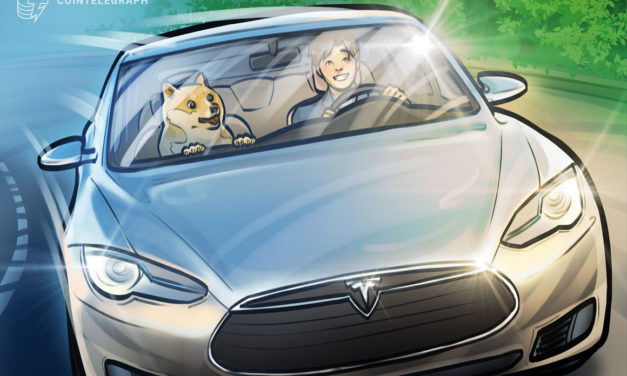
According to a new product catalog posted on Wednesday, electronic vehicle manufacturer Tesla is rolling out a new Cyberwhistle inspired by its futuristic Cybertruck series. The firm wrote:”Inspired by Cybertruck, the limited-edition Cyberwhistle is a premium collectible made from medical-grade stainless steel with a polished finish. The whistle includes an integrated attachment feature for added versatility.”All sales are final, and products are expected to ship within 4 to 6 weeks. On top of that, Tesla requires buyers to pay only in Dogecoin (DOGE). The price tag at the time of publication is 1,000 DOGE or around $60. Taxes and shipping are included in the DOGE price.Tesla says that Dogecoin is the only cryptocurrency that it currently accepts for select merchandise. Like other digital asset transactions, incorrect payment amounts or asset types sent to its address will not be reversed or refunded. Users require a Dogecoin wallet to pay for Tesla goods.”It is the responsibility of the purchaser to ensure that Dogecoin is transferred accurately.”Elon Musk, Tesla’s CEO, has been a prominent supporter of the meme currency, claiming last year that “Dogecoin is better than Bitcoin for payments.” Following Tesla’s suit, SpaceX also began accepting Dogecoin as payment for merchandise in May. The billionaire tech entrepreneur recently doubled down on his support of DOGE following a $258 billion lawsuit, alleging a crypto Ponzi scheme regarding the token. “I will keep supporting Dogecoin,” he said. 

Čítaj viac

NFT creator Doodles raises $54M in funding at $704M valuation

On Tuesday, nonfungible tokens (NFTs) collection Doodles announced that it had raised $54 million at a $704 million valuation in a funding round led by Seven Seven Six, with participation from 10T Holdings, Acrew Capital and FTX Ventures. As told by Doodles, the investment will allow it to scale its growth strategy and monetize its intellectual property globally through ventures in the music, culture and entertainment industries.Doodles is a collection of 10,000 NFTs co-founded by digital artist Burnt Toast and Web3 pioneers Evan Keast and Jordan Castro. Artistically, it is known for its colorful world and joyful cartoon character portraits of skeletons, cats, aliens, apes and mascots minted on the Ethereum blockchain. NFTs in the collection are generated from hundreds of traits and hand-drawn. Blockchain development software firm Dapper Labs founded the company in 2021.Earlier in March, Doodles invited its NFT holders to an exclusive experience at the South by Southwest festival in Texas. Users could visit Doodles-themed venues to buy a drink, get Doodles painted on their nails, order refreshments and display their NFTs throughout the exhibit. Regarding the new fundraise, Katelin Holloway, founding partner at Seven Seven Six, said:”We believe Doodles is developing the next digital frontier of how we experience and create content, unlocking the real value behind NFTs. Doodles is changing how the world connects and interacts by reimagining storytelling through the blockchain.”Since its launch in October 2021, the Doodles collection has surpassed 148,500 Ether (ETH) traded on OpenSea with a floor price of 8.4 ETH. Notable collectors include Justin Bieber, Future, Gary Vee, Snoop Dog, Fat Joe, Kygo, Diplo, Steve Aoki and Pranksy.

Čítaj viac

Získaj BONUS 8 € v Bitcoinoch

nakup bitcoin z karty

Registrácia Binance

Burza Binance

Aktuálne kurzy