
Autor Cointelegraph By Zhiyuan Sun

South Korean gov has confiscated 260B KWR in crypto for non-payment of taxes since 2021

According to regional news outlet mk.co.kr, the South Korean government has seized over 260 billion Korean won ($180 million) worth of cryptocurrencies over the past two years due to tax arrears. The country’s politicians enacted regulations allowing for the seizure of digital currencies for tax delinquencies and began enforcing them last year.One individual living in Seoul, dubbed “Person A,” had 1.43 billion won (roughly $101.6 million) worth of tax arrears and his cryptocurrency exchange account was seized by the authorities. The account contained 12.49 billion won (about $88.7 million) of digital assets spread across 20 coins and tokens, including 3.2 billion won (around $2.3 million) in Bitcoin (BTC) and 1.9 billion won ($1.3 million) in XRP.After the seizure, Person A reportedly paid the arrears and requested to halt the sale of seized assets. If tax arrears are not paid, South Korean law allows authorities to sell confiscated cryptocurrencies at market value.South Korea is one of the most popular countries in the world for crypto activity, with its digital currencies market growing to $45.9 billion last year. In March, crypto-friendly Yoon Suk-Yeol won the country’s presidential elections, and a coin used to mint his signature as a nonfungible token (NFT) surged by 60% shortly afterward. In addition, both leading candidates released campaign-related NFTs for election support. Yoon has pledged to “overhaul regulations that are far from reality and unreasonable” in South Korea’s crypto sector. One of the measures, dating from July, includes postponing a 20% tax on income generated from cryptocurrency transactions in excess of 2.5 million won ($177,550) for two years. 

Čítaj viac

Societe Generale launches custodial services for crypto fund managers

According to a new press release on Wednesday, Société Générale, one of the largest investment banks in Europe, said that it would be expanding its cryptocurrency asset management services through its Security Services subsidiary. Clients who are digital asset fund managers can now elect to have Société Générale as their fund custodian, valuator and liability manager. The tools are designed to facilitate the addition of cryptocurrencies into institutional investors’ portfolios. The firm’s most recent client is Arquant Capital SAS, a licensed asset management company in France with two euro-denominated digital asset products consisting of Bitcoin (BTC), Ether (ETH) and other derivatives. David Abitbol, director of Societe Generale Securities Services, commented:”By combining Societe Generale’s innovation expertise with Arquant Capital’s technical skills, we are expanding SGSS’ ability to meet the diversification needs of asset managers.”Meanwhile, Eron Angjele, CEO of Arquant Capital, wrote:”This solution provides Arquant Capital with an innovative structuring that allows us to scale our offering and focus on creating value for our clients.”Société Générale Security Services is ranked among the three largest European custodians and the top 10 worldwide. It has over $4.277 trillion worth of assets under custody, providing trustee services for 3,312 funds and valuation services for 4,426 funds. It also has 22 locations worldwide with over 4,000 staff.In the past, Société Générale has issued euro bonds on the Ethereum blockchain as well as proposed DAI stablecoin loans in exchange for bond tokens. The firm also has a security token on the Tezos blockchain. It is one of the financial behemoths that is currently partnering with the European Central Bank to develop a digital euro. 

Čítaj viac

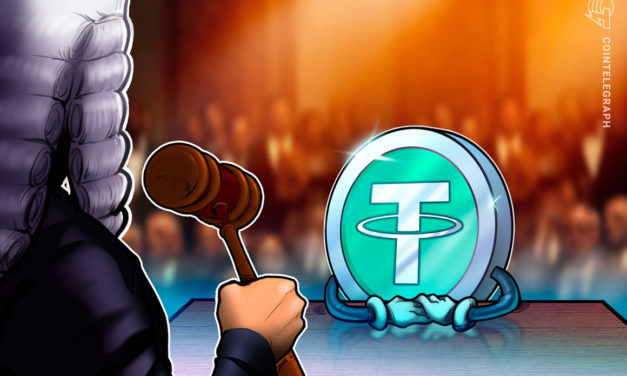
Tether says new court order to produce USDT reserve backing is a 'routine discovery matter'

On Wednesday, Tether (USDT), the issuer of the U.S. dollar-pegged USDT stablecoin, said that a recent order by a U.S. judge to provide evidence of USDT backing is part of routine discovery in court cases. The firm said that the decision did not substantiate any of the claims listed in an ongoing lawsuit: “We had already agreed to produce documents sufficient to establish the reserves backing USDT, and this dispute merely concerned the scope of documents to be produced. As always, we look forward to dispensing with plaintiffs’ baseless lawsuit in due course.”The lawsuit stemmed from October 2019 and was filed by a group of investors alleging that Tether and cryptocurrency exchange Bitfinex engaged in market manipulation by issuing USDT that were not backed by the U.S. dollar with the intention of using them to purchase volatile cryptocurrencies such as Bitcoin. Both Tether and Bitfinex have denied the allegations.Thus far, the plaintiff’s main objectives are to assess the backing of USDT with U.S. dollars and to allow a forensic accountant to evaluate the USDT reserve. This includes a review of general ledgers, balance sheets, income statements, cash-flow statements, and profit and loss statements relating to Tether’s operations.At the time of publication, Tether claims it has $68.15 billion of assets (collateral) against $67.96 billion of liabilities (stablecoins), with the vast majority of assets comprising cash and commercial paper. In the past, the firm has published results of its reserves being audited by independent accountant firms. Tether has recently increased the scope of its stablecoin issuance to the Euro, Mexican Peso, the Australian Dollar, and the Offshore Chinese Yuan.

Čítaj viac

Litecoin Foundation’s managing director shares his thoughts on decentralized money

Litecoin (LTC), known as “the silver to Bitcoin’s gold,” has been around for almost 11 years — which is quite a feat considering a fair amount of cryptocurrencies go bust within 12 months of launching. Cointelegraph spoke with the Litecoin Foundation’s managing director, Alan Austin, about why he thinks Litecoin’s core utility is serving as a reliable means of payment.As told by Austin, much of his vision for Litecoin is drawn from personal experience:“When I finished grad school, I worked with startup technology companies and real estate. And one of the things I did was managing accounts for firms like Bank of America and Fannie Mae, and it was surprising to see how old their technology was and how difficult it was to get stuff done.”After the 2008 financial crisis, Austin began losing faith in the traditional financial system. “Seeing how the big banks set different standards for everyone at their discretion when it comes to access to money, and how now they were the ones getting bailed out, it made me really appreciate what blockchain technology was trying to do,” he told Cointelegraph.Austin explained that Litecoin was created with many features and attributes similar to Bitcoin (BTC). “For starters, it’s decentralized, and there were no pre-mine tokens given to founders, making it a fair launch. It also has a limited supply, is highly liquid and has very low fees. Moreover, the blockchain has been online for 11 years without downtime.” According to Austin, the Litecoin development team primarily focuses on three efforts: onboarding business partnerships, merchants and outreach for the Litecoin Card debit card.“When you use stablecoins to pay for goods, in reality, all you’re doing is using a digital version of fiat money. Cryptocurrencies are volatile, but no middlemen are taking a hefty commission or scrutinizing your transactions.”With the launch of Litecoin’s new privacy layer, Austin said that the coin has become more user-friendly for those keen on protecting their data. “It offers fungibility,” he said. “When you go to pay with a credit card or hard cash, the merchant doesn’t know how much cash you’ve got in your pocket, nor your bank account. But, say, if you pay with Bitcoin, everyone can see that transaction and your wallet balance on the blockchain.” Austin explains that the new privacy layer on top of Litecoin solves the problem. “We are allowing users to hide their address and balance amount when making payments. And it’s really useful for protecting people’s privacy, such when receiving their payroll in crypto.”Finally, for Austin, the idea of Litecoin lies in its evolution as a new means of payment and not so much in capitalizing on the latest trends in the industry. “Our goal right now is to kind of build slow. We’ve been here for years, and we’ve seen that if you move too fast, the project can implode on itself. So, we’re sticking to our goal of developing Litecoin as a better payment.”

Čítaj viac

Maple Finance launches $300M lending pool for Bitcoin mining firms

On Tuesday, institutional crypto lending protocol Maple Finance and its delegate Icebreaker Finance announced that they would provide up to $300 million worth of secured debt financing to public and private Bitcoin mining firms. Qualified entities meeting treasury management and power strategies manastandards located throughout North America, as well as those in Australia, can apply for funding.On the other hand, the venture seeks to deliver risk-adjusted returns in the low teen percentages (up to 13% per annum) to investors and capital allocators. The pool is only open to accredited investors who meet substantial income and/or net worth qualifications within a jurisdiction. In the United Stat, among many criteria, this means having an annual pre-tax income of over $200,000 ($300,000 with a spouse) or having a liquid net worth of more than $1 million.As told by Maple Finance, underlying loans in the new lending pool would last for 12 to 18 months with interest rates of up to 20%. The loan would be secured by physical and intellectual assets owned by the borrower and could include Bitcoin mining rigs. Regarding the development, Sidney Powell, CEO and co-founder of Maple Finance, stated:”Recent market headwinds have caused lenders to pull back, while traditional financing vehicles have been slower to engage this sector. Miners play an essential role in growing the crypto ecosystem and local economies, and we are proud to extend a new financing vehicle to direct capital where it is needed the most.”Maple currently holds 50% of the institutional crypto lending market as measured by total loans outstanding. At the time of publication, liquidity pools on Maple have issued close to $1.8 billion worth of loans since its inception in May 2021.Today, @IcebreakerDeFi joins Maple and opens a $300M capacity pool to provide secured debt financing to blue-chip Bitcoin mining and digital asset infrastructure companies. pic.twitter.com/ZWyLV2P9hr— Maple (@maplefinance) September 20, 2022

Čítaj viac

Získaj BONUS 8 € v Bitcoinoch

nakup bitcoin z karty

Registrácia Binance

Burza Binance

Aktuálne kurzy