Autor Cointelegraph By Zhiyuan Sun

Central Banks of France and Switzerland announce successful trial of digital Euro, Swiss Franc

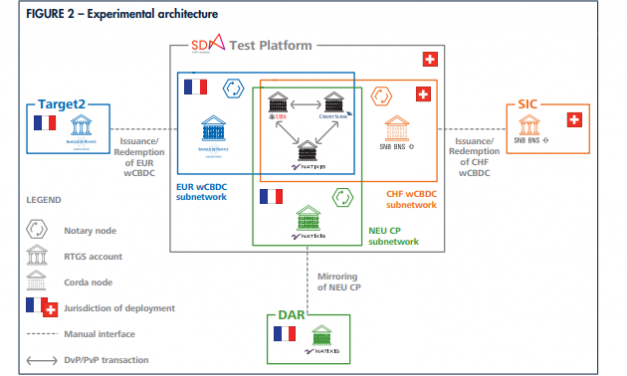
On Wednesday, the Banque de France (BdF), the BIS Innovation Hub (BISIH), and the Swiss National Bank (SNB) announced the success of a pilot run of a wholesale central bank digital currency (wCBDC), titled Project Jura. The project aimed to investigate cross‑border settlement with euro and Swiss franc wCBDCs, and launched on a third‑party distributed ledger technology platform.The experimental technology explored in Project Jura first consisted of a decentralized peer‑to‑peer network of computer nodes (Corda) to validate transactions while simultaneously ensuring that all legal, regulatory, and business rules of governing nations are satisfied. Then, there was the tokenization of the aforementioned fiat currencies and the Negotiable European Commercial Paper, a short-term maturity (one year or less) debt instrument denominated in euros. Finally, Project Jura looked into infrastructure networks enabling real‑time gross settlement of transactions, bond digitization, and a digital assets registry.Although the trial was successful, it does not guarantee the issuance of a wCBDC by Swiss, French, or European Union authorities. The report concluded that, “wCBDCs could be incorporated into novel settlement arrangements that could change the structure and functioning of capital markets, money markets and foreign exchange markets,” saying that:”Broadening the use of central bank money through wider access or increased cross‑border settlement could catalyse these changes, as could deeper integration of currencies with other digital assets and securities.”Experimental Architecture of Digital EUR/CHF | Source: BISIH

Čítaj viac

India to set maximum penalty for violating crypto norms at fine of $2.7 million or 1.5 years in jail

On Tuesday, BloombergQuint (Bloomberg India) reported that the penalty for non-compliance with the Indian government’s crypto policies could range from a maximum fine of 20 crore rupees ($2.7 million dollars) or 1.5 years in jail. Prime Minister Narendra Modi will likely give cryptocurrency investors a deadline to comply with new rules and declare their assets. While the regulatory environment in the country holds a high degree of uncertainty, reports have indicated that investors’ crypto must soon be held in exchanges operating under the oversight of the Securities and Exchange Board of India, or SEBI.This would mean that private wallets would not be legal under the proposed legislation, and investors who use them could be subjected to the aforementioned judicial penalties. In addition, Modi’s government plans to institute a minimum capital threshold for investing in cryptocurrencies.India is taking a hard-line stance against crypto due, in part, to the perceived rise in fraud, money laundering and terrorist financing in recent years. Another element, however, is that the competition from privately-owned or privately-issued cryptocurrencies would, in theory, threaten the Reserve Bank of India’s plans to launch a digital rupee. The official text from an ongoing controversial crypto bill in the country is as follows:”To create a facilitative framework for the creation of the official digital currency to be issued by the Reserve Bank of India. The Bill also seeks to prohibit all private cryptocurrencies in India; however, it allows for certain exceptions to promote the underlying technology of cryptocurrency and its uses.”

Čítaj viac

Japan's financial regulators may propose legislation in 2022 restricting stablecoin issuance

According to The Nihon Keizai Shimbun (Nikkei), one of the world’s largest financial newspapers and the entity behind the Nikkei 225 stock index, Japan’s Financial Services Agency, or FSA, will propose legislation next year restricting stablecoin issuance to only bank and wire transfer companies. Theoretically, this would prevent entities such as Tether (USDT), which does not operate as a bank and is only regulated in the British Virgin Islands, from conducting business with Japanese customers.However, the new proposed rules would only affect some stablecoin issuers. For example, USD Coin (USDC) issuer Circle plans to become a crypto bank chartered in the United States amid a regulatory crackdown. While operating as private companies alone, stablecoin issuers are typically exempt from financial reporting, auditing or regulatory oversight, leading to notable speculative claims that Tether may not have enough reserves to back USDT.In addition, the FSA also plans to toughen regulations in areas such as preventing transfers of criminal proceeds, verifying user identities and reporting suspicious transactions for both stablecoin issuers and wallet providers.Private stablecoins, however innovative, compete directly with central bank digital currencies, or CBDCs, and their adoption. In Japan, the central bank plans to roll out the digital yen, dubbed the ‘DCJPY,’ by the end of next year. It is supported by a consortium of nearly 70 companies, including the country’s largest financial institutions, which have all joined in on a trial of the DCJPY. There is currently a stablecoin digital yen in circulation, called the ‘GYEN”, and another pending launch backed by Circle.

Čítaj viac

Coinbase launches open-source cryptography library Kryptology

On Monday, Coinbase, the fourth-largest cryptocurrency exchange globally by trading volume, announced the creation of a novel cryptographic library, Kryptology, as a compendium of tools for blockchain developers. These include secure, audited and easy-to-use APIs as well as a repository of common issues and lessons learned throughout the history of crypto.Without cryptography, cryptocurrencies such as Bitcoin would be digital lines of code that anyone can copy/paste. It would be easily replicable and falsifiable, leading to significant issues such as currency double-spending. Recent advancements include Boneh–Lynn–Shacham, or BLS, signatures, which are used to verify senders’ identities and validate transactions while ensuring thei data is safely stored. Another recent adoption is the Shamir Secret Sharing, or SSS, algorithm. SSS divides a secret value among multiple participants, called shareholders, who must work then together to reconstruct the secret. The setup is ideal for storing private keys holding entrance to decentralized finance, or DeFi, pools, and smart contracts that lock a large sum of money.Then, there are zero-knowledge proofs, which ensure that encrypted messages can be passed on and validated without revealing underlying personal data, making them ideal for use in complex DeFi applications. Finally, the design of new elliptic curves, such as Pasta, could also potentially improve crypto wallets.One leading area of cryptography innovation is in privacy coins, which can enable users to evade tracking by blockchain forensic firms and prevent outside participants from viewing their transaction details. Law enforcement has shunned such technology due to its ability to promote illicit activities.

Čítaj viac

We are seeing ‘10x growth in terms of the number of nonprofits accepting crypto,’ says Alex Wilson of The Giving Block

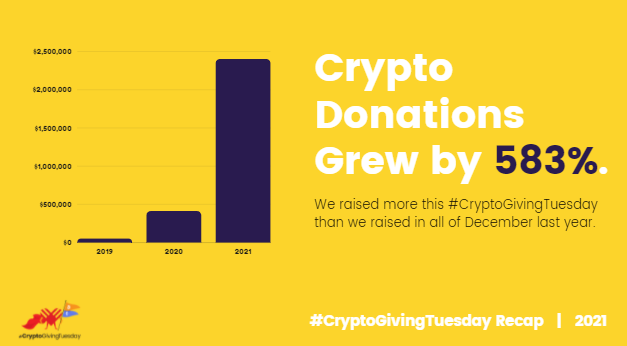
With the market capitalization of digital currencies surpassing $2 trillion, there is now record interest in crypto philanthropy. From helping to build a school in Uganda to fundraising for frontline healthcare workers and raising awareness for artists with intellectual disabilities, many nonprofit projects are gaining traction with generous assistance from crypto enthusiasts.But the rewards of giving crypto to charities aren’t limited to the feeling of having accomplished an altruistic task. The Internal Revenue Service currently classifies crypto as capital assets, like stocks. That means an investor can deduct the full market value of the cryptocurrency at the time of donation against their ordinary income (i.e., salary) over the period of a few years, while avoiding the capital gains tax altogether.For example, suppose a crypto investor, Elsa, makes $85,000 per year on employment income (single tax filing) and bought $10,000 worth of Bitcoin (BTC) four years ago. In December, she donates the full value of her investment, now worth $29,650, to the American Cancer Society.Not only does the ACS get a lump sum of cash to fund its operations, but Elsa can deduct 30% of the value of her donation per year, with the remaining amount carried forth for a maximum of five years. So her income for tax purposes for year one would only be $76,105, with Elsa saving $7,116 in federal taxes in total due to her donation.The generous tax treatment of crypto donations may be precisely why the practice is becoming so popular. In an exclusive interview with Cointelegraph, Alex Wilson, CEO of nonprofit fundraising platform The Giving Block, discussed how the setup results in a win-win situation for investors and charities alike. During Crypto Giving Tuesday, the organization raised over $2.4 million in a single day for charities.Crypto Giving Tuesday recap. Source: The Giving BlockCointelegraph: How are you making the donations secure to reach their intended charitable organizations?Alex Wilson: We were intentional in the way we set this up so that all the donations from a donor always go directly to a charity’s wallet. Now, we aren’t a pastor or anything like that, so it’s always going directly to the charity’s wallet. And on the back end, they have institutional accounts with Gemini. That way, they don’t have to worry about, you know, managing their private keys and things like that. They use a custody solution of Gemini through us.CT: Was there a major theme this year regarding donations?AW: I mean, it’s normalized to be a little bit of everything in terms of the theme. We see all sorts of different types of charities, also different sizes. We work with a lot of local charities, but also national, international brands. So, a little bit of everything really. I wouldn’t say there’s one group or one type of nonprofit that’s getting more donations than others. But I would say some of the larger charities tend to do pretty well, like some of the name brands that you might recognize, like Save the Children or American Cancer Society — you know, names like that. They tend to do a really good job fundraising. Or groups like St. Jude. They’re good at fundraising donations in general, so they tend to be better at fundraising crypto as well.CT: What is the volume of donations you saw this year, and how does it compare with previous years?AW: We’ll do over $100 million in donation volume just this year. And usually, it’s more than people expect. So, it’s significantly more than last year. Last year, we did $4 million for the entire last year. We’re doing more than that every month now. Also, in terms of the number of nonprofits, we’re working with huge growth. We had about 100 nonprofits on the platform last year, and now we just passed 1,000. So, basically 10x growth in terms of the number of nonprofits accepting crypto. It’s really hitting a tipping point now, and it’s becoming more mainstream. So, basically, nonprofits are getting more comfortable with the idea of raising crypto, especially now that they see these excellent outcomes. It’s no longer this like fringe thing. They’re seeing large companies getting into crypto, and they’re getting much more comfortable with this concept of fundraising crypto.CT: Do you have any features where an NFT could be donated directly to a charity organization or something similar to physical artwork?AW: Typically, what we recommend is just donating the proceeds of the NFT. The tricky thing about sending the NFT directly to the nonprofit is valuation and tax deductibility. So, it gets complicated with NFTs since there isn’t a lot of guidance from the IRS and other tax agencies on the tax treatment of NFTs. But it is evident when you’re just donating the proceeds because then it’s just like a regular crypto donation. So, in general, we’re saying, “Hey, if you’re an artist, a creator, please sell the NFT, then donate the proceeds directly to charity as Ether,” or whatever chain they sold it on. And that’s been popular. I mean, millions of dollars every month are being raised from this new category that we’re calling NFT philanthropy. And we even have a special day coming up next week called NFT Tuesday. So, next week, we’ll highlight all these philanthropic communities and creators and work with companies like Nifty Gateway.CT: To follow up on that question, where do you see regulation heading in this sector?AW: I think it will continue to get more apparent. Luckily, for crypto donations — surprisingly — that was remarkably clear for a long time already, as early as 2014. The IRS already put out guidance on how crypto donations are treated from a tax perspective. What the IRS decided in 2014 was that crypto would be treated as property. And when it comes to donating property, for crypto, it’s very similar to how crypto treats stock and other property donations because the donors don’t have to pay capital gains taxes on those donations. They get a fair market value deduction on their taxes when donating. And then for the charities, if they’re a registered charity, they’re tax-exempt, too. So, the charity isn’t paying taxes either. It’s a great win-win situation for both the donor and the charity.Crypto Giving Tuesday recap. Source: The Giving BlockCT: Do you plan to integrate with DeFi, such as designing a solution that could directly enable a portion of proceeds from borrowing and lending interest rates to go to charities?AW: We’re working on something similar to that; it hasn’t gone live yet. The way we’ve started working with some of the DeFi platforms and protocols is, for example, we’ve partnered with 1inch, where users on the 1inch platform can donate to all of the causes we work with. So, if you go on the 1inch page, there’s a donate-crypto button on their page. And if you click that, you’re able to donate to all the different causes we work with. We don’t have anything yet for lending, staking and yield-earning kind of stuff yet, but that’s coming in the future.CT: Would you like to include any mission statement or any additional comments?AW: I would like just a couple of things I would add briefly. December is, you know, certainly the busiest time for donations. Yesterday, we just kicked off our end-of-year campaign with Crypto Giving Tuesday. So, we started our own sort of crypto equivalent and bought a Crypto Giving Tuesday. And we use that as a kickoff point for a month-long campaign we do in December. And because there is this vast tax benefit we talked about, we see more donations happening in December than the rest of the month combined.So, there’s this hype and attention in December for people who are meeting with their accountants or tax attorneys or whoever their advisers might be on this stuff to make sure they get their donations in before year-end so it’s included in this tax year. So we, you know, will be raising a lot this year. And it’s amazing to see the crypto community come together for this. This month, we’ll be announcing how much our Crypto Giving Pledge members are donating and who they’re donating to. And you know, it’s pretty well-known people in the space, like Ryan Selkis, Meltem Demirors — a lot of really recognizable names that will be making huge charitable donations in December.From @satoshibles to @coolcatsnft to @mondoir and more, NFT artists are auctioning their art to support a variety of charities and causes this #NFTuesday!Interested in joining them? Submit an application today: https://t.co/kZOik9sOSp pic.twitter.com/BjKdsQafdG— The Giving Block (@TheGivingBlock) December 4, 2021

Čítaj viac

Získaj BONUS 8 € v Bitcoinoch

nakup bitcoin z karty

Registrácia Binance

Burza Binance

Aktuálne kurzy