
Autor Cointelegraph By Yashu Gola

This key trading pattern hints at the continuation of Fantom’s (FTM) 125% rebound

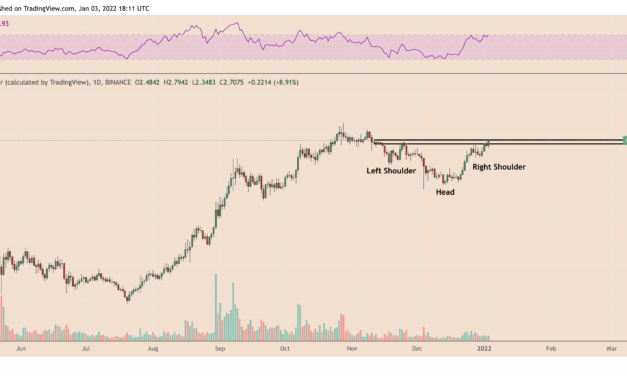
Fantom (FTM) looks poised to hit a new record high in the coming sessions after its 125% price rebound from $1.23 on Dec. 14, 2021, to $2.84 on Jan. 3, 2022 triggered a classic bullish reversal setup. Dubbed inverse head and shoulders (IH&S), the setup appears when an asset forms three troughs below a so-called neckline resistance, with the middle trough (the head) deeper than the left and right shoulder. The price of FTM has recently undergone a similar price trajectory, as shown in the chart below. As a result, FTM has a common resistance in the range defined by $2.55 to $2.74, which encompasses the length of the inverse head and shoulders pattern.FTM/USD daily price chart featuring inverse head and shoulders pattern. Source: TradingViewCould Fantom rally by another 50%?In a perfect world, an IH&S pattern would normally result in a bullish breakout once the price closes decisively above the neckline level. Ideally, the upside target be equal to the maximum distance between the head and the neckline, when measured from the breakout point.On Monday, FTM almost completed its IH&S formation by reaching its neckline. As a result, the Fantom token’s next move could be a bullish breakout above the $2.55 to $2.74 resistance range. In doing so, it would pursue a run-up toward $4.33, based on the setup presented in the chart below.FTM/USD daily price chart featuring the IH&S’s breakout setup. Source: TradingViewA sharp price pullback from the neckline range, accompanied by a spike in volume, would risk invalidating the IH&S setup. In that case, the next ideal support line may come near $2.08. This would be based on FTM’s volume profile visible range (VPVR), a metric that displays trading activity over a specified period at specified price levels.FTM/USD daily price chart featuring volume profile target. Source: TradingViewAre there risks of overvaluation?Downside risks in the Fantom market also appeared in the form of its relative strength index (RSI), a metric that measures the magnitude of the asset’s recent price changes to evaluate its overbought or oversold conditions.Relative Strength Index in a nutshell. Source: InvestopediaIn detail, FTM’s daily RSI entered an overbought territory on Jan. 3 as its reading marginally jumped above 70. The technical indicator suggests FTM is overbought and that it should undergo a certain degree of correction to neutralize its market sentiment. In layman’s terms, an RSI reading above 70 is usually seen as a signal to sell. However, the sell-offs typically do not necessarily come right after RSI jumps into the overbought zone.Related: 5 cryptocurrency projects that made waves in 2021Based on multiple RSI corrections spotted between August and September 2021, the FTM price appears to extend its upside momentum even after the indicator crosses above 70. At its best, the daily RSI had reached almost 89 on Sep. 9, coinciding with the FTM price hitting the then-record high of $1.99.FTM/USD daily price chart featuring RSI-led corrections. Source: TradingViewThat somewhat leaves FTM with the possibility of pursuing its IH&S profit target of $4.33 despite its overvaluation risks. What could follow is a correction towards its 20-day exponential moving average (20-day EMA; the green wave in the chart above) around $2.09.This would bring the price near to the VPVR support at $2.08, as discussed above.The views and opinions expressed here are solely those of the author and do not necessarily reflect the views of Cointelegraph.com. Every investment and trading move involves risk, you should conduct your own research when making a decision.

Čítaj viac
Yearn.finance risks pullback after YFI price gains 100% in less than 3 weeks

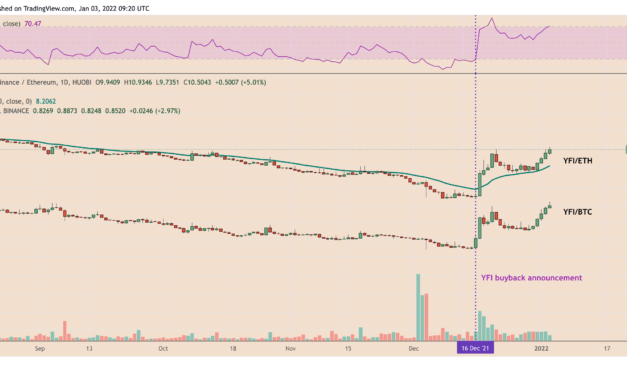
Yearn.finance (YFI) looks poised for a price correction after rising five days in a row to approach $42,000. Notably, an absence of enough buying volume coupled with overbought risks is behind the bearish outlook.The YFI price rally so farYFI’s price surged by a little over 47% in five days to $41,970 as traders rotated capital out of “top-cap” cryptocurrencies such as Bitcoin (BTC) and Ether (ETH) and looked for short-term opportunities in the altcoin market. #DeFi assets are showing some nice signs of growth to kick off 2022. $YFI, $UNI, and $AAVE are all ticking up nicely thus far with the first Monday of the year looking #bullish for several #altcoins. https://t.co/8ujolCvt5z pic.twitter.com/ASpf1dUbtn— Santiment (@santimentfeed) January 3, 2022Yearn.finance was among the beneficiary of the so-called capital migration, given its value against BTC and ETH rose almost 47% and 41.50%, respectively, in just five days. Meanwhile, at the core of traders’ sudden buying interest in the YFI markets was a token buyback program.YFI/ETH and YFI/BTC daily price performances after token buyback program announcement. Source: TradingViewOn Dec. 16, the Yearn.finance team announced that it had purchased more than $7.5 million worth of YFI tokens from the open market at an average price of $26,651 per unit. It also revealed $45 million extra cash in its treasury that it would use to continue its YFI buyback spree.Additionally, the Yearn.finance community also proposed that the YFI treasury direct a portion of the token buyback to reward YFI holders who actively participate in Yearn Governance. The proposal (full details here) is currently in its voting phase.1/8Since the cat is out of the bag here:-Yearn has started massively buying back YFI.-They are revisiting their tokenomics to do a fee distribution to holders, currently looking at veCRV model and xSushi models.-The ratios are insane. https://t.co/CzuHhbNuhx— Adam Cochran (@adamscochran) December 16, 2021

YFI’s price surged by more than 100% against the United States dollar after the token buyback announcement.YFI’s price correction risksHowever, YFI’s trading volume fell despite the rally, suggesting the low conviction among traders in its upward movement. YFI/USD daily price chart featuring price-volume divergence. Source: TradingViewTypically, a bearish divergence between price and volume leads to either correction or consolidation until conviction increases. As a result, the likelihood of YFI at least pausing its ongoing price rally is high, with its daily relative strength index also entering its overbought zone above 70, a sell signal.Related: YFI price gains 46% in just four days after Yearn.finance’s $7.5M buybackAdditionally, the Yearn.finance token’s latest price rally has brought it closer to a known inflection zone near $40,000, as shown via the Fibonacci retracement graph in the chart below.YFI/USD three-day price chart featuring Fib entry and exit levels. Source: TradingViewIn detail, the 0.618 Fib line near $40,113 has been limiting YFI’s upside intraday attempts. The same level was instrumental in stopping the token’s price rally between October and November, which later led YFI’s price to its 12-month low near $17,000.Nonetheless, if bulls manage to push YFI’s price above the 0.618 line decisively, they may also take the token out of its multi-month range defined by about $25,500 as support and $40,000 as resistance. In that scenario, YFI’s next upside target may move toward the 0.5 Fib line around $51,000.The views and opinions expressed here are solely those of the author and do not necessarily reflect the views of Cointelegraph.com. Every investment and trading move involves risk, you should conduct your own research when making a decision.

Čítaj viac
Little forkers: BCH and BSV get crushed by Bitcoin price in 2021

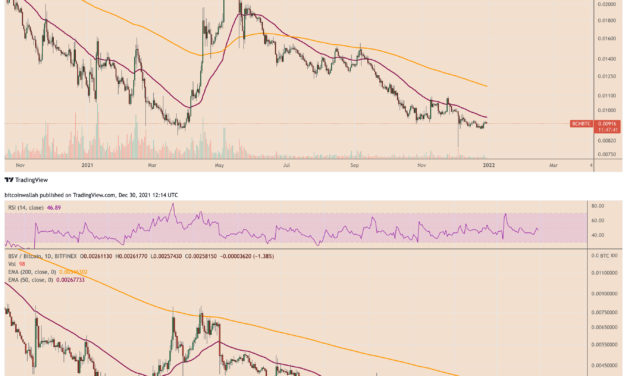
Bitcoin (BTC) looks set to beat its forked versions Bitcoin Cash (BCH) and Bitcoin SV (BSV) in terms of price-performance in 2021, market data shows.Notably, BTC’s year-to-date (YTD) returns sat near 60% at press time as its price wobbled near $47,500. In comparison, BCH rallied a little over 26% to $435.50, while the BSV price plunged over 25% to $122.30 in the same period.But the biggest takeaway remained the performance of Bitcoin Cash and Bitcoin SV against Bitcoin. In detail, the BCH/BTC rate declined over 22.50% YTD to 0.00916. Meanwhile, BSV/BTC dipped by nearly 55% YTD to 0.00258 BTC, signaling capital rotations out of Bitcoin forks.BCH/BTC and BSV/BTC daily candle price chart. Source: TradingViewMarket dominanceAdditionally, forked Bitcoin tokens — once counted among the top-ten cryptos by market capitalization — lost their positions to the emerging layer-one blockchain projects. Notably, the arrival of Solana (SOL), Cardano (ADA), Terra (LUNA), Avalanche (AVAX), and other protocols opened more avenues for crypto traders to park their money. On the other hand, Bitcoin Cash’s and Bitcoin SV’s main selling point remained claims of greater scalability, which didn’t gain traction with investors as Bitcoin’s transaction fees fell by over 50% this year. Performance of top 25 crypto assets as of Dec. 30, 1330 UTC. Source: MessariThat resulted in a decline in the market dominance of both Bitcoin Cash and Bitcoin SV. While the BCH’s share in the entire crypto market slipped to 0.37% from 0.84% at the beginning of this year, the BSV’s market portion also declined to 0.10% from 0.40% in the same period.Bitcoin, whose market dominance also slipped from 70% to under 40%, performed better than Bitcoin Cash and Bitcoin SV, nonetheless. That is primarily because of its rising adoption among retail and institutional investors as they searched for safe-havens against the central banks’ inflation-friendly loose monetary policies.Inflation keeps rising, debt keeps rising, interest rates near zero, and in some countries negative…Yeah, feels good to be a #bitcoin holder!— Lark Davis (@TheCryptoLark) December 19, 2021Abysmal development dataBitcoin also excelled over BCH and BSV based on developers’ activity.Data fetched by CryptoMiso.com showed that Bitcoin approved 2,937 changes suggested by over 100 contributors to its source code this year, the seventh-largest number of commits recorded on GitHub. In comparison, Bitcoin Cash and Bitcoin SV processed 1,099 and 496 commits in the same period.Bitcoin Cash and Bitcoin SV commits in 2021. Source: CryptoMisoA higher number of commits shows that more developers want to improve the open-source project in concern. Conversely, a lower count alerts about a slower rate of improvements on the protocol. In the end, Bitcoin SV turned out to be the worst-performer than Bitcoin Cash in terms of price-performance, as well as market dominance and developers activity. Investors also kept their distance as the Bitcoin SV network suffered three 51% attacks and its co-founder Craig Wright remained embroiled in a lawsuit, as Cointelegraph covered earlier.Now, BSV price may face more losses ahead should it break below a long-withstanding support level near $121.50, as shown in the chart below.BSV/USD weekly price chart. Source: TradingViewConversely, a pullback from the $121.50-support could have the BSV price test its 50-week exponential moving average (currently near $167) as the next upside target.Related: Top crypto winners and losers of 2021Likewise, the BCH price’s latest decline has brought it near its multi-year ascending trendline support. Therefore, a pullback from the said level could have the Bitcoin Cash token eye approximately $600 as its next upside target, as shown via Fibonacci levels below.BCH/USD weekly price chart. Source: TradingViewOtherwise, breaking below the long-term support level risks puts the BCH price en route to near $195, a level with a history of sending prices higher.The views and opinions expressed here are solely those of the author and do not necessarily reflect the views of Cointelegraph.com. Every investment and trading move involves risk, you should conduct your own research when making a decision.

Čítaj viac
What BTC price slump? Bitcoin outperforms stocks and gold for 3rd year in a row

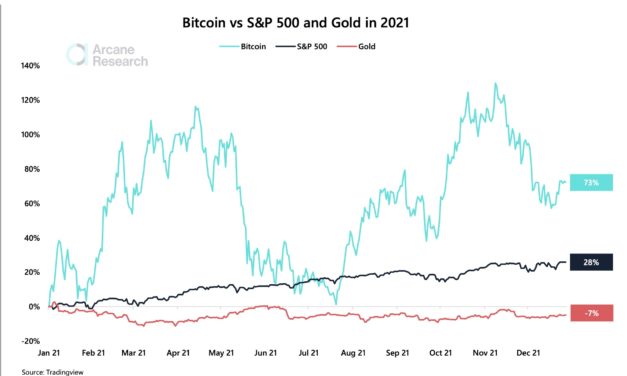
Bitcoin (BTC) may be down over 30% from its record high of $69,000, but it has emerged as one of the best-performing financial assets in 2021. BTC has bested the United States benchmark index the S&P 500 and gold.Arcane Research noted in its new report that Bitcoin’s year-to-date performance came out to be nearly 73%. In comparison, the S&P 500 index surged 28%, and gold dropped by 7% in the same period, which marks the third consecutive year that Bitcoin has outperformed the two.Bitcoin vs. S&P 500 vs. gold in 2021. Source: Arcane Research, TradingViewAt the core of Bitcoin’s extremely bullish performance was higher inflation. The U.S. consumer price index (CPI) logged its largest 12-month increase in four decades this November.“Most economists didn’t see the high inflation coming, as witnessed by the 1-year ahead consumer inflation expectations,” the Arcane report read, adding:“With its 73% gain in the highly inflationary 2021, Bitcoin has proven itself to be an excellent inflation hedge.”Inflation 2021: Actual CPI vs. Expected CPI. Source: BLS, New York FedBitcoin holdings grew among institutional investment vehiclesLoose monetary policies and a sustained fear of higher inflation also prompted mainstream financial houses to launch crypto-enabled investment vehicles for their rich clients in 2021.Arcane reported an inflow of 140,000 BTC (~$6.56 billion) across spot- and future-based Bitcoin exchange-traded funds (ETF) and physically backed exchange-traded products this year.Bitcoin exchange-traded fund holdings. Source: ByteTree, Arcane ResearchThat prompted more Bitcoin units to get absorbed into investment vehicles, underscoring a greater institutional demand for the cryptocurrency.In contrast, gold-backed ETFs witnessed an outflow of $8.8 billion in 2021, according to the World Gold Council’s report published this December.Global gold-backed ETF flows. Source: World Gold CouncilVolatility behind superior performance?Nonetheless, Bitcoin’s relatively superior performance in 2021 has included periods of high volatility. Many analysts believe that extreme price fluctuations keep Bitcoin from becoming an ideal inflation hedge. That includes Leonard Kostovetsky, a finance professor at Boston College, who recalled in his blog post that there have been 13 days in 2021 when BTC’s price has moved over 10% in one direction. He wrote:“It seems strange to think that a person who is worried about holding dollars because they lost 7% of their value over the last year would be comfortable holding Bitcoin which could (and often does) lose that much value in a single day.”Arcane, too, recognized Bitcoin for having been more volatile than the S&P 500 in 2021, noting that the cryptocurrency “behaved like a risk-on asset” by merely amplifying the most significant stock market movements.The researcher cited VIX, a measure of the expectation of volatility based on S&P 500 index options, to exemplify the relationship between Bitcoin and stock markets. It noted that BTC’s price fell hard whenever VIX readings spiked in recent times, underscoring that institutional traders viewed Bitcoin as a risk-on asset.Bitcoin vs. VIX. Source: Arcane Research, TradingViewAs a result, Bitcoin’s potential to fall harder in the wake of a stock market correction also became higher. Arcane also noted that a bearish 2022 for the S&P 500 may end up wiping a big portion of Bitcoin’s gains.“Therefore, be aware of stock market headwinds in the next year and their possible implications for bitcoin’s short-term price trajectory,” it added.Related: Arcane Research releases its crypto predictions for 2022But Aristides Capital managing member Chris Brown went far in predicting an all-and-all Bitcoin doom in 2022. He stated that cryptocurrencies could face massive selloffs ahead as the U.S. Federal Reserve ends its $120-billion-a-month asset-purchasing program followed by three rate hikes next year.BTC/USD weekly price chart vs. Federal Reserve balance sheet. Source: TradingView “If the Fed really does hike rates enough to make money considerably less loose, or if markets believe they will, you are going to see certain areas of speculation come to a screeching halt,” Brown said, adding:“The prime example of such asset speculation is cryptocurrency; here lies $2.64 trillion of ‘wealth’ that is backed by nothing and generates no cash flows.”The views and opinions expressed here are solely those of the author and do not necessarily reflect the views of Cointelegraph.com. Every investment and trading move involves risk, you should conduct your own research when making a decision.

Čítaj viac

Ethereum whales dumping ETH as price slides below $4K, data shows

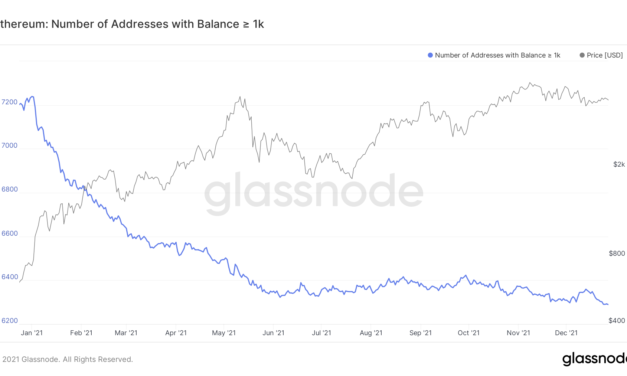
Ethereum is having difficulty keeping its richest investors in line as its native token, Ether (ETH), hints at logging more losses in the near term.Blockchain data analytics service Glassnode revealed that the number of Ethereum addresses holding at least 1,000 ETH dropped to 6,292 this Monday, the lowest reading since April 2017. At its year-to-date peak, the numbers were 7,239 in January.Number of Ethereum addresses with balance of at least 1,000 ETH. Source: GlassnodeOn-chain analysts typically observe ETH distributions among addresses to realize retail and institutional sentiments. They consider wallets that hold above 1,000 ETH (around $3.92 million at currency exchange rates) as “whales,” primarily for their ability to influence interim market trends via large sell and/or buy orders.But as the numbers of these so-called whales drop, it reflects an ongoing selling trend among the richest Ethereum wallet owners. For instance, the number of Ethereum addresses that hold at least 10,000 ETH (or around $39.20 million) has also plunged, from 1,208 in June to 1,156 at the time of this writing, marking an almost 4.5% decline.Number of Ethereum addresses with a balance of at least 10,000 ETH. Source: GlassnodeBut, on a year-to-date timeframe, the numbers have gone up from 1,065 to 1,156, just as the cost to purchase 1 ETH, in the same period, has jumped nearly 450%. Small investors are accumulatingUnlike whales, wallets that hold ETH in small quantities have been at the forefront of Ether’s 2021 price rally.For example, Glassnode’s data shows that the number of Ethereum addresses with a non-zero ETH balance reached an all-time high of over 71.23 million on Monday. That included wallets with at least 0.01 ETH (~$40), whose numbers shot up to 20.31 million versus 10.66 million at the beginning of this year.Meanwhile, addresses that hold at least 0.1 ETH (~$400) jumped to 6.44 million this Monday compared to 3.62 million on Jan. 1, 2021. That is almost a twofold rise, signaling a higher retail interest in the world’s second-largest cryptocurrency.Number of Ethereum addresses with a balance of at least 0.1 ETH. Source: GlassnodeETH eyes bullish reversalThe latest decline in Ether whales appeared as Ether struggled to close decisively above $4,000, its psychological resistance level. On Tuesday, ETH/USD dropped by over 3.27% to an intraday low of $3,880. Its drop came as a part of a wider correction that started after Ether tested a downward sloping trendline as resistance on Dec. 23. The chart below shows that the trendline is a part of a descending channel that appears like a “falling wedge.”ETH/USD daily price chart featuring falling wedge. Source: TradingViewIn detail, falling wedges are technically bullish reversal patterns that appear after the price trends lower inside a trading range featuring two converging trendlines. The instrument eventually breaks above the structure’s upper trendline ahead or after reaching the apex (where two trendlines converge).The profit target in a rising wedge scenario is generally obtained after adding the maximum distance between the structure’s upper and lower trendline to the breakout point. That puts ETH’s price en route to the $4,200–5,000 range, depending on its breakout level.ETH/USD daily price chart featuring falling wedge targets. Source: TradingViewNevertheless, Ether’s price still has enough room to decline, toward $3,200 in the worst-case scenario. The level is where wedge’s trendlines converge.Related: 3 reasons why Ethereum price can drop below $3K by the end of 2021Meanwhile, independent market analyst Pentoshi said that nothing concrete can be predicted for Ether now as it remains stuck between a “bear contested” and a “bull contested” area, as shown in the chart below.ETH/USD three-day price chart. Source: TradingView, Pentoshi“Maybe it’s the bottom. Don’t care,” tweeted Pentoshi on Tuesday. “I don’t like when them market gives this many times to buy an area with important historical context like this Would rather pay for confirmation.”The views and opinions expressed here are solely those of the author and do not necessarily reflect the views of Cointelegraph.com. Every investment and trading move involves risk, you should conduct your own research when making a decision.

Čítaj viac

Získaj BONUS 8 € v Bitcoinoch

nakup bitcoin z karty

Registrácia Binance

Burza Binance

Aktuálne kurzy