
Autor Cointelegraph By Yashu Gola

3 reasons why the FTX fiasco is bullish for Bitcoin

The “Bitcoin-is-dead” gang is back and at it again. The fall of the FTX cryptocurrency exchange has resurrected these infamous critics that are once again blaming a robbery on the money that was stolen, and not the robber. “We need regulation! Why did the government allow this to happen?” they scream.  For instance, Chetan Bhagat, a renowned author from India, wrote a detailed “crypto” obituary, comparing the cryptocurrency sector to communism that promised decentralization but ended up with authoritarianism. Perhaps unsurprisingly, his column conveniently used a melting Bitcoin (BTC) logo as its featured image.Hi all,“Crypto is now dead: FTX, a cryptocurrency exchange, collapsed last week, proving a lot of cool guys horribly wrong,” my column in TOI today.Do read and share! pic.twitter.com/A4ClVdHOt2— Chetan Bhagat (@chetan_bhagat) November 15, 2022Bhagat should have picked a more accurate image for his op-ed (melting FTX (FTT) Token?), particularly after looking at Bitcoin’s decade-plus history that has seen it surviving even nationwide bans. This includes 465 466 obituaries since its debut in 2009 when it traded for a few cents.Bitcoin performance since debut. Source: TradingViewThe FTX/Alameda’s collapse is similar to previous bearish trigger events like Mt. Gox in 2014. Therefore, this failure of centralization will once again underline what makes Bitcoin special, and why FTX is the opposite of Bitcoin and decentralization. Moreover, the incident should also boost growth and development of in, non-custodial exchanges for Bitcoin that will help reduce dependency on trust. FTX may have had zero Bitcoin in custodyTraders responded to FTX’s shocking collapse by pulling their BTC from custodial exchanges. Notably, the total amount of Bitcoin held by all exchanges dropped to 2.07 million BTC on Nov. 17 from 2.29 million BTC at the beginning of the month.United States-based exchanges saw the biggest outflows, in particular, with users withdrawing over $1.5 billion in BTC in the past week alone. Bitcoin reserves across all exchanges. Source: CryptoQuantOn Nov. 9, FTX halted withdrawals of all cryptocurrencies, including Bitcoin, raising suspicions that the exchange did not have adequate reserves to meet the demand. That was further evident in a leaked FTX balance sheet that showed the exchange having zero Bitcoin against its $1.4 billion liabilities in BTC. In other words, FTX enabled fractional-reserve Bitcoin trading. “This is, on the one hand, bad for you as you will only find out if they have been swimming naked once the exchange implodes, accompanied by you losing all your funds,” Jan Wüstenfeld, writes independent market analyst. He adds:”On the other hand, this artificially increases the bitcoin supply in the short-run, suppressing the price and preventing actual price discovery […] Yes, I know these are not real bitcoin, but as long as the exchanges issuing fake paper, Bitcoin remains operational, the effect is there.”Thus, FTX’s little-to-negligible exposure to Bitcoin potentially reduces Its likelihood of selling any remaining funds to raise liquidity. The incident is also likely to produce a new cohort of Bitcoin hodlers by forcing people to not keep their funds on risky exchanges and practice self-custody. While a decreasing amount of BTC on exchanges means fewer coins available to sell. Sam Bankman-Fried was anti-BitcoinFTX founder Sam Bankman-Fried (SBF) was the Democrats’ second biggest donor after George Soros for the midterm elections, giving nearly $45 million to lobby for crypto regulations that would allegedly benefit his firm.Related: US crypto exchanges lead Bitcoin exodus: Over $1.5B in BTC withdrawn in one weekBut speculations are large that SBF attempted to tarnish Bitcoin’s growth through the U.S. lawmakers,  as well as news articles, where he downplayed Bitcoin as an efficient payment system.MSM lionized this shady character. For example, here are 2 of the 219 articles about him on @FT. @SBF_FTX’s anti-Bitcoin, pro-centralisation and pro-heavy-handed regulation values certainly aligned with theirs. Was he the poster boy for an orchestrated propaganda campaign? https://t.co/urJcu6mqB6 pic.twitter.com/PTIn1JudXG— Bitcoms (@bitcoms) November 15, 2022

Other commentators have also pointed out a connection between SBF and anti-crypto U.S. Senator Elizabeth Warren, noting the former’s father, Joseph Bankman, helped the politician draft tax legislation in 2016. This is crazy:Elizabeth Warren is known for being the anti-crypto SenatorWho helped her draft her tax legislation in 2016?None other than Joseph (Joe) Bankman, the father of SBFhttps://t.co/QMYkC2gpE9— Ryan Shea (@ryaneshea) November 15, 2022

SBF’s influence among U.S. lawmakers is now gone with him facing potential criminal charges for illegally using customer funds for FTX trades. Press “F” to flush Past cryptocurrency market downturns have roots in the failure of centralized players as well as “altcoins” that ultimately ended up being a money-grab. FTX’s token FTT is just the latest example. Other failed projects that triggered a market downturn just this year include the Defi lending platform Celsius Network (CEL) and Terra (LUNA). FTX is the opposite of #Bitcoin #Bitcoin ’s protocol was created precisely to prevent Ponzi schemes, bank runs, Enron’s, WorldCom’s, Bernie Madoff’s, Sam Bankman-Fried’s……bailouts and wealth reassignments.Some understand it, some not yet. We’re still early./21m— Nayib Bukele (@nayibbukele) November 14, 2022

Created and operated by centralized entities, the supply of these tokens, and therefore price, becomes vulnerable to manipulation: undisclosed pre-mine allocations, insider VC deals, small float vs. total supply, you name it. It is exposure to such (crap) tokens, particularly in the form of collateral, that ultimately drove crypto hedge funds Three Arrow Capital, FTX’s sister firm Alameda Research, and many others to the ground.”In our view, the bubble in crypto that popped this year was in the atmosphere of tokens being created just for speculative purposes,” noted BOOX Research, adding: “While we can debate which cryptos are ‘bad money driving out the good’, FTT and LUNA are just two examples everyone can agree should not have existed.”Therefore, a market flush of altcoins that should not have ever existed, FTT included, may further strengthen investors’ trust in Bitcoin. Early data is showing the same, with CoinShares reporting an inflow uptick into Bitcoin-based investment funds. Notably, Bitcoin-based investment vehicles attracted $18.8 million to their coffers in the week ending Nov. 11, bringing its year-to-date inflows to $316.50 million.Flow by asset. Source: Bloomberg/CoinShares”The inflows began later in the week on the back of extreme price weakness prompted by the FTX/Alameda collapse,” noted James Butterfill, head of research at CoinShares, adding:”It suggests that investors see this price weakness as an opportunity, differentiating between ‘trusted’ third parties and an inherently trustless system.”Meanwhile, Bitcoin is not witnessing a collapse in demand in the current bear market compared to 2018, on-chain data reveals.The number of non-zero Bitcoin addresses has continued to climb despite the price downtrend, hitting a record high of 43.14 million as of Nov. 16.Bitcoin addresses count with a non-zero BTC balance. Source: GlassnodeIn comparison, the 2018 bear market saw a substantial drop in the number of non-zero Bitcoin addresses, suggesting traders have become relatively more confident about a price recovery, especially as the FTX domino effect clears out the dead wood.The views and opinions expressed here are solely those of the author and do not necessarily reflect the views of Cointelegraph.com. Every investment and trading move involves risk, you should conduct your own research when making a decision.

Čítaj viac
Solana entities sold 50M tokens to FTX — How long will SOL price suffer?

Solana (SOL) has lost 60% of its market value in a week due to its exposure to the now-defunct crypto exchange FTX, which could continue to haunt the “Ethereum killer” well into the future.FTX/Alameda exposure hurting Solana priceFTX and its sister-firm Alameda Research is liable to have control over 50 million SOL, according to Solana’s statement released on Nov. 10. The FTX entities received 4 million SOL from the Solana Foundation on Aug. 31, 2020. They also started receiving a portion of 12 million SOL from Sep. 11, 2020, and nearly 34.52 million SOL from Jan. 7, 2021, through a “linear monthly unlock” mechanism. Summary of Solana Labs’ SOL sales to FTX and Alameda Research. Source: Solana LabsFurthermore, the FTX entities started receiving portions of a 7.5 million SOL reserve from Solana Labs on Feb. 17, 2021. Notably, a transaction worth 62,000 SOL between the same entities stands unsettled.Most SOL tokens promised to FTX/Alameda are vested, meaning the firm does not yet have them in custody but is liable to receive them through the linear monthly unlock mechanism. The last of these unlocks will occur by January 2028.That leaves the market with interpretations about what might happen to the SOL tokens once they are unlocked, given FTX’s bankruptcy filing that’s likely to put a freeze on all remaining funds. my guess is the bky trustee will try to sell it all OTC to get funds to pay back creditors— DeFiNanner v2 (@ZekesMommasKid) November 14, 2022Also, the firm reportedly has $9 billion in liabilities versus a $1 billion balance sheet, which could prompt its trustees to liquidate its SOL holdings to repay debtors. To avoid such a scenario, Solana could make technical changes to its token economy, reducing FTX’s impact. One recent governance proposal submitted on Nov. 13 presented a few options that could be on the table, including:The errant allocation is burned. Increase the lock to 10 years on the errant allocation.Airdrop all SOL token holders’ additional SOL, except for the party holding the errant allocation.A combination of the above.SOL price relief bounce?From a technical perspective, Solana shows signs of bullish divergence between its price and relative strength index (RSI).A bullish divergence materializes when an asset’s price forms lower lows but its momentum indicator form a higher low. Traditional analysts see it as a buy signal, which may result in a short-term SOL price recovery on its daily chart.SOL/USD daily price chart featuring bullish divergence. Source: TradingViewSOL/USD could rise toward $18, its range resistance level, in the event of a short-term recovery. In other words, a 20% rebound.Related: Liquidity hub Serum forked by developers after FTX hackBut on longer-timeframe charts, SOL could see further decline toward $2.50, or an 80%-plus drop, in 2023, based on a giant head-and-shoulders setup shown below. SOL/USD weekly price chart featuring head-and-shoulder breakdown setup. Source: TradingViewInterestingly, the token’s downside target falls in its most voluminous range, per its Volume Profile Visible Range, or VPVR, indicator.The views and opinions expressed here are solely those of the author and do not necessarily reflect the views of Cointelegraph.com. Every investment and trading move involves risk, you should conduct your own research when making a decision.

Čítaj viac
FTX collapse is Trust Wallet Token's gain — Why did TWT price soar 150% in six days?

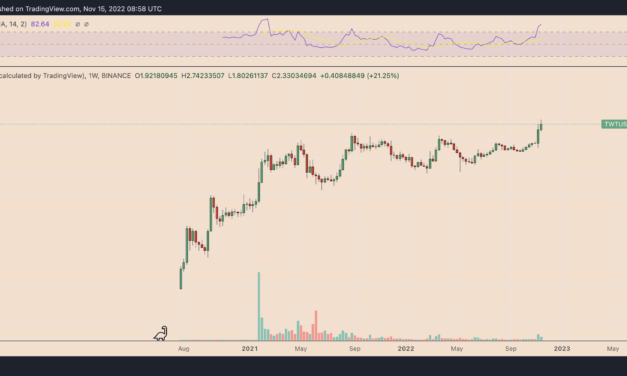
Trust Wallet Token (TWT) has surged by nearly 150% in the last six days, bucking the downturn in the cryptocurrency market, whose net capitalization has crashed by almost $100 billion in the same period.TWT whale accumulation picks up momentumTWT’s price reached an intraday high of $2.43 on Nov. 15, a day after establishing a record high at nearly $2.75. At its lowest in 2022, the token was changing hands for $0.40, which makes it one of the year’s best-performing assets, with over 225% year-to-date gains.TWT/USD weekly price chart. Source: TradingViewThe Trust Wallet Token’s uptrend picked up momentum in November following the collapse of Sam Bankman-Fried’s FTX, prompting a bank run situation wherein traders withdrew their funds from exchanges en masse.For instance, the total number of Bitcoin (BTC) in FTX’s wallets dropped to zero in the week ending Nov. 13. Similarly, the exchange’s Ether (ETH) reserves fell from 611,000 to just 2,800 in the same period.Ethereum balance on FTX. Source: GlassnodeDistrust in centralized exchanges seems to have boosted the appetite for self-custody wallets. Binance CEO Changpeng Zhao’s endorsement of the token’s parent platform, Trust Wallet, has also played a major part in driving up the TWT price. .@TrustWallet your keys, your coins. https://t.co/pJUc26kQ7n— CZ Binance (@cz_binance) November 13, 2022Furthermore, the Trust Wallet Token supply rate held by addresses with a balance between 1,000 TWT and 10 million TWT tokens surged during the six-day price uptrend, suggesting whale accumulation. Trust Wallet Token supply distribution among wallets holding 1K-10M TWT. Source: SantimentMeanwhile, the token’s trading volume has soared from 279 million TWT to 593.25 TWT in the same period, showcasing market’s conviction in its uptrend.Trust Wallet Token daily trading volume (in TWT). Source: SantimentTWT serves as a utility token for Trust Wallet, wherein traders can buy, sell, and collect NFTs, as well as exchange and stake cryptocurrencies. As a result, TWT typically operates as a centralized exchange token while Trust Wallet enables users to control their own funds.Thus, it’s likely that Trust Wallet emerged as an off-ramp for traders pulling their funds from cryptocurrency exchanges in the wake of the FTX fiasco, with TWT price rallying in response.’Not your keys, not your #crypto’ has been resonating around the Twitter space over these past few days.While many people utilise centralised exchanges, a lot of users are yet to harness the power of self custody.Start taking control, today https://t.co/h3pVVNzgpL— Trust – Crypto Wallet (@TrustWallet) November 11, 2022

Trust Wallet Token’s “overbought” risksFrom a technical perspective, TWT risks a massive price correction in the days leading up to the year’s end.At least two indicators are hinting at this bearish outlook. First, TWT’s weekly relative strength index (RSI) has become the most “overbought” since February 2021, suggesting a period of price consolidation or correction ahead.TWT/USD weekly price chart. Source: TradingViewSecond, TWT shows signs of upside exhaustion after hitting an ascending trendline resistance that capped the token’s upside attempts in 2021. Historically, a pullback from the said resistance line has pushed TWT toward one multi-month ascending trendline support multiple times. In 2022, this rising level coincides with another horizontal support line at $0.878, down 60% from today’s price levels.Related: Binance CEO urges crypto buyers to ‘hold’ amid ‘unpredictableness’On a brighter note, TWT has flipped a multi-month horizontal trendline resistance near $1.535 as support during its ongoing price rally, which may help limit its bearish prospects. That said, a decisive rebound from $1.535 could have TWT price go for a new record high in late 2022 or early 2023.The views and opinions expressed here are solely those of the author and do not necessarily reflect the views of Cointelegraph.com. Every investment and trading move involves risk, you should conduct your own research when making a decision.

Čítaj viac
Crypto.com’s CRO is in trouble, but a 50% price rebound is in play

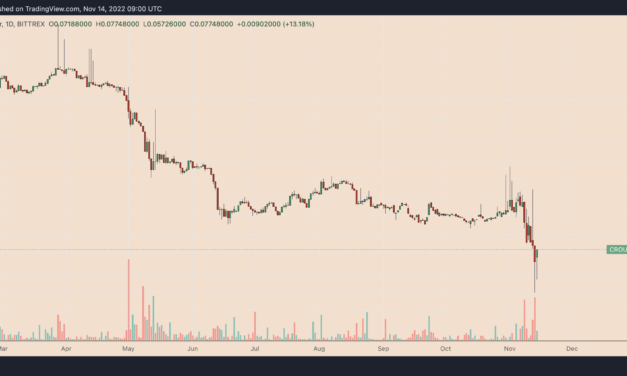
Crypto.com’s native token Cronos (CRO) is showing restraint on Nov. 14 against mounting sell-pressure building in the wake of the FTX’s dramatic collapse last week. Now, the CRO/USD pair is eyeing a watershed price recovery.On Nov. 14, CRO’s price wobbled between profits and losses, trading around $0.069 a day after crashing to $0.05, its lowest level since April 2020 — that’s a 60% price decline from November’s peak of around $0.178.CRO/USD weekly price chart. Source: TradingViewCRO funding rate drops to -3%The period of CRO’s price decline occurred alongside a sharp drop in the token’s perpetual futures funding rates.Funding rates are recurring payments made by traders based on the difference between the prices in the futures and the spot market. A positive funding rate means bullish traders (long positions) pay bearish traders (short positions), representing their confidence about a price rally.Conversely, a negative funding rate means short traders pay long traders to keep their positions open. On Nov. 14, CRO’s funding rates on Huobi and OKX dropped to minus 3%, showing traders are extremely bearish on the token.CRO funding rates history. Source: Coinglass.com“This is literally the exact same dynamic that occurred before Celsius and FTX collapsed,” warned Dylan LeClair, senior analyst at digital asset fund UTXO Management on Nov. 13, when CRO funding rates were near minus 2%.FTX contagion fears spread to Crypto.com The CRO sell-off started from fears of contagion amid the FTX fiasco, particularly concerns that Crypto.com, a Singapore-based crypto exchange, would collapse in the same manner as FTX.At the core of these worries is potential insolvency, with analysts pointing out that Crypto.com is holding low-liquid cryptocurrencies like Shiba Inu (SHIB) and its own token CRO as reserves, which reportedly make up 40% of the exchange’s total assets. 4.https://t.co/INIxikfNzy holds $1.6B worth of BTC/ETH/USDT/USDC/DAI/BUSD assets, accounting for 60%.40% of assets are low liquidity assets.— Lookonchain (@lookonchain) November 13, 2022In addition, Crypto.com also moved $210 million worth of stablecoins from Binance and Circle before demonstrating its reserves to the public. Binance CEO Changpeng Zhao confirmed the move, urging caution, the day before CRO dropped to its April 2020 low.If an exchange have to move large amounts of crypto before or after they demonstrate their wallet addresses, it is a clear sign of problems. Stay away. Stay #SAFU. — CZ Binance (@cz_binance) November 13, 2022

What’s more, Crypto.com also misconducted a $400 million Ether (ETH) transaction, sending it to a Gate.io exchange wallet instead of its cold storage. Later, the exchange did manage to recover the funds, but that also raised a lot of questions. Crypto_com CEO is claiming they “accidentally” sent $400 million of their eth to the wrong wallet.He’s either lying, or incompetent. https://t.co/hWXvPqBime— Coffeezilla (@coffeebreak_YT) November 13, 2022

Overall, Crypto.com saw its users withdraw $14 million in ETH and $39 million in other tokens over the weekend, according to data tracked by Argus Inc.50% Cronos price relief rally ahead?Strictly from a technical perspective, however, CRO’s price could nevertheless see a potential relief rally in the coming weeks.A set of indicators support the said bullish outlook, including CRO’s weekly relative strength index (RSI), which dropped to nearly 30, or nearly “oversold” territory. A similar drop in June earlier this year had preceded a 75% recovery rally from $0.099 to $0.162, as shown below.CRO/USD weekly price chart. Source: TradingViewThe other bullish indicator includes strong historical support of $0.061. In addition, CRO’s current price range of $0.061 and $0.111 has the token’s highest volume profile visible range (VPVR) on record. In other words, CRO price could recover to $0.111, up over 50% from the current price levels, as its next upside target. Related: Exchange outflows hit historic highs as Bitcoin investors self-custodyConversely, CRO/USD falling alongside funding rates suggests that its drop may have been driven by futures markets, which was also the case with Terra’s collapse in May. Thus, the persistent bearish sentiment across the entire cryptocurrency market could dampen CRO’s recovery prospects.The views and opinions expressed here are solely those of the author and do not necessarily reflect the views of Cointelegraph.com. Every investment and trading move involves risk, you should conduct your own research when making a decision.

Čítaj viac

Ethereum turns deflationary for the first time since the Merge — ETH price still risks 50% drop

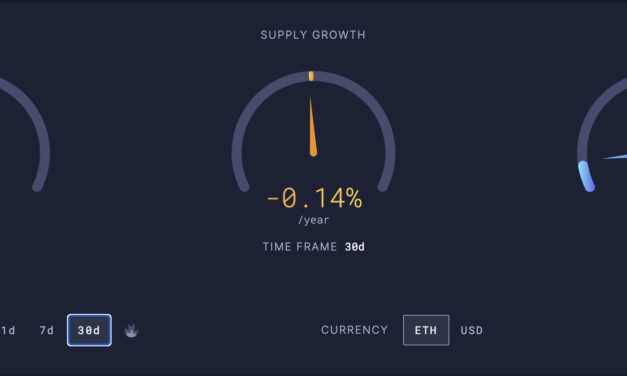
The annual supply rate of Ether (ETH) slipped below zero for the first time since Ethereum’s transition to proof-of-stake via the Merge in September. The reason? A spike in on-chain activity amid a massive cryptocurrency market crash. Ether turns deflationary for realAs of Nov. 9, more Ether tokens are being burned than created as a part of Ethereum’s fee-burning mechanism. Simply put, the more on-chain transactions, the more ETH transaction fees get burned. On a 30-day timeframe, the Ethereum network has been burning ETH at an annual rate of 773,000 tokens against the issuance of 603,000 tokens. In other words, ETH’s supply is going down by 0.14% per year.Ether supply growth as of Nov. 11. Source: Ultrasound.MoneyOverall, the Ethereum network has burned 2.72 million ETH since the fee-burning mechanism was introduced in August 2021. That amounts to the permanent destruction of nearly 4 ETH per minute.Ethereum’s transaction fees spiked to their highest levels since May 2022 due to traders rushing to transfer their ETH to and from exchanges amid the dramatic collapse of FTX. Ethereum transaction fees performance in the last six months. Source: YChartsIn detail, nearly 1 million ETH has left exchanges in November, according to data from Glassnode.Ether balance on all exchanges. Source: Glassnode Many analysts see Ether’s deflationary prospects as a bullish signal, which should boost its overall scarcity. But the ongoing deflationary rate is a product of current ETH price volatility, which may hurt its recovery prospects in the near term.Ether’s price in danger of another 50% crashEther’s price dropped nearly 20% month-to-date and was trading around $1,250 on Nov. 11 after it had rebounded from its $1,075 local low.Furthermore, Ether’s price action has also entered the breakdown stage of its prevailing symmetrical triangle pattern, which may push the price down further by another 50% from current levels.Related: Bitcoin price hits multi-year low at $15.6K, analysts expect further downsideSymmetrical triangles are continuation patterns, meaning they typically resolve after the price breaks out of their range while pursuing the direction of its previous trend. As a rule of technical analysis, the pattern’s profit target is measured after adding the triangle’s height to the breakout point.ETH/USD 3-day price chart featuring symmetrical triangle’s breakdown setup. Source: TradingViewApplying the theory to Ether’s symmetrical triangle places its downside target at around $675 by December 2022, down about 50% from current prices.$ETHIt got rejected from 1600-1650. Now it’s looking bullish on ltf, so expecting a last leg up to 1700, matching with BTC going to 21000-21500. 1700 is a key resistance. It should get rejected hard.Main target for a local bottom = $700-800 pic.twitter.com/UkAphVl2MV— il Capo Of Crypto (@CryptoCapo_) November 2, 2022More bearish arguments stem from a recent decline in the supply held by Ethereum’s richest investors. Notably, the duration of Ether’s November downtrend has coincided with the drop in Ether supply held by addresses with a balance between 1 million ETH and 10 million ETH.Ether supply percentage held by addresses with 10K–10M ETH balance. Source: SantimentConversely, addresses with a balance between 1,000 ETH and 10,000 ETH have risen during the price decline. This could mean two things. First, addresses with over 10,000 ETH tokens reduced their holdings and thus landed in the smaller cohorts.These cohorts may include exchange wallets that have witnessed massive ETH outflow amid the FTX fiasco.Ether supply percentage held by addresses with 10–10K ETH balance. Source: SantimentSecond, the 10–10,000 ETH cohort saw Ether’s price decline as a “buy the dip” opportunity, which boosted its control over Ether’s supply in November.The views and opinions expressed here are solely those of the author and do not necessarily reflect the views of Cointelegraph.com. Every investment and trading move involves risk, you should conduct your own research when making a decision.

Čítaj viac

Získaj BONUS 8 € v Bitcoinoch

nakup bitcoin z karty

Registrácia Binance

Burza Binance

Aktuálne kurzy