Autor Cointelegraph By Yashu Gola

Ethereum whale who shorted October 2025 crash opens $19.7M ETH short position

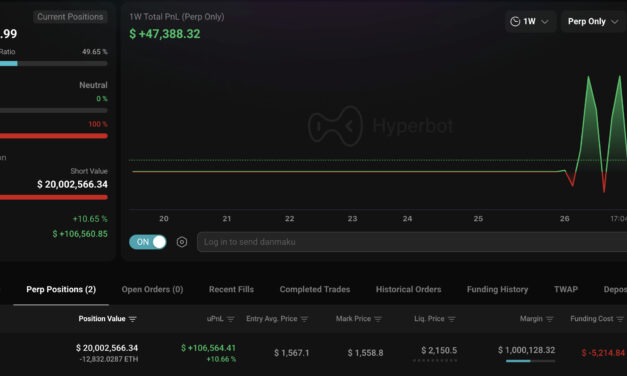
An Ethereum whale who shorted Ether (ETH) during the October 2025 crypto crash has returned after eight months of silence.Key takeaways:Ethereum whale opens a $19.72 million 20x ETH short near the $1,500 support zone.ETH’s bear flag setup hints at a decline toward $1,375, which may earn the whale roughly $2.39 million in profits.Ethereum whale opens 20x short after eight-month hiatusOn Friday, wallet ‘0xf83f…6728’ opened a 20x-leveraged ETH short worth $19.72 million as Ether reached the $1,500 support zone after dropping 18.25% over the last two weeks.The position was opened at an average price of around $1,565, according to data resource Hyperbot. As of this press time, the whale had earned nearly $106,500 in unrealized profits as the ETH price dropped around the $1,550 area.Ethereum whale’s $19.72M position status as of Friday. Source: HyperbotThe downside sentiment in the Ethereum market has tracked a broader tech-led risk selloff, with traders cutting exposure to speculative assets as Nasdaq and chip stocks came under pressure. Ethereum-specific sentiment has weakened further amid renewed scrutiny of the Ethereum Foundation, following reports of budget cuts, staff reductions and a wave of senior departures that have raised questions about the organization’s leadership stability.Ether is eyeing a decline toward the $1,375 level if it continues the breakdown out of its prevailing bear flag pattern.ETH/USD daily price chart tracking the bear flag breakdown setup. Source: TradingViewIf ETH falls to $1,375, the whale’s unrealized profit would rise to roughly $2.39 million before fees and funding, based on the position’s approximate $1,565 entry price.Same whale shorted ETH near October 2025 crash topThe wallet’s latest move stands out because of its trading history.Transaction logs show that wallet ‘0xf83f…6728’ last became active on Oct. 27, 2025, when it opened an ETH short near $4,172 as volatility from the October crypto crash was easing. Related: Are Ethereum OGs jumping ship? Here’s what the data saysThe trader later closed the position near $4,133, booking $41,693 in net profit after $5,263 in exchange fees.Ethereum whale’s filled ETH orders from October 2025. Source: HyperbotThe whale’s current strategy appears similar: short ETH into weakness, use high leverage, and lean into downside momentum. The scale has changed sharply, however, since the current position carries nearly $20 million in notional exposure, making it far larger than the whale’s October 2025 trade.ETH double bottom could threaten the whale’s shortThe whale’s bearish bet is not without risk.As of Friday, Ether’s daily chart showed a potential double bottom near the $1,500–$1,512 support area, where buyers stepped in twice in June. The setup remains unconfirmed, but a strong rebound from this zone could shift short-term momentum back toward the bulls.ETH/USD daily price chart tracking a potential double-bottom breakout setup. Source: TradingViewThe key level to watch is the neckline near $1,850. A decisive daily close above that level would confirm the double bottom pattern and open the door to a measured rebound toward roughly $2,190, based on the distance between the neckline and the $1,512 bottom.That would put ETH close to the whale’s liquidation zone near $2,150, meaning a confirmed bullish reversal could pressure or even wipe out the short position if the trader does not add collateral or reduce exposure.

Čítaj viac

These Bitcoin charts show how BTC price could hit $100K before October

Bitcoin (BTC) chart technicals suggest that the BTC price rebound to $100,000 may still happen by September. BTC/USD daily chart. Source: TradingViewKey takeaways: Bitcoin is painting a potential double-bottom and bullish divergence pattern.BTC price must break above a resistance confluence near $66,700Double-bottom hints at 60% BTC price upsideBTC rebounded 13.25% from its local low below $60,000, as a preliminary truce between the US and Iran revived risk appetite across global markets.The recovery pushed BTC back toward $67,000 on June 15, tracking a broader relief rally in risk assets after the geopolitical breakthrough pressured oil prices lower and reduced near-term inflation fears. Now, the three-day Bitcoin chart is flashing a potential double-bottom reversal near the $60,000 support zone.BTC has rebounded from the $60,000 area for the second time in 2026, strengthening the case that buyers are defending the same demand region that previously supported the market during earlier corrections. BTC/USDT three-day price chart. Source: TradingViewThe first bottom formed near the March low, while the latest rebound came after a sharp June sell-off that briefly pushed Bitcoin back toward the same level. As long as BTC holds above the $60,000 support, the double-bottom structure remains active.The setup’s neckline sits near $81,000, where Bitcoin previously stalled before the latest leg down. A decisive close above that level would confirm the double-bottom pattern and open the door to a measured move toward $108,000 by August or September, or over 60% from current price levels.Bitcoin weekly RSI divergence strengthens $100,000 setupBitcoin’s weekly chart is showing a bullish divergence between price and the relative strength index (RSI) momentum indicator.BTC recently made a lower low near the $60,000–$65,000 support zone, but its weekly RSI formed a higher low. That shows sellers pushed the price lower, albeit with less momentum.BTC/USD weekly chart. Source: TradingViewA similar divergence appeared near Bitcoin’s 2022 bear-market bottom, when RSI recovered before price followed with a multi-month rebound. In a Monday post, analyst Jelle said Bitcoin may act “similarly to late 2022 in the coming months.”The current setup now strengthens Bitcoin’s double-bottom case near $60,000. BTC still needs confirmation, with the first big resistance levels near the 20-week EMA at $74,500 and the 50-week EMA around $82,500.Reclaiming those levels would increase the probability of a summer recovery toward $100,000. While a weekly close below $60,000 would weaken the bullish setup.Bitcoin bear flag remains a risk Bitcoin’s short-term chart still leaves room for another downside move before the broader bullish reversal setup confirms.BTC is testing a resistance confluence formed by the bear flag’s upper trend line and the 20-day EMA (green) near $66,700. Related: Bitcoin analysis warns over BTC price rejection as $67K approachesA rejection from this zone could send the price back toward the flag’s lower trend line near $63,600, keeping Bitcoin trapped inside its bearish continuation structure.BTC/USD daily price chart. Source: TradingViewA decisive daily close below that lower trend line would confirm the bear flag breakdown. Based on the height of the previous sell-off, the measured downside target is $53,850, or about 20% below current prices.Declining volume during the flag’s formation increases the chances of this scenario, as weak participation often signals that the rebound is corrective rather than impulsive.Bitcoin whale inflows add downside pressureThe bearish short-term setup also aligns with elevated selling from Bitcoin whales.CryptoQuant analyst Darkfrost noted that whale inflows to Binance rose sharply after BTC’s latest correction. Large holders sent an average of 3,200 BTC per day to the exchange over the past month, up from 1,200 BTC at the end of April.Binance inflows by whales holding over 100,000 BTC. Source: CryptoQuant/Darkfrost”This trend suggests that many large holders increased their selling activity, or at least their willingness to sell, during the recent downturn,” he wrote in a Monday note.

Čítaj viac

SpaceX IPO update: Whale opens $22.3M SPCX long as synthetic price hits 30% premium

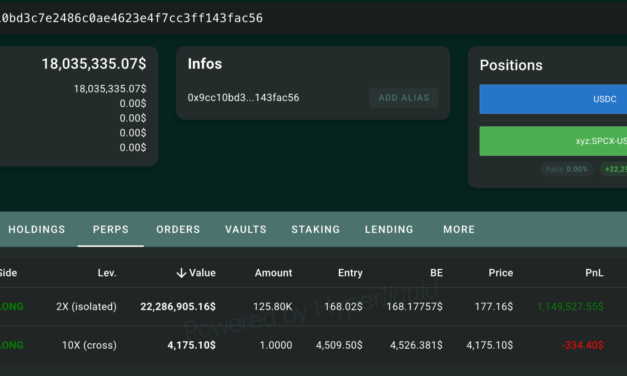
SpaceX’s IPO is already spilling into crypto markets, where one whale has opened a $22.3 million leveraged long on SPCX, a synthetic pre-IPO perpetual contract tied to Elon Musk’s aerospace company.Key takeaways:The whale is already sitting on more than $1.15 million in unrealized profit.Synthetic SPCX is trading near $175, roughly 30% above SpaceX’s $135 IPO price.Whale’s paper profits are over $1.15 million alreadyThe whale’s position, visible on data resource Hypurrscan, shows the trader holding a 2x isolated long on “xyz:SPCX” worth about $22.29 million. Address ‘0x9cc1…’ open perpetual positions as of Friday. Source: Hypurrscan The whale entered near $168, while SPCX recently traded around $175, leaving the position with roughly $1.15 million in unrealized profit. It had spent just over $500 in funding fees.Synthetic SPCX trades at 30% premium ahead of IPOSpaceX has priced its IPO at $135 per share to raise $75 billion by selling about 555.6 million shares, bringing the company’s valuation to around $1.77 trillion. The stock is expected to trade under the ticker SPCX on Nasdaq.At around $175, the synthetic SPCX market is trading about 30% above the IPO price. In other words, crypto traders are already pricing in a strong first-day rally before regular equity markets fully absorb the listing.SPCX/USDC hourly chart. Source: HyperliquidOther secondary markets are pointing in the same direction. For instance, IG International derivatives implied a SpaceX valuation of about $2.4 trillion, more than 35% above the valuation set by the IPO price.Polymarket traders put 56% odds on SpaceX closing its first trading day in the $2 trillion–2.5 trillion market cap range.SpaceX IPO closing market cap. Source: PolymarketHistory of IPOs warns of a strong SPCX correction after debut The 30% SPCX premium points to strong opening demand, but IPO history argues against chasing the first trade.US IPOs from 2020 to 2025 averaged roughly 30% first-day gains, according to Jay Ritter’s IPO database. However, that upside mostly benefits investors who receive shares at the offer price. US IPO average first-day returns. Source: Jay Ritter/IPO StatisticsBuyers who enter after the opening print often face a weaker setup, particularly after the initial euphoria fades. Ritter’s long-run IPO data show that companies with positive first-day returns averaged a 29.6% debut gain from 2001 to 2024, but then underperformed the market by 8.5 percentage points over the next three years.Related: SpaceX IPO nears 4 times oversubscribed, squeezing crypto and techHigh-valuation IPOs have performed even worse. Among IPOs with trailing sales above $100 million and price-to-sales ratios above 40, buyers at the first close saw an average three-year return of -44.8%. Long-run IPO returns by price-to-sales ratio. Source: Jay RitterSpaceX is going public at nearly 94 times the trailing sales, making it one of the most oversubscribed IPOs ever.Recent listings showed the same risk. Nasdaq-listed Cerebras (CBRS), a semiconductor company, priced its IPO at $185, opened at $350 and closed its first day near $311, but later fell to around $197, a roughly 50% drop from its first-day peak. CBRS daily chart. Source: TradingViewRivian (RIVN) and Uber (UBER) also struggled after strong early attention, with lockup expirations adding pressure as insiders and early investors became free to sell.SpaceX is overvaluedSeveral prominent voices have warned that SPCX could fall after the debut. Morningstar’s Nicholas Owens valued the company at just $780 billion, roughly 55% below the IPO price, calling it significantly overvalued and advising investors to wait for the stock to settle. NYU professor Aswath Damodaran put the fair value around $1.25–1.3 trillion and described the $135 offer price as “rich.” In a Wednesday post, analyst The Fundamental Investor said the stock is very likely to drop below the IPO price, potentially leaving early retail buyers underwater for years.Source: XThe whale’s liquidation level sits near $93.27. The position could incur an estimated loss of about $9.4 million if SPCX falls to that level.

Čítaj viac

Three signs that XRP price risks falling below $1 in June

XRP (XRP) charts are painting multiple bearish patterns this month with a downside target under $1.Key takeaways:XRP is forming head-and-shoulders and bear flag setups on its shorter-time frame chart.An on-chain metric is further signaling weak demand or capitulation sentiment among traders.Head-and-shoulders setup hints at 10% XRP declineSince June 5, the XRP price has formed what appears to be a head-and-shoulders (H&S) pattern.The setup develops when the price forms three peaks atop a common neckline support, where the middle peak, called the “head,” is higher than the other two, the “shoulders.”An H&S pattern typically resolves when the price breaks decisively below the neckline support, with its downside target measured by subtracting the breakdown level from the structure’s maximum height.XRP/USD four-hour price chart. Source: TradingViewAs of Thursday, XRP was forming the pattern’s right shoulder, eyeing an initial dip toward the neckline near $1.09. Applying the technical rule, the target for June is around $0.99, down roughly 10%, if the price breaks below the neckline.Conversely, a clear break above the right shoulder’s peak at around $1.12, a level also aligning with the 20-period exponential moving average (20-period EMA, green) on the four-hour chart, may invalidate the H&S pattern.In that case, XRP may rally toward the 50-period EMA (red) near $1.15, up 4.5% from the current price levels.Another bearish setup hints at a lower XRP price targetXRP’s four-hour chart also shows a bear flag, adding weight to the sub-$1 bearish outlook.A bear flag forms when the price consolidates inside a rising channel after a sharp sell-off. It typically signals a pause before the prior downtrend resumes.XRP/USD four-hour chart. Source: TradingViewAs of Thursday, XRP was testing the flag’s lower trendline near $1.10. A decisive four-hour close below this level could confirm the breakdown.Applying the technical rule, XRP’s bear flag target sits near $0.94, down roughly 15% from current prices.The relative strength index (RSI) near 43 supports the bearish view, showing weak momentum below the neutral 50 level.However, a rebound above $1.12 would weaken the setup. A stronger move above the 50-period EMA near $1.15 could delay the selloff and send XRP toward the flag’s upper trend line near $1.18–$1.20.On-chain data points to dip toward $0.96XRP’s MVRV pricing bands suggest the price still has room to fall toward the lower green zone.XRP MVRV extreme deviation pricing bands. Source: GlassnodeFor new traders, MVRV compares XRP’s market price with the average price at which coins last moved on-chain. In simple terms, it shows whether holders are sitting on large paper profits or losses. When price trades near the upper bands, the market is usually overheated. When it falls toward the lower bands, it often signals stress, weak demand, or capitulation.Related: XRP transaction demand falls 91.5% as traders focus on $0.65 supportThat lower green band has acted like a bear-market magnet for XRP in previous cycles. It declined toward or below the same zone during major downturns in 2018, 2020 and 2022 before finding stronger support later.The next major downside target sits near the green lower band near $0.96, about 13% below current prices if history repeats.

Čítaj viac

Audiera’s AI token BEAT beats Bitcoin, Ethereum as price surges 1,500% in a month

BEAT, the native token of AI music platform Audiera, has exploded higher over the past month, surging more than 1,500% to a record high of $9.20 even as Bitcoin (BTC) and Ether (ETH) fell roughly 25% and 30%, respectively, in the same period. BEAT/USD vs. BTC/USD and ETH/USD 1-month price performance. Source: TradingViewKey takeaways:Strong platform revenues mixed with excessive short liquidations send BEAT’s price higher.The AI token is now at its most overbought stage, which may prompt a 35% dip in the coming days.Why is Audiera’s BEAT price up so much?BEAT’s sharp outperformance has turned it into one of crypto’s hottest AI-linked trades, driven by a mix of platform revenue claims, token burns, and short liquidations. Audiera revenue and token burns strengthen BEAT bull caseBEAT’s rally has gained momentum from Audiera’s revenue-and-burn model, which has given traders a stronger value-capture story to chase.The project reported 772,045 BEAT in weekly revenue between June 1 and June 8, worth about $2.87 million at its stated price of $3.712. During the same period, Audiera said it burned 770,545 BEAT, taking the total burned supply to 12.35 million BEAT.Source: XBurns reduce BEAT’s available or future supply against its fixed 1 billion-token cap, strengthening the scarcity narrative when demand is rising.This resembles Hyperliquid’s HYPE token economics, which have seen 120% price gains so far in 2026. Related: Hyperliquid bear turns bullish after losing over $46M shorting HYPEHowever, Hyperliquid has already shown strong product-market fit in perpetual trading, while Audiera’s model remains newer and less tested. That leaves BEAT vulnerable to sharp profit-taking if revenue slows, burn activity weakens, or speculative demand cools.Short squeeze helps fuel BEAT rallyBEAT’s rally has received a strong boost from derivatives liquidations, particularly from traders betting against higher prices.Since May, BEAT has seen $28.72 million in short liquidations, compared with $13.74 million in long liquidations. That means bearish traders lost more than twice as much as bullish traders during the rally.BEAT’s daily aggregated liquidation bar chart. Source: TradingViewThis imbalance points to a classic short squeeze. As the BEAT price kept rising, traders holding short positions were forced to close their bets. Since closing a short position requires buying back the token, those liquidations added more upward pressure to the price.That helped turn BEAT’s rally from a strong uptrend into a vertical move. However, it also means part of the surge came from forced buying rather than steady spot demand. Once short-liquidation pressure fades, BEAT may need fresh buyers to keep the rally going.BEAT price may decline 35% in JuneBEAT’s price explosion over the past month has made its relative strength index (RSI), which gauges momentum, the most overbought on record.As of Thursday, BEAT’s daily RSI reading was 96.87, way above its overbought threshold of 70. In other words, the Audiera token’s rally remains vulnerable to a sharp pullback if buyers lose momentum or early investors start booking profits.BEAT/USDT daily price chart. Source: TradingViewA decisive pullback from the $9.47 resistance level, which aligns with the 1.618 Fibonacci retracement line, increases the odds of BEAT falling toward the 1.0 Fib line at around $3.71, down roughly 35% from the current price, in June.Conversely, a clear breakout above the $9.47 resistance level raises BEAT’s potential to rise toward its 4.236 Fib line above the $15 mark in the coming weeks.

Čítaj viac

Získaj BONUS 8 € v Bitcoinoch

nakup bitcoin z karty

Registrácia Binance

Burza Binance

Aktuálne kurzy