Autor Cointelegraph By William Suberg

US hints at more yen intervention: Five things to know in Bitcoin this week

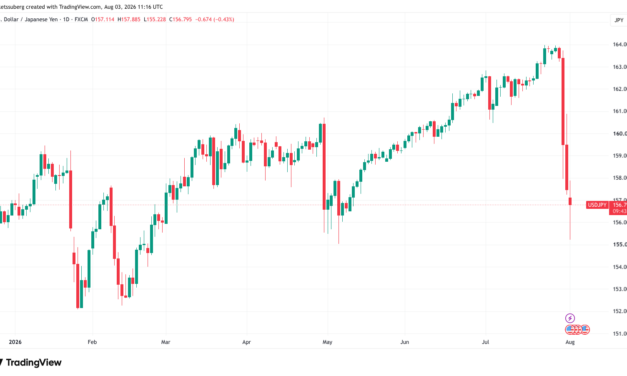
Bitcoin (BTC) starts the first full week of August circling $63,000 as traders weigh the impact of the ongoing Coldcard wallet hack.Key points:US Treasury Secretary Scott Bessent leverages a Federal Reserve repo facility for a joint intervention as the Japanese briefly recovers from forty-year lows against the dollarOil prices fall sharply as president Donald Trump gives hope of a deal with Iran.Bitcoin rounds out July 7.4% higher, but warnings of a red August stay in place.Bessent eyes further yen interventionsConcerns over US Treasury markets were behind the US decision to intervene in the Japanese yen last week. Washington engaged in a rare operation to support the yen after  USD/ JPY had reached almost 164 last week, per data from TradingView.USD/JPY one-day chart. Source: Cointelegraph/TradingView“It was the first coordinated US–Japan foreign-exchange intervention since 2011 and the first joint operation specifically supporting the yen since 1998,” crypto trading company QCP Capital noted in analysis released on Monday. “The distinction matters. The New York Fed acted as the Treasury’s fiscal agent rather than as an independent monetary-policy decision by the Federal Reserve. The operation therefore highlights how institutions outside the FOMC can also influence currencies, liquidity and broader financial conditions.”Speaking to mainstream media, industry insiders placed emphasis on the desire to avoid Japan selling large amounts of US Treasuries. The use of the Fed’s Foreign and International Monetary Authorities (FIMA) repo facility, which allows a handful of foreign central banks to access dollar liquidity without selling Treasuries, supports the theory.“There is a self-preservation element here. Volatile markets driven by potentially fiscally-aggressive policies from Japan could extend to the U.S. Treasury markets, destabilizing the dollar,” Louise Loo, head of Asia economics at Oxford Economics, told CNBC.In a post on X, Treasury Secretary Scott Bessent argued that FIMA could make further appearances going forward.“Friday’s coordinated foreign exchange actions countered disorderly yen movements. Treasury remains attentive and in close communication with our counterparts at MOF and BOJ. We will not hesitate to participate in further joint intervention. The FIMA Repo Facility is an important backstop. We would encourage it to be upsized in the coming months,” he wrote. Oil dives as Trump teases hope of Iran dealUS nonfarm payrolls data is the main point of interest for crypto and risk asset traders this week. Due on Thursday, the numbers will shed light on the strength of the labor market as recent US inflation prints have delivered mixed signals.Last month, nonfarm payrolls came in far lower than expected. Only 57,000 jobs were added in June, short of the 114,000 anticipated, while the previous two months’ numbers were revised down by a combined 74,000 jobs. Bitcoin jumped on the news, because weaker labor-market conditions put pressure on the Federal Reserve to soften its stance on rate hikes. Some market participants expect a rebound in July’s payrolls data. However, macro research firm Continuum Economics simultaneously projects an uptick in unemployment.“We expect July’s non-farm payroll to rise by 120k overall and by 110k in the private sector, a significant improvement from June’s respective gains of 57k and 49k but largely explained by a recovery in leisure and hospitality. We expect unemployment to rise to 4.3% from 4.2%, reversing a June decline, and an in line with trend 0.3% rise in average hourly earnings,” it forecast last week. US civilian unemployment rate. Source: Bureau of Labor StatisticsMacroeconomic data prints form just one locus of potential risk-asset volatility as markets look for cues for a lasting ceasefire between the US and Iran.In a post on Truth Social on Sunday, US president Donald Trump revealed a delay to further strikes on Iranian territory, with a potential deal on the table.“This would include the Immediate, Complete, and Total OPENING OF THE HORMUZ STRAIT, and an end to Iran’s  nuclear threat. Based on this request, I have agreed, for the future benefit of the WORLD and, likewise, the survival of a successful and prosperous Iran, to cancel the attack, subject to being able to rapidly make a DEAL,” he wrote.Oil prices fell immediately as the week began, with WTI and Brent crude both down more than 8% on Monday.Stocks face tough seasonality into US MidtermsUS stocks face seasonal friction between now and October, in the run-up to the US Midterm elections, analysis from trading resource Mosaic Asset Company warns.The S&P 500 finished July down 0.8%, while the tech-heavy Nasdaq Composite Index saw its worst July losses since 2006 at -3.2%. In the latest edition of its regular newsletter, The Market Mosaic, flagged seasonal changes as a major hurdle for equities beginning this month.“Based on multiple lookback periods, seasonality becomes a much stronger headwind over the next couple months,” it wrote, with data indicating that it could take until the start of Q4 for the situation to improve.S&P 500 average monthly returns. Source: Mosaic Asset CompanyUS equities failed to mount a meaningful comeback into the monthly close, even as Asia markets rebounded from a major sell-off centered around semiconductor stocks. Missed earnings and concerns over debt obligations fueled a $620 billion wipeout over just two days. This comes as combined 2026 capex guidance from Alphabet, Microsoft, Amazon, and Meta is now tracking toward $730 billion.For Bitcoin itself, the picture has a familiar precedent, analyst Benjamin Cowen, founder and CEO of quantitative analysis platform Into the Cryptoverse argued. “Bitcoin is still generally tracking the average of prior midterm years (only slightly elevated off of that average),” he reported on X while tracking year-to-date return on investment.Bitcoin RoI comparison. Source: Benjamin Cowen on X.comExchange flows cool after Coldcard shockBitcoin investors continue to react to the low-entropy bug in Coldcard hardware wallets as funds are being stolen for a fourth consecutive day. The hack, which appeared to be centered on a security vulnerability originating in 2021, had drained BTC worth nearly $90 million as of Sunday.Alex Thorn, head of firmwide research at crypto and blockchain research platform Galaxy Research, told Coldcard users to move funds “ASAP” and employ high transaction fees to reduce the remaining time spent interacting with Coldcard wallets to a minimum.Exchange transaction data, however, does not show a mass influx of BTC from users seeking a temporary alternative to hardware wallet storage or converting their funds to ETFs. Data from CryptoQuant shows net inflows of 34,932 BTC on Friday and 8,768 BTC on Sunday. While this constitutes a significant inflow day, it is not out of the ordinary and matches the levels seen throughout the month.  Bitcoin exchange inflows. Source: CryptoQuantThe number of depositing transactions saw a more pronounced reaction, spiking to match some of its highest daily totals since March before dropping significantly over the weekend. Exchanges recorded 31,217 inbound BTC transactions on Friday, while on Sunday, the number fell to 19,537.Bitcoin exchange deposit transactions. Source: CryptoQuantResponding, CryptoQuant head of research, Julio Moreno, revealed that the influx was driven by transactions of between 1 and 10 BTC. At around 7,300, these saw their highest daily total since early February.Bitcoin exchange inflows by transaction size. Source: Julio Moreno on X.comIn some of its latest analysis released on Monday, CryptoQuant observed that on a rolling 30-day basis, Bitcoin’s long-term holders (LTHs) remained in a broad accumulation phase.“Data shows that the BTC LTH Accumulation & Distribution (30D) indicator is currently recording LTH Supply Inflow of around 220.4K BTC. This suggests that the amount of Bitcoin flowing into the Long-Term Holder cohort continues to outweigh the amount being distributed back to the market,” it wrote.Bitcoin 30-day LTH accumulation and distribution (screenshot). Source: CryptoQuantTrader consensus sees a “red” August for BitcoinBitcoin continues to see key trend lines act as resistance into August as market participants warn over bear-market history repeating. BTC/USD finished July up 7.4%, slightly below its 2025 performance, per data from CoinGlass. BTC/USD monthly returns (screenshot). Source: CoinGlassDespite this, expectations remain for downside BTC price pressure to return this month, keeping the 2026 bear market in line with historical patterns. The 50-month exponential moving average (EMA) at $65,827 is an important psychological level for traders.“It has been confirmed. The 50-Month EMA continues to act as resistance,” trader and analyst Rekt Capital wrote in an X post on Sunday. “Continued rejection from the 50 EMA would set price up for downside continuation over time.”BTC/USD one-day chart with 50-month EMA. Source: Cointelegraph/TradingViewOn shorter time frames, CoinGlass data that tracks clusters of high-leverage BTC bets in the derivatives market showed $64,200 as a potential area of forced liquidations should price reverse higher.BTC liquidation heatmap. Source: CoinGlassQuant analyst David Eng described the price as “sitting on its long-term statistical floor” near $63,000. Eng uploaded data from the power law model, which sees price growing as a power of time.Bitcoin Power Law data. Source: David Eng on X.comBitcoin heads into August with long-term holders quietly accumulating even as short-term charts flash caution. Whether the month breaks its historical pattern of weakness will likely come down to how the next few macro data points land. 

Čítaj viac
Bitcoin price sinks to 2-week lows as US stocks fail to copy Asia rebound

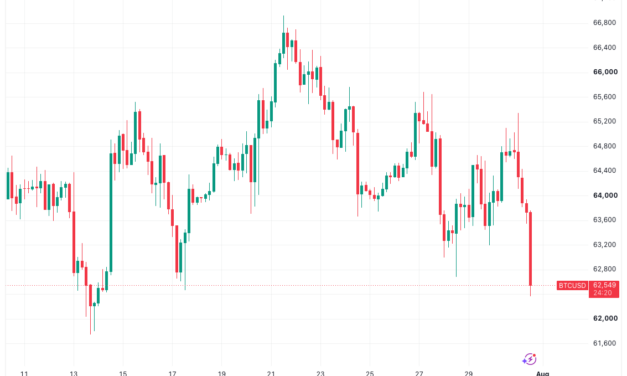
Bitcoin (BTC) fell to its lowest levels in over two weeks on Friday as US stocks saw pressure into the monthly close.Key points:Bitcoin approaches $62,000 as daily losses hit 3.5%.US stocks saw no positive reactions to relief in Asia, where stocks rebounded after the semiconductor sell-off.Analysis warns that Bitcoin bear-market history should continue to repeat in August.Bitcoin price targets $62,000 in month-end volatilityData from TradingView showed BTC/USD falling 3.5% to reach $62,369 on Bitstamp, a level last seen on July 14.BTC/USD one-hour chart. Source: Cointelegraph/TradingViewUS stocks turned red at the open before treading water, diverging from a major relief bounce seen in Asia. There, South Korea’s KOSPI index ended the day up 17.9%, its largest single-day gain on record.KOSPI index one-day chart. Source: Cointelegraph/TradingView“Semiconductor shares led both the sell-off and the subsequent recovery, reflecting the index’s high exposure to the global AI and memory-chip cycle,” trading company QCP Capital wrote in commentary on the latest macro market moves.QCP noted that crypto market trading activity increased around the KOSPI gyrations, something it said “highlighted the growing relationship between crypto liquidity, regional equity positioning and broader technology-sector sentiment.” Both Japan and Korea reportedly engaged in currency interventions on Thursday, while Japan’s central bank kept benchmark interest rates at 1.0%, following the US Federal Reserve’s decision to stand pat on Wednesday.Bitcoin traders see bear-market history repeating in AugustBTC/USD approached the end of the monthly candle up 8.5%, marking its strongest July performance since 2022, per data from CoinGlass.BTC/USD monthly returns (screenshot). Source: CoinGlassRelated: Here’s what happened in crypto todayPreviously, traders had anticipated a relief bounce for the pair lasting until August, mirroring the 2022 bear market and ultimately reaching its next long-term bottom.Trader and analyst Rekt Capital, among those seeing BTC price action copying bear-market moves from four years ago, forecast that the tide might not turn immediately.“It’s likely price will try to maintain these highs in the early stages of August but history suggests price could rollover just like it did in 2022,” he wrote in a post on X on Friday.Rekt Capital reiterated that Bitcoin’s 50-month exponential moving average (EMA), currently at $65,820, continued to act as resistance after two failed breakouts since mid-June.BTC/USD one-day chart with 50-month EMA. Source: Cointelegraph/TradingView

Čítaj viac

BOJ intervenes to defend yen near 160, holds rates steady

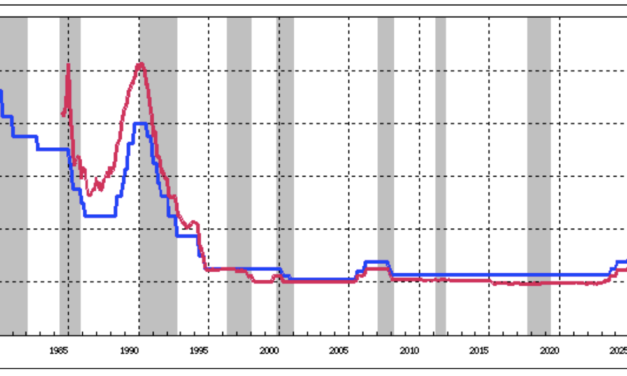
Japan’s central bank held interest rates steady at 1.0% on Friday after a reported major intervention in the yen.Key points:Japan holds interest rates at 1.0%, following market expectations.Both Japan and South Korea’s central banks reportedly engage in currency interventions, as the JPY briefly gains 3.5% overnight.Bank of Japan warns of incoming CPI inflation headwinds in the second half of the year.Yen rises up to 3.5% as Korea joins interventionIn its latest statement, the Bank of Japan (BoJ) revealed broad consensus among officials for holding rates at current levels — an outcome that markets had anticipated in advance.“The Bank will encourage the uncollateralized overnight call rate to remain at around 1.0 percent,” it confirmed.Eight out of nine members of the bank’s Policy Board voted for the outcome, with only Hajime Takata proposing a 0.25% rate hike.Japan benchmark interest rate (screenshot). Source: BoJJapan’s benchmark rate remains at its highest levels since 1995, with the BoJ meeting result coming just hours after the yen saw snap volatility. Against the US dollar, the currency rose by as much as 3.5% on Thursday, per data from TradingView, in a move that has widely been attributed to central bank interventionJPY/USD one-day chart. Source: Cointelegraph/TradingViewThe BoJ did not officially comment on the latest moves, which coincided with a significant rebound in the South Korean stock market after days of heavy selling concentrated on semiconductor stocks. The Korean won was up by around 1% at the time of writing amid reports of a joint intervention between the BoJ and Korea’s central bank. Analysts referenced “tightly aligned” mutual interests of the two countries as facilitating the joint move.“The interests of each country aligned. For Korea-Japan cooperation, the won and the yen are so tightly coupled that a joint intervention could double the impact,” Lee Min-hyuk, an analyst at KB Kookmin Bank, commented to local media outlet Straits Times.The Nikkei newspaper earlier noted that the US had engaged in rate checks — a form of soft intervention which can precede a more pronounced operation — during Thursday’s trading session, resulting in speculation over a three-way coordinated move.“The key signal from last night’s move is that MOF remains uncomfortable with excessive yen weakness. The line in the sand is probably better viewed as a zone around 162-165 rather than a specific level,” Masahiko Loo, senior fixed income strategist at asset manager State Street Investment Management, told CNBC.BoJ sees CPI inflation headwinds increasing in 2026As the yen came off its highest levels against the dollar since 1986, the BoJ warned of future upside in the Consumer Price Index (CPI) inflation.Related: Rate path still divides investors: Five things to know in Bitcoin this week“The year-on-year rate of increase in the consumer price index […] is likely to accelerate to a level clearly above 2 percent from the second half of fiscal 2026,” it stated in its latest quarterly Outlook for Economic Activity and Prices report.In addition to rising prices of durable goods, the report referenced “waning of the effects of high crude oil prices” due to the ongoing US-Iran war and closure of the Strait of Hormuz oil-transit route.Gyrations in the yen have remained an important consideration in crypto trading circles ever since the “unwinding” of the yen carry trade sparked major Bitcoin and altcoin downside pressure in August 2024.Earlier this year, Arthur Hayes, former CEO of crypto exchange BitMEX, suggested that the combination of a weak yen and rising Japanese bond yields may cause investors to move away from low-yielding US bond allocations. He linked central bank liquidity interventions to positive moves in crypto markets.“This discussion of Japanese financial markets is important because for Bitcoin to exit its sideways funk, it needs a healthy dose of money printing,” he wrote in a blog post.In December 2025, Hayes predicted that USD/JPY could rise as high as 200.

Čítaj viac

Bitcoin stable as Fed fave PCE inflation sees first monthly drop in six years

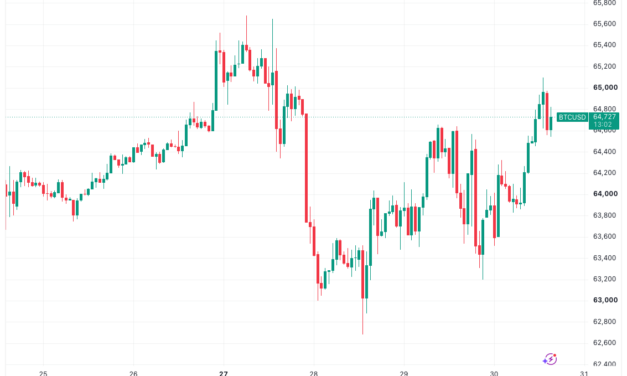
Bitcoin (BTC) shook off volatility on Thursday as US stocks rebounded on the back of inflation-data relief.Key points:Bitcoin avoids a snap reaction to US personal consumption expenditures (PCE) inflation data, which reverses a local uptrend.Analysis remains wary of inflationary tendencies despite PCE conforming to expectations.Bitwise predicts that going forward, Bitcoin will become less sensitive to Fed interest-rate changes.PCE ends uptrend while staying above Fed inflation targetData from TradingView showed BTC price action focusing on $64,500, broadly unchanged from the day prior. BTC/USD one-hour chart. Source: Cointelegraph/TradingViewThe major risk-asset headwind from earlier in the week in the form of a mass sell-off in semiconductor stocks eased on the day, sparing crypto during the US trading session. The S&P 500 index and Nasdaq Composite index were up 1% and 2.3%, respectively, at the time of writing.Nasdaq Composite Index one-day chart. Source: Cointelegraph/TradingViewThe June print of the US Personal Consumption Expenditures (PCE) index added another positive catalyst, this coming in at 3.7% year-on-year — in line with market expectations. May’s PCE print, at 4.1%, was the highest in three years.PCE is considered the Federal Reserve’s preferred inflation measure as it offers a broader and more comprehensive measure of inflation and more quickly picks up adjustments in consumers’ choices in response to price changes, according to the Federal Reserve Bank of Cleveland.“The increase in current-dollar personal income in June primarily reflected increases in compensation, personal income receipts on assets, and government social benefits that were partly offset by a decrease in farm proprietors’ income,” the US Bureau of Economic Analysis (BEA) said. The BEA said in its data release: “The $65.2 billion increase in current-dollar PCE in June reflected increases of $58.2 billion in spending on services and $7.0 billion in spending on goods.”US PCE data percentage change (screenshot). Source: BEAWhile ending an uptrend in PCE numbers and showing the first month-on-month decline since 2020, the June print sparked conservative reactions. Trading resource The Kobeissi Letter noted that the 3.7% figure was still the second-highest result since October 2024.“US inflation continues to run at nearly double the Fed’s 2.0% target,” it said on X.Johns Hopkins economist Steve Hanke described inflation as “the genie the Fed just can’t put back in the bottle,” while also noting the mismatch with its 2% target.Bitwise CIO sees BTC brushing off future rate cuesThe Federal Reserve left interest rates unchanged at its latest meeting on Wednesday, with an emerging split among the Federal Open Market Committee (FOMC) members regarding appropriate policy.Related: South Korean crypto trading surges amid stock market plungeFollowing the event, Matt Hougan, chief investment officer at crypto asset manager Bitwise, forecast that future interest-rate announcements would have less impact on BTC price performance.“Rationale: Throughout bitcoin’s history, interest rates swung wildly — from 0% to 2.5% to 0% to 5% to 3.5%.  Changes have been measured in whole percentage points. But future changes seem likely to be more modest; the CME expects a 50bps rise over the next year,” he told X followers, referring to rate expectations as measured by CME Group’s FedWatch Tool.Fed target-rate probabilities (screenshot). Source: CME GroupHougan said that new Fed chair, Kevin Warsh, will likely echo former chair Alan Greenspan with the scale of rate changes, diverging from his immediate predecessor, Jerome Powell. Prior to Warsh’s appointment, US president Donald Trump gave repeated signals that he expected Warsh to adopt a dovish stance on the issue, a move that would bolster risk-asset performance.

Čítaj viac

South Korean crypto trading surges amid stock market plunge

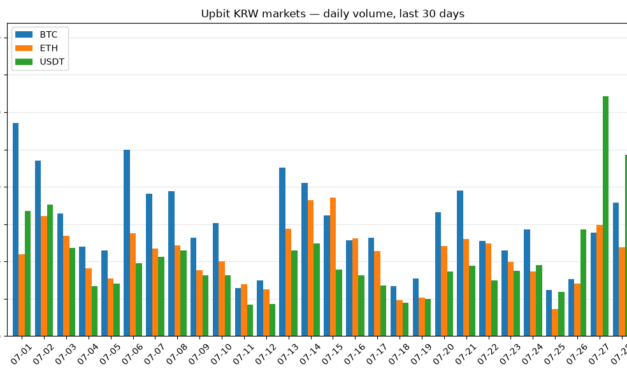
Cryptocurrency trading volumes spiked in South Korea as its stock market fell by nearly 18% this week. Key points:South Korean exchanges see a 600% uptick in crypto trading volume around the snap declines in the KOSPI.Investors may be seeking to capitalize on volatility by buying stock-linked products overseas, per analysis.Bitwise highlights Bitcoin’s surprising resilience to macro headwinds throughout July.KRW/USDT volumes spike in response to stock sell-offData from largest South Korean exchange Upbit shows trading volume accelerating between the Korean won and Tether (USDT). It neared 200 billion won (140 million USDT) on July 29, up from just 20 million USDT on July 25 — an increase of 600%.Korean won crypto trading-volume data. Source: UpbitOn the back of several straight days of downside on South Korea’s KOSPI, which came as a result of a sell-off in chip-maker stocks, investors variously sought protection and to take advantage of the decline. Capital could have flowed out of stocks to crypto, analysis referenced by local media outlet Seoul Economic Daily suggested, while investors could also have targeted derivatives of Korean equities via overseas crypto exchanges.“There is a possibility that demand increased for moving funds to overseas exchanges or personal wallets to trade perpetual stock futures,” Cho Yoon-sung, a senior researcher at independent digital asset research and data provider Tiger Research, told the publication.As Cointelegraph reported, an influx into semiconductors and away from crypto earlier this year is now under scrutiny as the tide turns on the AI trade’s rapid rise.Crypto trading remains a hive of activity in South Korea, as younger traders in particular display a fondness for risk. Traders’ fondness for leveraged bets is an overarching feature of both crypto markets and this year’s AI retail boom.Analyst underscores BTC price strengthThe impact of  KOSPI volatility on crypto trading volumes was in evidence before this week’s rout. On July 14, Upbit saw a conspicuous volume surge after the index plunged 10% in a single day.Related: Bitcoin price wedged into ‘most divided’ FOMC as Iran war spikes oil prices 8%Commenting on the latest events, Andre Dragosch, European head of research at crypto asset manager Bitwise, underscored the lack of contagion resulting from the semiconductor “meltdown.”“Bitcoin is essentially flat since semis peaked in late June,” he summarized, suggesting that Bitcoin’s resilience was unexpected.In an analysis released earlier this week, Bitwise attributed “remarkable outperformance” to Bitcoin in comparison to a range of US mega-cap stocks.“Bitcoin continues to demonstrate remarkable outperformance and resilience vis-à-vis US mega cap stocks such as the Magnificent 7 and SpaceX (SPCX) – a relative strength that is all the more notable in the context of tightening financial conditions and consistent with our view of Bitcoin as the ‘canary in the macro coal mine,’” it stated.Bitwise argued that Bitcoin may already be giving early indications of future monetary-policy easing by central banks despite rising inflation and the short-term potential for interest-rate hikes as a result.BTC/USD vs. SpaceX and Magnificent 7 stocks. Source: Bitwise

Čítaj viac

Získaj BONUS 8 € v Bitcoinoch

nakup bitcoin z karty

Registrácia Binance

Burza Binance

Aktuálne kurzy