
Autor Cointelegraph by Vince Quill

Petition to scrap South Korea's crypto tax reaches 50K threshold

A petition to scrap a 22% tax on crypto investment gains in South Korea reached the 50,000-signature threshold required for the country’s Finance and Economic Planning Committee to review objections to the new tax regime.The 22% tax, set to take effect in January 2027, imposes financial and reporting “burdens” on investors, while also limiting upward mobility for younger individuals, who are locked out of housing markets due to skyrocketing real estate prices, according to the petition.The petition now has more than 52,000 signatures. Source: South Korea AssemblyThe petition also said that taxing crypto gains at 22%, while giving other asset classes preferential tax treatment, undermines South Korea’s share of the crypto market. In a translated statement, the authors of the petition wrote:“If taxation is enforced in order to secure short-term tax revenues, it is likely to lead to greater losses in the long term, namely, a contraction of industry and an outflow of capital and talent abroad.”South Korea is a key crypto hub in the Asia-Pacific region, and in March 2025, about 32% of the country’s population owned cryptocurrencies, according to local news agency Yonhap. However, ownership has declined so far this year as crypto prices remain under pressure.Related: South Korea plans July rules for tokenized securitiesSouth Korea’s crypto market contracts as tighter controls are proposedThe total value of crypto held by South Koreans declined from about 121.8 trillion won ($83.3 billion) in January 2025 to about 60.6 trillion won ($41.4 billion) in February 2026, according to industry data.Daily trading volumes on the five largest crypto exchanges in the country, which include Upbit, Bithumb, Coinone, Korbit and Gopax,  also fell from $11.6 billion in December 2024 to just $3 billion in February.Daily trading volume for South Korea’s largest crypto exchanges. Source: CoinGeckoTighter Anti-Money Laundering (AML) regulations and Know Your Customer controls in South Korea are also driving investors away from the sector, critics of the policies say. In March, South Korea’s Financial Services Commission (FSC) and the Financial Intelligence Unit (FIU) proposed that all crypto transactions above 10 million won ($6,630) sent to or from foreign crypto wallets should be automatically flagged as suspicious.Crypto industry advocacy organizations in the country have pushed back against the new rules, arguing that the reporting requirements would create an operational burden for exchanges.Magazine: South Korea gets rich from crypto… North Korea gets weapons

Čítaj viac
STRC preferred stock investors are mispricing major 'dislocation' risk: Analyst

Investors are mispricing risk for perpetual preferred stocks, like Bitcoin treasury company Strategy’s Variable Rate Series A Perpetual Stretch Preferred Stock (STRC), according to Matt Dines, the chief investment officer of credit asset management company Build Markets.The corporate issuers of perpetual preferred stocks never have to repay holders their principal investment, and can just pay dividends indefinitely, without renegotiating the investment terms, Dines told the Truth for the Commoner (TFTC) media outlet.If holders want to cash out, they must sell the perpetuals on the secondary market to recover their principal, which leaves holders exposed to liquidity contraction and interest rate risks that exist forever because perpetuals lack a maturity date, he said. He added:“If spreads start to rise and the market demands higher yields from corporate borrowers, you also have to attach that to the infinite duration of the perpetual. So, if this dislocation comes in liquidity, it will come from the fiat side.”Basic performance metrics for Strategy’s STRC perpetual preferred stock. Source: SaylorTrackerThe analysis comes amid growing demand for STRC; on Thursday, its daily trading volume surged to $1.5 billion, a new record for the financial instrument, as Strategy leans into preferred stock issuance to fund its Bitcoin purchases.Related: Strategy to repurchase $1.5B of 2029 convertible notesStrategy’s preferred funding vehicle may hit a ceiling in the next year STRC currently has an authorized issuance cap of about $28 billion, according to crypto research company Delphi Digital.If the authorized issuance cap is not raised before the $28 billion threshold, the company’s BTC accumulation may slow down, Delphi’s researchers said. The total notional face value of outstanding STRC shares already sits at $8.5 billion, with the total market value of all outstanding shares at the time of this writing totaling about $8.4 billion.STRC is trading at about $99 per share at the time of publication and carries a dividend rate of 11.5%, according to Strategy.Detailed STRC performance metrics. Source: StrategyThe preferred stock’s dividend rate is variable, meaning that the yield offered to investors is subject to change on a monthly basis.Strategy has also opened up voting for its common equity and STRC holders to approve semi-monthly dividend payments.Magazine: Bitcoin’s ‘biggest bull catalyst’ would be Saylor’s liquidation: Santiment founder

Čítaj viac

Strategy to repurchase $1.5B of 2029 convertible notes

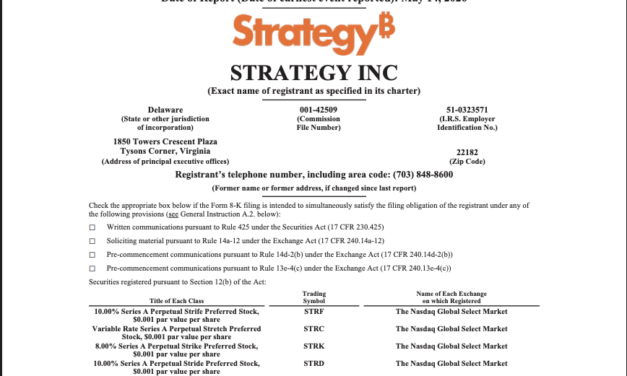
Bitcoin treasury company Strategy announced on Friday that it will repurchase $1.5 billion in 0% convertible notes, due in 2029, retiring about half of the 2029 convertible note tranche’s total outstanding debt. Strategy entered into “privately negotiated transactions” with a portion of its 0% senior convertible note holders on Thursday, agreeing to repurchase the debt for an estimated $1.38 billion, according to the company’s Securities and Exchange Commission (SEC) filing. The transaction is set to settle on Tuesday of the week following the publication of this article, the company said, adding that the final repurchase amount could “vary” from the estimated amount based on market conditions. The company added:“Strategy expects to fund the repurchases with available cash reserves, proceeds from sales of securities under its at-the-market offering program, and/or proceeds from the sale of bitcoin.” Strategy’s SEC filing documenting the 2029 convertible note repurchase. Source: StrategyThe move follows comments made by Strategy co-founder Michael Saylor in May 2026, signaling that the company could sell a portion of its Bitcoin holdings to fund dividend payments, and earlier comments in February that the company plans to equitize its debt in the coming years.Related: Strategy’s Bitcoin engine faces $28B STRC ceiling: Delphi DigitalStrategy plans to swap its convertible debt for equity over the next 3-6 years Strategy plans on equitizing its convertible debt over the next 3-6 years, gradually turning holders of its credit instruments into equity holders.This would reduce the debt burden on the company, but would also dilute existing stockholder value by adding new equity shares.Source: Michael SaylorStrategy has about $8.2 billion in total outstanding debt at the time of publication, according to data from the company, and has funded its BTC buys in 2026 primarily through its Stretch Perpetual Preferred Stock (STRC).On Thursday, STRC hit $1.5 billion in daily trading volume, setting a new record for the equity instrument, and signaling strong investor interest.The company’s most recent Bitcoin purchase occurred on Monday, when it bought 535 Bitcoin for $43 million, bringing its total Bitcoin holdings to 818,869 coins, valued at about $64 billion, using BTC’s spot market price at the time of publication.Magazine: Big Questions: Can Bitcoin save you from the dreaded Cantillon Effect?

Čítaj viac

ICE, CME press US regulators to 'rein in' Hyperliquid energy trading: Report

Intercontinental Exchange (ICE) and the Chicago Mercantile Exchange (CME), the two biggest exchanges for energy-linked commodities, are pressuring US regulators to clamp down on the Hyperliquid decentralized exchange’s expansion into commodity markets.Executives from both companies say that Hyperliquid’s energy-linked onchain derivatives create insider trading and price manipulation risks, according to Bloomberg, which cited unnamed sources familiar with the ongoing talks with US regulators.ICE and CME cited the “anonymous” and “unregulated” nature of Hyperliquid as major risks to critical energy markets, like oil and gas, which could be used by state actors to circumvent sanctions, the report added.Daily trading volume for HIP-3 perpetual futures markets. Source: DeFiLlamaHyperliquid introduced HIP-3, also known as “Builder-Deployed Perpetuals,” in January 2025, which allows anyone who stakes 500,000 HYPE tokens, the platform’s native cryptocurrency, to build perpetual futures markets for any electronically traded asset class.The deployment of HIP-3 represents a broader trend of traditional financial markets coming onchain, as the line between blockchain-based infrastructure and traditional market architecture continues to erode. Related: Why is Hyperliquid’s HYPE token price up 23% in one day?Hyperliquid’s token price surges following the introduction of HIP-3 The price of HYPE jumped by over 58% within three days of the launch of HIP-3. The token rose from a low of about $20 to over $38, and is trading at about $44 at the time of publication.In March, market analyst and crypto investor Arthur Hayes forecast that HYPE could hit $150 per token by August, driven by demand for commodities-linked onchain derivatives instruments.The HYPE token’s price action. Source: CoinMarketCap“Hyperliquid, the dominant perp DEX, is the largest revenue-generating project that isn’t a stablecoin,” he said.The exchange also dedicates 97% of trading fee revenue to HYPE token buybacks, which boosts demand and raises the token’s price over time, according to Hayes.“If the market believes that HYPE can continue siphoning volumes away from centralized exchanges and add new features to accelerate revenue growth, then HYPE can pump in absolute terms,” he added. Open interest for HIP-3 markets has continued to rise since their inception, climbing to over $2.5 billion in May, according to data from DeFiLlama.Magazine: Guide to the top and emerging global crypto hubs: Mid-2026

Čítaj viac

US law firm files motion requesting redistribution of $344M USDt linked to Iran

Law firm Gerstein Harrow LLP filed a new motion on Thursday in a miscellaneous enforcement lawsuit, asking the court to compel stablecoin company Tether to hand over more than $344 million in frozen USDt linked to Iranian entities.The motion claims that the plaintiffs are owed more than $532 million in compensatory damages and more than $1.8 billion in punitive damages from acts of “terrorism committed or sponsored by Iran,” stretching back more than 25 years. The latest filing is part of a broader lawsuit against North Korea (DPRK) and Iran, attempting to claim and redistribute digital assets as compensation for victims of various and unrelated judgments tied to state-sponsored violence, drawing criticism from the crypto community.The motion to claim $344 million in frozen stablecoins linked to Iranian entities. Source: PACERIn May, the law firm filed a restraining notice against the Kelp decentralized autonomous organization (DAO), which manages the liquid staking platform, attempting to block the transfer of frozen Ether ( ETH) tied to the $293 million Kelp exploit in April.The law firm’s tactics have drawn condemnation from the crypto community, with critics arguing that distributing funds owed to hack victims to satisfy unrelated judgments stretching back decades delays repayment for hack victims, who have a greater claim to the funds.Related: Coinbase faces lawsuit over frozen funds from $55M crypto theftZachXBT slams Gerstein Harrow for crypto targeting strategy Gerstein Harrow LLP has a long history of filing similar claims against cryptocurrency companies and platforms following hacks and cybersecurity exploits, including the Harmony protocol, the Bybit cryptocurrency exchange, and others, according to onchain sleuth ZachXBT. “This is a predatory US law firm with a strategy that is pure evil,” he said in an X post from May 1, adding that the law firm used his cybersecurity research of various crypto hacking incidents to justify the claims.“Whenever there’s a new Lazarus Group victim after an exploit and crypto assets get frozen, these clowns come in and say they have a claim for an alleged DPRK victim from 26 years ago that has zero relation to crypto or exploits/hacks,” he added.Source: ZachXBTIn April, the United States Office of Foreign Assets Control (OFAC) ordered Tether to freeze $344 million in stablecoins tied to Iranian entities.The asset freeze also drew mixed reactions from the crypto community over the ethics of wallet freezes and the role of centralized crypto issuers in enforcing law enforcement requests. Magazine: Are DeFi devs liable for the illegal activity of others on their platforms?

Čítaj viac

Získaj BONUS 8 € v Bitcoinoch

nakup bitcoin z karty

Registrácia Binance

Burza Binance

Aktuálne kurzy

