
Autor Cointelegraph by Vince Quill

Bitcoin treasury company Nakamoto falls nearly 67% YTD after reverse stock split

Nakamoto (NAKA) is trading down more than 10% on Wednesday just days after the Bitcoin treasury company completed a 1-for-40 reverse stock split undertaken to stay compliant with the Nasdaq stock exchange’s listing criteria. NAKA stock is down by about 67% year-to-date (YTD) and by more than 99% since its May 2025 peak of about $34 per share, reaching a low of about $0.16 per share in April before the reverse stock split on Friday.Nasdaq warned the company in December that its shares would be delisted after trading below $1 for at least 30 consecutive days, according to a Securities and Exchange Commission (SEC) filing.The reverse split reduced the number of outstanding shares to about 17.4 million from about 696 million, according to the company. NAKA stock price is down by nearly 67% year-to-date. Source: Yahoo FinanceCointelegraph reached out to NAKA for comment but did not receive a response by the time of publication. The decline in NAKA’s value comes amid a broad downturn in the Bitcoin treasury sector that started in 2025; however, the company has also underperformed the industry’s top players, including Strategy (MSTR), Twenty-One Capital (XXI) and Strive Asset Management (ASST).Related: Bitcoin firm Nakamoto records net loss in Q1 despite sixfold revenue growthBTC treasury companies show signs of recovery, but market remains challenging Strategy, the biggest Bitcoin treasury company as measured by its BTC holdings, is up about 2.5% YTD, and is trading at about $155 per share.Twenty-One Capital, the second-largest publicly traded BTC treasury, with 43,514 coins, is down by more than 17% YTD, and is trading at about $7.26 per share.The current distribution of Bitcoin among publicly traded BTC treasury companies, private enterprises, government entities and investment funds. Source: Bitcoin TreasuriesStrive is also up by over 20% YTD, last trading at about $17.72 a share.The digital asset treasury space is likely to experience consolidation in 2026, as bigger companies eat up smaller firms, according to venture firm Pantera Capital.“2026 will see brutal pruning. In each major asset class, only one or two players will dominate. Everyone else gets acquired or left behind,” analysts at Pantera forecast in January.Magazine: Bitcoin will not hit $1M by 2030, says veteran trader Peter Brandt

Čítaj viac
Soaring bond prices signal 'structural' shift and Bitcoin 'supercycle': Analyst

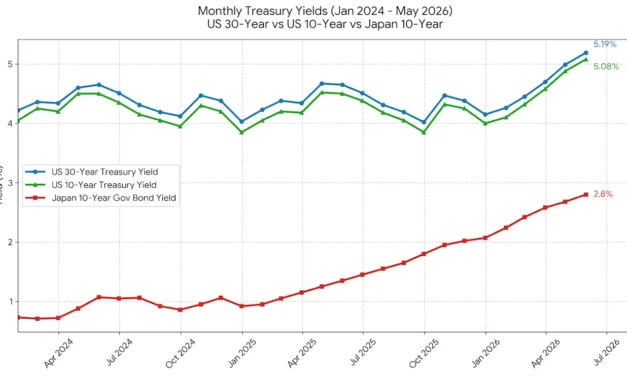
Rising government bond yields signal a coming “structural” shift that will create a Bitcoin “supercycle” of rising prices, as investors flee debasing assets for one that cannot be inflated, according to Shang Wu, a senior research analyst at crypto exchange BitMEX.The yield on the 30-year US Treasury broke past 5.14% on Tuesday, while the Bank of Japan’s 10-year government bond yield touched 2.8%, Wu said. These yields are unsustainable in the long-term and will force governments to choose between debasing their currencies and a “sovereign debt collapse,” Wu said.Bond yields for US and Japanese government debt from April 2024 to May 2026. Source: BitMEX“Central banks are backed into a corner. They must choose between a sovereign debt collapse and debasing their currencies,” Wu said. According to the analyst:“For Bitcoin, the upcoming volatility will be chaotic in the short term, but it serves as the ultimate structural tailwind for a long-term supercycle.” The analysis comes as the US national debt crosses $39 trillion, and growing geopolitical tensions threaten to boost government spending, while the ongoing war in Iran causes a surge in energy prices and a corresponding inflationary spike.Related: Bitcoin bounces as Trump prepares to announce ‘negotiated’ Iran dealRate hike won’t solve problem, it will simply bankrupt the governmentCentral banks typically use higher yields to tamp down inflation by restricting access to credit; when borrowing costs are high, consumers and investors borrow less, and asset prices fall.However, the $39 trillion US national debt, which continues to grow due to deficit spending, makes it impossible to control inflation by raising interest rates, as the higher rates would also increase the government’s debt servicing costs, Wu said.A forecast of what the annual US budget would look like if bond yields spike to 7%. Source: BitMEX“With the national debt at $39 trillion, keeping rates at these levels means the annualized interest expense of the government will soon consume the entire federal tax base,” according to the analyst.Wu and others, including macroeconomist Lyn Alden, say that the government and central banks will attempt to disguise quantitative easing by adding liquidity through other methods like yield curve control and unannounced buybacks of US government debt.  Magazine: Big Questions: Can Bitcoin save you from the dreaded Cantillon Effect?

Čítaj viac

Buterin fires back at Ethereum Foundation critics, recommits to neutrality

Ethereum co-founder Vitalik Buterin responded to growing criticisms of the Ethereum Foundation’s role in the Ethereum ecosystem, pushing back against critics who want the organization to take a more active role in supporting token prices and marketing.Buterin said the Foundation will continue to focus on promoting censorship-resistance, open source software code, long-range research, cybersecurity, and decentralization of the Ethereum Protocol, as outlined in its mandate. He said:“EF is not a ‘center of Ethereum’, rather EF is ‘one node, with a defined purpose, alongside other nodes’. We have always said that the EF should be the latter, but many in the Ethereum ecosystem, and even within the EF, wanted us to be the former. The Ethereum Foundation’s mandate was published in March 2026. Source: Ethereum Foundation“Now, we are taking action to ensure that we will be the latter,” he continued, adding that the Ethereum Foundation seeks to strengthen Ethereum’s cybersecurity and code base but not necessarily compete with high-throughput chains or scale to 1 million transactions per second.The comments follow several large ETH holders selling their entire ETH position and high-profile departures from the Ethereum Foundation, as the current price of the cryptocurrency, about $2,094, sits more than 50% below its all-time high of nearly $5,000 reached in August 2025.“The EF has only about 0.16% of all ETH,” he said, noting that it is common for other foundations to hold 10-50% of their native tokens.Related: Blockchain researcher defends Ethereum Foundation, says it’s doing ‘exactly’ its jobUnder pressure amid falling token price “I think Ethereum’s original sin was not considering tokenomics with every move it made from Dencun on,” cryptocurrency journalist Laura Shin said.The Dencun upgrade was a major protocol update released in March 2024, which significantly reduced network fees for layer-2 transactions and led to a subsequent collapse in Ethereum’s base layer revenue.Fees on the Ethereum layer-1 blockchain network fell significantly after the Dencun upgrade in March 2024. Source: Token TerminalMost investors “don’t want to believe in something that is not also putting up points on the scoreboard,” Shin said about ETH.Buterin said on Sunday that the Foundation would focus on “longevity” and stretch its funds to finance research, meaning it would sell less ETH in the future. In May, the Foundation unstaked 21,270 ETH from the Lido liquid staking platform, as part of its treasury strategy.Unstaking ETH means those holdings will no longer generate yield for the Ethereum Foundation, but it is not a confirmation that the organization will sell those tokens.Magazine: Why is Ethereum Foundation selling? BTC futures warning signs: Market Moves

Čítaj viac

FTX law firm Fenwick & West to pay $54M to victims in settlement

Fenwick & West LLP, the principal law firm that advised former cryptocurrency exchange FTX, agreed on Friday to pay $54 million to settle a 2023 class action lawsuit, filed by former customers of the defunct exchange.The plaintiffs allege that Fenwick “facilitated FTX’s fraud” by playing “a key and crucial role in the most important aspects of why and how the FTX fraud was accomplished,” according to the original complaint. Plaintiffs argue that the Silicon Valley law firm helped the now-bankrupt FTX obscure the misuse of customer funds by creating legal entities, structures and other strategies to hide the commingling of funds, including transfers between the exchange and its trading arm, Alameda Research.Court filing excerpt from $54 million settlement Fenwick & West LLP has agreed to pay. Source: PACERThese strategies also included advising FTX on creating legal structures that would alleviate the exchange from having to acquire money transmitter licenses. Fenwick initially sought to have the lawsuit dismissed before agreeing to settle with the plaintiffs in February. However, the settlement must still be approved by a US judge.The settlement marks the latest development in the legal fallout from the 2022 collapse of the FTX exchange, which sent shockwaves through the crypto industry at the time and exposed the sector to greater scrutiny from US regulators and lawmakers.Related: Law firm Fenwick & West sued for $525M over alleged role in FTX collapseFTX estate pays former customers and creditors at steep discount In March, the FTX Recovery Trust, which oversees the distribution of assets to former creditors and customers of the exchange, distributed $2.2 billion to the damaged parties.  The next tranche of reimbursements is scheduled for May 29.However, customers and former creditors of the exchange say the Trust has mismanaged the liquidation of assets, often selling the recovered assets at a steep discount or below all-time high values reached that were reached following the collapse of FTX. Source: SpaceXThe Recovery Trust sold a 5% stake in AI company Cursor for about $200,000 in April 2023, missing out on windfall profits when the value of that 5% stake ballooned to about $3 billion in April 2026. Magazine: Are DeFi devs liable for the illegal activity of others on their platforms?

Čítaj viac

70% of all crypto wrench attacks happen in France: Report

About 70% of all wrench attacks, physical attacks against crypto holders and their families, carried out in an attempt to steal digital assets, occur in France, according to Bitcoin journalist Joe Nakamoto. There have been 41 crypto-related kidnappings in France so far in 2026, Nakamoto said, or about one attack every two and a half days, he added. He attributed the rise in wrench attacks to know-your-customer data collection, which is stored in centralized servers that were compromised in several high-profile data leaks, including the 2020 leak of hardware wallet provider Ledger’s customer data.An overview of wrench attacks in France so far in 2026. Source: Joe NakamotoThat data leak disclosed the identities, home addresses and emails of more than 270,000 customers worldwide, he added. Jameson Lopp, the CEO of crypto wallet and key management company Casa, said:“France is the canary in the coal mine, demonstrating how financial regulations create a surveillance apparatus that causes direct harm to bitcoin holders.” Opposition to know-your-customer data collection is mounting inside the crypto and Bitcoin communities, as digital asset holders continue to be targeted with physical attacks and kidnappings, prompting a need for increased security measures.Related: Europe sees ‘hyperconcentration’ of crypto wrench attacks as losses hit $101MDon’t become a target: Bitcoiners offer advice to safeguard against attacksThe attacks are typically orchestrated by criminals living abroad, who contract young people living in France to carry out the physical attacks, Nakamoto said.Users can stay safe by using crypto custody services that offer security features like a pre-agreed-upon word or phrase that lets a custodial or key management company know the holder is being actively attacked.A database of known wrench attacks. Source: GitHubThe company can then freeze the assets, making sure they are not accessed by the attackers, and can even alert law enforcement authorities, he said.He also suggested keeping a “decoy” crypto wallet with a small amount of funds to hand over to criminals in the event of an attack. Finally, crypto holders should keep a low profile and not discuss crypto topics online or make it public knowledge that they hold digital assets, he added.At least 88 individuals have been arrested in connection with crypto wrench attacks in France, according to Vanessa Perrée, the country’s national prosecutor for organized crime.Magazine: Agent wastes 14 hours of scammers’ time, LLMs ‘poisoned’ by Iran: AI Eye

Čítaj viac

Získaj BONUS 8 € v Bitcoinoch

nakup bitcoin z karty

Registrácia Binance

Burza Binance

Aktuálne kurzy

