
Autor Cointelegraph By Turner Wright

Crypto PAC backed by Anchorage and Chainlink announces endorsements for 2026 midterms

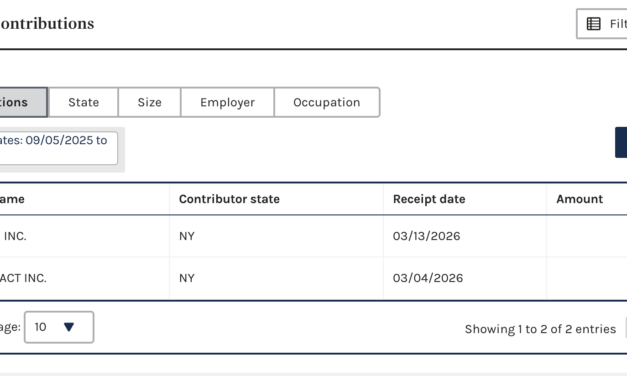
A political action committee (PAC) that claimed to “support candidates working to advance digital asset and blockchain policy in the United States” announced its picks for the 2026 election cycle, potentially influencing key races with money from the crypto industry.In a Thursday notice, the Blockchain Leadership Fund said it had endorsed ten candidates for the 2026 US midterm elections, four in the Senate and six in the House of Representatives. Chainlink Labs and Anchorage Digital announced the launch of the PAC in March amid other committees that spent heavily in the 2024 US election cycle, like Fairshake.The PAC’s picks included Republicans Barry Moore, Kurt Alme and Jon Husted for US Senate races in Alabama, Montana and Ohio, respectively, and Houston Gaines, Jim Kingston and Jon Bonck for House runs in Georgia’s 10th district, Georgia’s 1st district and Texas’ 38th district, respectively. It will also support Democrats Angie Craig’s run for the US Senate in Minnesota and Adrian Boafo, and Christian Menefee and Don Davis for House races in Maryland, Texas, and North Carolina. “We believe constructive bipartisan participation is critical to ensuring the US remains a global leader in financial technology and the future of finance,” said an Anchorage Digital spokesperson. “We remain committed to supporting responsible innovation and constructive policymaking that brings digital assets further into the regulatory perimeter and strengthens trust in the ecosystem.”Funding for Blockchain Leadership Fund. Source: FECThe committee, which is a hybrid PAC set up to allow contributions directly to candidates as well as independent expenditures, said it may announce support for other candidates “who support responsible digital asset policy” before the midterm elections in November. As of Thursday, filings with the Federal Election Commission (FEC) showed only $175,000 in funding for the Blockchain Leadership Fund: $100,000 from Anchorage and $75,000 from Chainlink.Related: Georgia primary to test crypto PAC’s support for Democratic candidateThe Blockchain Leadership Fund’s endorsements came after some of its chosen candidates won their respective primaries on Tuesday. Kingston and Gaines won Republican primaries in Georgia, and Moore will go to a runoff for Alabama’s US Senate seat after failing to secure a majority of the vote. All three already benefited from a combined $8.5 million in media spending by the Defend American Jobs PAC, a Fairshake affiliate, which also poured about $350,000 into media to support Bonck in Georgia. Another PAC affiliated with Fairshake, Protect Progress, spent more than $4.1 million to support Menefee in his Texas runoff against incumbent Al Green and more than $2 million on media for Boafo in Maryland.Crypto spending ahead of Texas Senate race, Trump gets involvedWhile Menefee and Green are set to go head-to-head next Tuesday, money from the crypto industry is also flowing into Texas over a Republican primary for one of the state’s US Senate seats.The Fellowship PAC, an $11 million committee funded by Cantor Fitzgerald and Anchorage Digital, reported to the FEC on Wednesday that it would be spending $500,000 to support Texas Attorney General Ken Paxton for US Senate. The filing came more than a month after Fellowship reportedly withdrew funding for media on Paxton in response to pressure from Republican leaders toward Commerce Secretary Howard Lutnick, connected to Cantor Fitzgerald. Truth Social post endorsing Ken Paxton for US Senate. Source: Donald TrumpUS President Donald Trump announced on Tuesday that he would be supporting Paxton over incumbent John Cornyn. State Representative James Talarico won a March Democratic primary, and will face off against the Republican candidate to be decided after a Tuesday runoff between Paxton and Cornyn.Magazine: 5 tech predictions the mainstream media got horribly wrong

Čítaj viac
Missouri AG sues crypto ATM operator CoinFlip ‘for enabling scams’

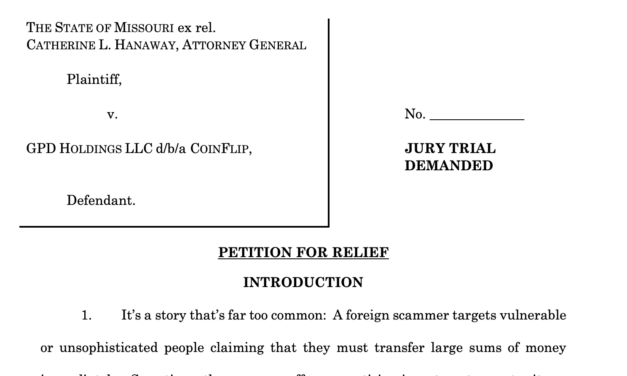
Missouri is suing the company behind cryptocurrency ATM operator CoinFlip for “knowingly facilitating fraudulent transactions and profiting from them,” in the latest move by a US state authority targeting digital currency kiosks and ATMs.In a Wednesday notice, the office of Missouri Attorney General Catherine Hanaway said the lawsuit against GPD Holdings, doing business as CoinFlip, was in response to incidents of fraud, including against the state’s “seniors and veterans.” The state began a probe in December into several crypto ATM companies, including Bitcoin Depot, which recently filed for bankruptcy.Missouri lawsuit against CoinFlip. Source: Missouri AG“The Attorney General’s Office is asking the Court to declare that CoinFlip’s practices violate the Missouri Merchandising Practices Act; to enjoin CoinFlip from operating in Missouri; to impose civil penalties of $1,000 per violation over the past five years (up to $1,826,000); and to award restitution to consumers,” said the AG’s office.According to CoinFlip’s website, the company operates 136 crypto kiosks in Missouri, and 4,229 in the US.In recent months, ATM operators like Bitcoin Depot, CoinFlip and others have been repeatedly targeted by US state authorities and municipalities which have passed laws and ordinances restricting or outright banning the technology. Related: Minnesota to weigh ban on crypto kiosks after scam reportsWarning about fraud from May 2025. Source: CoinFlipCointelegraph reached out to CoinFlip for comment on the lawsuit but did not receive an immediate response.Bitcoin Depot warned of lawsuits and regulations before filing for bankruptcyIn a May 12 filing with the US Securities and Exchange Commission, crypto ATM operator Bitcoin Depot said “substantial doubt exists about the Company’s ability to continue as a going concern.” The concerns over paying more than $20 in legal judgments in the fourth quarter of 2025 and “ongoing litigation matters” came just a few days before Bitcoin Depot filed for voluntary Chapter 11 proceedings in Texas. Bitcoin Depot was one of the largest crypto ATM operators in North America, responsible for more than 9,000 kiosks globally.Magazine: 5 tech predictions the mainstream media got horribly wrong

Čítaj viac

SEC’s ‘Crypto Mom’ to join law school, signaling end of time at regulator

Hester Peirce, a two-term commissioner at the US Securities and Exchange Commission (SEC), head of the agency’s crypto task force and known to many as “Crypto Mom,” will join the Regent University School of Law as faculty.In a Tuesday notice from Regent University, the law school said that Peirce would join as an associate professor starting in November. Her term at the SEC officially expired in June 2025, but commissioners “may continue to serve up to approximately 18 months after terms expire if they are not replaced before then,” according to the agency.She joined the SEC in January 2018, after her nomination by President Donald Trump and Senate confirmation in December 2017. She was confirmed for her second term in 2020. She was initially nominated by President Barack Obama for a Republican seat on the SEC in 2015, but the US Senate did not act on her nomination.Peirce is expected to help the law school bolster its academic focus in several areas, including federal litigation, securities regulation and digital assets, according to the university. Source: Hester PeircePeirce’s seat may not be filled immediately. Caroline Crenshaw, the agency’s previous Democratic commissioner, departed in January, 18 months after her term ended and no nominations to fill that seat have been made by President Trump. Peirce’s departure will leave only two Republican commissioners at the SEC: Mark Uyeda and Chair Paul Atkins.  Related: SEC rescinds defendant ‘gag rule’ when settling enforcement actionsSince Trump took office in January 2025, the SEC has radically changed its approach to crypto regulation and enforcement. The agency dropped several enforcement actions and investigations into crypto companies, including those tied to Trump and his family.CFTC also faces raft of vacanciesTogether, the SEC and Commodity Futures Trading Commission (CFTC) are the two most prominent federal financial regulators overseeing aspects of the crypto industry. Under Atkins and CFTC Chair Michael Selig, both Trump picks, the agencies said that they would coordinate on approaches to end what they called “regulatory turf wars.”Source: Paul AtkinsHowever, with a digital asset market structure bill moving through Congress, many lawmakers are calling on Trump to nominate a bipartisan group of commissioners to fully staff the agencies. Selig remains the sole CFTC commissioner and chair in a panel intended to be made up of five people, and with the impending departure of Peirce, the SEC will be down to two out of five commissioners. Trump had not announced any nominations to either agency as of Wednesday.The market structure bill, the CLARITY Act, is expected to shift many of the responsibilities and authority regulating crypto markets from the SEC to CFTC.Magazine: 5 tech predictions the mainstream media got horribly wrong

Čítaj viac
Fairshake PAC’s $20M backing pays off in three US state primaries

Political action committees (PACs) aligned with and funded by the cryptocurrency industry notched a series of wins in three US state primaries on Tuesday, potentially setting a precedent for the 2026 midterm elections.The Fairshake PAC and its affiliates poured a combined $20 million into supportive media for the races. The committee, largely funded by crypto companies Ripple Labs and Coinbase, is behind the Defend American Jobs PAC in supporting Republican candidates and Protect Progress PAC for Democrats considered to be “pro-crypto.”Four Republican candidates and one Democrat won their respective primaries for US Senate and House of Representatives seats in Georgia and Kentucky, while one Alabama Republican will go to a runoff election. “Fairshake’s 6-0 sweep tonight was a clear victory for pro-crypto leaders across the country,” Fairshake spokesperson Geoff Vetter told Cointelegraph. He said:“This powerful bipartisan mandate is being heard across America from Georgia to Alabama to Kentucky.”According to Federal Election Commission filings, Protect Progress spent more than $4.2 million to support Jasmine Clark, a Georgia representative running in the state’s 13th Congressional district. Defend American Jobs reported similar expenditures for media to support Republican candidates: $455,000 for Clay Fuller in Georgia’s 14th district, $709,000 for Houston Gaines in Georgia’s 10th district, $431,000 for Jim Kingston in Georgia’s 1st district and $7.2 million for Andy Barr for Kentucky’s US Senate seat. Barry Moore, who was supported with $7.4 million from Defend American Jobs in his run for Alabama’s US Senate seat, will head to a runoff against state Attorney General Steve Marshall and Republican candidate Jared Hudson, after none of the three not secured a majority of the vote in the primary.Source: Jasmine ClarkFairshake and its affiliates, backed by the crypto industry, are expected to spend millions of dollars in 2026 to “oppose anti-crypto politicians and support pro-crypto leaders,” according to a spokesperson in January. The company reported holding a $193 million war chest, far surpassing its 2024 expenditures of $130 million on media and ads to support congressional candidates.Related: Crypto PACs spend $7.2M to support candidates in 5 US states ahead of electionsDespite the multimillion-dollar expenditures, the crypto-backed PAC hasn’t always been successful in swaying enough voters before a key election or primary. Fairshake reportedly spent $8 million opposing Illinois Lieutenant Governor Juliana Stratton in her US Senate primary, but she beat other candidates with more than 40% of the vote.Coming Texas run-off seen again testing crypto PAC supportProtect Progress has ramped up spending on supportive media for Democratic candidate Christian Menefee, running to unseat incumbent Al Green in Texas’ 18th Congressional District. Representative Al Green addressing the House Financial Services Committee in March. Source: Al GreenAccording to FEC filings as of Tuesday, the PAC spent more than $4.1 million to support Menefee. It also reported spending more than $2.8 million on media to oppose Green, who has expressed anti-crypto views and voting records against the payment stablecoin bill GENIUS Act and digital asset market structure bill, the CLARITY Act.Protect Progress reportedly spent more than $1.5 million opposing Green ahead of a March primary against Menefee, but neither candidate secured a majority of the vote, triggering next Tuesday’s runoff.Magazine: 5 tech predictions the mainstream media got horribly wrong

Čítaj viac

CFTC sues Minnesota, Governor Tim Walz over prediction markets ban

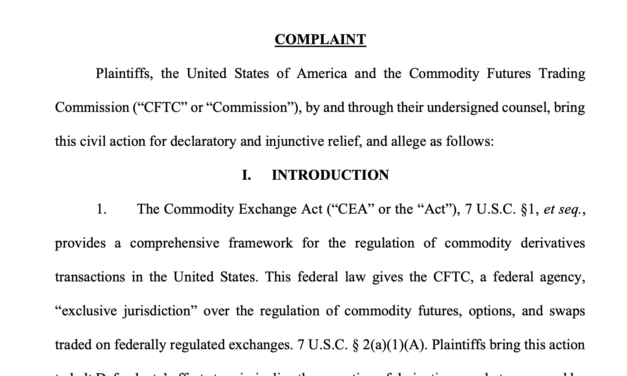
The US Commodity Futures Trading Commission (CFTC), under Chair Michael Selig, has filed a lawsuit against the state of Minnesota and its officials after lawmakers passed a bill “prohibiting prediction markets-related activities.”In a Tuesday filing in the US District Court for the District of Minnesota, the CFTC said that Minnesota, Governor Tim Walz, Attorney General Keith Ellison and the state’s director of the department of public safety, Jon Anglin, had passed the “first outright ban” on prediction markets in the country with Senate File (SF) 4760. Signed into law by Walz on Monday, the bill amended Minnesota’s statutes to prohibit advertising, creating, operating or otherwise facilitating prediction market platforms, effectively banning them in the state. The law, set to go into effect on Aug. 1, specifically said that the event contracts on prediction markets platforms like Kalshi and Polymarket, including sporting events, military conflicts and weather were effectively “wagers” and therefore prohibited.Source: CFTC The CFTC claims in its lawsuit that it has “exclusive jurisdiction” to oversee prediction markets under the Commodity Exchange Act. The commodities regulator asked a court to “preliminarily and permanently” block the Minnesota law based on the legal premise that event contracts on the platforms were “swaps” to be regulated exclusively by the CFTC.“If permitted to go into effect, Minnesota law will criminalize exchanges that the Commission has expressly approved, as well as event contracts that have been self-certified to the Commission and that the Commission has permitted to be listed,” said the lawsuit. “These consequences directly harm the federal government’s legally protected interest in enforcing federal law.”Related: Crypto’s CLARITY Act faces partisan fight over ethics on Senate floorSelig, who currently serves as the sole commissioner in the absence of nominations from US President Donald Trump, has repeatedly claimed that state-level actions against prediction market platforms would be challenged in court. Lawmakers have pressed Trump to nominate additional commissioners to form a five-person bipartisan panel at the CFTC, but the president had not announced any picks as of Tuesday.Several state authorities have filed complaints challenging prediction market platforms’ activities, specifically alleging illegal sports betting and other prohibited actions, but Minnesota’s law appeared to be the first outright ban passed by lawmakers. The CFTC has recently sided with Kalshi in a state-level action filed in Ohio, as well as against authorities in Connecticut, Illinois, and New York over similar actions against prediction markets.Source: Michael SeligCointelegraph sought comment from Polymarket but did not receive an immediate response. A Kalshi spokesperson said that the Minnesota law was “unenforceable” and a “blatant violation of the constitution and federal law.”Minnesota passing other laws covering crypto users, investorsOn Friday, Walz signed a bill into law permitting Minnesota-based banking institutions and credit unions to offer and perform “certain virtual-currency custody services.” Like the prediction markets ban, the law is set to go into effect on Aug. 1.Minnesota lawmakers also worked to ban crypto kiosks and ATMs across the state in response to incidents of residents being scammed. Walz signed the bill into law on May 5.Magazine: Crypto scammers face death, Aussie CGT makes Asian hubs attractive: Asia Express

Čítaj viac

Získaj BONUS 8 € v Bitcoinoch

nakup bitcoin z karty

Registrácia Binance

Burza Binance

Aktuálne kurzy
