Autor Cointelegraph By Turner Wright

Bermuda to transition ‘key’ financial services to Stellar blockchain

The government of Bermuda announced that it will begin moving payment and financial-services activities to the Stellar network as part of its plans to be a “fully on-chain national economy.”Speaking at the Bermuda Digital Finance Forum on Tuesday, Premier David Burt said that the island nation’s government, after risk assessments, could accept and invest in digital assets. In addition, Stellar announced that Bermuda would move certain financial services onto its network in response to high transaction fees.”The lack of mobile money applications and reliance on legacy payments infrastructure has left Bermudians paying high payment processing fees and hindered additional economic growth opportunities,” said Burt. “The use of digital dollars can change that, and the Stellar network’s capacity to support public sector initiatives are what make it possible to deliver this responsibly and at the scale Bermuda requires.”Source: StellarStellar is primarily classified as a Layer 1 blockchain. It is designed to facilitate fast and low-cost transactions across various currencies and assets. It powers cross-border payments, fiat on and off ramps, and stablecoin issuance for financial institutions, fintechs, and exchanges around the world.Burt announced at the World Economic Forum in Davos, Switzerland in January that the government had partnered with Circle and Coinbase. The island nation has been attempting to establish itself as a jurisdiction friendly to crypto companies since passing its Digital Asset Business Act in 2018.Related: DerivaDEX debuts Bermuda-licensed derivatives DEX“This is not the government, this is the private sector leading, working in concert with the government of Bermuda to go ahead and support this ecosystem,” said Burt.David Burt speaking at Bermuda Digital Finance Forum on Tuesday. Source: SALTAdoption of digital assets among merchantsWith a gross domestic product of about $9 billion as of 2024, Bermuda remains one of the smaller economies globally, turning to implementing policies favorable to digital asset companies. Some companies have likewise followed in expanding adoption through payments and merchants in other countries. Cryptocurrency exchange Bybit announced in April that it had expanded its services to South Africa by allowing users to pay merchants with digital assets. Magazine: Guide to the top and emerging global crypto hubs: Mid-2026Cointelegraph is committed to independent, transparent journalism. This news article is produced in accordance with Cointelegraph’s Editorial Policy and aims to provide accurate and timely information. Readers are encouraged to verify information independently.

Čítaj viac

Senate confirms Kevin Warsh as Federal Reserve governor, with chair vote expected

The US Senate has approved Kevin Warsh as the newest governor of the Federal Reserve, with a vote on his confirmation as chair of the central bank expected this week.In a 51 to 45 vote in the US Senate on Tuesday, lawmakers sided on party lines, with the exception of Democratic Senator John Fetterman, to approve President Donald Trump’s nominee. The chamber immediately followed by approving a motion to invoke cloture on a vote for Warsh as the next Fed chair, setting up a potential vote soon.Source: US SenateThe vote confirmed Warsh as a Fed governor for 14 years, and is expected to lead to lawmakers voting on his nomination for a four-year term as Fed chair. He previously served as a Fed governor under former US Presidents George W. Bush and Barack Obama from 2006 to 2011.Jerome Powell, whose term as Fed chair ends on Friday, has faced Trump’s repeated threats to fire him. His term as a Fed governor will continue until 2028, but the shakeup in the leadership of the US central bank has the potential to move markets amid concerns over changing interest rates and the Fed’s independence from the White House’s policies. Related: Federal Reserve chair nominee’s disclosure includes crypto and AI holdingsWarsh said in a 2025 interview that Bitcoin (BTC) was a “transformative” technology and “an important asset that can help inform policymakers.” During his confirmation hearing in the Senate Banking Committee, however, many Democrats questioned whether as Fed chair he could remain independent from the president’s policy agenda.Crypto market structure bill markup scheduled for ThursdayThe vote on the nomination came the same week that US lawmakers on the Senate Banking Committee will choose whether to advance a digital asset market structure bill expected to change oversight and regulation of cryptocurrencies. On Monday, the panel’s leadership released the text of its version of the Digital Asset Market Clarity Act (CLARITY), that included a compromise provision on stablecoin yield that had long been a sticking point for many in the crypto and banking industries.On Thursday, the banking committee will hold a markup on CLARITY, potentially setting the bill up for a vote in the full Senate.Magazine: XRP ‘probably going to $12,’ Bitcoin ETFs add $1B: Market MovesCointelegraph is committed to independent, transparent journalism. This news article is produced in accordance with Cointelegraph’s Editorial Policy and aims to provide accurate and timely information. Readers are encouraged to verify information independently.

Čítaj viac

Latest version of crypto market structure bill raises eyebrows ahead of Senate markup

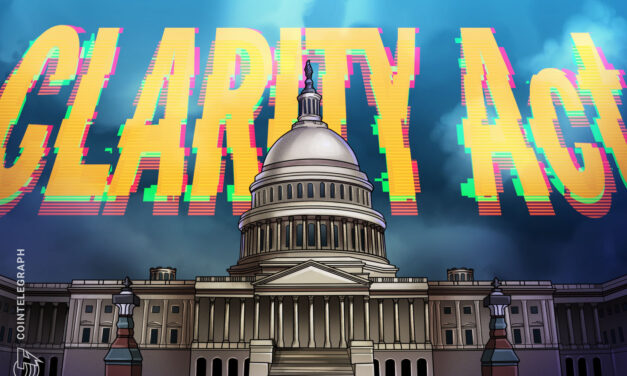
The recently released text of the Digital Asset Market Clarity Act (CLARITY) in the US Senate Banking Committee is raising some eyebrows among experts before a scheduled Thursday markup for provisions on housing and the lack of ethics language.On Monday, three Republican lawmakers unveiled the text of the bill lawmakers will use to consider advancing crypto market structure legislation in the banking committee. It followed drafts released in July and September 2025, building upon discussions between crypto and banking industry representatives over stablecoin yield.Text of CLARITY Act. Source: US Senate Banking CommitteeHowever, the latest version includes provisions seemingly unrelated to crypto market structure. In the last pages of the legislation was a provision on housing called the Build Now Act, which, according to a section-by-section summary of the text, was aimed at creating “a pilot program to incentivize housing development of all kinds in certain Community Development Block Grant participating jurisdictions.”According to Senators Tim Scott, Cynthia Lummis, and Thom Tillis, the bill reflected “continued negotiations with Democratic colleagues,” signaling bipartisan support in Thursday’s markup. However, some Senate Democrats, including Kirsten Gillibrand, said that they would not vote for market structure on the floor without clear provisions on ethics to address potential conflicts of interest.“We have worked too hard on this bill to give up now,” Senator Angela Alsobrooks, who sits on the banking committee and announced the stablecoin yield compromise with Tillis, told Cointelegraph. “My hope is to get to a bipartisan markup on Thursday with a compromise on ethics.”Related: Seven Democrats seen as ‘key’ to advancing CLARITY Act: GalaxyThe CLARITY Act is expected to give the Commodity Futures Trading Commission (CFTC) more authority in overseeing and regulating digital assets, in a shift of roles usually handled by the Securities and Exchange Commission (SEC). The Senate Agriculture Committee passed its version of the bill in a January markup, but the legislation must pass the banking committee, full Senate, and reconcile in the House of Representatives before potentially being signed into law.What‘s in the bill?CLARITY explicitly prohibits paying interest or yield on payment stablecoins, with the exception of “rewards or incentives based on bona fide activities or bona fide transactions that are not economically or functionally equivalent to the payment of interest or yield on an interest-bearing bank deposit.” The bill also included language from the Blockchain Regulatory Certainty Act, legislation proposed to protect developers from money transmitter requirements. The advocacy organization DeFi Education Fund said in a Monday X post that it was “encouraged by the direction of recent negotiations” over the bill, noting the software developer protections. Lawmakers did not include any provisions on ethics related to Democrats’ concerns over US President Donald Trump’s crypto ventures, such as his memecoin and his family’s World Liberty Financial business.“This bill puts investors, our national security and our entire financial system at risk – and it will turbocharge Donald Trump’s crypto corruption,” said Massachusetts Senator Elizabeth Warren in response to the bill. “In just one year in office, the President and his family have raked in at least $1.4 billion in gains from crypto deals alone, and yet this bill stunningly includes zero provisions to prevent that.”The Senate Agriculture Committee voted along party lines to advance the bill in January, but the legislation would require 60 votes to pass the Senate even if the same were to happen in the banking committee on Thursday. When stablecoin payments legislation, the GENIUS Act, was under consideration in the Senate in June 2025, many Democrats joined with Republicans to pass the bill in a 68-30 bipartisan vote.Magazine: Guide to the top and emerging global crypto hubs: Mid-2026

Čítaj viac

Ethics remain a sticking point as crypto market structure bill goes to markup

With lawmakers on the US Senate Banking Committee set to consider a markup on a cryptocurrency market structure bill this week, some Democrats are holding the line — and potentially their votes — on ethics provisions.The Digital Asset Market Clarity Act (CLARITY), passed by the US House of Representatives in July 2025, is scheduled for a markup in the Banking Committee on Thursday after months of delays due to concerns about language on stablecoin yield, tokenized equities, ethics and more issues related to the crypto industry. Although the Senate Agriculture Committee passed its version of the bill in a January markup, the legislation must pass through both panels to address different aspects of securities and commodities laws.“Negotiations continue to be positive, and I remain confident we can get a bipartisan bill over the finish line this Congress,” Senator Kirsten Gillibrand told Cointelegraph. “Americans deserve a well-regulated market with strong consumer protections and real ethics reforms so politicians can’t cash in on their insider status for personal gain.”Earlier this month, Senators Thom Tillis and Angela Alsobrooks, both of whom sit on the banking committee, announced a compromise deal on stablecoin yield that could allow the CLARITY Act to move forward after months of delays. However, New York’s Gillibrand said that even if the bill were to pass the banking committee, her fellow Democrats would not vote in favor of CLARITY without an ethics provision to deal with potential conflicts of interest by members of Congress, elected officials and the US President and Vice President.Prediction market sentiment on CLARITY Act passage. Source: PolymarketRelated: 7 Democrats seen as ‘key’ to advancing CLARITY Act: GalaxyEven before taking office in January 2025, US President Donald Trump had close ties to the industry, through the launch of his memecoin Official Trump (TRUMP) and his family’s crypto business, World Liberty Financial. Forbes reported that the president’s personal fortune had increased by about $1.2 billion as of July 2025 due to his crypto ventures. Full steam ahead for some Republican lawmakersSenator Tim Scott, the Republican who chairs the banking committee, said that concerns about the president’s crypto ties were outside the body’s purview for markup and needed to be addressed by the ethics committee before any potential floor vote in the chamber. Tillis, also a Republican, said in April that he would not support any bill without “a bipartisan agreement when it comes to the ethics provision.” Cynthia Lummis, Wyoming’s junior senator who has led the charge on the bill in the Senate and will be retiring in 2027, has urged lawmakers to vote for CLARITY on Thursday.Source: Cynthia Lummis“I’m hopeful, given that there seems to be so much momentum from the Democrats, from the Republicans saying ‘hey, we’re ready to get a deal to get this done’ that they can resolve ethics and that it won’t hold this up,” Cody Carbone, CEO of crypto advocacy organization The Digital Chamber, told Cointelegraph. “Ethics has to be tackled on the floor, it’s not within the jurisdiction of the Senate Banking Committee, so I don’t expect it to hold up the markup.”Even if the bill were to advance in the banking committee and get the 60 votes needed to pass in the Senate, CLARITY would likely need to return to the House for both chambers to pass a reconciled version before it could go to Trump’s desk to potentially be signed into law.Magazine: Strategy reveals why they would sell BTC, Trump Media posts loss: Hodler’s Digest, May 3 – 9

Čítaj viac

MoonPay makes prediction markets push with Dawn Labs buy, AI tool launch

Financial technology company MoonPay announced the launch of an AI technology tool for trading strategies on prediction markets following its acquisition of Dawn Labs for an undisclosed amount.MoonPay said Monday that it had launched Dawn CLI in an effort to facilitate trading strategies “in plain English,” citing activity on prediction market platforms like Polymarket and Kalshi. Dawn Labs founder Neeraj Prasad said the tool will democratize trading “by general intelligence.”“Prediction markets are one of the fastest-growing categories, attracting a new generation of active traders across platforms like Polymarket and Kalshi,” MoonPay said in its announcement. “These traders use signals from social media, automated strategies and cross-platform positioning, but the infrastructure required for high performance remains fragmented, manual and technically demanding.”Source: MoonPayThe move closer to prediction markets comes as Kalshi and Polymarket face several state-level lawsuits over allegations that the companies are illegally facilitating sports betting and other activities not permitted by state law. Until December 2025, Caroline Pham, MoonPay’s chief legal officer, was a commissioner and acting chair at the US Commodity Futures Trading Commission (CFTC), which has since claimed exclusive jurisdiction over prediction markets.Related: MoonPay releases open-source wallet standard for AI agentsTrading on prediction markets continues to be under scrutiny by many US lawmakers and industry leaders given the platform’s models often allowing insider trading. In April, a soldier was charged with using classified information about the US military operation to capture former Venezuelan President Nicolás Maduro to make more than $400,000 through event contracts on Polymarket.Kalshi increases valuation to $22 billionMoonPay’s acquisition followed prediction markets platform Kalshi closing a $1 billion funding round last week, resulting in the company reaching a valuation of about $22 billion. The move effectively doubled Kalshi’s valuation in five months. Magazine: Strategy reveals why they would sell BTC, Trump Media posts loss: Hodler’s Digest, May 3 – 9Cointelegraph is committed to independent, transparent journalism. This news article is produced in accordance with Cointelegraph’s Editorial Policy and aims to provide accurate and timely information. Readers are encouraged to verify information independently.

Čítaj viac

Získaj BONUS 8 € v Bitcoinoch

nakup bitcoin z karty

Registrácia Binance

Burza Binance

Aktuálne kurzy