Autor Cointelegraph By Tom Mitchelhill

Crypto trading in rubles falls even as ECB warns again on sanctions

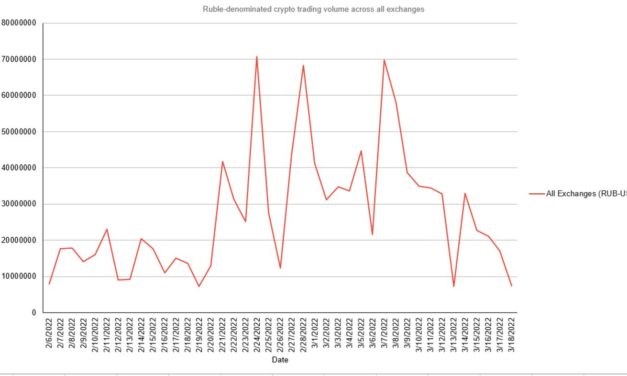
The President of the European Central Bank, Christine Lagarde has reiterated warnings that Russian individuals and businesses are using cryptocurrencies to skirt sanctions.However, as of March 18, daily ruble-denominated crypto trading volume was sitting at just $7.4 million, down over 50% from recent figures and a peak of $70 million on March 7, according to data from Chainalysis. This amount represents a tiny slither of the total global crypto market volume, with Bitcoin’s total daily volume generally fluctuating between $20 billion and $40 billion. In a presentation at the Bank for International Settlements Innovation Summit on Tuesday, the crypto skeptic Lagarde said that European financial authorities had seen the “volumes of rubles into stable, into cryptos, at the moment [is at] the highest level that we have seen since maybe 2021.” Lagarde did not point the finger at the Russian government and outlined that it was primarily Russian individuals and businesses turning to cryptocurrencies. However she said that cryptocurrencies “are certainly being used as a way to try to circumvent the sanctions.” “So is it [crypto] a threat? Yes. Has it … been a threat in the past? Yes, because when you look at a lot of the dubious transactions that are taking place, a lot of the criminal activities payments that are taking place, very often you find some crypto assets.”Lagarde’s comments seem to be at odds with data provided by Chainalysis and Kaiko, as well as that of expert opinion. The Blockchain Association’s Jake Chervinsky has said that Russia is unlikely to utilize crypto assets as a method of circumventing Western sanctions. Ruble-denominated trading volume across all crypto exchanges. Source: BloombergData provided by crypto analysis firm Kaiko, showed that ruble to USDT volume is down 86% from its peak of $38 million on March 7 to less than $5 million on March 22. There was a surge in the lead up to the war and spikes afterward, but volumes are now back to levels below that seen throughout most of early February. That’s before sanctions were imposed.Related: Fighting economic warfare with crypto’s double-edged swordConversely cryptocurrency is playing a role in helping Ukrainian refugees escape the country. CNBC told the story of a Ukrainian refugee using the pseudonym “Fadey” who fled the war torn nation with $2000 in Bitcoin on a cold wallet, which made it far easier for him to access his monetary assets once he had reached safety in Poland. Alex Gladstein, chief strategy officer for the Human Rights Foundation, said that trying to withdraw money from Ukrainian banks in the weeks leading up to the invasion was incredibly difficult and highlighted the difficulties faced by refugees currently attempting to access their funds from countries like Poland. “How are you going to access your Ukrainian bank account in Poland? Good luck.”Donations made to Ukraine via crypto assets have skyrocketed over the past 3 months with the overall daily donations being made to Ukraine now sitting at $100.9 million, according to data from Merkel Science.

Čítaj viac


Optimism saves users $1B in fees, raises $150M in Series B

Popular Ethereum scaling solution Optimism has announced a $150 million Series B funding round co-led by Andreessen Horowitz (a16z) and Paradigm at a total valuation of $1.65 billion. According to a blog post from Optimism, the Layer 2 (L2) solution has saved users of the Ethereum network over $1 billion in gas fees. The funding will be used to expand the Optimism team and go towards working on reducing network fees even further. Fees on the Optimism network were reduced by a cumulative 30% last year, and now the team is contributing work towards an Ethereum Improvement Proposal (EIP-4844) for Shard Blob Transactions, which may potentially reduce Ethereum network fees by up to 100x in the near future. Today on Ethereum #AllCoreDevs, our very own @protolambda presented EIP-4844: Shard Blob Transactions.https://t.co/3yagEcvdz4With the potential to decrease fees by 100x for all rollups, and a practical path to implementation, we strongly support this EIP.But how, you ask?— Optimism ✨ (@optimismPBC) March 4, 2022L2 solutions like Optimism, have grown massively in popularity due to the increased demand for NFTs, smart contracts and DeFi applications on the Ethereum network, which in turn congests transaction processing and drives up gas fees. Optimism works by employing “optimistic rollups” , which aggregates transactions outside of the Ethereum blockchain, providing the benefits of reduced slippage, decreased transaction costs and vastly improved transaction speeds.According to data tracker, L2Beat the total value locked (TVL) on L2 platforms has grown to $5.76 billion, with Optimism currently ranked in fourth place amongst its L2 peers, with around $440 million in TVL on its platform. Kain Warwick, Australian crypto veteran and founder of Synthetix, a decentralized derivatives exchange, told his 107,000 twitters followers that he not only participated in the Optimism funding round, he “doubled down hard” expecting Optimism to “be up there with ETH in size soon.”Disclosure I participated in this round following on from the previous round but I double down hard. My portfolio by size is now looking like this:SNXETHILVGRTBTCOP (optimism)I expect Optimism to be up there with ETH in size soon, I wonder what the catalyst might be… https://t.co/yBw4mBtDz4— kain.eth L222 (@kaiynne) March 17, 2022

Late last year, Optimism expanded from its whitelist only status and made the network publicly accessible, meaning that any developer could start building a project on the Optimism network. ​​Related: Optimism announces upgrades enabling ‘one-click’ roll-up deploymentMaking network development publicly available offers some major upsides in terms of increased output, but as iOS jailbreak developer Saurik discovered, it also allows the potential for “critical bugs” to occur. Luckily, Saurik, real name Jay Freeman, discovered one such bug in early February, which would have allowed malicious hackers to create infinite ETH on the network and notified the Optimism team. He was paid a $2 million bug bounty, one of the largest bounties to date.

Čítaj viac

Aussie fintech to offer mainstream direct access to DeFi with a fixed rate

Australian fintech company, Block Earner, has officially gone live, offering everyday investors a 7% fixed rate investment product by utilizing decentralized finance (DeFi) technology.Block Earner has already attracted attention from big names in the crypto industry, finalizing a $6.4 million seed funding round in December last year. It was led by Framework Ventures and joined by Coinbase Ventures, DeFi Alliance, LongHash Ventures, as well as crypto veteran Kain Warwick, the founder of Synthetix, an Australia-based crypto derivatives exchange. Jordan Momtazi, the co-founder of Block Earner, said in an interview to Cointelegraph that Australia’s current economic climate makes products that offer yields on savings attractive, especially when it is practically impossible to achieve similar returns using methods offered by traditional financial institutions. According to a survey conducted by Block Earner and Sydney-based market researcher Pure Profile, 86% of Australians have noticed the recent effects of inflation and 22% are concerned about how they will make ends meet considering the rising price of goods and services. Comparing the difference between the benchmark of returns between traditional finance and DeFi, Momtazi said: “The best returns Australians can get from a traditional savings account ranges from 0.1-0.3% — compare that to a 7% product like Block Earner, it’s easy to see where people are going to end up.”Momtazi continued to say that the entire point of Block Earner is to make sure that everyday Australians have access to new technology without doing any “heavy lifting” so that they can grow their savings over time. Block Earner works by converting Australian dollars into a U.S. dollar stablecoin called USD Coin (USDC). Block Earner lends that USDC into two primary DeFi protocols called Aave and Compound, which provides investors with a yield.It is also worth noting that Block Earner is the first fintech company to grant mainstream integration into Aave and Compound. While Momtazi promises that investors will receive a fixed 7% return until July of this year, he added that Block Earner’s variable interest rate product could see investors potentially rewarded with up to 18% per annum returns.The burgeoning and largely unregulated realm of DeFi is not without its risks and companies like Block Earner remain exposed to the issues that occasionally occur in DeFi, such as malfunctioning smart contracts, the lack of demand for lending products and the liquidity pools (Aave and Compound) suffering some form of attack. Related: Aave launches v3 liquidity pool following unanimous governance decisionMomtazi stressed that Block Earner is a “conservative” company, emphasizing that the company “chose stablecoins like USDC because of its security and its legitimacy.” We believe being conservative is part of the long-term project. We believe that safety and trust is a fundamental part of a long-term strategy, and we’re just not opting for double digital returns from other less regulated areas.”Tempering the fears of crypto skeptics, Momtazi continued to state that the continued performance of Block Earner will gradually prove the legitimacy of DeFi over time. “New things are always seen as scary, and that’s natural — we will prove the legitimacy of DeFi technology with continued performance,” While Block Earner is registered with Australian financial intelligence agency AUSTRAC and protects investors’ funds with Fireblocks, one of the world’s largest digital custodians, the company did not need to apply for an ASIC license. Speaking on the issue of potential regulation of DeFi products from the Australian government, Momtazi was completely optimistic, stating that regulation is a positive measure for the crypto industry, and Block Earner is ready to fit into what regulatory measures Australian legislators deem appropriate. “Legislation legitimizes this space in a much better way… and so far things in regards to regulation have been very positive; enforcing standards around the custody of assets, and maintaining bare minimum levels of auditing — to bring that altogether is only a positive thing.”

Čítaj viac

Bored Ape NFT holders to receive ApeCoin: ‘The Dogecoin of NFTs’

Owners of Bored Ape Yacht Club (BAYC) NFTs — including celeb holders like Eminem, Steph Curry, Jimmy Fallon and Mark Cuban — are set to receive a brand new token called ApeCoin (APE) as yet another incentive for being part of the exclusive digital asset club. The developer of the new token is the ApeCoin DAO and is notably separate from Yuga Labs. Introducing ApeCoin ($APE), a token for culture, gaming, and commerce used to empower a decentralized community building at the forefront of web3. — ApeCoin (@apecoin) March 16, 2022Owners of BAYC NFTs will be able to claim approximately 10,000 ApeCoin each, but the 1 billion soon-to-be-released ApeCoin tokens will also be distributed amongst a series of different parties. According to the ApeCoin DAO website, 62% of the total supply will be added to an ecosystem fund,14% will be given to “launch contributors,” 9.75% of tokens will be held by the creators of BAYC, Yuga Labs, 8% of the tokens will go directly to the founders of Yuga Labs, and the remaining 6.25% is to be donated to the Jane Goodall Foundation, a charity dedicated to preserving the habitats of chimpanzees. While the token itself remains technically separate from Yuga Labs, the firm is set to fully adopt ApeCoin as the “primary token for all new products and services” that emerge from Yuga Labs. According to the Yuga Labs, this includes a yet to be released, play-to-earn blockchain game that the team at Yuga Labs plans to release later this year with game developer nWay.ApeCoin will also be used in the upcoming play-to-earn game Benji Bananas, a game from Hong Kong-based blockchain gaming company Animoca Brands, that also owns nWay.1/ @animocabrands has proposed AIPs 4 & 5, these are live on Discourse for viewing. AIP 4 covers a novel staking mechanism to reward @apecoin and BAYC ecosystem NFT holders. AIP 5 proposes the size of the staking liquidity pools – 17.5% of the total token allocation over 3 years— Yat Siu (@ysiu) March 16, 2022

Co-founder of Animoca Brands and ApeCoin DAO board member Yat Siu told Cointelegraph that ApeCoin is a step forward in the progression of NFTs. “ApeCoin a token that represents the zeitgest of NFTs today — it is, in a sense, the expression of the current culture of NFTs”He stated that ApeCoin is set to become the “Dogecoin of NFTs where the utility is community created and community valued.” Siu is optimistic about the future of ApeCoin, but noted that utility would be provided straight away though games:“ApeCoin itself has some starting utility, [which will] kick off with games and more to come… the benefits will be the creative energy that combines this mix of technology and culture that the BAYC community has kicked off already, [which] will reach much larger audiences due to the fungible and transferable nature of ApeCoin.”Related: Gaming industry to have a ‘blockchain-connected’ future, studio execs saySince launching in April last year, Bored Ape Yacht Club has grown to become on the highest profile NFT collections and continues to add high profile celebrities to its owners list, now including Paris Hilton. Last week, Yuga Labs acquired two of the other largest NFT projects — CryptoPunks and Meebits, expanding its dominance over the burgeoning NFT market. According to the official website ApeCoin will be available for purchase on all major exchanges,

Čítaj viac

Congress members concerned SEC stifling innovation with crypto scrutiny

In a bipartisan letter put forward by Republican Minnesota Congressman Tom Emmer, a cohort of Congress members has written to Securities and Exchange Commission (SEC) Chairman Gary Gensler, challenging the regulator’s scrutiny of cryptocurrency firms and expressing concern that “overburdensome” investigation may be suffocating the crypto industry. They suggest the SEC is drowning companies in paperwork in contravention of the SEC’s stated aims and mandated jurisdiction. Emmer tweeted to his 51,000 followers: “My office has received numerous tips from crypto and blockchain firms that SEC Chair @GaryGensler’s information reporting ‘requests’ to the crypto community are overburdensome, don’t feel particularly… voluntary… and are stifling innovation.”This is why I sent a bipartisan letter today to SEC Chair @GaryGensler with @RepDarrenSoto, @WarrenDavidson, @RepAuchincloss, @RepDonaldsPress, @RepJoshG, @RepTedBudd, and @RepRitchie regarding the SEC’s crypto information seeking process. pic.twitter.com/8HcTgZA0XL— Tom Emmer (@RepTomEmmer) March 16, 2022In the letter, which was co-signed by four Democrats and three Republicans, all of whom are members of the bipartisan Congressional Blockchain Caucus, Emmer asserts that the Gary Gensler-led SEC is abusing its investigative powers and overburdening crypto firms — claiming that the regulator has been using the Division of Enforcement and Division of Examination authorities to unfairly bog down crypto and blockchain companies in excessive paperwork.The legislators believe the regulator has been misusing these divisions and pointed out limitations in the SEC’s mandated jurisdiction,“It appears there has been a recent trend towards employing the Enforcement Division’s investigative functions to gather information from unregulated cryptocurrency and blockchain industry participants in a manner inconsistent with the Commission’s standards for initiating investigations.”The Congress members believe the SEC could be violating the Paperwork Reduction Act (PRA) of 1980, which regulates the volume of paperwork that any individual or private entity needs to provide to a federal agency.Managing Partner at emerging technologies legal firm Brookwood, Collins Belton lauded Emmer’s work on Twitter, saying that the requests in the letter “will not paint the commission in a good light.”This is actually an interesting move I wasn’t expecting, clearly some of y’all in DC have gone to work. The requests in the letter are particularly on point and will *not* paint the commission in a good light imo, and that’s solely off of the requests I’m personally aware of. https://t.co/ElguJ77sEa— Collins Belton (@collins_belton) March 16, 2022

Belton also shared that he was “really glad” the issues raised by Emmer and the other Congress members were coming to light, as legal privilege had made it difficult for him to express concerns about the SEC publicly. “I haven’t been able to discuss much in public as much as I would like to due to privilege issues, but with answers to some of these, I think the public will see just how absurdly broad some of these requests have been.”Related: Motions denied for both SEC and Ripple as battle continuesEmmer has been a staunch defender of blockchain technology and cryptocurrency in the past, introducing the Security Clarity Act in Jul. 2021, which aimed to provide a clear legal definition for digital assets. Emmer hopes that the bill will allow blockchain entrepreneurs to distribute their assets without fear of any additional regulatory burdens, after meeting the requirements set out in the bill. The bill is still in its introduction phase and is yet to pass through the House of Representatives.

Čítaj viac

Získaj BONUS 8 € v Bitcoinoch

nakup bitcoin z karty

Registrácia Binance

Burza Binance

Aktuálne kurzy