Autor Cointelegraph By Tom Mitchelhill

Cash App and Chivo help drive Lightning payment volume up 400%

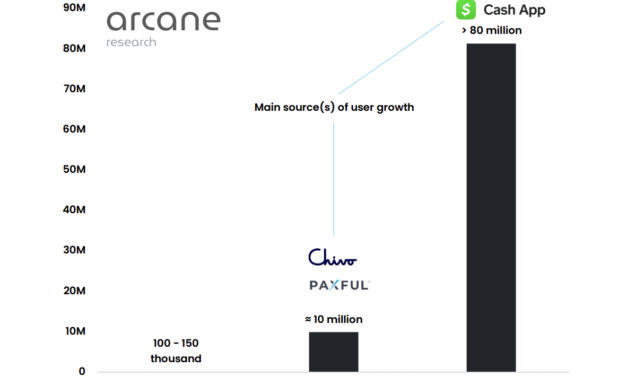
A new report highlights how the Lightning Network has grown in popularity as a way of transferring digital assets quickly and efficiently around the globe. CNBC today told the story of Alena Vorobiova, a Ukrainian refugee currently seeking sanctuary in Poland. Vorobiova used Lightning to transfer $100 worth of Bitcoin from Miami, where it was then withdrawn from an ATM in the equivalent Polish currency — all within the space of three minutes. That’s the sort of low cost, high speed transaction that has seen the Layer 2 scaling solution for Bitcoin grow 410% in payment volume over the past year.According to the report published by Arcane Research, the number of payments that occurred on the Lightning Network in the past year doubled while the total value of those payments quadrupled. The report warned that the widely-cited public metrics used to measure Lightning Network adoption — most commonly total value locked (TVL) — underestimate the size of the network as they fail to count private channels and invisible nodes. Additionally, the metrics don’t reflect real world Lightning Network usage, whereas looking explicitly at payment volume paints a clearer picture of real Lightning adoption. A partial explanation for the surge in payment is owed to the enormous increase in the number of users who have recently gained access to the Lightning Network. This is through apps like El Salvador’s Chivo Wallet and US-based payment application, CashApp. The State of Lightning Vol. 2 Report: Arcane ResearchArcane estimated that in Aug. 2021, roughly 100,000 users had access to Lightning payments. By March of this year, over 80 million people had the ability to access payments on the Lightning Network , which shows that there is a large potential user base. The report found that roughly 50% of the value of all payments came from direct transactions between individuals — Peer-to-Peer (P2P) transactions. Almost one third of the payment value came from exchange withdrawals and deposits, with the remaining 20% coming from purchases made through some form of vendor.Related: Lightning to strike Shopify merchants with addition of BTC paymentsDespite Bitcoin being originally designed as an electronic cash system — the sluggishness of the Bitcoin networks in resolving transactions gave rise to layer-2 solutions. The Lightning Network was launched in March 2018 to provide faster and cheaper BTC transactions.

Čítaj viac
Samson Mow’s new company JAN3 helping build Bitcoin City in El Salvador

Samson Mow, former chief strategy officer of Blockstream and founder of Pixelmatic, said on Thursday that he has started a new company called JAN3 which will focus on accelerating Bitcoin adoption. The Chinese-Canadian Bitcoin entrepreneur told Reuters that JAN3 has already signed a memorandum of understanding to assist in developing digital infrastructure in El Salvador.”It’s a general MOU that says we’ll work together to build digital infrastructure for the country and for Bitcoin City.”Mow added that making the decision for JAN3 to work with El Salvador was an easy choice, “I just set up my company and I said ‘do you want to work together?’ and they said ‘sure.’”Mow and his new firm will work alongside El Salvador’s President, Nayib Bukele, and its government to assist in the establishment of Bitcoin City, a development that will reportedly use geothermal power from nearby volcanoes to power Bitcoin mining as well as the city‘s infrastructure.According JAN3’s recently established Twitter account, which boasts a rapidly growing follower count of 3,300, the company has reportedly raised $21 million in funding at a valuation of $100 million.The funding round was led by Alistair Milne, the CIO of Atlanta Digital Currency Fund, Chun Wang, the co-founder of crypto mining firm F2Pool, as well as El Zonte Capital, a new investment fund founded by prominent Bitcoin bull Max Keiser and his wife, Stacy Herbert.The news comes as Mow spoke at the Bitcoin 2022 Conference, where he announced that two new jurisdictions — The Caribbean island of Roatán and Madeira, an autonomous region of Portugal — would be adopting Bitcoin as legal tender. Mow also mentioned Mexico, however the country is still considering the idea. Related: Bitcoin 2022: Thiel calls Buffett ‘sociopathic’, Mexican billionaire has 60% in BTCThe name “JAN3” is a reference to Jan. 3rd, 2009, which is the day that Bitcoin’s pseudonymous founder, Satoshi Nakamoto mined the first block — also known as the “genesis block” — of Bitcoin. Playing on this namesake, the company’s first tweet was a not-so-cryptic reference to The Times’ headline on that day.

Čítaj viac

Terra buys $200M in AVAX for reserves as rival stablecoins emerge

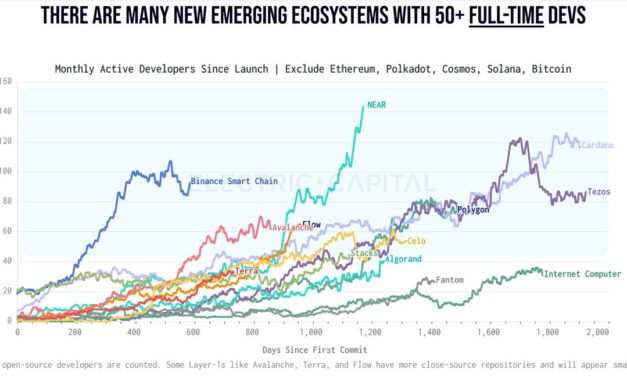
Terraform Labs (TFL) and the Luna Foundation Guard (LFG) have announced they have purchased a combined $200 million worth of AVAX tokens from the Avalanche Foundation. TFL, the company responsible for the development of the Terra blockchain, swapped $100 million worth of Terra’s native token, LUNA for AVAX tokens, in order to “strategically align ecosystem incentives”, according to Terra’s twitter. LFG, a non-profit organization mandated to build reserves for Terra’s algorithmic stablecoin UST, used its own holdings of UST to purchase an additional $100 million worth of AVAX from the Avalanche Foundation.These purchases are meant to reinforce the stability of Terra’s native UST stablecoin, which currently has a market cap of $16.7 billion. Do Kwon, the founder of Terraform Labs, told Bloomberg that LFG selected AVAX for its UST reserves because of solid growth in the blockchain’s ecosystem as well as the stark loyalty of its users. “Avalanche is still a growing ecosystem — a lot of it is fueled by loyalty to the AVAX token and users feel a lot of affinity with an asset that aligns itself with AVAX…whereas for the average Ethereum user, aligning yourself with Ether doesn’t really mean that much.”As Terra continues to strengthen the position of UST, competitors are looking for new ways to dethrone the stablecoin. Near Protocol (NEAR), a Layer-1 blockchain and competitor to both Ethereum and Terra, is rumored to be releasing a stablecoin called USN, which will reportedly also offer a decentralized finance protocol capable of providing users with a 20% annual percentage yield (APY) on their USN deposits. This is similar to the Terra ecosystem’s Anchor protocol which currently offers users a 19.49% APY on UST deposits. In a Substack post detailing what he understands of the plans, Crypto Insiders Telegram group founder Zoran Kole argued that Near protocol was superior to both Etheruem and Terra, offering data from Electric Capital that outlined Near Protocol’s substantial growth in terms of development. Source: Zoran KoleKole concluded that Near’s network growth combined with its soon-to-be-released USN stablecoin and subsequent DeFi protocols could eventually allow for Near Protocol with an $11.7 billion market cap to catch up to and eventually eclipse Terra, which has a market cap of $37.2 billion. “This will lead to a comparison of Near to Terra ($LUNA) as the narrative for attractive stablecoin yields proliferates.”

Čítaj viac

Bitcoin 2022: Thiel calls Buffett 'sociopathic', Mexican billionaire has 60% in BTC

Day two of the Bitcoin 2022 in Miami was as colorful as we’ve come to expect, with Pay-Pal co-founder and venture capitalist Peter Thiel offering up his Bitcoin “enemies list” while Mexico’s third-richest man, Ricardo Salinas revealed he has 60% of his portfolio in Bitcoin. Thiel, one of the keynote speakers, took to the main Nakamoto stage of the conference in the early afternoon and kicked the speech off in style by throwing a wad of $100 bills into the crowd in an attempt to explain the difference between crypto and government-backed fiat currency. As the crowd quickly reached for the money, Thiel joked, “I thought you guys were supposed to be itcoin maximalists.”He then gave an energizing pro-Bitcoin speech in which he predicted that Bitcoin would increase 100-fold from today’s price and that traditional finance markets would eventually crumble. “The central banks are going bankrupt. We are at the end of the fiat money regime.”Thiel also offered up his enemies list in which he gave legendary Berkshire Hathaway investor Warren Buffett the top spot, labeling him “Enemy No.1”. Thiel called Buffett a “sociopathic grandpa” — obviously taking issues with the Berkshire Hathaway CEO’s Bitcoin-critical commentary. Thiel’s list also included JPMorgan Chase CEO, Jamie Dimon and Blackrock CEO, Larry Fink, denouncing the group of billionaires for running a “gerontocracy” — a society ruled by old people — against cryptocurrency. Later in the day Mexican billionaire, Ricardo Salinas used his 15 minutes on the main stage to take aim at bonds and announce that he currently holds 60% of his entire liquid investment portfolio in Bitcoin — a considerable increase from the 10% that he held in Dec. 2020.“I definitely don’t have any bonds… I have 60% in Bitcoin and Bitcoin equities, and then 40% in hard asset stocks like oil and gas and gold miners, and that’s where I am.”Salinas, whose net-worth is estimated to be roughly $12.8 billion, was an early investor in Bitcoin. In an interview with Cointelegraph, Salinas said that he purchased his first Bitcoin in 2013, when the average price was roughly $200 a piece. Earlier in the day, Samson Mow, the former chief strategy officer of Blockstream, announced two new jurisdictions would be moving to adopt Bitcoin as legal tender. The Caribbean island of Roatán and Madeira, an autonomous region of Portugal confirmed that they will be adopting BTC as legal tender. Mexico is also reportedly considering the move. Related: Mayor unveils ‘Miami Bull’ statue with laser eyes to kick off Bitcoin 2022El Salvadoran president, Nayib Bukele was scheduled to speak second-last on Thursday, however the Bitcoin Conference officially announced his withdrawal on Twitter on April 7, quoting “unforeseen circumstances.” There is currently a state of emergency in the country due to spiraling gang violence. Day 3 of the Bitcoin 2022 conference will feature more talks from high-profile guests including a fireside talk with famous psychologist Jordan Peterson, a keynote speech from legendary investor Mike Novogratz, as well as a presentation by Thiel Capital director, Eric Weinstein.

Čítaj viac

One-fifth of global Bitcoin hash rate is now controlled by listed companies

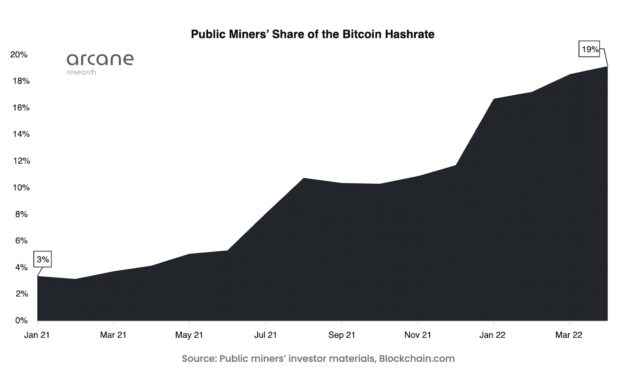
A recent report has shown that nearly one-fifth of the total share of Bitcoin’s hash rate now belongs to publicly-listed mining companies.The report, published by Arcane Research, details that publicly-listed Bitcoin (BTC) mining companies now account for 19% of Bitcoin’s total hash rate, growing considerably from a mere 3% in Jan. last year. Public miner’s share of BTC hash rateThe term hash rate refers to the total computing power used by a miner’s computing equipment to confirm a transaction. A higher hash rate ensures increased protection against double-spending attacks, which is the process of reversing BTC transactions over the blockchain by contributing to at least 51% of the BTC hash rate. While there were only a small number of public mining companies at the beginning of last year, there are now a total of 26 different public companies involved in Bitcoin mining, an increase driven by the growing number of mining companies going public. The report suggests that the growth in the number of public mining companies has been driven by public companies having greater access to capital, which allows them to expand their mining fleets faster than their private competitors.At present, 44.95% of the global hash rate emerges from North American miners, according to the latest data from the Cambridge Bitcoin electricity consumption index. With the massive projected increases in target hash rate among the publicly traded Bitcoin miners, this number is expected to increase, which means that the Bitcoin network will become gradually more centralized over time. Related: Miners that hodl the most Bitcoin are ‘relentlessly expanding’Bitcoin 1 year hash rate: YChartsThe rate of Bitcoin mining has grown substantially over the past few years as the crypto asset’s hash rate reached a new all-time high of 248.11 exahashes per second (EH/s) on Feb. 18 of this year. Currently, the network’s hash rate is at 213.16 EH/s, roughly two hundred and thirteen quintillion hashes per second.

Čítaj viac

Získaj BONUS 8 € v Bitcoinoch

nakup bitcoin z karty

Registrácia Binance

Burza Binance

Aktuálne kurzy