
Autor Cointelegraph By Tom Mitchelhill

Binance embarrassed after unveiling swastika-like emoji… on Hitler's birthday

Binance, the world’s largest cryptocurrency exchange, released a new Binance Emoji on Twitter that users noticed bore a striking resemblance to a swastika. On Wednesday morning, Binance CEO, Changpeng Zhao (CZ) retweeted Binance’s original post, adding “#binance” to show off the new emoji. The original posts, which have since been deleted, were quick to do the rounds on Twitter in the form of screenshots, where users immediately began criticizing the resemblance . The new Binance emoji is a literal swastika pic.twitter.com/lCOuWuPnyF— mann0000.eth (@nftshare) April 20, 2022Smaller Twitter account, Nftshare posted about it to their 300 followers which gained more than 6000 likes and hundreds of retweets, saying that “The new Binance emoji is a literal swastika” while other large accounts on Crypto Twitter rushed to make jokes about Binance’s gaffe. Compounding the mistake, users also pointed out the fact that April 20 also happened to be Hitler’s birthday. Most didn’t assume that Binance was making an intentional reference to the Nazi party, nor did they assume the error was as a result of celebrating cannabis day 4/20 a little too enthusiastically. After initially deleting the tweets from its own and CZ’s Twitter pages, Binance backpedaled by taking the emoji down and making a public apology nearly eight hours after the incident first went viral. Binance told its 8.4 million followers that the error was obviously really embarrassing. “We’re not sure how that emoji got through several layers of review without anyone noticing, but we immediately flagged the issue, pulled it down, and the new emoji design is being rolled out as we speak.”If I was the worlds largest cryptocurrency exchange, I would just not make my logo a swatiska on Hitler’s birthday— Bennett Tomlin (@BennettTomlin) April 20, 2022

While being quite blunt in his criticism of Binance, crypto-critic Bennet Tomlin tempered his attack by saying that the people working on the logo may not have had the cultural knowledge to understand how it could have been misinterpreted. The swastika symbol — which is synonymous with Nazism in the west — was originally used as a symbol for divinity and spirituality by many ancient East-Asian religions and remains a familiar sight on temples across countries like Japan.

Čítaj viac

Robinhood CEO outlines how DOGE could become 'currency of the internet'

Robinhood CEO Vladimir Tenev took to Twitter on Thursday afternoon to explain how Dogecoin could become the “future currency of the internet.”In a thread of 12 posts to his nearly 200,000 followers, Tenev outlined what steps need to be taken to transform the memecoin into a usable asset for everyday payments and transactions on the internet. Can #Doge truly be the future currency of the Internet and the people? As we added the ability to send/receive DOGE on Robinhood, I’ve been thinking about what that would take.— VLAD (@vladtenev) April 14, 2022Tenev began by drawing attention to the fact that Dogecoin’s transaction fees — roughly $0.003 per transaction — are already small enough to place the altcoin as a feasible e-cash frontrunner.He believes the block size and the block time of Dogecoin are the main areas that require improvement if the cryptocurrency is to become widely adopted.Ideally, the block time (time between successive blocks being added to the chain and to verify a transaction) should be fast enough that the transaction can be recorded in the next block in less time than it takes to pay at a point of sale terminal.— VLAD (@vladtenev) April 14, 2022

Dogecoin currently has a 1MB block size and a 1 minute block time which means that Dogecoin’s total throughput stands at approximately 40 transactions per second (TPS).In comparison, the VISA network has a throughput of approximately 65,000 TPS — meaning that DOGE would need to increase its total throughput by roughly 1,625 times in order to be on par with VISA. Tenev says that this isn’t a worry, and can be solved simply by increasing DOGE’s block size limit from 1MB to 1GB and eventually to 10GB. Tenev finished the thread with a message to the developers of Dogecoin, urging them to focus on increasing the block size limit above all else. This just in: Guy who loves databases wants to turn memecoin into a database. https://t.co/EzVSomnJwq— kain.eth L222 (@kaiynne) April 15, 2022

Tenev’s thread was published just three hours after Dogecoin creator Jackson Palmer took aim at former “Dogecoin CEO” Elon Musk’s planned potential hostile takeover of Twitter. “It takes some pretty impressive mental gymnastics to associate any type of ‘freedom’ with the richest man in the world initiating a hostile takeover and forcing one of the largest public social media platforms private,” said Palmer in a tweet to his 41,000 followers. Palmer doesn’t mince words when it comes to criticizing Musk. In mid-May last year, Palmer called Musk a “self absorbed grifter” and claimed that the billionaire’s viral performance on Saturday Night Live was “cringe, bro.”The price of Dogecoin remains relatively unaffected by these recent events, with the token trading sideways between the $0.14 and $0.15 mark over the past seven days.

Čítaj viac

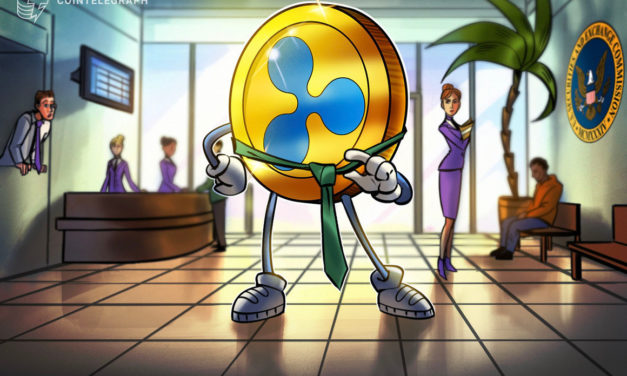
Ripple CEO: SEC case is going ‘much better than I hoped’

Ripple CEO Brad Garlinghouse is increasingly optimistic that the long-running case with the Securities and Exchange Commission (SEC) will deliver a positive result for the blockchain-based global payments company. Speaking on the main stage at Paris Blockchain Week on Thursday, Garlinghouse told attendees of the fireside chat that Ripple’s defense in the ongoing case was faring better than he expected. “The lawsuit has gone exceedingly well, and much better than I could have hoped when it began about 15 months ago.”Live from #PBWS2022, @bgarlinghouse sat down with @cnbc’s @ryan_browne_ to talk crypto regulation, Ripple’s global traction and use cases that he sees growing across the industry. pic.twitter.com/ouQYhY3B5n— Ripple (@Ripple) April 14, 2022The SEC filed suit in 2020 against Ripple and its senior executives Brad Garlinghouse and Christian Larsen for selling unregistered securities in the form of XRP. The comments come following a RippleNet community lawyer’s announcement that Ripple had secured a “very big win” against the SEC after Presiding Judge Sarah Netburn denied the SEC’s request to reconsider shielding documents under privilege. The documents were related to a speech delivered by former-SEC Director, William Hinman, where he specified that Bitcoin (BTC) and Ethereum (ETH) are not securities.“This case is important, not just for Ripple; it’s important for the entire crypto industry in the United States,” said Garlinghouse. He added that if Ripple were to lose the case, a precedent could be set that would see most tokens on cryptocurrency exchanges become recognized as “securities” by the SEC. This would mean that exchanges can be forced to register with the SEC as brokers and exchanges would be compelled to register the identity of all token holders. Related: SEC scores a minor victory in legal dispute with Ripple Lab“If you determine XRP as a security of Ripple, we have to know every person that owns XRP,” he said. “That’s an SEC requirement. You have to know all of your shareholders. It’s not possible.”However, a convincing Ripple victory could see the SEC take a step away from its aggressive pursuit of the crypto industry. Stay up to date with Paris Blockchain Week with live updates from Cointelegraph. Check the first-day coverage here.  See the second-day reporting here. 

Čítaj viac

Japan’s most popular social messaging app Line adds NFT marketplace

Japan’s largest social media app, Line has officially launched its own non-fungible token (NFT) marketplace called LINE NFT. Partnering with Yoshimoto Kogyo, a major Japanese entertainment conglomerate — the LVC Corporation, Line’s crypto and blockchain manager — will offer approximately 40,000 different NFTs to its 90 million users. The first wave of soon-to-be-released NFTs will include videos from the company’s in-house, Yoshimoto NFT Theatre, as well depictions of characters from well-known anime series, Patlabor the Mobile Police, with more to come on offer in the coming months.Also NFTs from the iconic anime series Patlabor the Mobile Police, and NFTs of other popular characters. At a later point, more #NFTs from a variety of genres will be available.#nftigoo #NFTanime pic.twitter.com/32ZGRbt0Lb— Nftigoo (@nftigoo) April 13, 2022Users will store their purchased NFTs in the LINE BitMa wallet, a product offered in conjunction with crypto-exchange BitMax. The app adds NFT capabilities to a growing list of crypto-ready features, after introducing the option of allowing users to pay for items with its native LINK token (LN) at any of LINE Pay’s online merchants, earlier this year. Line has a reputation for being among the first major technology companies in Japan to adopt cryptocurrency and blockchain technology, after launching its very own crypto exchange in 2018. Related: Japanese business giant Nomura to explore crypto and NFTs with new unitNFTs are becoming increasingly popular throughout Japan, despite the country’s relatively strict crypto regulations. The Japanese financial services conglomerate Nomura Holdings is the latest major player in the country to develop an action plan for implementing NFTs. Earlier this year, major Japanese e-commerce firm Rakuten announced the launch of its own NFT trading platform, dubbed Rakuten NFT.

Čítaj viac

BoJ official says digital yen won’t be used to achieve negative interest rate

The Bank of Japan (BoJ) has said that its Central Bank Digital Currency (CBDC), the digital yen, will not be used to help attain negative interest rates. The BoJ’s Executive Director, Shinichi Uchida made the announcement in his most recent public speech. “While the idea of using such a functionality as a means to achieve a negative interest rate is sometimes discussed in academia, the Bank will not introduce CBDC on this ground.”Japan initially adopted negative interest rates in 2016 in an attempt to combat decades of deflation by encouraging borrowing and spending. Negative interest rates are only used as a last resort by central banks during a recession to stimulate an economy by encouraging borrowing and spending, with interest being paid to borrowers rather than lenders.Echoing this sentiment was former head of the BoJ’s financial settlement department Hiromi Yamaoka, who warned earlier this year that CBDCs could potentially destroy the Japanese economy. While Yamaoka agreed with the idea of digitizing payment methods, he did not support the idea of using a CBDC for it.Senior Wall Street Journal columnist James Mackintosh has similarly argued that the difference between a CBDC and cash would be highlighted if interest rates fell below zero. People would be more inclined to hold on to physical cash to “earn zero” rather than lose money on a digital dollar issued by the central bank.In his speech, Uchida stated that if the creation of digital yen does move forward, then Japanese citizens can expect the CBDC to be released with a series of unique features.The bank is considering imposing a limit on the transaction amount of each individual or entity for the duration of the pilot, and is also contemplating whether or not to make the digital yen an interest-bearing asset.The BoJ first shared its three-phase trial outline for its central bank digital currency (CBDC) in October 2020. The first two phases of the trial are focused on testing the proofs-of-concept while the third phase would see a pilot currency be launched.The first phase began in April 2021 and finished on March 22 this year. The BoJ began its second phase of trials on March 24, stating that it would begin testing the more technical aspects around the issuance of the digital yen.However, the governor of the BoJ, Haruhiko Kuroda, announced at Japan’s FIN/SUM fintech summit earlier this month that it has no plans to introduce a CBDC anytime soon. Related: Former BOJ official warns against use of digital yen in the financial sectorKuroda explained that the BoJ plans to carefully consider the expected roles of central bank money in the lives of Japanese citizens before making any major decision or announcements.“We consider it important to prepare thoroughly to respond to changes in circumstances in an appropriate manner, from the viewpoint of ensuring the stability and efficiency of the overall payment and settlement systems.”The popularity of CBDCs continues to grow as governments around the world look to the potential benefits of the digital assets. On Tuesday April 12, Brazil’s central bank confirmed that a CBDC pilot program would be launching by the second half of this year, while the Reserve Bank of South Africa finalized its technical proof-of-concept concerning its CBDC.

Čítaj viac

Získaj BONUS 8 € v Bitcoinoch

nakup bitcoin z karty

Registrácia Binance

Burza Binance

Aktuálne kurzy