Autor Cointelegraph By Tom Mitchelhill

Aurora launches $90M fund to finance DeFi apps on Near Protocol

Aurora, an Ethereum Virtual Machine (EVM) designed to scale decentralized applications (DApp) built on the Near protocol, has launched a token fund worth $90 million. The fund was launched today in partnership with Proximity Labs and will be focused on financing decentralized finance (DeFi) applications on the Near protocol. Near Protocol is a DApp platform that focuses on usability among developers and users. As an emerging layer-1 competitor to Ethereum, Near Protocol is also smart-contract capable and runs a proof-of-stake consensus mechanism. Funding was provided by Aurora Labs, which allocated 25 million AURORA tokens — currently valued at roughly $90 million — from its DAO treasury to proximity labs.As a result of the funding model, Proximity Labs will now be responsible for managing the funds and providing grants to developers aiming to build DeFi Dapps on Aurora. The Aurora Labs team believes that the token-based funding structure will also increase activity across the network.The founder of Aurora Labs, Dr. Alex Shevchenko stated that the launch of the new token fund will help make developing Ethereum applications on the Near protocol more attractive to developers. “Aurora DAO continues its mission to extend the Ethereum economy outside Ethereum blockchain. This grant is a next big step in the development of the Aurora ecosystem and I’m happy that Proximity Labs accompanies us in this journey.”The EVM is a blockchain-based computer engine at the core of Ethereum’s operating system, responsible for transaction execution, smart contract deployment and other operating functionalities, in addition to enabling developers to build DApps on its blockchain.Related: From smart insurance to on-chain document verification: Here’s how NEAR aims to improve KenyaAn increasing number of independent blockchains have adopted the EVM as the default smart contract engine, including BNB Chain, Avalanche Chain, Polygon and Fantom.

Čítaj viac


Doge gets more love on Twitter and Ethereum gets more hate: Data analysis

Ethereum has taken out the top spot on Twitter as the most hated of five cryptocurrencies studied, while the meme-token Dogecoin is the most liked.The findings emerged from a new report by TRG Datacenters that analyzed a year’s worth of tweets between Jan. 2021 to Jan. 2022, concerning five of the most popular cryptocurrencies to figure out which digital assets were the most emotionally stirring on Twitter. According to the analysis — which looked at Bitcoin (BTC), Cardano (ADA), Dogecoin (DOGE), Ethereum (ETH) and Litecoin (LTC) — Ethereum was firmly the most negatively associated with 29% of all tweets containing a negative sentiment. (The decision not to include Ripple, which has ardent fans but also very passionate critics, probably makes the study less comprehensive than it should have been.) The bulk of the criticism leveled at Ethereum concerned its speed compared to other Layer 1 alternatives, as well as its energy costs. Peak Ethereum negativity from Crypto Twitter occurred when a bug caused Ethereum to briefly split into two chains in late Aug. 2021. Bitcoin was the second-most hated on Twitter with a 27% total negativity score. Cardano followed a distant third with a 16% negative association, while Litecoin sat in fourth place with just 8% of all tweets having a negative angle. The report collected data in such a way that negative sentiment tweets were analyzed based on the inclusion of the following phrases and the name of each cryptocurrency; “Hate,” “is a scam,” “disappointed with” / “disappointed,” “dip in,” “bad,” “lost money with”/ “loss on.”Dogecoin was the crowd favorite on the social media platform, with just 6% of all tweets concerning the popular memecoin containing some form of unfavorable sentiment. This means that 94% of all tweets concerning DOGE contain a positive slant, displaying the strength and cohesiveness of the token’s community on Crypto Twitter. Dogecoin’s popularity was closely linked to the token’s healthy relationship with the social media platform’s new owner, Elon Musk. Musk’s public decision to accept DOGE as payment for Tesla merchandise drove sentiment to all-time-highs. Chris Hinkle, the Chief Technology Officer at TRG Datacenters drew attention to the different types of influence that Twitter has on the price of crypto assets. “Meme stocks in particular appeared to be driven by retail investors. In the case of larger currencies such as Bitcoin, tweets have actually lagged price movements, implying some degree of institutional lean.”“[This] means that small cap stocks and coins in general are experiencing a very real phenomenon of price fluctuations led by retail investors,” Hinkle added. Related: Ice Cube backs DOGE and an ‘incredible and historical’ transactionHinkle went on to explain that the recent acquisition of Twitter by Musk may lead to a more retail-driven crypto market, claiming that Musk’s newfound influence may “perhaps pave the path for less algorithmic manipulation and the beginning of a new era of retail investors.”

Čítaj viac

Ethereum whales get busy as transactions hit highest point since January

Despite widespread losses being posted throughout the crypto market, Ethereum whales have been busy buying and selling Ether (ETH) at a rate not seen since January this year. According to data from Santiment, Ethereum whales made a total of 2,956 transactions, each valued at over $1M on Wednesday, marking the highest day of whale transactions in nearly 5 months. Santiment clarified that whales are typically defined as any account holding between $1M to $10M. #Ethereum’s whales have been extremely active today, firing off 2,596 transactions valued at $1M or more. This is the highest day of whale transactions since January, and something to monitor if $ETH drops below $2k for the first time since last July. https://t.co/FZoTsFJwEn pic.twitter.com/MVFEpzysxN— Santiment (@santimentfeed) May 11, 2022The data comes as the ETH/BTC paring also continues its display of relative strength, despite the Terra-based contagion that continues to put downward pressure on the market and general sentiment. Earlier this week on May 6, ETH/BTC reached a three week high and according to market analysis from Cointelegraph the paring is hinting at a potential breakout, particularly as both Bitcoin (BTC) and Ether approach what Santiment has called their “historic buy zones.” Notably, Ethereum has grown by nearly 250% against Bitcoin since the Beacon Chain went live, marking the beginning of its migration to proof-of-stake in December 2020. It isn’t just the Ethereum whales that have been busy either — according to data from Glassnode, Wednesday also marked the largest one day transfer of Bitcoin from Whale Entities to exchanges. Speaking to Cointelegraph, Carlos Gomez, the Chief Investment Officer at Belobaba crypto hedge fund said that this type of market activity may mean crypto investors are closer to the bottom of the current market dip than they realize. Isn’t it clear enough? pic.twitter.com/PQwfb6Eu4z— Carlos Gomez (@hedgefundcarlos) May 11, 2022

Gomez said that the above graph shows a “clearly coordinated movement of most of the large holders in a specific 24-hour-window,” meaning that whales are continuing to hunt for weak hands.Related: 10-month BTC price lows spark $1B liquidation as Bitcoin eyes $35K CME futures gapGomez added that it’s hard to say whether or not the bottom is well and truly in but he suggested that “recent evidence shows that we’re not too far from it — the only thing is, we may have to live down here at these levels for a few weeks before going up again”

Čítaj viac

NFT collectors sent $37B to marketplaces in 2022, nearly equaling 2021 already

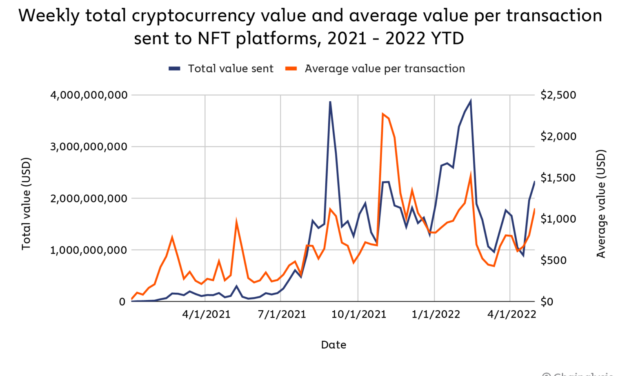
Collectors of non-fungible tokens (NFTs) have already sent more than $37 billion in value to NFT marketplaces this year (as of May 1), a figure that nearly exceeds the total amount in all of 2021. According to a report from Chainalysis, investors sent $40 billion worth of cryptocurrency to smart contracts associated with NFT collections and marketplaces throughout 2021. Source: ChainalysisSince the beginning of last year, NFT transaction volume has grown considerably, but the overall growth of the industry has been inconsistent. The report outlines that NFT transaction volume occurs sporadically, and has been in a downturn since mid-February. The NFT market has since made a brief recovery as of mid-April — most likely due to the recent hype around Moonbirds and the Bored Ape Yacht Club’s metaverse project, Otherside. Despite the short-term fluctuations in NFT transaction volume, the number of people around the world buying and selling NFTs remains strong, with 950,000 unique addresses buying or selling NFTs in Q1 2022. As of May 1, Q2 2022 491,000 unique addresses have transacted with NFTs, putting the market on track to continue its growth trend in the number of participants. By analyzing the web traffic of the major NFT marketplaces, Chainalysis determined that NFTs attract users from all corners of the globe, with Central and Southern Asia leading the charge, followed closely by North America and Western Europe.Source: ChainalysisRelated: The NFT sector is projected to move around $800 billion over next 2 years: ReportThe report contradicts the conclusion of a recent article published by the Wall Street Journal, which claimed that NFT sales were flatlining. The article stated that “The NFT market is collapsing,” yet, in the same week the top five NFT collections alone accounted for more than $1 billion in primary and secondary sales.Chainalysis’ report also comes the day after Coinbases’ launch of its in-house NFT marketplace failed to generate any major interest. On-chain data showed that a mere 150 transactions occurred on May 4 — the first day of trading — with just $75,000 in volume moving through the platform.

Čítaj viac

Hop Protocol reveals details of Hop DAO and Optimism-style airdrop

Hop Protocol, a cross-chain bridge designed to facilitate the quick transfer of tokens between different Ethereum Layer-2 scaling solutions, has unveiled a new governance model alongside an airdrop that will see early users receive 8% of the total supply of soon-to-be-released HOP tokens.Similar to Optimism, which recently unveiled a new governance structure that will see early users airdropped 5% of the total supply of the OP token — Hop Protocol is aiming to create a community-oriented governance model, called Hop DAO, that seeks to aid Layer-2 scalability.An official date for the airdrop is yet to be announced. repost:There will be an initial supply of 1b $HOP tokens:• 8% airdropped to early users• 60.5% to the Hop treasury• 22.45% to the initial development team (3 yr vesting, 1 year cliff)• 2.8% saved for future team • 6.25% to investors (3 year vesting, 1 yr cliff) pic.twitter.com/rQ7xcGa9ba— HopProtocol (@HopProtocol) May 5, 2022Speaking to Cointelegraph’s Elisha Ayaw on Twitter Spaces, co-founder Chris Winfrey said that Hop Protocol and the Hop DAO airdrop, were designed with unique models for both governance and bridging in mind. “We see Hop as core Ethereum infrastructure. It’s very important for users to be able to move their assets from one rollup to the next. For this reason, we believe Hop should be a community-owned bridge,” said Winfrey. Speaking on the structure of the airdrop, Winfrey said, “the goals of designing the airdrop were to… make sure that that you know early liquidity providers were rewarded”“For the users that provided a lot of liquidity, those folks got a lot more HOP, so that piece of the air drop was very plutocratic,” Winfrey continued. Winfrey noted that the Hop Protocol bridging mechanism is unique, allowing the Hop team to isolate a bridge attack or network threat quickly and minimize harm to users. “If a catastrophic event were to happen, we can isolate the event to only the place where it’s happening and protect users.””Hop uses an intermediary asset called the H token for every asset we support. Each of these H tokens is claimable on L1 for the underlying asset, and at any time you can send it back to L1 and get the underlying token,” added Winfrey. According to data compiled by Chainalysis, bridge hacks have cost the cryptocurrency industry more than $1 billion over the past year, underscoring major security vulnerabilities of the new technology. The recent Axie Infinity Ronin bridge hack is perhaps the most infamous attack, with the attackers stealing over $600 million worth of digital assets in just two transactions.Related: Ape-themed airdrop phishing scams are on the rise, experts warnCurrently, Hop supports the transfer of ETH, USDC, MATIC, DAI, and USDT from and to the following networks; Mainnet, Polygon, Optimism, Arbitrum, and xDai.Rollups settle the transactions outside of the main Ethereum network but post the transaction data back to the Ethereum network.

Čítaj viac

Získaj BONUS 8 € v Bitcoinoch

nakup bitcoin z karty

Registrácia Binance

Burza Binance

Aktuálne kurzy