Autor Cointelegraph By Tom Farren

MakerDAO deploys on layer-2 network StarkNet to enhance functions of DAI stablecoin

MakerDAO, a decentralized autonomous organization serving the popular DeFi lending protocol Maker, has announced an upcoming deployment schedule on the decentralized zero-knowledge (ZK) Ethereum rollup, StarkNet.Expected to become fully operational in the third quarter of this year as identified in the protocol’s roadmap, the integration will seek to enhance the multichain capabilities of their dollar-pegged stablecoin DAI, and associated Maker Vaults function, by striving to reduce transactional cost and throughput speed on the network.The move is largely consistent with their overarching multichain strategy first witnessed via the launch of DAI token bridges on both Optimism and Arbitrum One in March and September 2021, respectively.Core Unit Facilitator at StarkNet Engineering, Louis Baudoin noted that “as we see unsustainable gas fees drive more activity and users to a wider variety of blockchains, security challenges that come with bridging will continue to grow”, before stating that:“Projects must move on to Layer-2 to continue to serve users, and MakerDAO is partnering with StarkNet to do exactly that. With this strategy, we are positioned to cement the Maker’s Protocol’s position as the leading decentralized lending protocol in the industry, and also the status of DAI as the most decentralized, secure stablecoin.”Related: MakerDAO community proposal to replace MKR governance tokenBullish for our first Twitter Space! ️ @prose011 will be the host of this first edition in which we’ll talk with @KryptoKiril from @Nexo.Main topic: $MKR, $DAI, @Nexo and CeFi & DeFi integrations.When?: April 21 4 PM UTCWhere?: Here, in this Twitter account! pic.twitter.com/3HmlgyCNlV— MakerDAO Growth (@MakerGrowth) April 19, 2022In February this year, StarkWare co-founders Uri Kolodny and Eli Ben-Sasson spoke to Cointelegraph about the scalability requirements for the cryptocurrency’s mainstream adoption. This followed the launch of their inaugural decentralized applications (dApps) on the StarkNet platform.According to analytical data from DeFi Llama, MakerDAO is currently placed fourth in the leaderboard for total-value-locked with $14.24 billion, only behind Curve, Lido and Anchor.

Čítaj viac
Web3 initiative Reli3f has raised over $1.5M for Ukrainian aid efforts

Reli3f, a humanitarian initiative birthed upon the innate artistic commitment to narrate stories in times of hardship, launched their second nonfungible token (NFT) collection Thursday, raising over $300,000 for recognized Ukrainian charities and taking their total to over $1.5 million.Founded by several esteemed Web3 entrepreneurs — Satvik Sethi, Andrew Wang, Giovanni Gussen, Aleksandra Artamonovskaja, Raskalov, and developer SignorCrypto — in late February this year, Reli3f has unified the talents of 62 artists across the world to showcase the enormous philanthropic potential of NFTs for social good. The team chose to distribute the first collection’s fund across a range of enterprises, including 46.25 ETH each to Razom Ukraine, Serhiy Prytula Foundation, Valery Sozanovsky Headquarters, and CEO Club — as evidenced by the Gnosis multi-sig wallet. An additional 40 ETH was also equally gifted to Outright Action International and Web3 For Africans in Ukraine via the royalties fund.Reveling from the momentum and cultural advocacy of their inaugural collection — which included the likes of renowned artist fvckrender, co-founder of Cool Cats, Clon, and creator of Creature World, Danny Cole — the team reiterated their dedication to supporting the cause with the release of a second series. Drop 2 featured Reli3f team member Aleksandra Artamonovskaja, alongside the creator of the Coolman Universe, Danny Casale, and music icon Sia under her alias Bianca ‘de Medici, among many others.RELI3F 2 UKRAINE We are so excited to announce our roster of 23 incredible artists from around the world who are joining us to raise money for humanitarian efforts for Ukraine!Come for the art, stay for the impact.#Web3ForGood pic.twitter.com/nFQksANjKv— RELI3F (@reli3fxyz) April 13, 2022According to Sethi, only five of the thirty-seven artists featured in the debut collection opted to retain their revenue royalties and, in those cases, solely to transfer funds to their loved ones in Ukraine or to elevate personal circumstances.All other funds were redistributed back into the charitable treasury, a trend that was replicated in the second collection.Drop 2 showcased a multitude of artistic disciplines from a generative algorithmic piece based upon the artist’s unique hash seed as in Gavin Li’s ‘Motherland,’ a defiantly symbolic photograph depicting a righteous protester during the Maidan Revolution in Ukraine in Feb 2014 in Den Didenko’s ‘Ray of freedom out of darkness,’ through to a visually playful, thematically intricate wimmelbilderbuch as seen in Sergius’ ‘Revelation.’Pictured: Gavin Li’s MotherlandCointelegraph’s tech reporter, Tom Farren spoke to Aleksandra Artamonovskaja, Satvik Sethi and Andrew Wang to understand more about the initial origins of the project, the receptiveness of artists to participate, as well as the future of Reli3f amid operationally agile models for the decentralized autonomous organization (DAOs).This Zoom interview has been slightly adjusted for clarity, and condensed to suit reading constraints.“What’s interesting about this drop is that there are a lot of artists that haven’t minted works before, or don’t consider themselves traditional NFT artists. We tried to be really balanced and not just take famous people, but people who are from different regions and have different life stories.” – ArtamonovskajaRecognizing the occurrence of gas wars in drop 1, the team agreed to alter the mechanics for drop 2, deploying a blind-mint open edition whereby all interested parties had the opportunity to purchase as many as desired within a fifteen-min time period for a price of 0.05 ETH.In total, the drop 2 raised 86 ETH, equivalent to $260,000, during the minting period, and has since traded an additional 21 ETH on OpenSea at the time of writing.Artamonovskaja: “I was in Ukraine between mid-January to mid-February and was feeling a bit depressed because reading the news, and seeing the stuff people were writing would kind of scare you. And then I remember that one moment my dad came home and gifted me this set of pastels and black paper. I’ve minted photography before and done some glitch art, but I haven’t really drawn with pastels since middle school.””One day I was feeling sad, so I started drawing. I shared my art on Instagram, and one of the collectors that follow me said that if you mint this, I’ll buy it. I was like what, really?! [laughs].” Those two pieces subsequently sold for 0.25 ETH each on OpenSea.Her piece for Reli3f’s drop 2, titled ‘Alba Dreaming of Home,’ was dually inspired by a stencil mural of a dog in her home city and Banksy’s infamous ‘Balloon Girl’ and sought to capture the sorrow of displacement and lack of belonging through the eyes of a domestic companion so integral to the lives of many modern families. Alba Dreaming of Home My piece for @reli3fxyz, part of the pastel portraits series (https://t.co/pg3wtY5Zb9) Thank you to the 69 collectors pic.twitter.com/IgvzDdpzpR— Aleksandra Art (@aljaparis) April 14, 2022

Speaking from personal experience as a Ukrainian citizen, Artamonovskaja stated that “without having momentum, it can end up being a war that is stuck on our territory and just becomes a norm. We just want this to end, so people can go home and start rebuilding.”Sharing some insights on the accomplishments of the first drop, Sethi revealed that they had “tons of artists that were reaching out to us saying ‘why didn’t you ask us to be a part of this, and we’d love to help’” after witnessing the viral exposure.Sethi also detailed that drop 2 has been “a month in the making,” and that “we didn’t give ourselves a time constraint” like this first collection, but to allow the process of creation to occur organically.  pic.twitter.com/3jxEwnedqj— andrew wang (@andr3w) April 14, 2022

The blossoming of Web3 digital communities, originally on Clubhouse and now predominately on Twitter, has empowered what Wang refers to as the “power of network effects” to occur. In other words, the easily-accessible and rapidly-scalable capacity for influencers and luminaries to catalyze social and cultural innovation within the space. “I think what made Reli3f interesting to a lot of people was that it wasn’t just a use-case for freedom to transact via crypto, or even a use-case for using art to donate, but a use-case for how community can be called upon, almost at a moment’s notice, to act.” – WangRelated: The DAO is a major concept for 2022 and will disrupt many industriesSpecifying the principles of both investment and social DAOs, Wang shared an insightful perspective that DAOs “don’t have to exist forever, or for the long-term,” continuing to say that “sometimes DAOs can be really effective at putting out a use-case or doing something towards a specific goal at a specific moment in time, and then afterward either disband or slow things down until they are needed again.”He cited Constitution DAO as a prime example of an initiative founded solely to purchase the United States constitution. Although unsuccessful in their first endeavor, they could utilize the oscillating nature of their model to reform if and when required.With that ideology in mind, he concluded the conversation by saying, “I think Reli3f can help build the future, but it doesn’t have to be the future.”

Čítaj viac

Missed Paris Blockchain Week Summit? Here are 5 key takeaways from the event

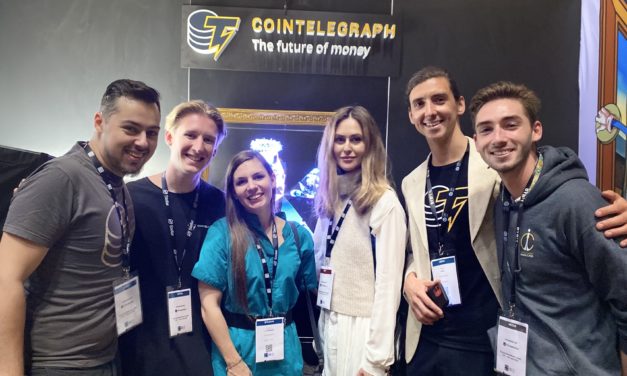
The city of Paris — the capital of France, renowned for its affinity for romanticism, historical architecture and acquired palate for culinary delicacies — played host to the two-day Paris Blockchain Week Summit this week. The event saw the participation of the industry’s leading figureheads and over 3,000 crypto enthusiasts. Held at the Palais Brongniart, the former home of the Paris stock exchange and once synonymous with its exchange of wheat grain, the newly transformed conference center saw keynote speeches and fireside chats from experts such as Binance’s Changpeng “CZ” Zhao, Tether’s Paolo Ardoino and Digital Currency Group’s Rumi Morales, among many others.If you missed the action, here’s a literary highlight reel of all the most important moments from the summit. And you might see some familiar faces from Cointelegraph along the way!Binance to invest 100 million euros into the French crypto ecosystemDelivering the opening keynote speech on stage, Binance CEO CZ spoke about a “great shift of attitude” by policymakers and legislators over the past 12 months before stating that France is “uniquely positioned” in terms of regulations, talent and expertise and has the potential to become a leading crypto hub in Europe. CZ also announced Binance’s recent decision to invest 100 million euros in French startup firms within the Web3 space in partnership with incubator Station F. “I think France has one of the most progressive and open-minded governments that could help in developing pro-crypto regulations.”Following this, CZ sat down with Cointelegraph’s Joseph Hall to share his views on regulation and business operation, in addition to his expectations for the remainder of 2022.[embedded content]Related: Binance’s NFT head adopted this implementation model during the platform’s creationTether’s chief technology officer reveals adoption plans for pro-crypto city of LuganoBack in March, the southern Swiss city of Lugano announced it would adopt Bitcoin (BTC) and Tether (USDT) as de facto legal tender in a partnership with Tether. Since then, it has received broad interest from the crypto community as a result of its progressive policies.Ardoino, Tether’s chief technology officer, shared some statistical insights in an interview with Cointelegraph, stating that “We have been able to start onboarding 25 to 30 different companies and startups, […] which between the company’s assets and private wealth are valued between 300 to 400 million Swiss francs.”Alongside this, Ardoino noted Tether’s intention to develop educational programs for university students in the region, as well as fund their tuition fees.  Related: Stablecoins are the perfect Trojan horse for Bitcoin, says Tether CTOBybit’s Lawrence Tan analyzes the mechanism of the Ronin bridge hackLawrence Tan, Bybit’s spot business development director, shared his assessment of decentralized finance’s security landscape on stage during the ​​“DeFi Security: the Risks Behind the Yield and Mitigation” session. He stated that four major vulnerabilities are responsible for the majority of security breaches in the space: administrator key compromises, coding flaws, rug pulls and flash loan attacks.Referencing the historic Ronin bridge hack as a prime example, Tan advocated for greater educational security resources within the space following a year of numerous exploits and hacks.Related: The aftermath of Axie Infinity’s $650M Ronin Bridge hackRipple’s CEO is optimistic on the future of the SEC caseIn a fireside chat on cryptocurrency regulations, Ripple CEO Brad Garlinghouse shared his optimism surrounding the ongoing Securities and Exchange Commission case regarding it carried out an unregistered securities sale by selling XRP, stating that “The lawsuit has gone exceedingly well, and much better than I could have hoped when it began about 15 months ago.”Related: Ripple CEO: SEC case is going ‘much better than I hoped’Blockchain.com’s Nicolas Cary reflects on a decade in cryptoBlockchain.com co-founder Nicolas Cary and Cointelegraph editor-in-chief Kristina Cornèr assessed the evolution of the crypto industry following 10 years in business, with Blockchain.com founded in 2011 and Cointelegraph set to reach the landmark figure next year.During the conversation, the two also spoke on the nature of anonymity in the space and the vision for democratization that blockchain instills, with Cary stating that “We are building fabrics of the internet that would allow anyone regardless of their circumstances to trade, exchange, save, earn rewards of different types of digital wealth.”And lastly, a final goodbye from us. See you next year!Pictured from left to right: Alex Cohen, managing editor; Jackson DuMont, head of video; Kristina Cornèr, editor-in-chief; Anna Shakola, NFT project manager; Joseph Hall, European news reporter; and Max Kuivenhoven, community manager.

Čítaj viac

Elon Musk endeavors to buy Twitter but will reconsider position if rejected

In a letter sent to the chairman of Twitter’s board Bret Taylor on Thursday, entrepreneur Elon Musk, best known for founding and heading Tesla and SpaceX, has offered to purchase the entire Twitter company for $54.20 a share, stating that the social media platform has “extraordinary potential” that he will “unlock.”Published by the U.S. Securities and Exchange Commission in a 13D filing, Musk stated that “Since making my investment, I now realize the company will neither thrive nor serve this societal imperative in its current form. Twitter needs to be transformed as a private company.”Following this, Musk categorically states that this offer is his “best and final”, and if not accepted, he “would need to reconsider his [my] position as a shareholder.”I made an offer https://t.co/VvreuPMeLu— Elon Musk (@elonmusk) April 14, 2022Related: What Elon Musk’s investment could mean for Twitter’s crypto plansOn March 14, Musk became Twitter’s biggest shareholder following a 9.2% share acquisition valued at over $3 billion. In the weeks that followed, he has been keen to utilize the platform for democratic free speech and greater audience participation, tweeting a poll about an edit button which garnered over 4.4 million votes and sharing weed inspired memes from his time on the Joe Rogan podcast. Based on shares outstanding statistics published on Feb. 10 this year, Twitter currently has 800.64 million shares which means that Musk’s offer of $54.20 per share approximately totals $43.4 billion.pic.twitter.com/TW2lLQakE5— Elon Musk (@elonmusk) April 7, 2022

Čítaj viac

Binance's NFT head adopted this implementation model during the platform’s creation

Attending and reporting from the two-day Paris Blockchain Week Summit (PBWS), Cointelegraph’s managing editor, Alex Cohen sat down with Helen Hai, head of Binance’s NFT platform for a candid discussion on the early inspirations for their NFT platform, as well as her vision for regulatory communication, among other topics.Citing the methods in which the Asian economy capitalized on the growth potential within the second industrial revolution by driving job creation for the lower and middle classes, Hai stated that the internet era — typically referenced as Web2 — was a contributing factor for the widening of digital-economic disparities between various societal groups. During the interview, Hai spoke on how this imbalance could be re-established through the usage of Web3 technologies, as well as revealing insights into the early stages of Binance’s NFT marketplace, the importance of cultivating reciprocal relationships with regulators in policy making, and the emphasis required on female leadership in the Web3 ecosystem..@iamwill is joining @HelenHaiyu and Athena from @TheBinanceNFT for a fireside chat at Paris Blockchain Week to talk about NFTs, crypto, and how it’ll shape the future of the music industry!Watch on #Binance Live now ⬇️— Binance (@binance) April 12, 2022Binance launched its nonfungible token (NFT) marketplace in June last year in an attempt to capitalize on the mainstream euphoria around digital collectibles, registering 2.5 million NFTs and over 1,000 creators at the turn of 2022.Hai revealed that that platform’s initial inspiration arose from the potential for an artistic renaissance with the support of blockchain technology, speaking with pride on their optimistic values of idea creation and learn-as-you-go style deployment.“For us, it’s very much 2% strategy and 98% implementation.” Stating that founder and CEO, Changpeng Zhao, known as CZ, “ really empowers leaders, like myself. If I have a good idea, he says, Helen, why don’t you just try it and you’ll prove yourself.””Six months down the line, we have accumulated millions of users, and have innovated the mystery box and the initial game offering (IGO) model for the gaming industry. We’re still in the learning stage, but we’re working with our users everyday on how we can help creators to get more connected with them.”Related: Paris Blockchain Week, April 13: Latest updates from the Cointelegraph team on the groundSharing her expectations for the prospect of engaging in constructive, open dialogue with regulators in the crypto and NFT space, in addition to the possible hurdles of education literacy and governmental advocacy, Hai stated that she’s “very positive”, but that currently “regulation is very much a one way thing”, and should evolve into a “two-way communication” system.“We need to get people in the crypto industry to find a good way to communicate everything we’ve done well and the things we need to improve to the regulators, and the regulators should also learn what is happening, what is actually achieving values, and how they can use regulations to protect the users.”Hai was enthused by conversations with senior banking officials in Dubai who empathized with her concerns around the stringent financial limitations of banking transactions in comparison to the crypto industry. She mentioned that the growing trend of employments from the traditional finance and governmental office to crypto could help bridge the gap of understanding and foster greater

Čítaj viac

Získaj BONUS 8 € v Bitcoinoch

nakup bitcoin z karty

Registrácia Binance

Burza Binance

Aktuálne kurzy