Autor Cointelegraph By Tom Farren

Coinbase introduces crypto to Fortune 500 while FTX CEO featured in TIME 100

In an industry milestone, cryptocurrency exchange Coinbase has become the first corporation within the crypto and blockchain space to be featured on the prominent Fortune 500 list.A 68-year-old annual tradition, the Fortune 500 list is synonymous with ranking the leading corporations in the United States by total revenue, as well as other quantifiable metrics such as percentage profit margins, assets and the number of employees, among others.Retail giant Walmart captured the top spot for the tenth consecutive year with $572,754 million in revenue and a growth of 2.4%. Amazon registered second place with $469,822 and 21.7%, while Apple took third with $365,817 and 33.3%.Coinbase Global’s inclusion at 437th was supported by revenues recorded of $7,839.4 million, a 513.7% annual gain, and 3,730 employees globally.The 68th edition of the @Fortune500 is out. Check out the full list here: https://t.co/VeQjz1IfHA— FORTUNE (@FortuneMagazine) May 23, 2022Related: Coinbase CEO has ‘never been more bullish’ even after $430M Q1 lossIn the other news, FTX CEO Sam Bankman-Fried was featured in The Most Influential People of 2022 by TIME Magazine.Nominated by TIME correspondent Andrew R. Chow — the author of the recent Vitalik Buterin feature piece — maverick leader Bankman-Fried was noted as an “effective altruist” and recognized for his instrumental role in advancing a positive narrative for the crypto space, and “using every tool imaginable to convince the public of its strengths” according to the 99-year-old magazine.A recently published report documenting Coinbase’s financial performance across Q1 of 2022 revealed $430 million in losses, the first incident of the company’s public history following four prior quarters of substantial profit.CEO Brian Armstrong was not fazed by the fortunes though, declaring that these cyclical periods of low market volume provide the opportunity for the company to “focus more intently on product development”.This optimistic sentiment also applies to Coinbase’s publicly-traded Nasdaq stock COIN, which has plummeted 82% from all-time highs of $368.90 following the initial coin offering bump in April 2021 to $66.10 at the time of writing.

Čítaj viac
WEF 2022: Terra were offering unsustainable yields; DeFi can support financial inclusion

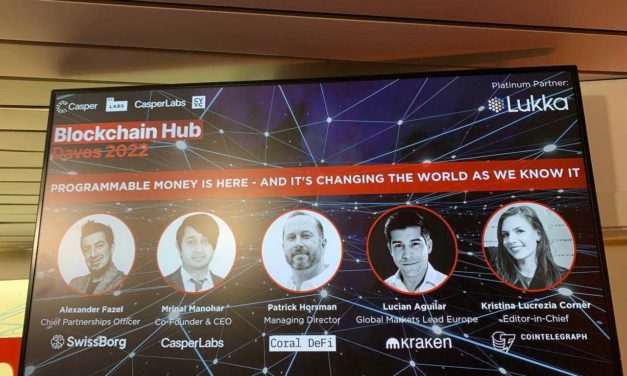
Reporting from the inaugural day of the Blockchain Hub Davos 2022 conference, Cointelegraph’s editor-in-chief, Kristina Lucrezia Cornèr hosted a panel discussion centered around decentralized finance (DeFi) titled “Programmable Money is Here — and It’s Changing the World as We Know It.”Panelists included chief partnership officer of SwissBorg, Alexander Fazel; Global Markets lead of Kraken Europe, Lucian Aguilar; co-founder and CEO of CasperLabs, Mrinal Monahar; and managing partner of Coral Capital, Patrick Horsman.In the opening remarks, Aguilar reflected upon his attendance of the event two years ago, assessing the differences in receptiveness and attitude to crypto. He also noted how the prevailing narrative has evolved, stating: “Last time [there were] a lot of projects here that were trying to sell and present. This time, when I look around, it’s more talking about building, adopting and innovating.”All of his fellow panelists concurred with this viewpoint. Horsman shared that DeFi’s total value locked (TVL) was $1 billion in May 2020, but has since grown 150 times — a healthy barometer of success for the industry by his account.Engaging the audience in a hand-raising exercise to determine their entry-point into the space, SwissBorg’s Fazel stated that “in TradiFi people are thinking [that] I don’t want to lose money — how can you help me keep my wealth regardless of markets? So, it’s very risk-management orientated. While in DeFi, the degens are like ‘gimme those triple-digit yields wooo!’”He argued that protocols within the space should adopt higher transparency standards for the risk associated with annual percentage yields (APYs), advocating that additional education could also help balance investors’ expectations.Advancing that thesis, Coral Capital’s Horsman shared that the Terra (LUNA) crisis partly occurred because “they were essentially offering yields that were unsustainable, and [that] there were venture capital firms that were bootstrapping those yields in order to bootstrap an ecosystem.” He noted that his firm decided to withdraw funds from the project in November–December 2021 after their reserve modeling data predicted worrying calculations for the future.Related: Why did Terra LUNA and UST crash? | Find out on The Market ReportIn response to that anecdote, Aguilar shared his belief that protocols with vastly significant APYs in the triple-digit range are most likely seeking to mitigate their own high-risk factor, stating:“A lot of these APYs, I see them as a risk premium because the underlying is so underpredicted and unstable that it’s needed to offset the risk for a traditional investor.”Transitioning to the World Economic Forum’s (WEF) ambitions in tackling modern global challenges — climate change and the pandemic being two of the most prominent examples of recent times — Cornèr asked the panelists how they assess the status of financial inclusion, and how DeFi can empower communities to reduce the prejudicial disparity in the current system.Monahar stated that “I think DeFi has a huge potential to create financial inclusion,” but that to achieve visions of decentralization, there needs to be “interoperability at a true fundamental algorithmic level.” This, he argued, will cultivate a frictionless experience that promotes commonality and fosters incentives for inclusion.He recognized the recent convergence of developers to the programming language Rust as well as its similarities to the software synonymous with the internet, HTTPS, as a positive signal.Furthering the conversation around financial inclusion, Fazel stated that “there’s no better way to earn wealth than in DeFi” and that data monetization services such as Brave Browser, play-to-earn games such as Axie Infinity a play-to-move platforms such as Sweatcoin and the soaring trend of STEPN, are granting the opportunity to “generate wealth without necessarily having wealth in the beginning.”The airdrop incentives that some of these platforms provide can support the inclusion of wealth across less developed countries, argued Fazel, disclosing a personal story of his father — a resident of Iran where the monthly salary averages $250 — immensely benefitting from the 300 Uniswap (UNI) airdrop.Related: WEF 2022, May 23: Latest updates from the Cointelegraph Davos teamCointelegraph representatives are extensively reporting on the World Economic Forum (WEF) and the Blockchain Hub 2022 this week. Read our live-action blog to follow along with all the highlights and best moments of the global events!Readers of this article can watch the full interview of “Programmable Money is Here — and It’s Changing the World as We Know It” on Youtube.

Čítaj viac

WEF 2022: Ripple CEO reveals he visited SEC several times before lawsuit struck

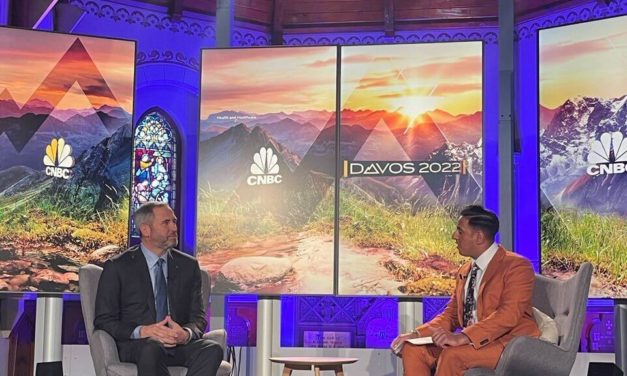
Brad Garlinghouse, the CEO of cross-border payments company Ripple, spoke during a panel discussion Monday at the World Economic Forum in Davos, Switzerland.Garlinghouse, who also occupies a role as a member of the company’s board of directors, commented on a wide range of topics, most notably the current status of regulation in the United States versus G20 nations. Ripple CEO Brad Garlinghouse. Source: CointelegraphEmphasising the prudent necessity for regulatory frameworks which serve integral principles of “clarity and certainty”, Garlinghouse stated his belief that:“The overwhelming majority of people working within the crypto industry are good actors that want to do right by regulators. But when the rules of the road aren’t clear, it’s very difficult to manage within that.”Later in the conversation, Garlinghouse revealed that he personally went to the U.S. Securities and Exchange Commission (SEC) office “four or five times in the years leading up to their decision to file a lawsuit,” stating that the Ripple associated asset XRP should be legally categorized security.Related: WEF 2022, May 23: Latest updates from the Cointelegraph Davos team”It demonstrates how out-of-step the United States is with the G20”, Garlinghouse argued, citing Switzerland, Singapore, the United Kingdom and Japan as nations that have more favorable regulatory environments for cultivating technological innovation. 

Čítaj viac

MSP Recovery joins forces with Tokenology to release tokenized healthcare initiative

MSP Recovery LLC, a healthcare recovery firm based in Miami, United States and valued in the region of $32.6 billion, has announced a collaborative partnership with Web3 solution Tokenology to launch a fraud-prevention blockchain platform, titled Lifechain.Lifechain will seek to utilize the verifiable and transparent nature of blockchain technology to enhance the accessibility of healthcare charges, claims and medical records for patients and industry professionals.MSP Recovery’s consumer application LifeWallet — which launched in January this year and has since registered over 1 million users, according to recent data — will house the technology alongside a tokenized solution LifeCoin.The press release provided greater context into the scale of the task within the healthcare industry; notably, working in the field of reimbursing secondary medical insurance payments.“The massive number of daily medical claims being tokenized is expected to surpass 50 million/day by 2024, requiring the kind of scale, security and sustainability that only Polygon can deliver.” @DiscoverMSP, a $32.6 billion publicly-traded U.S. healthcare company, has partnered with @Tokenologycom to launch LifeChain #onPolygon.A first-of-its-kind commercial platform for fully tokenizing healthcare services.Learn more https://t.co/kEaYUQltnN— Polygon – MATIC (@0xPolygon) May 20, 2022MSP Recovery became a publicly tradable company in mid-2021 following the acquisition of Lionheart Acquisition Corp II and operates on the Nasdaq under the ticker symbol MSPR.The co-founder of Polygon (MATIC), Sandeep Nailwa, shared his assessment of the partnership, stating that the project is “truly impactful” and “a testament to the evolution of enterprising new solutions that developers like Tokenology are building using Polygon technology.” 

Čítaj viac

Court documents reveal Do Kwon dissolved Terraform Labs Korea days before LUNA crash

The dramatic story of the Terra (LUNA) crash — referred to by some as the Lehman Brothers of crypto — has taken yet another remarkable turn as legal documents reveal the liquidation of two South Korean offices and the dissolution of the Terraform Labs Korea corporation in the days preceding the dual currency collapse.Initially reported by South Korean news outlet Digital Today, the information obtained from the country’s Supreme Court Registry Office highlight that Do Kwon successfully instigated the liquidation of two branches and an entire company.Both the Busan headquarters and Seoul offices were agreed to be dissolved during a general shareholders meeting on April 30, with their demise being actioned on May 4 and May 6, respectively. The timing of these decisions has raised suspicions within the crypto community due to their potential correlation to the events of the Terra (LUNA) and UST stablecoin financial obliteration in the early hours of May 10.Related: Why did Terra LUNA and UST crash? | Find out on The Market ReportThis is a developing story that will be updated in due course.

Čítaj viac

Získaj BONUS 8 € v Bitcoinoch

nakup bitcoin z karty

Registrácia Binance

Burza Binance

Aktuálne kurzy