Autor Cointelegraph By Tom Farren

The Graph awards $48M to GraphQL developer The Guild

The Graph Foundation has announced a $48 million funding grant to open-source API platform The Guild in a bid to advance usability and performance of the networks subgraphs.Joining as a core network developer, The Guild will provide vast experience from its time managing and contributing to the growth of components within the GraphQL ecosystem — a programming language initially established by Meta, formerly Facebook, in 2012 — to focus on enhancing subgraphs features such as “composition, analytics and mutations” on The Graph.The Graph, a Web 3.0 indexing and querying infrastructure platform, has invested $248 million into their core developer network over the last twelve months, the most recent of which was last week’s $60 million investment in infrastructure service, Semiotic AI, to accelerate research and development initiatives in cryptography and artificial intelligence.Related: The Graph Foundation taps protocol infrastructure developer for $60M grantDirector of The Graph, Eva Beylin, shared detailed insights into the potential impact the networks latest core developers, The Guild, could have on a multitude of sectors in the Web 3.0 sphere, including decentralized finance (DeFi), the metaverse and decentralized autonomous communities (DAO’s) among others, stating:“The Guild will collaborate with developers in The Graph ecosystem throughout the course of this four-year funding to develop new subgraph features and improve The Graph Node’s querying capabilities, allowing developers to more quickly construct feature-rich apps using The Graph.”This is an emerging story which will be updated soon.

Čítaj viac

Finance Redefined: AWS turns crypto exchanges offline, and Sushi CTO resigns, Dec. 3–10

Welcome to the latest edition of Cointelegraph’s decentralized finance newsletter.Although the markets may be down and technical indicators built upon AWS malfunctioning, fear not young degens, fundamental news and the spirit of Wagmi is abundant as ever. So, read on and discover all you need to know about the most important events of this week.What you’re about to read is a shorter, more succinct version of the newsletter. For a comprehensive summary of DeFi’s developments over the last week, subscribe below.AWS outage highlights the need for truly decentralized exchanges.An Amazon Web Service outage this week produced significant cascading effects on the global supply chain and delivery industry, as well as hours-long operational disruptions to decentralized exchange dYdX and leading centralized exchanges Binance.US and Coinbase.AWS is the world’s largest cloud service infrastructure, which provides an array of services, including network servers, storage capacities, remote computing and mobile development, to name a few.According to data published this year by Synergy Research Group, the tech titan holds a 33% share of the cloud infrastructure market, followed by Microsoft and Google with 20% and 10%, respectively.Details on the incident were largely undisclosed; however, it was stated on the company’s service health page that “multiple AWS APIs in the US-EAST-1 Region,” located in Northern Virginia, were experiencing connectivity issues.In a Twitter statement shared on Tuesday, and into the early hours of Wednesday, dYdX spoke about enhanced latency across the network, as well as website loading failures, before disclosing its overreliance on the centralized servers, one of which is AWS.Unfortunately, there are still some parts of the exchange that rely on centralized services (AWS in this case). We are deeply committed to fully decentralizing and this remains one of our top priorities as we continue to iterate on the protocol. We apologize for this outage.— dYdX (@dydxprotocol) December 8, 2021Analytical data from DappRadar reveals that dYdX is the 13th largest decentralized finance application built on the Ethereum Network, registering approximately $1.5 billion in daily trading volume. In September this year, dYdX achieved a historic transactional milestone in surpassing the volume of Coinbase over the course of a single day, with $4.3 billion in comparison to $3.7 billion.Decentralization is understood by many early crypto adopters to be a core component of the industry’s architecture. Alongside security and scalability, the former makes up the so-called blockchain trilemma, a concept coined by Ethereum co-founder Vitalik Buterin, to denote the necessity to sacrifice one side of the triad to experience the benefits of the other two.In the world of crypto exchanges, many opt to prioritize security and scalability in pursuit of mass adoption but, therefore, operate with largely centralized, Web 2.0-like structures.Related: Decentralization vs. centralization: Where does the future lie? Experts answerJoseph Delong wraps up time as SushiSwap CTOSushiSwap chief technology officer Joseph Delong, announced his immediate departure from the decentralized exchange this week, pledging to honorably pass the proverbial baton onto the next leader, alongside necessary accounting and information data.Delong explained the reasoning behind his decision in a candid Twitter thread, citing internal conflicts and a lack of unified vision for the project, stating:​​“I wish Sushi the best and am saddened that Sushi is so imperiled within and without. The chaos that is occurring now is unlikely to result in a resolution that will leave the DAO as much more of a shadow than it once was without a radical structural transformation.”Delong has experience working in the Web 3.0 space as a blockchain engineer and developer. Formerly employed as a senior software engineer at ConsenSys, Delong took up the position of chief technology officer at SushiSwap at the beginning of 2021 following Chef Nomi’s infamous exodus in the months prior.Over the past year, Delong has guided SushiSwap to the 12th ranked position in nominal total value locked value (TVL) with $2.85 billion but also suffered obstacles with stringent whitelisting acceptance on layer-two protocol Optimism, as well as a $3-million supply chain exploit on launchpad MISO and, more recently, a rumored vulnerability in its smart contracts to the value of $1 billion.Related: SushiSwap denies reports of billion-dollar bugCoinbase opens cryptography library to promote innovationOne of the leading cryptocurrency exchanges, Coinbase, this week announced the launch of an open-source library-themed platform, titled Kryptology, designed to provide developers with a suite of “secure, audited, and easy-to-use application programme interfaces (APIs).”In an official blog post, Coinbase outlined its intentions for the library in fostering the continued development of this long-standing technology:“While enabling further innovation is our primary goal, we also aim for Kryptology to elevate the standard for what is considered to be a robust, usable cryptographic library.”Related: Coinbase announces support for hardware wallets, starting with LedgerToken performances Analytical data reveals that DeFi’s total value locked has decreased 11.3% across the week to a figure of $143.95 billion.Data from Cointelegraph Markets Pro and TradingView reveals DeFi’s top 100 tokens by market capitalization exceeding bearish across the last seven days.Terra (LUNA) was the sole gainer of the top 100 this week with a mere 1.81%. Not the most memorable technical week for DeFi, let’s put it that way, but unsurprising considering the wider context of the crypto-wide market pullback.Interviews, features and other cool stuffThanks for reading our summary of this week’s most impactful DeFi developments. Join us again next Friday for more stories, insights and education in this dynamically advancing space.

Čítaj viac

Semiotic AI granted $60 million by The Graph Foundation to support ecosystem growth

The Graph Foundation has announced a $60 million eight-year funding grant to Semiotic AI in a bid to expand the start-up software firm’s research and development capacity in sectors of cryptography and artificial intelligence.Specifically, the partnership will focus on building the architecture required for automated and verifiable indexing and querying on the Graph, in addition to developing micropayments functionalities utilizing zero-knowledge proofs such as ZK-SNARKs.Over the course of 2021, Semiotic AI have worked alongside the Graph to contribute to the growth of the ecosystem with a litany of initiatives, such as the construction of a beta query prediction service, serving in an indexing operation role, supporting zero-knowledge proof infrastructure design, as well as receiving an initial grant in March this year, among others.With this news, Semiotic AI follows in the footsteps of two infrastructure platforms in becoming a core protocol developer on the network. StreamingFast acquired a $60 million funding grant from the Graph in June, while blockchain service provider Figment were granted $48 million in late-July.Co-founder of the Graph, Brandon Ramirez, shared insights into how Semiotic AI will pursue greater economic efficient and scalability on The Graph through the usage of artificial intelligence and cryptography, stating:“They specialize in the same AI toolkit Google Deepmind used to beat the world’s best Go player and to then solve the age-old protein folding problem. The Graph is all about data, and just as AI plays a central role in all web2 products, this partnership will contribute to the convergence of AI and the decentralized internet.”Incepted on mainnet in December 2020, the Graph quickly gained prominence as one of the leading indexing and query platforms in the Web3 sphere. At the time of writing, the network supports indexing data from 22 networks, including Ethereum, Arbitrium, Avalanche, as well as facilitating over 22,000 subgraphs including ENS Domains, Compound V2, and Uniswap V2, among others.In early September, the co-founder of Ethereum, Vitalik Buterin touted ZK-SNARKs as a potential major technological adoption over the coming decades.I expect ZK-SNARKs to be a significant revolution as they permeate the mainstream world over the next 10-20 years.— vitalik.eth (@VitalikButerin) September 2, 2021Related: The Graph explores integrations for Bitcoin, Polkadot, and other Layer-1 blockchainsCo-founder and CTO of Semiotic AI, Sam Green, also commented on the recent partnership, using telephone and web search as prime examples of how a plethora of innovations can blossom from foundational technologies, stating:“R&D efforts on these utilities resulted in countless inventions that improved communications and access to knowledge for the entire world. As a result of this collaboration, we will similarly invent new, open-source technologies that will benefit both users of The Graph and the larger web3 community.”

Čítaj viac

Mnemonic raises $4 million to launch B2B API platform focused on NFT's

Mnemonic has emerged from a period of six-month incubation to announce the upcoming launch of its nonfungible token (NFT) analytics platform designed to facilitate API and cross-chain aggregation functionalities which enable developers to build NFT-centric applications.Above this foundational layer, the platform also intents to provide on-chain quantitate data insights into popular collections in the emerging sector, commencing with Lazy Lions, World of Women, Gutter Cat Gang and Dystopunks, with plans to expand in the near future.The San Francisco-based firm was co-founded by four entrepreneurs with experience working as senior executives and lead engineers at blue-chip technology firms Google, Uber and Reddit, among others, on aspects of machine learning, big data, application programming interfaces (API), and more.Earlier this year, the company completed a seed funding round of $4 million led by venture capital investor Kenetic, and participated by Sound Ventures and Tribe Capital, as well as angel investors Coinbase, IntoTheBlock and People.ai. Alongside this, the company has also established relationships with Dapper Labs and Mintable in a bid to expand their market position.Cointelegraph spoke to the co-founder and CEO of Mnemonic, Andrii Yasinetsky, for insight into his expectations for how on-chain data insights could impact the education of retail investors entering the NFT space:“While these dashboards are not our core product, and are instead simply a showcase of our data, it’s exciting to see even more awareness being brought to the attention of NFT collectors, and potential collectors and investors. We power the tools, services and applications retail investors will use to gain a better understanding of the market they are transacting in.”Related: Blockchain analytics service Nansen to incorporate DeFi protocol ArbitrumPulling on-chain data for NFTs should be easy and offer basic search, intelligence with analytics, rarity, metrics, etc all w/o rate limitingIt’s why we invested in the seed round of @mnemonichq. Their easy B2B NFT API solution makes it SO easy to pull this data. https://t.co/cG5k3ea9jW— maaria.eth (@maariabajwa) December 7, 2021As the NFT market emerges into the mainstream, the demand for correlated data tools is witnessing a parallel ascension. Yasinetsky noted how the Mnemonic platform differs from other multi-sector competitors such as Nansen:“They are primarily wallet focused, providing insights into more abstract trends and behaviors within wallets. Our intelligence platform focuses on NFTs and covers a wider spectrum of consideration than just wallet behavior: NFT traits, transaction volumes and values, metadata analysis and more.” “We have built a Google-like crawling system that not only ingests what’s available on chain, but also indexes all pieces of the metadata associated with every NFT — millions of NFTs — to provide the freshest and most relevant results to our customers. On its own, this is a very hard engineering problem that had not been widely addressed in the space until now,” he said.

Čítaj viac

Finance Redefined: Two DeFi hacks top $120M, and $500M Algo Fund launches, Nov. 26–Dec. 3

Welcome to the latest edition of Cointelegraph’s decentralized finance newsletter.A week packed with positive advancements in the DeFi space including nine-figure fund raises, successful product launches and soaring token prices was somewhat tarnished by the news of two severe security exploits. Read on to get the full scope of developments across the week.What you’re about to read is the smaller version of this newsletter designed for brevity. For the full version of DeFi’s developments over the last week, drop your email below.Borderless Capital launches $500M fund to support Algorand ecosystemCapital venture firm Borderless Capital announced the launch of ALGO Fund II this week, a $500-million initiative assembled to support the creation of digital asset projects on the Algorand blockchain. Announced via a blog post by the Algorand Foundation, the capital will specifically focus on decentralized applications, niche services of liquidity mining, lending, borrowing and yield farming, as well as nonfungible tokens.We are excited to announce the launch of our $500M Borderless ALGO Fund II!https://t.co/EP0U6Ib8HV pic.twitter.com/okXf6GBFo8— Borderless Capital (@borderless_cap) November 30, 2021Algorand is an open-source decentralized blockchain most regarded for its speed of efficiency, security and status as a potential competitor to Ethereum’s dominance.Incepted in November 2018, Borderless Capital has already invested in over 100 blockchain-related projects via its $400-million ALGO Fund I, including Tinyman, Yieldly, Opulous and Flare Network, among others, as well as established successful accelerator programs across three major industrial continents.Iota prepares to launch decentralized smart contract platformDistributed ledger platform Iota announced the launch of decentralized layer-one smart contract network Assembly and accompanying ASMB token this week.Assembly will seek to drive adoption of smart contract services and foster an environment for creators, developers and community advocates that facilitates the expansion of the Iota ecosystem into Web 3.0 sectors, including the metaverse.Expected to launch in 2022, Assembly will function in parallel to Iota and employ the network’s existing infrastructure, most notably the directed acyclic graph structure, to operate as an interoperable, self-sovereign bridge that reaps the benefits of scalability and security, among others.Decentralized application developers will be able to create their own smart contract chains and set individual parameters for low-cost execution fees, a function that will also enable service providers to issue on-chain stablecoin assets to incentivize validators.In a recent Twitter post, Iota revealed that stakers can earn rewards in both Shimmer (SMR) and ASMB tokens upon launch of the networks, stating that “for every 1 MIOTA staked, users receive 1 $SMR and 4 microASMB every 10 seconds, for 90 days, once the staking has started.”Stakers get not just 1 token but 2! And after the @shimmernet and @assembly_net network launch, you can receive even more rewards when securing both networks by staking $SMR and $ASMB. Visit: https://t.co/gx9ucphSR2#IOTA pic.twitter.com/VjV77gPK5Q— IOTA (@iota) December 2, 2021

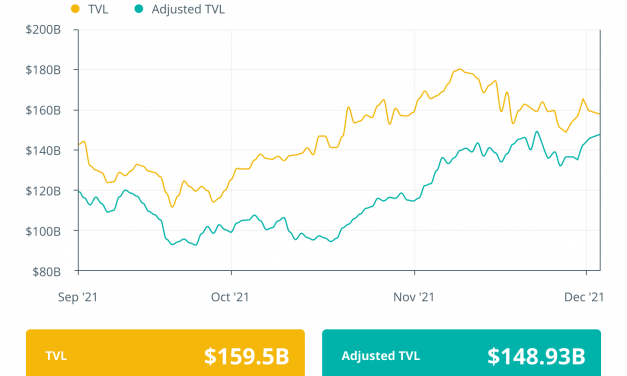
DeFi projects MonoX and BadgerDAO exploited for $150MThis week, decentralized projects MonoX and BadgerDAO were the victims of individual sophisticated protocol hacks that resulted in over $150 million in asset losses. The MonoX platform suffered a single cyberattack on Tuesda when a bug in the smart contract’s swap contract enabled manual price manipulation of MONO tokens, an asset that had only just been listed on the Huobi exchange in the days prior.After boosting the MONO token to what the team described as “sky-high” levels, the hackers exchanged the funds into other assets on the platform and secured lucrative profits.In the days following the breach, the MonoX team confirmed that losses totaled around $31 million, alongside the publication of a remorseful statement, the essence of which stated:“Days like yesterday are horrible, there is no sugar coating the harsh reality of a contract being exploited and people losing money. Our supporters put their faith in a new project like us, and yesterday we let them down.”Similarly, but with no affiliation to the other, BadgerDAO was also the victim of a financial exploitation this week. Although concerns were raised by community members on Discord regarding suspicious increases in allowance in the days preceding, admins didn’t perceive this to be a threat as highlighted in this tweet from 0xMoves.According to blockchain analytics service PeckShield, losses from the BadgerDAO have amassed $120 million at the time of writing, including 2078.76 Bitcoin (BTC), 30.27 Interest Bearing Bitcoin, and 151.32 Ether (ETH).The Badger team has now responded by opening a full investigation into the events in addition to pausing smart contract activity until safety on the protocol is once again stabilized.Related: Recounting 2021’s biggest DeFi hacking incidentsToken performances Analytical data reveals that DeFi’s total value locked has increased 8.01% across the week to a figure of $159.5 billion.Data from Cointelegraph Markets Pro and TradingView reveals DeFi’s top 100 tokens by market capitalization performed reasonably well across the last seven days.Terra (LUNA) soared to record heights this week thanks to gains of 66.85%. Uniswap (UNI) achieved a healthy 14.3%, while Tezos (XTZ) posted an increase of 12.70%. The fourth and fifth spots this week were claimed by Chainlink (LINK) and Oasis Network (ROSE) with 8.1% and 8% gains, respectively.Analysis and hot topics from the last week:Thanks for reading our summary of this week’s most impactful DeFi developments. Join us again next Friday for more stories, insights and education in this dynamically advancing space.

Čítaj viac

Získaj BONUS 8 € v Bitcoinoch

nakup bitcoin z karty

Registrácia Binance

Burza Binance

Aktuálne kurzy