Autor Cointelegraph By Tom Farren

Polygon network activity spikes as NFT sales reach new height

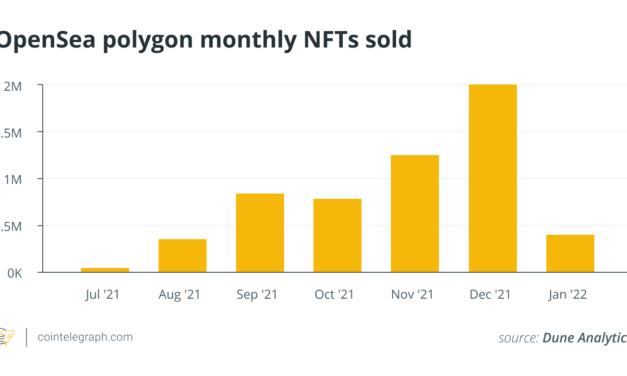
The number of nonfungible tokens (NFT’s) sold on the layer-two protocol Polygon reached an all-time high last month at just short of 2 million. According to Dune Analytics, this marks a near 60% rise in comparison to November and the third consecutive monthly increase for the network.An Ethereum-based scaling solution seeking to construct, distribute and manage securities on blockchain technology, Polygon’s ecosystem has grown exponentially over the past twelve months, registering in excess of 3,000 decentralized applications on its network, in addition to a total value locked figure of $3.86 billion.Alongside this, the number of unique daily active proof-of-stake chain addresses on the network is also expecting a new all-time high, aiming to surpass the record of 566,516 printed on Oct. 2, 2021, with the most recent data from Jan. 5, 2022, calculating 554,163.Related: Here’s how Polygon is challenging the limitations of Ethereum, as told by co-founder Sandeep NailwalIn an interview with Cointelegraph last month, co-founder Sandeep Nailwal revealed that Polygon has found a niche in attracting a high proportion of gaming companies and platforms to build NFT’s on their network, as opposed to the collectibles and art often witnessed on Ethereum.Polygon’s native token, MATIC, reached a peak price of $2.92 on Dec. 27, 2021, and has subsequently fallen to $2.11 at the time of writing in line with a wider market decline.

Čítaj viac

UK advertiser ASA continues crypto ad banning spree

The United Kingdom’s Advertising Standards Authority, or ASA, has ruled to place an official ban on two mobile application advertisements from popular trading platform Crypto.com which promoted the ease of purchasing cryptocurrencies such as Bitcoin, as well as earning yield rewards on digital assets.Gaining notoriety within the industry for their strict legislation on the proposed implications of a cryptocurrency advert, the ASA flagged the marketing material for breach a number of financial watchdog rules, including not effectively stating the risk potential of the investment, abusing consumer’s lack of market understanding, as well as not specifying the limitations of purchasing crypto with credit cards.Crypto.com removed the advert voluntarily once the concern was raised, but debated the nuances of the advertisements with the regulator, stating that the intention of the inaugural advert — published on the Love Ball app on July 30 2021 — w that users could “earn up to 8.5% p.a”, was insinuating through yield investments, not specific crypto assets.Likewise, according to Crypto.com’s written response, the subsequent advert, published on the Daily Mail newspaper app on Sept 1, was intending to showcase the speedy process of purchasing crypto assets on their platform — “Buy Bitcoin with credit card instantly” — as opposed to directly advising consumers to engage in trading activities.Related: UK advertising watchdog bans crypto ads for Coinbase and KrakenCrypto.com’s marketing forays in the United States has propelled their brand recognition to a mainstream audience. The Matt Damon TV commercial, the purchase of a twenty-year lease $700 million for the naming rights for the historic Staples Center now known as the Crypto.com Arena, as well as the launch nonfungible tokens, or NFTs in partnership with the UFC, have all expanded the platform’s ambitions.Concluding their assessment, the ASA advised Crypto.com that future marketing material of such kind must be made “sufficiently clear that the value of investments in cryptocurrency was variable and could go down as well as up and that cryptocurrency was unregulated.”Alongside this, that the material does not “irresponsibly take advantage of consumers’ lack of experience or credulity by irresponsibly encouraging investing in cryptocurrency using a credit card”, as well as that “using a credit card could be subject to higher interest rates, extra fees and that some credit card issuers prohibit the buying of cryptocurrency.”In the month of December 2021, the ASA flagged a number of crypto-related firms for violating advertising rules in their marketing campaigns.On Dec 15, the ASA flagged marketing campaigns from Coinbase, Kraken and eToro, among others for misleading investment material, while on Dec 22, accused Arsenal FC and blockchain firm Chiliz of “taking advantage of consumers inexperience in crypto assets” in the issuance and subsequent promotion of the club’s fan token, $AFC.Earlier that month, Members of Parliament, or MPs, at the treasury select committee implored the nation’s overarching financial body, the FCA, that investments within the cryptocurrency market should not be compared to traditional investments, and that they could be utilized by criminals seeking to launder money.

Čítaj viac

Airdrop culture could pose integral threat to DeFi industry

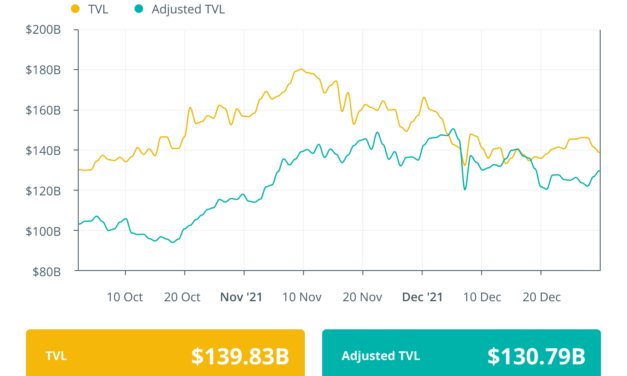
EtherWrapped, a project designed to provide a yearly summary of users nonfungible token (NFT) activity, launched a little over eight hours ago to palpable fanfare within the crypto community. The website detailed a plan to airdrop YEAR tokens based upon quantitative engagement statistics in users’ MetaMask wallet, or in simpler terms, their number of transactions, volume traded and gas fees, among other data.Upon verification on EtherScan, a number of well-regarded developers and engineering experts in the space assessed the coding of the smart contract. Meows.eth noted that these parties saw a “presence of a function titled _burnMechanism,” but concluded that it was merely a harmless error by the seemingly amateur creator.What we noticed during a brief pass was the presence of a function titled _burnMechanism.This function looked innocent enough, it would fail if you attempted to interact with the contract owner.What myself and others missed is how might one weaponize it for evil. 7/ pic.twitter.com/CthmAw3a2A— meows.eth (@cat5749) December 31, 2021However, unbeknown to all, the creator of the contract maliciously planted this flaw in order to administer the “revokeOwnership” function soon after, designating ownership to themselves and subsequently orchestrating a honeypot scenario in which users could only buy, not sell, the asset.Consequently, those who had connected their wallet and received the airdropped token witnessed their asset soaring in value, and as such, fuelled by the alluring propensity of fear of missing out (FOMO), were incited into purchasing more on the secondary Uniswap V2 market.It must be stated, the action of interacting with the contract or claiming the token did not result in losses, but rather the ensuing investments into the YEAR asset on decentralized exchanges.According to EtherScan, the malicious entity was able to siphon 59.7 Ether (ETH) from the scam, equivalent to $225,000 at current prices. In addition to this, the Uniswap V2 contract registered $6.8 million in daily trading volume.Although not a vast amount in the wider context of DeFi’s $139 billion in total value locked (TVL), the incident does highlight the critical importance of reviewing and verifying the authenticity and contractual diligence of newly formed smart contracts prior to connecting Web 3.0 wallets.Related: Recounting 2021’s biggest DeFi hacking incidentsDecentralization, often in the form of financial distribution, is one of the fundamental principles of Web 3.0. Whereas the previous iteration of the internet curtailed power to centralized Silicon Valley behemoths, Web 3.0 promises to grant power to the people.Last year, a panoply of decentralized finance projects, including UniSwap, dXdY, ParaSwap, and others, successfully deployed native assets — many of which were valued at tens of thousands of dollars — to members of their community in a bid to advance the development of their ecosystem.Last month, ENS become the latest project to showcase the genuine potential for governance models, and more recently, OpenDAO’s SOS token and GasDAO’s GAS token were allocated to those who registered trading activity on leading NFT marketplace OpenSea, and those who spent at least $1,559 of ETH on transactional fees.Now, while these projects are legitimate innovations with openly-documented roadmap objectives, the growing prevalence of such airdrops — especially their inflated speculation and outlandish early-expectations for projects just emerging from the cryptographic womb — could become the catalyst for a trend of rug pulls, Ponzi schemes, and pump & dump projects which pursue short-term monetary gains, akin to the ICO token era of 2017.Although a handful of the assets launched during the initial coin offering (ICO) craze became successful, a vast number experienced catastrophic falls from financial grace, tarnishing the integrity and confidence of the entire cryptocurrency space, as well as fueling the often contemptuous mainstream narrative.Feels like we’re back to the good old ICO token days. But instead of white papers we now get airdrops and rugs.What a great way to end the $YEAR— richerd.eth ᵍᵐ (@richerd) December 31, 2021

Looking ahead, circulating rumors of potential MetaMask and OpenSea tokens are cultivating optimism for the construction of a truly decentralized and community-centric Web 3.0 industry. Whether this technological utopia becomes reality amid the motivations of venture capitalists and tech giants is another matter of debate.The views, thoughts and opinions expressed here are the author’s alone and do not necessarily reflect or represent the views and opinions of Cointelegraph.

Čítaj viac

Finance Redefined: Polygon fixes $24B bug, Hoskinson optimistic for Cardano in 2022, Dec. 24–31

Welcome to the latest edition of Cointelegraph’s decentralized finance newsletter.As the calendar year comes to an end, Cardano’s personable leader Charles Hoskinson shares a message of optimism, unity and collaboration for the future of crypto.As a gesture of goodwill for the holiday season, this week our long-form DeFi newsletter will be published in full here as an article alongside the regular email. Subscribe below for full access to next week’s edition!Polygon fixes potential billion-dollar protocol vulnerability Layer-two protocol Polygon announced this week the rectification of a potentially multi-billion-dollar vulnerability in its proof-of-stake Genesis contract through implementing an Emergency Bor Upgrade to the mainnet.The incident and subsequent upgrade took place at the beginning of December. If compromised to the fullest extent by a malicious entity, the vulnerability could have resulted in almost $24 billion in financial losses, equating to 92.7% of the network’s native MATIC tokens and effectively causing imminent demise.All you need to know about the recent Polygon network update.✅A security partner discovered a vulnerability✅Fix was immediately introduced✅Validators upgraded the network✅No material harm to the protocol/end-users✅White hats were paid a bounty https://t.co/oyDkvohg33— Polygon | $MATIC (@0xPolygon) December 29, 2021According to a recent blog post from Polygon, two good-willed whitehat hackers, Leon Spacewalker and Whitehat2, discovered the incident on Dec. 3 and Dec. 4, respectively, alerting blockchain security platform Immunefi.Following procedural investigation and authentication from Immunefi, the information was passed to Polygon, which upgraded the network on Dec. 5, albeit a hacker was able to drain 801,601 MATIC ($2.04 million) before the bug was resolved. Polygon co-founder Jaynti Kanani emphasized the network’s ability to promptly resolve the critical bug, noting in a blog post that:“What’s important is that this was a test of our network’s resilience as well as our ability to act decisively under pressure. Considering how much was at stake, I believe our team has made the best decisions possible given the circumstances.”Leon Spacewalker is set to be rewarded a cool $2.2 million in stablecoins for their efforts, while the second anonymous hacker, Whitehat2, will pocket $1.27 million in MATIC tokens directly from Polygon.Related: Here’s how Polygon is challenging the limitations of Ethereum, as told by co-founder Sandeep NailwalCardano founder Charles Hoskinson predicts DeFi “greater extinction”This week, in an end-of-year YouTube live stream titled “DApps and Cardano DeFi Alliance,” Cardano founder Charles Hoskinson spoke candidly about the emerging landscape of DeFi projects and creators on Cardano in addition to advising participants about the volatile nature of exponential markets. “It’s very hard to do this kind of engineering and to do it right, with an eye and foresight for the future. Unfortunately, many of the projects in this space will not stand the test of time. It’s just a fact that we will see a great extinction occur in the next five to 10 years.”Broadcasting with evident enthusiasm from “warm sunny Colorado” — a location which he humorously describes as “always warm, always sunny, sometimes Colorado” — Hoskinson predicted a big year ahead for the cryptocurrency space and his beloved Cardano.The “only thing that holds us back is us,” he said before exclaiming that empathetic and friendly collaboration is a fundamental component to productive dialogue and progress toward our shared pursuit of a more prosperous financial future.[embedded content]Following the successful launch of Cardano’s smart contracts in September through the Alonzo hard fork, the project has come under scrutiny for tedious developments on its roadmap. Despite this, Hoskinson believes that the user count will exceed 10 times the current 2 million in 2022 because of the vast demand within the nonfungible token space. Alongside this, Hoskinson introduced the Cardano DeFi Alliance, an initiative that seeks to construct an open-source library of resources, tools, services and best practices to cultivate the growth of the entire DeFi ecosystem.Related: Cardano’s ADA price eyes 30% rally with a potential ‘triple bottom’ setupHuobi Research predicts rise in play-to-earn games in 2022Huobi Research, the research arm of crypto exchange Huobi, has identified GameFi — which refers to the combination of gaming and decentralized finance — as an emerging trend based on its quantitative analysis of on-chain data.In an extensive blog post, Huobi detailed GameFi projects’ sharp increases in user activity and volume transacted since June, stating “DApp rankings show that five of the top nine apps are GameFi apps.” Further, “as of early December [2021], GameFi’s weekly active users have reached 9.21 million, a record high.”Thanks @Cointelegraph for covering the report.Read it ➡️https://t.co/MnG14w5KNW https://t.co/mzFggnLp0z— Huobi Research (@Huobi_Research) December 30, 2021

The researchers noted that these games differ from traditional games, such as World of Warcraft, across three distinctive categories: free trading of game materials, free trading and pricing of game currencies, and protection of property rights.Huobi Research argues that GameFi’s ability to “significantly reduce transaction fees for gold farming,” a term used to denote the conversion of in-game tokens to real-world currency, is the primary reason for its heightened financial appeal:“In GameFi, the owners have the right to decide whether to sell certain resources or not, which lifts the degree of user independence and stimulates market competition, thus saving transaction costs.”Additionally, developers in the GameFi space have the advantage of deploying private property rights via nonfungible tokens at a lower cost: “This not only is a comparative advantage that traditional game developers never had, but also reflects the intrinsic value of blockchain technology in the gaming industry,” the firm stated.Related: Korean government tells Apple and Google stores to take down P2E gamesToken performances Analytical data reveals that DeFi’s total value locked has decreased by 1.8% during the week to $140 billion, seemingly slowing down for the holiday season.Data from Cointelegraph Markets Pro and TradingView reveals that DeFi’s top 100 tokens by market capitalization have mainly been bullish over the last seven days.SushiSwap (SUSHI) took the lead this week with 42% gains. Oasis Network (ROSE) blossomed 37.5%, while Fantom (FTM) grew 26.1%. Gnosis (GNO) and PancakeSwap (CAKE) claimed fourth and fifth places this week with 25.4% and 3%, respectively.Interviews, features and other cool stuffThanks for reading our summary of this week’s most impactful DeFi developments. Join us again next Friday for more stories, insights and education in this dynamically advancing space. Happy New Year!

Čítaj viac

Ready Player Me raises $13M to expand metaverse platform

Metaverse gaming platform Ready Player Me has announced a $13-million Series A funding led by the respective co-founders of Wise and Teleport, Taavet+Sten, with further participation from the co-founder of GitHub, Tom Preston-Werner, alongside Samsung Next, Konvoy Ventures and Gmoney.The platform intends to utilize the capital to advance ambitions for avatar interoperability between metaverse worlds. This initiative supports the thesis of multiple digital dimensions as opposed to a singular model, a critic often leveled at Meta, formerly known as Facebook, amid cautions of its attempts to land-grab, or monopolize, the metaverse space.Aside from this, Ready Player Me will also expand its workforce to over 70 employees and support its community of developers with the introduction of new application program interfaces and software development kits to enhance the product offering, and in turn, the front-end user experience.Today, Ready Player Me’s avatar model is being utilized by more than 1,000 companies and organizations, ranging from Somnium Space to Verizon. In addition, the platform has also established collaborative partnerships with seasoned commercial brands Warner Brothers, Dior and New Balance, among others.The metaverse isn’t a single app/game – it’s a network of thousands of virtual worlds people visit to play, work, and collaborate. It makes no sense for you to create a new avatar for each game or experience. Your avatar should be able to travel with you across the metaverse.— Ready Player Me (@readyplayerme) December 28, 2021Revealing its ambitions for the coming year in an official blog post, the team’s marketing manager, Daniel Marcinkowski, noted that it would aim to “build the best avatar system for developers across the metaverse,” while CEO Timmu Tõke stated:“With the funding, we will scale our partner network further and will build out monetization tools for developers to help them make money with avatar customization assets and NFT’s. Our goal is to become the default system for the metaverse.”Related: Concerts in the metaverse could lead to a new wave of adoptionAmid growing speculation on the visual characteristics of metaverse worlds, consumer privacy and safety, the evolution of social interaction and other technological questions, a wider conversation on the implications of Web 3.0 — to which the metaverse is an essential part — has emerged on Twitter.Tech titan Jack Dorsey argued that the early construction of current Web 3.0 infrastructure is being dominated by venture capitals and limited partnerships who hold traditional Web 2.0 centralized intentions. “It will never escape their incentives,” he said of Web 3.0 before perceiving that it is “ultimately a centralized entity with a different label.”Dorsey received passionate engagement from several crypto experts, advocates and commentators, including Balaji Srinivasan, Farokh, Tyler Winklevoss, alongside intermittent satire from Elon Musk, who pronounced his consistent rhetoric of favoring Dogecoin (DOGE) over other crypto assets.In late November this year, Dorsey departed Twitter to commence work on a decentralized exchange project titled tbDEX, alongside pledging to support the cultivation of Bitcoin’s ecosystem to reach its maximum potential, perhaps even to surpass the dollar in his view. https://t.co/YaEO5tLlWl— jack⚡️ (@jack) December 21, 2021

Čítaj viac

Získaj BONUS 8 € v Bitcoinoch

nakup bitcoin z karty

Registrácia Binance

Burza Binance

Aktuálne kurzy