Autor Cointelegraph By Tom Farren

Solana Pay launches to expand crypto e-commerce market

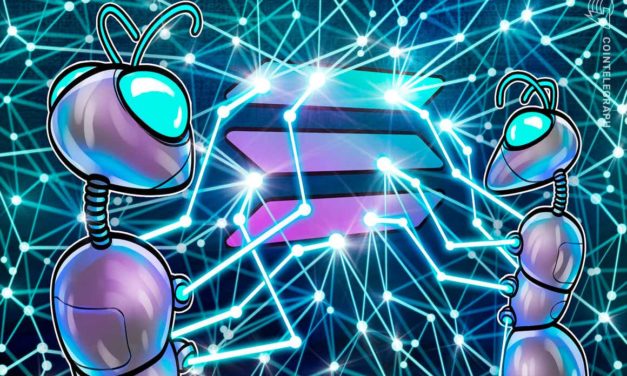
Solana Pay is a peer-to-peer payments infrastructure designed to enable the global market of online merchants and point-of-sale providers the ability to accept and settle payment transactions in a panoply of digital assets.A joint collaboration between Solana Labs, Checkout.com, Circle and Citcon, in addition to wallet integrations from Phantom and FTX, the platform’s inbuilt software development kit acts as an intermediary between traditional fiat-centric businesses and the cryptocurrency sector, promising to promote wider engagement and adoption from traditional consumers.In an exclusive statement, Solana Pay revealed that they perceive the “most prevalent use-case to be with digital dollar currencies” such as Circle’s USDC stablecoin, but also are enabling the option of Solana-related assets such as Solana’s native SOL, FTX’s FTT, and Serum’s SRM, among others.Built upon Solana — a blockchain that launched April 2019 and quickly became regarded for its high-speed and fraction-of-a-cent transaction fees — Solana Pay is seeking to provide a low barrier-to-entry crypto payment alternative, as well as the possibility for integration of emerging asset classes such as nonfungible tokens, or NFTs.Cointelegraph spoke exclusively to the Head of Payments at Solana Labs, Sheraz Shere — formerly responsible for co-creating the Google Wallet — to discuss his anticipations for Solana Pay in supporting the wider growth of the Solana ecosystem throughout 2022.Shere revealed that the platform “leverages Solana’s unique differentiators of high throughput, low cost and scalability”, before stating that:“While Solana Pay will provide frictionless payments to Web3 participants in the Solana ecosystem, we believe this protocol transcends Web3 and will be transformational for the payment’s ecosystem across physical and online commerce.”Related: Solana could become the ‘Visa of crypto’: Bank of AmericaIn an interview with Cointelegraph on Dec. 22, Head of Communications at Solana Labs, Austin Federa, spoke on topics of recent network outages such as that of mid-September — an incident that was attributed to denial-of-service attacks — the benefits of scalability and questions around centralization of nodes, among others.Shere noted that Solana Pay is dedicated to supporting the onboarding process of merchants throughout the coming year, irrespective of their prior education, concluding that:“We anticipate a growing understanding amongst mainstream merchants about the benefits of stablecoins and digital dollars.”In addition to this, Solana Pay is also expected to launch a series of payments-centric hacking events this year in a bid to connect the global community of developers and whitehats with their technological infrastructure.

Čítaj viac

Co-founder of defunct exchange QuadrigaCX allegedly runs Wonderland

In a series of twitter posts published Jan. 27, decentralized finance (DeFi) investigator zachxbt seemingly unveiled the true identity of previously anonymous QuadrigaCX co-founder Michael Patryn, doxxing him to be that of @0xSifu, the founder of DeFi protocol Wonderland.1/ This needs to be shared @0xSifu is the Co-founder of QuadrigaCX, Michael Patryn. If you are unfamiliar that is the Canadian exchange that collapsed in 2019 after the founder Gerald Cotten disappeared with $169mI have confirmed this with Daniele over messages. pic.twitter.com/qSfWNnQPhr— zachxbt.eth (@zachxbt) January 27, 2022Following the publication of private messages between zachxbt and Daniele Sesta — the founder of Wonderland and Abracadabra — Sesta tweeted his perspective on the case, stating that “I have no bias about @0xSifu he has became a friend and part of my family and if my reputation of judgment will be hit by his dox, than be it.”A recent Mirror.xyz blog written by Sesta reveals that he became aware of Sifu’s career background just one month ago, but decided to maintain his role as treasury manager based upon principles of second chances. However, following passionate public outcry in response to his tweets this morning, Sesta took a moment to reflect upon the situation and concluded that:”I have decided that he needs to step down till a vote for his confirmation is in place. Wonderland has the say to who manages its treasury not me or the rest of the wonderland team.”On Jan. 9, Sesta declared his bullishness on projects in which the founders and teams reveal their personal identity, stating that “Doxxed teams tokens will outperform anons ones. Pay attention.”This is a common theme witnessed in the DeFi and NFT space to support the evolution of the brand from a purely web-dimensional entity, to a global physical and digitally interactive community.Wonderland emerged into the space in September 2020 as a fork of the Olympus DAO, launching on the Avalanche network. The community denotes themselves as “frogs,” but the decentralized reserve currency protocol hasn’t made great leaps in the market as of yet.According to current data from the website, the protocol has $360 million in total value locked (TVL), while its native asset, TIME is down almost 97.5% from all-time highs just two months ago, and down 30% today to $355.In the last week, the founders intervened with a quantitative-easing type strategy of injecting millions of dollars into the projects in a desperate bid to stem the price bloodshed. Related: QuadrigaCX Co-Founder Michael Patryn Is Actually Convicted Criminal Omar DhananiThe QuadrigaCX saga began following the untimely passing of Gerald Cotten, the co-founder of Canadian-based cryptocurrency exchange in December 2018. In the days that followed, allegations emerged that in excess of $145 million of customers funds were misplaced, with the team citing an inability to locate the encrypted passwords to the cold storage wallets.In the years that followed, an ongoing legal battle commenced between the estimated near 20,000 claimants and the exchange, with trustee firm Ernst & Young revealing in late 2020 that they only have approximately $29.8 million in assets to distribute in comparison to the $171 million worth of claims.The story sparked the interest of streaming and production giant Netflix, which has recently announced that a documentary film dramatizing the mystery surrounding Cotten’s death and subsequent financial fallout is in the works.Titled, Trust No One: The Hunt for the Crypto King, the film is set to premiere in 2022, and detail the suspected malice of QuadrigaCX in orchestrating a rug-pull as per countless personal accounts from the community base.

Čítaj viac

Ripple announces $200M share buyback and expresses optimism for 2022

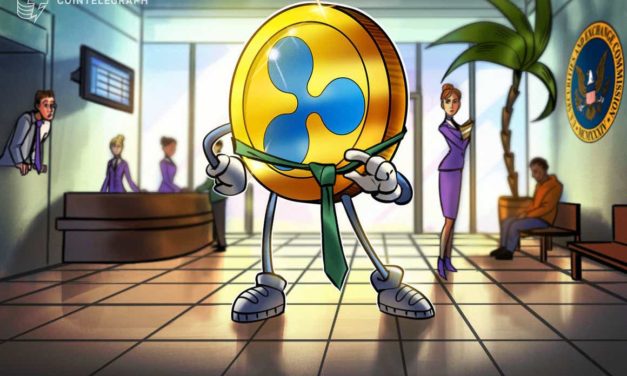
Blockchain payments firm Ripple has announced a $200 million Series C share buyback, a decision that will take the San Francisco-based tech firm to a record-high valuation of $15 billion.Back in December 2019, Ripple raised $200 million in a Series C funding round with Tetragon Financial Group, a United Kingdom-based investment firm, acting as the lead investor alongside other participants SBI Holdings and Route 66 Ventures.However, in December 2020, the United States Securities and Exchange Commission (SEC) issued a $1.3 billion-dollar financial lawsuit against Ripple Labs, as well as co-founder Chris Larsen and CEO Brad Garlinghouse; accusing the parties of using the native XRP token as an unlicensed digital asset security.Intent on disassociating themselves with Ripple amid their high-profile and openly public lawsuit, Tetragon sued Ripple in early January 2021 in the Delaware Chancery Court, seeking to enact their contractual obligation of a buyback clause to the value of their undisclosed investment sum.However, just three months later in April, the court ruled in favor of Ripple and against the plaintiff, Tetragon, putting an end to the financial dispute.In choosing to willingly purchasing the shares from Tetragon, SBI Holdings and Route 66 Ventures, it implies that Ripple is seeking to enhance their financial strength, a sentiment which Garlinghouse eluded to in a recent tweet thread.“Even with 2021’s headwinds, it was our best year on record”, he stated, alongside revealing that their $1 billion bank balance position places them in the “strongest we’ve ever been.”RippleX – full speed ahead on establishing a multitude of capabilities to the XRP Ledger – NFTs, CBDCs, interoperability bridges, sidechains and so much more – working hand in hand with devs and partners around the world. It’s a multichain world after all 4/4— Brad Garlinghouse (@bgarlinghouse) January 26, 2022Alongside the news of buyback and valuation, Garlinghouse also shared optimism for the future of RippleNet and Ripple X, the latter of which is posed to enhance the utility of the XRP Ledger in an array of emerging sectors, including nonfungible tokens, central bank digital currencies, as well as interoperable, multi-chain functionalities, among others.Cointelegraph reached out to Ripple for comment but did not receive a response at publishing time.

Čítaj viac

Finance Redefined: Secret’s $400M fund, and 1inch expanding, Jan. 14–21

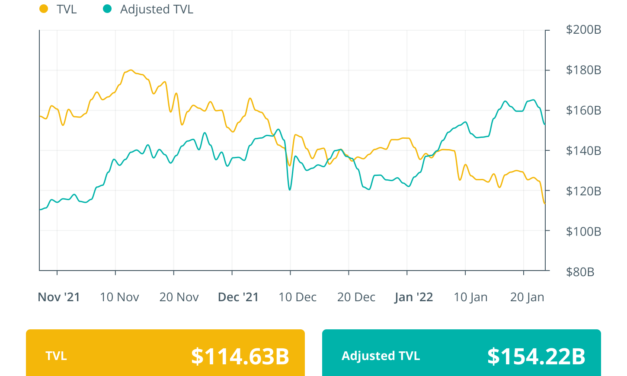
Welcome to the latest edition of Cointelegraph’s decentralized finance newsletter.Following a bearish decline for many of the leading decentralized finance (DeFi) tokens, it is within the fundamental news where the optimism for growth and prosperity lies. Read on to hear about the most impactful DeFi stories of the last seven days.What you’re reading is the shorter, snappier version of the newsletter. For the full roundup of DeFi developments across the week delivered directly to your inbox, subscribe below.Secret Network offers $400M community fund schemeSecret Network, a privacy-oriented layer-one blockchain, announced the launch of a $400 million funding pot this week in a bid to expand their application and network infrastructure, and tooling mechanisms in addition to accelerating adoption for their native token, SCRT.Comprising a $225 million ecosystem fund and a $175 million accelerator fund, the capital raise was supported by a number of existing partner organizations, including BlockTower Capital, Arrington Capital and Fenbushi Capital.The $400 million fund is the first of an expected series of deployments within the Shockwave Initiative, a global growth strategy, announced by the company on Jan. 12. The initiative is focused on the expansion of its ecosystem, including fostering and incubating the roll-out of decentralized privacy applications on its platform, as well as expanding the utility and adoption of the SCRT token, to overall become a fully comprehensive privacy hub for Web3.Secret Foundation founder Tor Bair told Cointelegraph that the capital will be used to “scale privacy-first, decentralized applications to global adoption by millions of users,” as well as emphasizing the importance of Web3 technology, stating that “privacy technologies are essential to ensure that Web3 will be empowering and open, rather than an extension of the failures of Web 2.0.”Also in the news recently was Secret Network’s issuance of Pulp Fiction-themed nonfungible tokens in partnership with iconic filmmaker Quentin Tarantino. The collection is set to debut seven previously-unseen handwritten chapters of Tarantino’s screenplay of the 1994 classic, with more details on the first sale expected to be made public on Jan. 24.Despite the fanfare around the launch of these tokens by fans and the wider film community, production company Miramax filed a lawsuit on Nov. 17 accusing director Quentin Tarantino of copyright infringement in pursuing this NFT venture, citing that it interferes with their own visions of future NFT launches and is simply a cash-grab that could potentially devalue the film’s reputable public image. The case remains ongoing at the time of writing.Related: ‘Privacy-preserving computing is the future,’ says Secret Network’s Guy Zyskind after Quentin Tarantino NFT drop 1inch Network expands to Avalanche and Gnosis ChainDecentralized exchange aggregator 1inch Network announced its intention to roll out the 1inch Aggregation Protocol and 1inch Limit Order Protocol this week on Avalanche and Gnosis Chain, respectively, and as such, expand their foothold within the DeFi sector.An initial list of protocols will become immediately available via 1inch on cross-chain network Avalanche such as 1inch Limit Order Protocol v2, Aave, SushiSwap, Trader Joe and KyberSwap, among others.Similarly, those protocols immediately accessible on Gnosis Chain, formerly known as xDai Chain, via 1inch, include 1inch Limit Order Protocol v2, Curve v1, and SushiSwap.1/ In life, we often have to choose between two options both of which may seem important to us. But what if we could go for both options at once? Sounds fantastic, doesn’t it?Well, nothing is impossible for #1inch…#DeFi #Avalanche #Gnosis pic.twitter.com/bwN9bBL5Br— 1inch Network (@1inch) January 20, 2022“1inch’s main goal is to offer users the best deals across the blockchain space,” stated Sergej Kunz, 1inch Network co-founder, continuing to remark that the expansion to Avalanche and Gnosis Chain “will offer 1inch users more options for cheap and fast transactions.”According to analytical data from DeFi Llama, the Avalanche ecosystem currently holds $9.77 billion in total value locked (TVL), the majority of which is dominated by Aave, Benqi and Trader Joe with $2.48 billion, $1.35 billion, and $1.21 billion.On the other hand, Gnosis Chain is currently recording a TVL of $206.8 million, largely accumulated in the last three months from projects including Curve, SuperFluid and RealT, which have amassed $62.9 million, $54 million and $31.3 million, respectively.Token performances Analytical data reveals that DeFi’s total value locked slightly decreased by 8.29% across the week to a figure of $114.63 billion, continuing along with the wider market decline.Following an overwhelming bearish 24 hours for DeFi’s leading tokens, all price results are negative this week and will be ranked by market capitalization.Terra (LUNA) registered minus 8.15%. Avalanche (AVAX) fell sharply by 18.73%, while Wrapped Bitcoin (WBTC) pulled back 9.3%. Stablecoin Dai (DAI) suffered a similar fate down by 0.06%, while Chainlink performed the worst out of the top five, taking a 21.8% hit.Interviews, features and other cool stuffThank you for reading our summary of this week’s most impactful DeFi developments. Join us again next Friday for more stories, insights and education in this dynamically advancing space.

Čítaj viac

Hedera Governing Council to buy hashgraph IP, and open-source projects code

The Hedera Governing Council has officially voted to purchase the intellectual property rights to the hashgraph consensus algorithm from founding architect and inaugural member of the council, Swirlds Inc, for an undisclosed fee.A Jan. 19 announcement also details plans to transition their code to an open-source model this year under Apache 2.0 license, in addition to transferring core team members such as CEO Mance Harmon and chief scientist Dr. Leemon Baird from Hedera to Swirlds Inc. as the CEO and CTO respectively, and deploying community staking and node opportunities, among other updates.Hedera Hashgraph is an enterprise-grade distributed ledger technology designed to create decentralized applications in the Web3 sphere.It’s governing council is composed of 25 corporations including Google, IBM, Tata Communications and Boeing, who each support the project’s decentralized ambitions through the establishment and operation of blockchain nodes, and participating in governance voting, among other duties.Hedera’s evolution to an open-source technology differs from their current model of open-review, in which the code appears as publicly visible, but is not accessible for editing or developmental purposes by the global community.The decision to enact this change came about following conclusive technical assessments that the probability of a network split within the Hedera ecosystem is highly unlikely, and therefore the patent upholding legislative exclusivity to the technology can be safely distributed into the public domain, with assurances that it will not serve as an advantageous tool for market competitors, but rather a mechanism to foster internal growth.Baird, the newly appointed CTO of Swirlds, and co-chair of the Hedera Council’s Technical Steering and Product Committee, said:“From day one, I have had a vision to enable ‘Shared Worlds’, where anyone can gather, collaborate, conduct commerce, and control their own online footprint.Baird also noted that the next challenge for Hedera is to expand from a Layer 1 protocol “to deliver products and services that enable others to leverage the power of the Layer 1 protocol to create value.”Harmon and Baird, among others are scheduled to host a YouTube webinar at 11 a.m. ET on Jan. 26 to discuss the Shared Worlds initiative in further detail, alongside developments over the coming months.From a technical perspective, Hedera’s native token, HBAR has largely consolidated in the $0.33 to $0.25 price range since the turn of the year, currently valued at $0.257.Related: UK air traffic tech firm uses Hedera Hashgraph to track dronesEarlier this month, Hedera partnered with London-based tech firm, Neuron Innovations on a drone initiative designed to collate and store quantitative data metrics on an array of sectors including commercial and military aviation, as well as government initiatives.Supported by the United Kingdom’s Department for Business, Energy and Industrial Strategy, the pilot scheme — conducted in April and October 2021 — is expected to support the adoption of drones into the existing air traffic transportation system.

Čítaj viac

Získaj BONUS 8 € v Bitcoinoch

nakup bitcoin z karty

Registrácia Binance

Burza Binance

Aktuálne kurzy