Autor Cointelegraph By Tom Farren

Finance Redefined: Wonderland reveal and Wormhole hacked, Jan. 28–Feb. 4

Welcome to the latest edition of Cointelegraph’s decentralized finance newsletter.It’s been a tumultuous week of doxxing, hacks, bailouts and new highs in the decentralized finance space. Read on to recap the most impactful stories of the last seven days. This article represents a conspectus of the full email newsletter. For the full edition, sign up via the box below.Wonderland lost in no mans amid Sifu sagaFollowing the revelatory identification of previously anonymous QuadrigaCX co-founder Michael Patryn as the founder of DeFi protocol Wonderland — known on social media as @0xSifu — a subsequent community vote decided upon the permanent closure of Wonderland for outstanding security concerns.The saga commenced when DeFi investigator Zachxbt doxxed Patryn to be Sifu, a figure with a notorious reputation within the digital asset space for alleged fraudulent and illicit activity, most notably regarding the $145-million losses incurred at Canadian-based cryptocurrency exchange QuadrigaCX in December 2018.Having been made aware of Sifu’s real identity one month prior to this week’s announcement, Daniele Sestagalli, co-founder of Wonderland and stablecoin protocol Abracadabra, posed a crucial question to the community members: “Do we wind down or continue to fight for the aspect of an investment DAO being a revolutionary new organization?” Sestagalli stated his personal preference to be the latter, to fight.From a technical perspective on Jan. 15, Wonderland recorded a near all-time high of $776.64 million in total value locked, or TVL. However, as a consequence of the exposure, the TVL figure dropped substantially to $78.57 million on Jan. 25, marking an 89.9% demise. At the time of writing, the figure has somewhat recovered to $408.59 million.In true Web3 style, the decision to “Wind down Wonderland and give the treasury back to its holders” was put to a community snapshot vote. The two-day governance participation resulted in a split decision, an inconclusive majority with 116,000 TIME tokens allocated to the decision of no, and 95,000 to yes.In response to this, co-founder Sestagalli assessed that “the duty of the team is to enact the will of the token holders. As the vote is so close to 50/50 there is only one path forward, it is to reimburse/unwind,” confirming this in a follow-up tweet.1/Wonderland experiment is coming to an end. It is clear from the vote that the community is divided. The core and heart of Wonderland is still the community. If we cannot find agreement on wether to continue or not, it means that we failed.— Daniele never asks to DM (@danielesesta) January 30, 2022Discussions within the community are vehemently ongoing in a bid to find an accommodating solution to the Wonderland saga for all involved. Proposals currently at the forefront are a merger with Abracadabra or a transition to a DAO structure with greater transparency.Wormhole exploited for $321M, parent bails it outDeFi bridging protocol Wormhole suffered a significant security exploit on its network this week to the tune of 120,000 Wrapped Ether (wETH) tokens, equivalent to $321 million at the time of impact — the second-largest hack in the history of decentralized finance behind Poly Network’s seismic $610-million breach in August 2021.Wormhole is known within the industry for its cross-chain token bridge service in which users can transfer crypto assets between chains such as Ethereum, Solana and Polygon, among others, without interacting with centralized exchanges.After analyzing blockchain data, it was uncovered that the attacker minted 120,000 wETH on Solana and then proceeded to redeem 93,750 wETH for Ether (ETH) worth $254 million. The remaining wETH was swapped for Solana (SOL) and USD Coin (USDC) on Solana.Following on from this, the hacker utilized a portion of the funds on an asset-buying spree that included SportX (SX), Meta Capital (MCAP), Finally Usable Crypto Karma (FUCK), as well as the highly anticipated soon-to-be-released asset, Bored Ape Yacht Club Token (APE).In response, the Wormhole team pledged to the community that the token supply, in addition to the one-to-one backed asset total, would be fully reinstated and is offering a generous whitehat bug bounty reward to the malicious entity for full recompensation of the funds.The hack risked serious cascading ramifications for protocols and platforms within the Solana ecosystem that rely on the wETH supply for collateral. If their assets were not backed with wETH, investors would have been unable to utilize the service, perhaps lose confidence, and, therefore, short the asset. Solana fell around 13% in the fallout of the news.In a fortuitous turn of events, Wormhole’s parent company, Jump Crypto, stepped in to bailout the platform and restore all lost funds, an action confirmed by Wormhole in a tweet.1/2All funds have been restored and Wormhole is back up.We’re deeply grateful for your support and thank you for your patience.— Wormhole (@wormholecrypto) February 3, 2022

Despite a resolution for the platform’s affected users, concerns still remain as to the whereabouts of the $321 million in lost funds, in addition to the intentions of the hacker within the marketplace. Ethereum hash rate hits new ATH in PoS transitionQuantitative insights from popular data aggregation site Glassnode this week revealed that the hash rate for Ethereum reached a new all-time high of 1.11 petahash per second (PH/s) on Jan. 28, surpassing the previous figure of 1.08 PH/s established just 15 days prior.Fluctuations in the hash rate of proof-of-work (PoW) networks such as Bitcoin and Ethereum are prime indications of additional nodes joining the network, scenarios that ultimately result in higher security and more expansive decentralization of the network. #Ethereum $ETH Mining Difficulty just reached an ATH of 13,119,856,939,346,200Previous ATH of 13,076,339,792,989,700 was observed on 23 January 2022View metric:https://t.co/s9t4z96wMA pic.twitter.com/Cxk3JMg1Qp— glassnode alerts (@glassnodealerts) February 1, 2022

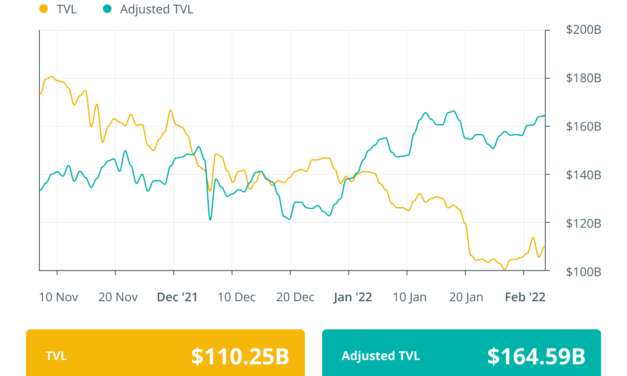
In December 2021, participants of the Ethereum network implemented the Arrow Glacier upgrade, an initiative designed to delay the activation of a coding mechanism that is set to halt production of mining activities on the network, otherwise known as the “difficulty bomb.”It is widely expected that Ethereum’s transition to PoS will occur during the latter half of 2022, with Arrow Glacier being the final upgrade, a market sentiment recognized by one of the core developers facilitating the upgrade, Tim Beiko, during a recent commentary.Token performancesAnalytical data reveals that DeFi’s total value locked slightly increased by 8.87% across the week to a figure of $109.92 billion, attempting to recover from the market downturn in recent weeks.Tezos (XTZ) reported the highest score in the top 100 following its partnership with Manchester United at 31.60%. Maker (MKR) came in second with a respectable 25.54% gain, while Convex Finance (CVX) recorded a 19.46% increase. Curve DAO Token (CRV) and Oasis Network (ROSE) gained 15.29% and 11.79%, respectively.Interviews, features and other cool stuffThanks for reading our summary of this week’s most impactful DeFi developments. Join us again next Friday for more stories, insights and education in this dynamically advancing space.

Čítaj viac

Solana integrates Web3Auth to lower DApp barrier-to-entry

Solana Labs and Web3Auth have announced a collaborative digital wallet initiative designed to eliminate the prerequisites for seed phrases in cryptocurrency interaction, and in turn, streamline a presently tedious and complex process to drive consumer adoption in the Web3 sphere.The Solana Torus Wallet is a non-custodial product that enables users to access all decentralized applications (DApps) and associated wallets within the Solana ecosystem.Upon creation of a cryptocurrency wallet, a user has required the record and remember a seed phrase; a random computer-generated list of words, typically twelve to twenty-four, which acts as the wallet holders master key to their asset safe. Web3Auth’s cryptographical infrastructure enables users to interact and log in via a multi-factor authentication approach, whether this is through a personally created backup code, via Apple’s inbuilt touch identification mechanism, or through traditional networking platforms such as Google, Facebook, Twitter and Discord.The primary purpose of this technology is to construct a simplified, easy-to-interact user interface by integrating accounts, profiles and platforms that consumers are already vastly familiar with.This zero seed phrase technology has already been adopted by more than 500 DApps, as well as implemented into a number of leading Web3-orientated platforms and initiatives, such as Binance Chain, gaming giant Ubisoft’s nonfungible token launch and NFT marketplace Rarible, among others.Related: Dormant Bitcoin wallet holding 321 BTC activated after eight yearsCointelegraph spoke exclusively to the Co-Founder and CEO of Web3Auth, Zhen Yu Yong, to discover more about the industry’s concerns of seed phrases, and specifically their vulnerability in securing digital assets.”Seed phrases are far from ideal. They’re a one-size-fits-all solution to a far more complex process, deceptively easy to steal or misplace, and they hinge on a single point of failure.”Just last month, Web3Auth raised $13 million in an eighteen-investor Series A funding round led by Sequoia Capital India, with additional participation from FTX, Bitcoin.com, DARMA Capital, among others. Following the round, the team pledged to enhance the efficiency and security of the service, in addition to pursuing decentralization of the Torus Network.

Čítaj viac

Cryptocurrencies are the “new frontier” says financial researcher

In an exclusive television interview with Fox Business on Wednesday, JMP Securities director of financial technology research, Devin Ryan spoke candidly on a range of topics within the cryptocurrency industry. This included the macroscopic regulation amid the impending expectations of a White House policy framework, states within the United States accepting Bitcoin as legal tender as well as the vast potential for consumer adoption in the coming year.Cryptocurrency assets have experienced significant volatility over the past month, with leading asset Bitcoin falling almost 44% from all-time highs and Ethereum recording a similar demise.Despite price drawbacks, capital investment, consumer adoption, community optimism and corporate valuations for the digital asset space has never been higher, the latter epitomized by recent multi-billion-dollar valuations for Animoca Brands, Fireblocks and FTX at $5 billion, $8 billion and $32 billion, respectively.On the subject of coin supply within the market, Ryan stated that “many of them we don’t think really have a future, but some of them really have use-cases to help solve problems in the world with blockchain technology.”Additionally, he cited the potential of crypto mechanisms being integrated within the gaming space, assessing that “people can monetize their time in ways that haven’t existed before.” He also stated that cryptocurrency is “the new frontier” and continued on to predict that overall growth of the sector will be preceded by volatility in the short-term as these technologies vie for mainstream adoption.Related: Kraken CEO reverses $100K BTC 2021 forecast: Crypto winter now possibleResponding to a question on Miami and New York’s endeavors to create a state-wide digital asset, in addition to Arizona and Wyoming pursuing various methods of Bitcoin adoption, Ryan stated that there is “tremendous innovation and capital formation happening,” and that states and countries will be keen to become headquarters that foster the technology.

Čítaj viac

Dune Analytics raises near-$70M in Series B funding round

Dune Analytics, a leading data analytics platform, has announced a capital raise of $69,420,000, in addition to a $1 billion-dollar valuation, the latter of which means that the company attained “unicorn” status, which describes privately-held startups that have attained a valuation of $1 billion or more. The Series B raise was led by New-York based private equity firm Coatue, with additional participation from previous investors Multicoin Capital and Dragonfly Capital, among others.The raise succeeds the company’s seed funding round of $2 million in September 2020 — of which Dragonfly Capital Partners was the lead investor — and its follow-up Series A raise of $8 million in August 2021 led by Union Square Ventures.According to the announcement, the capital will be utilized to “educate, reward, and foster a new generation of analysts, who will be empowered with real-time, actionable insights into web3 data.”Dune Analytics is highly-regarded throughout the space for providing real-time, on-chain quantitative metrics, graphics and charts on the crypto, blockchain, decentralized finance (DeFi), and more recently, nonfungible token (NFT) markets. As of now, the platform publishes blockchain data from Ethereum, Polygon, Optimism, Binance Smart Chain and xDAI.Blockchains generate an *ocean* of dataAs more and more value moves to crypto…Extracting insight from it presents historic opportunities many times greater than siloed, paywalled data platforms of the TradFi pastThe revolution will not be reported quarterly— Dune Analytics (@DuneAnalytics) February 2, 2022Related: Decentralized exchange aggregator trading volumes surge to new highsIn a new initiative to promote Web3, Dune is seeking to expand its existing community of 10,000 contributing analysts up to a figure of 1 million through the construction of a community-centric architecture that incentives contribution on the platform.Referred to as Dune Wizards, this community of analysts will be responsible for creating compelling content in the pursuit of decentralizing knowledge, and in turn, empowering investors to make insightful, data-backed decisions. This marks an evolution of the walled-garden traditional financial market model in which Wall Street investors were granted informational advantages over their retail counterparts.Dune co-founder and CTO Mats Olsen pledged the company’s intentions to build a community-centric model in the Web3 landscape:“Dune will provide the necessary tools so that users of all skill levels will be able to conduct more thoughtful, impactful analysis and gain deeper insight into the ever-evolving world of web3.”

Čítaj viac

Získaj BONUS 8 € v Bitcoinoch

nakup bitcoin z karty

Registrácia Binance

Burza Binance

Aktuálne kurzy