Autor Cointelegraph By Tom Farren

1Password integrates security API into Phantom Wallet

Digital security service 1Password has announced a collaborative partnership with Phantom Wallet to enable asset holders to amalgamate their vast accumulations of public key addresses, seed phrases and other corresponding security details into a single ‘Save in 1Password’ system.Operating primarily in the traditional financial sector at this time, 1Password has over 100,000 corporate clients from a panoply of industries, including well-recognized brands like IBM, Slack, Shopify and Under Armour.The application programming interface (API) of 1Password aims to simplify the user experience, enable asset sovereignty and assign portfolio responsibility to help investors sufficiently manage their cryptocurrencies and nonfungible tokens (NFTs) held on the Solana blockchain.A centralized entity at its core, some would argue that 1Password challenges the ideological consensus of the Web3 industry, countering the trustless thesis often proclaimed, with a conscious emphasis on security certitude and loss prevention.Related: Cointelegraph Magazine: What the hell is Web3 anyway?Consumers familiar with interaction in the e-commerce and social profiling markets have obtained vast experience navigating the tedious password login and storage processes. Upon entering the cryptocurrency space, comprehensive education on the intricate nuances of digital wallet security is crucial for the protection and true ownership of acquired assets.Cointelegraph reached out to Matt O’Leary, the VP of Partnerships for 1Password, for an in-depth assessment on the subject of security, as well as whether the prevalence of hacks and exploits in the decentralized finance (DeFi) space has catalyzed demand necessity and subsequent innovation for security solutions such as 1Password.O’Leary stated that its “important to keep in mind that crypto wallet logins are much more complex than the average login, made up of long chains of characters and word strings that must be remembered and entered without error”, before remarking:1Password’s partnership with Phantom is a great example of innovation that is conquering this challenge… This human-centric approach to crypto wallet security was designed with the end user in mind, making it easier than ever to invest in crypto safely and securely.O’Leary expects Phantom to be the first of many crypto-themed partners over the coming months to integrate within the companies flagship service, Save in 1Password. Cointelegraph also spoke to Brandon Millman, the CEO and Co-Founder of Phantom Wallet, to learn more about his macroscopic vision for the digital wallet security market as we progress towards the conceivable utopia of mainstream adoption.”In order for crypto and Web3 to go mainstream, people need to feel confident in the safety and security of their assets. Stories of people losing crypto or getting hacked can be intimidating. Millman continued on to explain that “the benefits of a non-custodial wallet in terms of personal control and independence also comes with the added responsibility of personal key management.”

Čítaj viac

Finance Redefined: Axelar becomes a unicorn, new ETH addresses hit 1.5M per month, Feb. 11–18

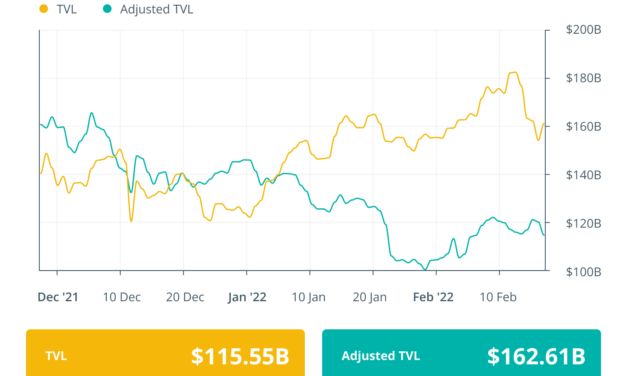
Welcome to the latest edition of Cointelegraph’s decentralized finance newsletter.This week has been full of funding raises, innovations, service deployments and a bit of volatile technical price action — for a change.Axelar Network attains $1B valuation following secondary raiseThe Axelar Network announced the completion of a $35-million Series B funding round this week, elevating its total market valuation to over $1 billion and establishing its status as a unicorn corporation.Major participants of the round include Dragonfly Capital, Polychain Capital and North Island Ventures, among others. The network has implemented partnership integrations with a suite of validators, as well as leading blockchain platforms such as Ethereum, Avalanche, Polygon and Polkadot.Cointelegraph spoke exclusively to Axelar CEO and co-founder Sergey Gorbunov for an exclusive insight into the specific strategies for capital deployment across the business in preparation for its upcoming mainnet release.He noted that the “primary focus is to provide universal interoperability with minimal risk” and that “the funds will be used to continue building the core network functionalities and scaling integrations with more blockchains and applications.”“Axelar developers are also working to make the network easy to use so that developers on any blockchain can reach the deepest liquidity and broadest user base. With this in mind, we are dedicating resources to improving our APIs, SDKs and associated documentation.”18.36M Ethereum addresses registered across 2021New quantitative data released by blockchain intelligence firm IntoTheBlock this week revealed stark insights into the growth of network activity on Ethereum, with 18.36 million new addresses being created in 2021, equivalent to 1.53 million per month.#Ethereum users growth in a nutshellA good way to track the adoption is by following the number of addresses with a balance- There are 70.4m addresses holding $ETH- Just in 2021, it increased 18.36m. That means the network was growing at a pace of 1.53m addresses per month pic.twitter.com/xnhDw3wHVm— IntoTheBlock (@intotheblock) February 15, 2022Despite numeral figures reaching new highs for primary addresses, the proportion of active addresses in relation to the overall figure decreased throughout the year, posting at 1.05% on Jan. 1, peaking at 1.66% on April 25, and subsequently falling to 0.86% by Feb. 15.Despite this, Ethereum remains the dominant force in the smart contract market, topping the podium at a distance to its nearest competitor with $123.15 billion in total value locked, compared to Terra (LUNA) and the newly titled BNB Chain (BNB) with $15.5 billion and $12.6 billion, respectively. Avalanche ecosystem fosters cross-chain bridge innovationThe technical performance of layer-1 network Avalanche’s native asset, AVAX, over the last 12 months has been a major proponent for cultivating an innovative ecosystem of new products and services designed to enhance or entirely replace existing infrastructure elements. Implementing this into practice, the Umbria Network has integrated a cross-chain bridge into the network titled Narni and reported capabilities to reduce transaction fees by up to 90% compared to the existing Avalanche bridge. Alongside this, Umbria has circulated claims suggesting that the service can lower the barrier of entry for retail market newcomers through its utilization of single-sized liquidity pools and lesser complex mathematical algorithms.Cointelegraph spoke exclusively to Barney Chambers, co-founder and co-lead developer of Umbria, about the specific reasoning behind choosing Avalanche as a home for the project and whether the ambition for economic accessibility drove the decision.“Umbria is acting as the glue between all of the layer-1 and layer-2 blockchains, enabling users to move their assets in a cheap and timely manner. At Umbria, we envision that, in the future, users will not even need to know what blockchain they are using.”Token performancesAnalytical data reveals that DeFi’s total value slightly decreased by 6.2% across the week to a figure of $116.78 billion.Convex Finance (CVX) was the solitary riser this week with 8.75% following a market-wide decrease in the latter half of the week.Interviews, features and other cool stuffThanks for reading our summary of this week’s most impactful DeFi developments. Join us again next Friday for more stories, insights and education in this dynamically advancing space.

Čítaj viac

Blockchain platform Axelar establishes unicorn status, mainnet launch impending

The Axelar Network has announced the completion of a $35 million Series B funding round, pushing its market value above $1 billion. Participants of the round include Dragonfly Capital, Polychain Capital and North Island Ventures, among others.The raise succeeds a previously undisclosed round led by the head of Crypto.com Capital, Bobby Bao in late-November 2021, a nine-investor $25 million Series A raise led by Polychain Capital, and participated by Mike Novogratz’s Galaxy Digital in mid-July 2021, in addition to two seed rounds across the year of 2020.Founded in early 2020 by inaugural team members at Algorand and esteemed MIT graduates, Axelar is an infrastructure protocol that fosters interoperable connectivity between blockchain platforms, decentralized applications (DApps) and associated functionalities.After securing mainnet integrations with a series of validators and leading blockchain platforms such as Ethereum, Avalanche, Polygon and Polkadot, in addition to the upcoming release of the Axelar SDK, developers will have the ability to build applications to become accessible across all networks within the Axelar system.In principle, this cross-chain technology would provide expansive possibilities for both developers and users by increasing access to liquidity and user base while enabling seamless transition across networks.Cointelegraph reached out to Sergey Gorbunov, the CEO and Co-founder of Axelar, for an exclusive insight into the specific strategies for capital deployment across the business in preparation for their upcoming mainnet release.He noted that the “primary focus is to provide universal interoperability with minimal risk”, and that “the funds will be used to continue building the core network functionalities, and scaling integrations with more blockchains and applications.”“Axelar developers are also working to make the network easy to use so that developers on any blockchain can reach the deepest liquidity and broadest user base. With this in mind, we are dedicating resources to improving our APIs, SDKs and associated documentation.”In December 2021, Gorbunov contributed to a Cointelegraph experts opinion piece and spoke proficiently on concerns that the DeFi industry is becoming over-reliant on centralized interoperability bridges, a culturally relevant topic that raises justified questions over bona fide decentralization in the space. @Cointelegraph piece on taking crypto mainstream: “We’re going to witness the development of singular, universal infrastructures that help blockchain ecosystems achieve true interoperability, taking the industry a step closer to mainstream adoption.”https://t.co/qDP75HPqqa pic.twitter.com/VlFFKBC0Xd— Axelar Network (@axelarcore) December 24, 2021Later in our conversation, Gorbunov shared his perspective on the potential for a cross-chain and/or multichain ecosystem model, and how their wide-scale implementations could benefit both users and developers.”Multichain isn’t the future, it is here: Witness the growth of multiple Layer 1 blockchains. The demand for cross-chain services is also evident, in the proliferation of pairwise solutions and the growing value committed to those solutions.”He continued on to state: “It’s clear that developers want the ability to build on the chain that best suits their needs, without siloing liquidity. Users want the same thing. At Axelar, it is our goal to minimize the risks involved in cross-chain activity, and maximize the potential benefits to developers and users.”

Čítaj viac

Chingari integrates native token to advance Web3 social networking

Indian social networking platform Chingari has announced ambitions to revolutionize the experience of its 100 million-user creator economy through the integration of native digital asset, $GARI, and accompanying cryptocurrency wallet via the Solana blockchain.Translating into the word ‘Spark’ in the languages of Urdu and Hindi — a branding visibly consistent with its flame icon — the Chingari user interface often draws parallels to popular Western entertainment services TikTok, Instagram Reels and YouTube Shorts, for its principal focus on short-timed, infinitely accessible video content.Launched in 2018, the platform has grown exponentially over the past few years, amassing over 35 million monthly active users to become the most popular mobile application in the country on the Google Play store. As in the case of TikTok, creators are revered for their entertainment across an array of topics such as lip-synching, belly dancing, comedic sketches and fashion tips, among others.Since April 2021, Chingari has obtained capital from numerous raises, including a $13 million corporate round on Apr 1, a $19 million Series A led by Galaxy Digital and Republic Crypto on Oct 8, and a $40 million initial coin offering on Nov.4, concluded by a $13.37 million Series A continuation on Jan 17 this year.Cointelegraph reached out to a spokesperson from Chingari for an exclusive insight into the platform’s expectations for the ways in which the $GARI token will enhance the existing experience for both creators and fans alike.The team member noted that GARI, a Solana Program Library (SPL) asset, will be utilized to “connect and transact with their counterparties, place governance votes, and catalyze platform engagement and user base growth”, before outlining:“The goal is to empower both creators and viewers on the Chingari App with technological tools to interact directly with each other and allow all users on the Chingari App to participate in the long-term direction of the social economy impacting the GARI Token.”In addition, they revealed future plans to launch an NFT marketplace in which “creators will be able to mint their videos, sell it as NFT and earn GARI.”Following nation-wide concerns over the regulatory intentions of the Securities and Exchange Board of India (SEBI) towards digital assets, a proposed infrastructure bill seen by local news outlet NDTV suggests that the government are preparing to impose a regulatory framework for digital assets, not an outright ban. Alongside this, the Indian government has adopted a firm stance to denounce the acceptance of cryptocurrencies such as Bitcoin and Ethereum as instruments of legal tender, but rather to pursue the viability of a government-backed central-bank digital currency (CBDC), digital rupee.Related: Crypto tax doesn’t legalize trading, says Indian tax department chiefLater in our conversation, Chingari reps revealed the mechanisms in which the $GARI asset will serve as a governance token in fostering genuine decentralization on the platform, stating:“We are built on Web3, and Web3 DAO runs on decisions of the community. $Gari holders will be able to stake and earn yield as well as vote on proposals to decide the future direction of the platform.”The GARI token price has fluctuated in a range-bound zone between $0.252 and $0.685 over the past two weeks. Following last week’s attainment of trading status on a number of prominent exchanges, including FTX, Kucoin and Huobi, among others, the asset now seeks to establish a level of stability around the $0.51 mark at the time of writing.Upon inquisitive dialogue into the potential for a token airdrop for groups such as early adopters, top creators, or perhaps the 500 community members who participated in beta testing, the Chingari team disclosed to Cointelegraph:“We will be airdropping 100 GARI tokens [to] every Chingari app user who completed certain tasks in the airdrop campaign… provided that the users have completed KYC. This is one of the biggest airdrop campaign which was organised with approx 5 Mn tokens reserved for the community.”

Čítaj viac

Finance Redefined: Alchemy raises $200M, Bunny goes DAO, Feb. 4–11

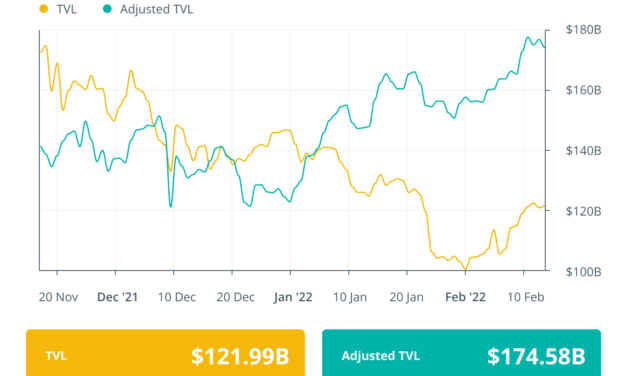
Welcome to the latest edition of Cointelegraph’s decentralized finance newsletter.As the DeFi space continues its technical resurgence, essential news on funding, innovation and DAOs continues to drive adoption in what remains a nascent industry.For the full version of this newsletter including longer, more descriptive analysis of the top stories this week, subscribe below: Alchemy raises $200M in latest funding, ACH token soars 77%Web3 platform Alchemy announced the launch of a $200-million Series C funding round this week, giving the company a decacorn status and a valuation of $10.2 billion.The seven-investor round was led by two California-based venture firms — Lightspeed Venture Partners, which were investors in FTX’s recent tertiary funding round, and Silver Lake — with additional participation from Pantera Capital and previous lead investor in October’s $250-million raise, Andreessen Horowitz’s a16z, among others.Alchemy provides the underlying infrastructure for Web3 applications — akin to the service provided by Amazon Web Services for internet sites — and has worked with the likes of OpenSea, Adobe, Dapper Labs, “CryptoPunks” among others to support the growth of the Web3 ecosystem into the mainstream.Since October’s funding round led by a16z, Alchemy has implemented several initiatives such as an open Web3 University to foster education within the space, a startup program titled Alchemy Ventures designed to support emerging businesses, in addition to a nonfungible token (NFT) application programming interface for website developers.According to the company, NFT marketplaces built on the Alchemy platform have registered in excess of $1.5 billion in artist royalties over the past 12 months, a crucial community-orientated metric among Web3 participants.Alchemy co-founder and CEO Nikil Viswanathan shared his assessment of the last year across the industry, as well as predictions for the upcoming year, stating:“2021 was the year developers took Web3 mainstream and created businesses that are transforming the lives of millions. In 2022, we’ll be doubling down on our commitment to meeting developer needs in more places, making it easier than ever to unlock the potential of Web3.”Bunny and Qubit pivot to DAO in the wake of $80-million exploitDeFi protocol Bunny Finance announced that following a seismic $80-million bridge exploit on Qubit, the future of the project in its current form is untenable, and therefore, the team has pledged to grant governance control of the protocol over to community members in the form of a decentralized autonomous organization, or DAO.The incident, initially reported by Cointelegraph on Jan. 28, occurred when an anonymous hacker exploited a so-called “logical error” in the Qubit X-bridge, enabling them to withdraw tokens on the Binance Smart Chain (BSC) without depositing any Ether (ETH) as is traditionally required. All in all, the hacker stole 77,162 Qubit xETH (qXETH), or $185 million, from the protocol and utilized it as a collateral mechanism to borrow a number of assets within the lending pools equivalent to the value of $80 million. On-chain data analysis reveals that the hacker borrowed tokens included 15,688 Wrapped Ether (wETH) worth $37.6 million, 767 Bitcoin BEP2 (BTCB) ($28.5 million), $9.5 million worth of stablecoins and $5 million worth of PancakeSwap (CAKE), Pancake Bunny (BUNNY) and MDEX (MDX) tokens.Subsequent announcements from the team noted that the participants of the community DAO would become responsible for major protocol developments, including upgrading contracts and altering fee structure, among other things. Hashstack launches Open protocol testnet, offering under-collateralized loansDeFi platform Hashstack Finance deployed a closed testnet version of its crypto lending protocol, Open this week. Initially birthed from Harmony’s $300-million Ecosystem Fund, Hashstack’s Open protocol seeks to balance the prerequisites for collateral loan sums in typical DeFi protocols.Constructed on the Harmony blockchain, Hashstack’s Open protocol claims to enable borrowers to receive a loan with a collateral-to-loan ratio of up to 1:3, allowing the potential of borrowing up to $300 in crypto in exchange for $100 of collateral.Following this, users have the ability to withdraw 70% of the collateral, valued at $70 in this case, while utilizing $230 as in-platform trading capital. Commenting on the subject, Hashstack claimed that lending within the DeFi space is often over collateralized in that on average, a borrower provides a minimum of 42% excess collateral against the loan they intend to borrow.Vinay, founder of Hashstack Finance, explained the intricate process in more detail: “Today, if you want to borrow $100 on Compound, or Aave, or even MakerDAO, you are required to provide collateral of at least $142. This breaks the primary intent behind loan procurement and has restrictive use-cases for the borrower.”15/ @0xHashstack’s Open protocol is the world’s first autonomous lending framework enabling under-collateralized loans up to 1:3 collateral-to-debt ratio.Website: https://t.co/cLpTbRqJCm#defilending #Fintech pic.twitter.com/QLOiemEu0x— Harmony (@harmonyprotocol) December 5, 2021Token performancesAnalytical data reveals that DeFi’s total value locked increased by 11.97% across the week to a figure of $123.08 billion, successfully recovering from the market downturn in recent weeks.Secret (SCRT) gained an impressive 30.4% over the past seven days. Avalanche (AVAX) followed up last week’s 25.54% gain with a further 36.7%, while Loopring (LRC) registered a 19.5% increase. Wrapped Bitcoin (wBTC) and THORchain (RUNE) gained 14.5% and 13.2%, respectively.Interviews, features and other cool stuffThanks for reading our summary of this week’s most impactful DeFi developments. Join us again next Friday for more stories, insights and education in this dynamically advancing space.

Čítaj viac

Získaj BONUS 8 € v Bitcoinoch

nakup bitcoin z karty

Registrácia Binance

Burza Binance

Aktuálne kurzy